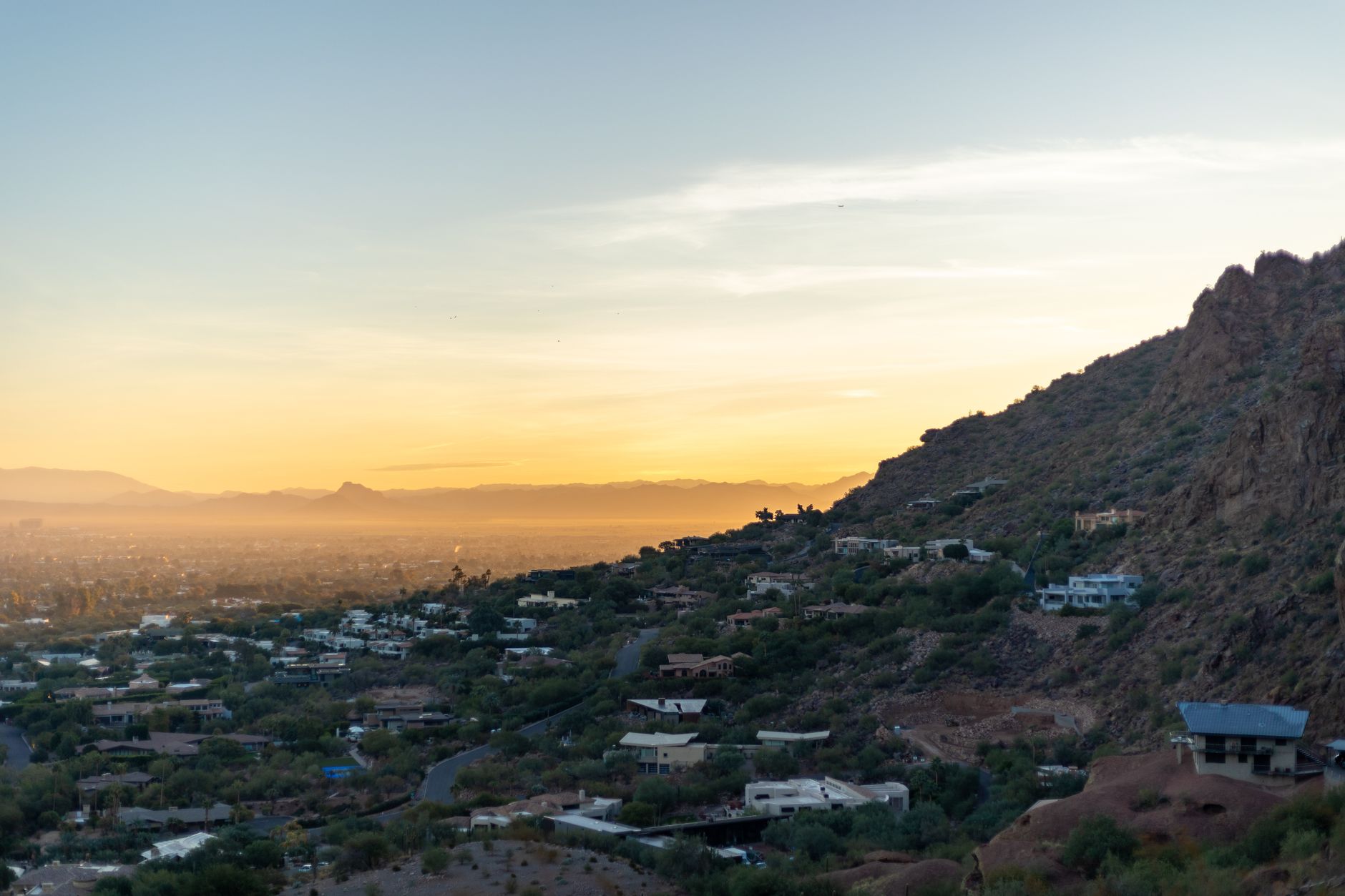
Phoenix, the capital of Arizona and the heart of the 'Valley of the Sun', is the largest city in the American Southwest and one of the fastest-growing in the country. Set in the middle of the Sonoran Desert, surrounded by saguaro cactus, bare mountains and golf courses, it boasts almost perpetual sunshine —more than 300 clear days a year— which has turned it into a winter destination, a retirement destination and an outdoor-sports destination.
It is a sprawling, modern metropolis formed by the merging of several cities (Scottsdale, Tempe, Mesa, Glendale…), combining skyscrapers and artsy neighborhoods with luxury resorts, spas, a powerful Southwestern food scene and the Native and Mexican culture that runs through the region. Its name, 'Phoenix', evokes the bird that rises from its ashes, a nod to the modern city that sprang up on top of the ancient canals of the Hohokam people.
This guide walks through the essentials of Phoenix with a practical eye: the urban hiking of Camelback and South Mountain, the spectacular Desert Botanical Garden, the Heard Museum of Native art, neighboring Scottsdale and its resorts, the trips out to Sedona and the Grand Canyon, the climate (and how to survive the summer heat), how to get around a city designed for the car, and where to stay and eat. Phoenix is sun, desert and modernity in equal parts.
More than a thousand years ago the Valley of the Sun was home to the Hohokam people, who built an extensive network of irrigation canals to farm the desert before disappearing around the 15th century. Modern Phoenix was born in the 1860s, when settlers reused those ancient canals for agriculture; hence the name 'Phoenix', for the city reborn on the ruins of another. The capital of Arizona since 1889, its growth took off in the 20th century with air conditioning, which made the desert livable in summer. The full story is on our history page.
Read the full history ↓The Grand Canyon state: land of the Navajo, Hopi and Apache, of the Sonoran Desert and its saguaros, of the thousand-year-old canals of the Hohokam, of copper and the Old West, and of legendary landscapes such as Monument Valley, Sedona and Antelope Canyon.
Read the history of Arizona →If you book from here we earn a commission and you pay no more. Prices and availability come from Civitatis.
No exact prices: a scale from $ (budget) to $$$$$ (luxury), with 2-3 options per category.
Origins, formation and what the sources say.
The name Phoenix is neither an accident nor a poetic whim: it is one of the most literal urban etymologies in the United States. The city is called 'Phoenix', the bird that rises from its ashes, because it literally was reborn on the ashes of another civilization, reusing the irrigation canals that a vanished people had dug a thousand years earlier. To understand Phoenix you have to start with those first engineers of the desert: the Hohokam.
Long before Phoenix existed, the Valley of the Sun was one of the great centers of civilization in the American Southwest thanks to the Hohokam people, who inhabited the region along the Salt River and the Gila River for more than a thousand years, roughly between the 3rd and 15th centuries of our era. Their name, Hohokam, comes from the O'odham language and is usually translated as 'those who have gone' or 'the ancestors'.
Their most extraordinary achievement was hydraulic engineering. In a desert where it barely rains, the Hohokam built a vast network of irrigation canals —hundreds of kilometers of hand-dug ditches, some more than 15 meters wide— that diverted river water to irrigate fields of corn, beans, squash and cotton. It was one of the most sophisticated pre-Hispanic irrigation systems in North America, capable of sustaining tens of thousands of people in the middle of an arid land, and so well laid out that 19th-century engineers simply reopened it instead of designing a new one.
The Hohokam raised villages, ceremonial platforms and ball courts of Mesoamerican influence, and they traded over long distances for shells from the Gulf of California and macaws from Mesoamerica. By the 15th century, however, their society came apart and they abandoned their large settlements, possibly because of droughts, catastrophic floods, soil salinization or conflict. Their descendants are, in part, the present-day O'odham and Pima peoples of the region, who still live in the valley.
Modern Phoenix was born from the ruins of that civilization. In the 1860s, after the Civil War, Anglo-American settlers reached the valley and realized that the old Hohokam canals could be reused for farming. Around 1867 the pioneer Jack Swilling launched a company to clear and reopen those thousand-year-old ditches, which made it possible to farm the desert once again.
The settlement that emerged needed a name. According to tradition, it was Darrell Duppa, a cultured British settler, who proposed calling it 'Phoenix', after the mythological bird that is reborn from its ashes: a new city flourishing on the ruins of the ancient Hohokam civilization. The name turned out to be prophetic.
Phoenix was officially incorporated as a city in 1881. Its early economy was based on irrigated agriculture (cotton, citrus, crops) and ranching, helped by the arrival of the railroad, which connected the valley with the rest of the country. In 1889 Phoenix became the capital of the Arizona Territory, and it remained so when Arizona achieved statehood in 1912.
The growth of Phoenix depended, above all, on water. The passage of the Reclamation Act of 1902 and, above all, the construction of the Roosevelt Dam (completed in 1911) on the Salt River guaranteed a steady supply for agriculture and for the population, securing the valley's future. Controlling the water turned the desert into one of the most productive farming regions in the Southwest.
But the real explosion of Phoenix came with an invention that made the desert livable in high summer: air conditioning. From the 1930s and 1940s on, and on a massive scale after the Second World War, refrigeration made it possible to live and work comfortably despite temperatures approaching 45 °C. Without air conditioning, today's Phoenix would simply be unthinkable.
The Second World War also brought military and aeronautical bases, and with them industry, jobs and new residents. Phoenix stopped being a farming city and became a magnet for internal migration, attracting those who were after sun, space and opportunity in the growing 'Sun Belt' of the southern United States.
From the postwar years on, Phoenix saw spectacular, sustained growth, among the fastest in the country. The population multiplied decade after decade as retirees arrived drawn by the climate (pioneering retirement communities such as Sun City sprang up), along with technology and manufacturing companies, and families looking for affordable housing and permanent sun. Air conditioning, the automobile and the freeways shaped a horizontal, sprawling, low-density metropolis.
The metropolitan area —the Valley of the Sun— gradually absorbed and connected neighboring cities such as Scottsdale, Tempe, Mesa, Glendale and Chandler, until it formed one of the largest conurbations in the United States. That expansion brought prosperity, but also challenges: dependence on the car, pressure on water resources in an arid region and the difficulty of a sprawling urban model.
Phoenix also established itself as the cultural and sporting center of the Southwest, with teams in the major professional leagues, top-tier museums such as the Heard and an identity marked by Native, Mexican and Old West heritage living alongside technological modernity.
Today Phoenix is the fifth most populous city in the United States and the heart of a metropolitan area of almost five million people, one of the fastest-growing in the country. The capital of Arizona, it combines skyscrapers, arts districts, universities, a powerful services and technology economy and a quality of life tied to sun, sport and the outdoors for much of the year.
Its greatest challenge for the future is, paradoxically, the very thing that defines it: the climate. Extreme heat is intensifying with climate change and the urban 'heat island' effect, and increasingly severe summers raise public health and energy-consumption challenges. On top of that comes the water question: in the middle of the desert, the sustainable management of the Colorado River and of the aquifers is vital for a metropolis that keeps on growing.
Phoenix faces those challenges with innovation —in energy efficiency, urban shade, solar power and water recycling—, true to its name. Like the phoenix that was reborn from the ashes of the Hohokam canals, the city keeps reinventing itself in one of the most demanding environments on the planet, showing just how far human beings can go to flourish in the desert.