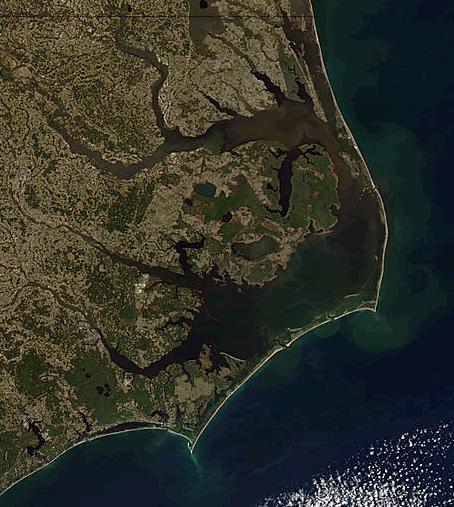
The Outer Banks are one of the best-loved beach escapes on the U.S. Atlantic coast: a slender chain of barrier islands off North Carolina, with mile after mile of golden sand, towering dunes, century-old lighthouses and beach towns of stilt houses. Known as 'OBX', they are shorthand for family vacations, oceanfront rental homes, sunsets over the sounds and a slow rhythm that invites you to switch off.
But the Outer Banks are far more than beach. Here, in 1903, the Wright brothers achieved the first powered flight in history over the dunes of Kitty Hawk. Here is the lost colony of Roanoke, the first attempt at an English settlement in America, whose colonists vanished without a trace. And here, in the treacherous waters known as the 'Graveyard of the Atlantic', hundreds of ships were wrecked, watched over by emblematic lighthouses such as Cape Hatteras, the tallest brick lighthouse in the country.
This guide covers the OBX with a practical eye: which towns to pick depending on the plan (family, wild, historical), how to climb the lighthouses, where to see the wild horses of Corolla, how the ferries to Ocracoke work, which beaches are the best and when to go to dodge crowds and hurricanes. It's a destination to take slowly, with a car, sunscreen and a craving for the sea.
The barrier islands of the Outer Banks are geologically young and permanently on the move, shaped by the swell, the currents and the storms of the Atlantic. Long before the Europeans, they were the territory of Algonquian peoples. In 1584-1587, the English crown tried to found its first colony in America here, on Roanoke Island, financed by Sir Walter Raleigh: the second group of colonists, where Virginia Dare was born (the first English child born in America), vanished without a trace, giving rise to the enigma of the 'Lost Colony'. For centuries, the waters of the OBX were so dangerous for navigation —with shifting sandbars and storms— that they earned the nickname 'Graveyard of the Atlantic'; hundreds of ships were wrecked, and the pirate Blackbeard died off Ocracoke in 1718. To guide sailors, iconic lighthouses were built such as Cape Hatteras (1870). On December 17, 1903, Orville and Wilbur Wright chose the windy dunes of Kill Devil Hills, near Kitty Hawk, to make the first powered, sustained and controlled flight in history. In the 20th century, the OBX went from communities of fishermen and lifesavers to a tourist destination, with the creation in 1953 of Cape Hatteras National Seashore, the country's first 'national seashore'. The full story is on our history page.
Read the full history ↓The state of the first flight: Cherokee land and home of the 'lost colony' of Roanoke, of the Appalachian Mountains and the Great Smoky Mountains, of the Outer Banks beaches where the Wright brothers flew and of the thriving Research Triangle.
Read the history of North Carolina →They depart from Norfolk, 128 km away. If you book from this link we earn a commission and you pay no more.
No exact prices: a scale from $ (budget) to $$$$$ (luxury), with 2-3 options per category.
Origins, formation and what the sources say.
The Outer Banks are a barrier island system: long, narrow strips of sand that form parallel to the coast, separated from the mainland by shallow lagoons and estuaries called 'sounds' (Pamlico, Albemarle, Currituck). They are geologically young formations, permanently changing, sculpted by the wind, the currents and the storms of the Atlantic.
Unlike a solid coastline, these islands literally migrate over time: the swell takes sand from one side and deposits it on another, storms open and close inlets (channels between islands), and the shoreline advances or retreats. That's why life in the OBX was always marked by fragility in the face of the sea.
This geography also explains why the waters off the Outer Banks were so feared by sailors. Here the warm Gulf Stream, rising from the south, collides with the cold Labrador Current, coming down from the north. The encounter generates dangerous seas, fogs and, above all, the Diamond Shoals: treacherous, shifting sandbars off Cape Hatteras. That lethal combination gave the region its most famous nickname: the 'Graveyard of the Atlantic'.
The Outer Banks were the setting for one of the great mysteries in the history of America. In the 1580s, under the patronage of Sir Walter Raleigh and Queen Elizabeth I of England, the English tried to establish their first permanent colony in the New World here, on Roanoke Island, even before Jamestown.
A first attempt (1585) failed because of conflicts with the local Algonquian peoples and a lack of supplies. In 1587 a second group arrived, this time with whole families. There Virginia Dare was born, the first person of English descent born in America. Governor John White went back to England for provisions, but the war with the Spanish Armada kept him from returning for three years.
When he finally came back in 1590, he found no one: the colonists had vanished without a trace. The only clue was the word 'CROATOAN' carved on a post and 'CRO' on a tree, a possible reference to the nearby island and the Croatan people. The colonists were never found. Theories abound: that they merged with local tribes, that they died of hunger or attacks, that they tried to return to England. The enigma of the 'Lost Colony' remains unsolved and is commemorated each summer in a celebrated outdoor drama on Roanoke Island.
For centuries, the waters of the Outer Banks were a nightmare for navigation. The shifting sandbars, the storms and the meeting of currents caused the wrecking of hundreds —some estimates say more than a thousand— of ships throughout history, from colonial galleons to Second World War vessels sunk by German submarines off the coast. Hence the nickname 'Graveyard of the Atlantic'.
To reduce the tragedies, emblematic lighthouses were raised. Cape Hatteras, completed in 1870, is the tallest brick lighthouse in the United States, with its famous black-and-white spiral; in 1999 it was moved whole about 880 meters inland to save it from erosion, an astonishing feat of engineering. Also notable are the lighthouses of Bodie Island, Currituck Beach and Ocracoke (the latter, from 1823, the oldest in the state still in use). The lifesaving service (U.S. Life-Saving Service) set up stations along the islands to rescue shipwreck survivors.
The region also holds pirate stories. The most famous, Edward Teach, known as Blackbeard, used the inlets of the Outer Banks as a refuge. He died in combat off Ocracoke Island in November 1718, in a battle against the Royal Navy. The legend of Blackbeard is still very much alive on Ocracoke.
The most celebrated episode in the history of the Outer Banks happened on December 17, 1903, near Kitty Hawk, in the dunes of Kill Devil Hills. There, two brothers from Dayton, Ohio —Orville and Wilbur Wright, owners of a bicycle shop— achieved what until then had seemed impossible: the first flight of a heavier-than-air machine, powered, sustained and controlled by a human being.
The Wrights chose the Outer Banks precisely for their geography: they needed steady, strong wind (plentiful here), soft sandy ground to cushion the landings and privacy for their experiments. After several summers of tests with gliders, in December 1903 they mounted a light engine and a propeller on their 'Flyer'.
That day they made four flights. The first, piloted by Orville, lasted barely 12 seconds and covered about 37 meters. The last, with Wilbur at the controls, flew 59 seconds and nearly 260 meters. They were modest distances, but they changed history: they had proved that powered flight was possible. Today the Wright Brothers National Memorial marks the site with a large monument, replicas of the Flyer and the markers of those four founding flights of aviation.
For much of their history, the Outer Banks were inhabited by isolated, self-sufficient communities: fishermen, whalers, lifesavers and families who lived off the sea and the sounds. The isolation was such that in places like Ocracoke a dialect of its own developed, the 'Ocracoke brogue' or 'Hoi Toider', with echoes of Elizabethan English, still heard in the mouths of the oldest islanders.
The arrival of bridges and roads in the 20th century changed everything. From the 1930s and, above all, after the Second World War, the OBX were gradually connected with the mainland, which opened the door to beach tourism. In 1953 Cape Hatteras National Seashore was established, the first 'national seashore' in the United States, protecting miles of wild beaches from development.
Since then, the Outer Banks have established themselves as one of the most popular family beach destinations on the East Coast, with their characteristic model of large oceanfront rental homes. The challenge of the 21st century is balancing that tourism with the conservation of a fragile ecosystem and the growing threat of rising sea levels and hurricanes over islands that, by nature, never stop moving.