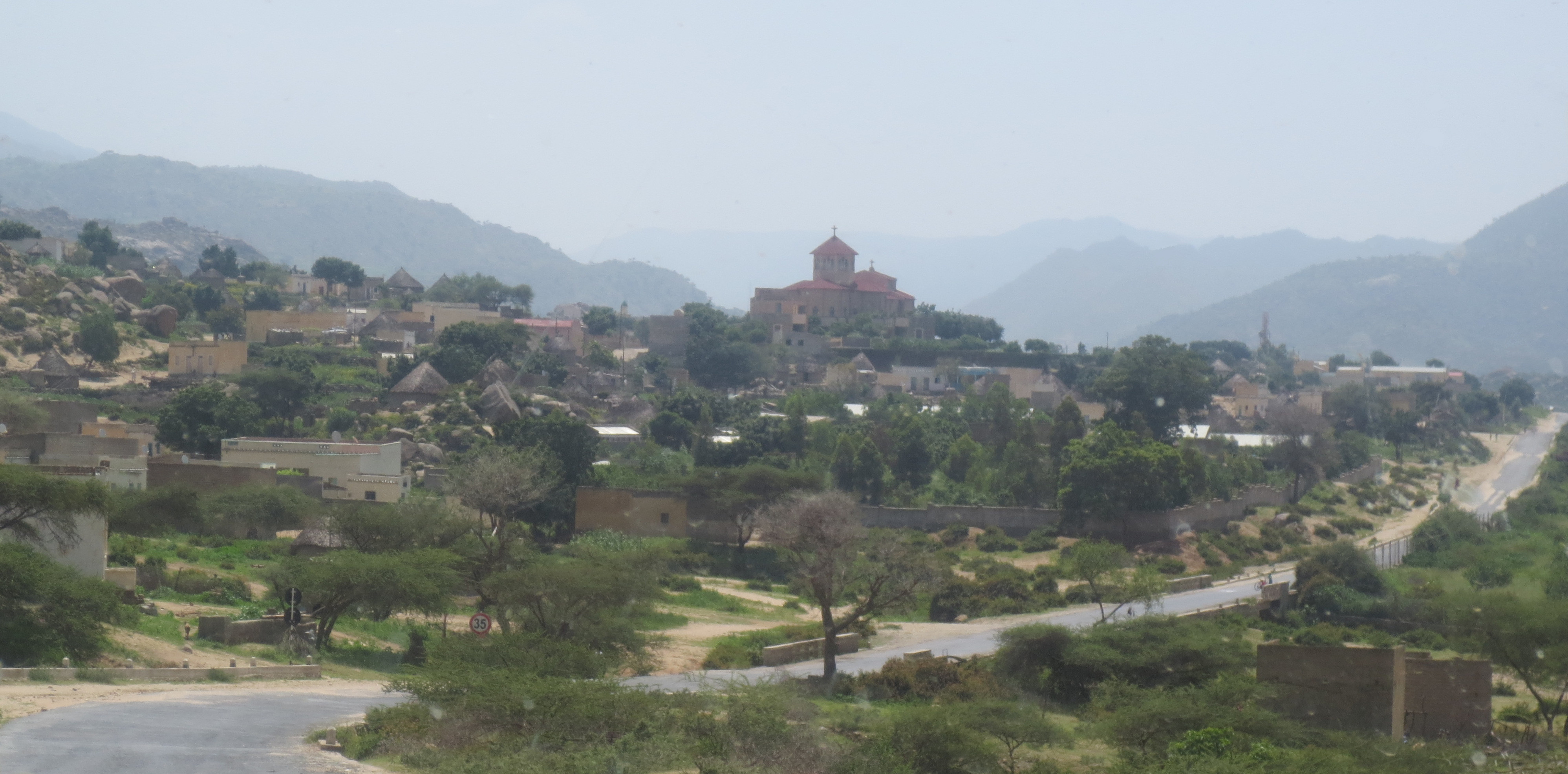
Elabered is a green surprise in the middle of Eritrea's arid north. Halfway between Asmara and Keren, this fertile, well-watered valley is home to one of the country's best-known farms, the Elabered Estate, an oasis of citrus orchards, fruit trees, historic vineyards, coffee plantations and dairies created by Italian settlers in the late 19th century and restored after the war.
More than a monumental destination, Elabered is a stop for landscape and rural life: orange and lemon trees heavy with fruit, fodder fields, dairy cows, and fresh fruit and dairy products sold by the roadside that supply the markets of Asmara and Keren. The contrast between this lush garden and the dry mountains around it sums up the diversity of Eritrean geography and how much water and farming matter to the country.
This guide suggests Elabered as the perfect stop on the trip to Keren: what to see, how to make the most of the stop, what to buy and how to combine it with the nearby Debre Sina monastery. A simple but memorable stop that shows Eritrea's agricultural, everyday side, far from the big historical landmarks but very close to real life.
Elabered began as a farm in the late 19th century, when an Italian entrepreneur used the valley's water and fertile soil to grow vegetables, tobacco, sisal and fruit trees. Over time it became a model farm of the colony, with citrus, vineyards, coffee and a dairy. The war of independence left it badly damaged, and from 1998 it was rebuilt as a modern integrated state farm focused on food security: today it produces fruit, vegetables, dairy products and fodder that keep prices stable and supply Asmara and Keren. Its full story is told on our history page.
Read the full history ↓The mountainous Muslim north: Keren and its camel market, the fertile valley of Elabered and Nakfa, the town that became the symbol of the war of independence and gave its name to the national currency.
Read the history of The north: Keren and Anseba →No exact prices: a scale from $ (budget) to $$$$$ (luxury), with 2-3 options per category.
Origins, formation and what the sources say.
The story of Elabered begins with geography. In the middle of the dry mountains of northern Eritrea, between the Asmara plateau and the town of Keren, nature carved out a fertile valley well watered by springs and streams. That green corner, so different from the arid landscape around it, was prized for centuries for its water and its land, and local communities used it for grazing and subsistence farming.
Water was always the key to Elabered. In a region where rain is scarce and irregular, a valley that could support crops for much of the year was a treasure. That natural fertility would eventually become the basis of one of the country's best-known farms, but before that the valley was simply an oasis known to the herders and farmers of the Anseba area.
When the European powers carved up the Horn of Africa in the late 19th century, that farming potential did not go unnoticed. Italy had made Eritrea its first colony in 1890 and was looking for land where it could try out modern, profitable agriculture. The Elabered valley, with its water and its climate, looked like an ideal candidate for the colonial experiment.
The Elabered Estate was founded in 1893, when an Italian entrepreneur set up a farm in the valley on about twelve hectares. At first it grew vegetables, tobacco, sisal and other cash crops. Thanks to the valley's water and the mild climate, the estate grew and diversified until it became one of the model farms of the Italian colony of Eritrea.
Over the years Elabered became famous for its citrus (oranges and lemons), its fruit trees, its vineyards and its coffee and olives, along with some early livestock and dairy farming. The estate stood for the farming ambitions of the Italian colonial project, which saw the Eritrean highlands as a good place to grow Mediterranean-style fruit and vegetables. Its produce supplied Asmara and the settler community.
That period left a lasting mark: Elabered's focus on fruit and dairy, its irrigation infrastructure and its reputation as the orchard of the north. But it also tied the estate to the ups and downs of colonial history and, later, to the tragedy of the war that would destroy much of what had been built. Like the rest of Eritrea, the estate would not escape the decades of conflict that lay ahead.
Eritrea's long war of independence, which lasted from the 1960s until 1991, hit the Anseba region and Elabered hard. The estate had prospered for decades, but it was badly damaged during the conflict: buildings were destroyed, plantations were abandoned and irrigation systems were ruined. The orchard that the Italians had built, and that had kept producing under later administrations, became a shadow of its former self.
The destruction of Elabered was one example among many of the economic and social cost of the war. After thirty years of fighting, much of Eritrea's farming, industrial and service infrastructure was damaged or at a standstill, and rebuilding would be a huge task for the young country that became independent in 1993. Bringing farms like Elabered back to life was not only an economic matter but also a symbolic one: it meant making the land produce again.
With peace, the new Eritrean state focused on food security and on reviving the large estates that could supply the cities. Elabered, with its fertile valley and its farming tradition, was a natural candidate for a comeback, and in the late 1990s work began to rebuild it as a modern farm.
From 1998 the Elabered Estate was rebuilt and modernised as an integrated farm, which means it combines crops and livestock in a single production system. Crops were replanted and expanded (oranges, lemons, papayas, mangoes, guavas, avocados, coffee, olives and vegetables), fodder fields such as alfalfa were developed, and dairy farming was relaunched with Holstein and local Barka cattle, alongside pigs and sheep.
A key part of the renewed estate is its milk processing plant, which makes dairy products sold in Elabered, Asmara and Keren. Thousands of litres of milk go to the capital every week, and Elabered's fruit and vegetables have become a byword for quality in Eritrean markets. The farm has two aims: to produce food and, by producing it in volume, to help keep the prices of fruit, vegetables and dairy stable across the country.
In an Eritrea shaped by scarcity and by the state's focus on food self-sufficiency, Elabered stands out as a flagship estate. It represents a bet on modern, organised farming that makes the most of the few fertile corners of the country to feed the population, and the state showcases it as an example of national agricultural development.
Today's Elabered is, above all, a productive valley and a green oasis that surprises travellers in the middle of the arid north. Its citrus and fruit orchards, fodder fields, dairies and processing plant keep it among the best-known farms in Eritrea and make it a mainstay of Asmara's and Keren's supply of fruit, vegetables and dairy.
If you're travelling the Asmara–Keren road, Elabered is a pleasant, bright stop: the contrast between the irrigated valley and the dry mountains, the fresh fruit stalls by the roadside, rural life in full swing. It isn't a destination for grand monuments. Instead, it offers a window onto the Eritrea of farm work and the everyday struggle for food security, a central theme in the country's life.
Paired with the nearby Debre Sina monastery and the neighbouring town of Keren, Elabered rounds out a trip that shows the different sides of the Anseba region: water and farming, Orthodox Christian faith, and the cultural mix of the lowlands. Born in the colonial era, it survived the war and was reborn after independence, and this fertile valley is still the orchard of northern Eritrea.