Viajá con Gus
Home › China › Lhasa
Lhasa
🇨🇳 China · The interior and the west (Tibet)

Lhasa

🪪 What do I need to enter China?Pick your citizenship and we tell you the visa, the days and the paperwork, with the official source.

By leaving your email and citizenship you agree to receive the documents you asked for and weekly travel news. You can unsubscribe whenever you want. How we handle your data.
Jump to what you need
📍Region
Lhasa is the capital of the Tibet Autonomous Region (Xizang), in south-west China, and the spiritual, historical and cultural heart of the Tibetan people. It sits at about 3.650 metres above sea level, in a valley of the Lhasa River (a tributary of the Yarlung Tsangpo, the Brahmaputra), surrounded by the mountains of the Tibetan plateau, the 'roof of the world'. Its name means 'place of the gods'. For more than a thousand years it has been the centre of Tibetan Buddhism and the seat of the Dalai Lamas, and today it is both a Buddhist pilgrimage city and a modern Chinese city in rapid transformation. Important: foreigners need a special permit and an organised tour to visit Tibet (see below).
📌Best time to visit
The best time to visit Lhasa is from April to October, with spring and autumn (April-May and September-October) being ideal thanks to their mild weather and clear skies. Summer (June to August) is the monsoon rainy season, but showers tend to be short and fall at night, leaving sunny days; it is high season. Winter (November to March) is very cold and dry, with fewer tourists, although Lhasa is known for being sunny all year round ('the city of sunlight'). Solar radiation is intense at this altitude: sunscreen and sunglasses are essential in any season.
📌Suggested days
We recommend at least 3 or 4 days in Lhasa, partly for the sights and partly to acclimatise to the altitude before going higher. In 2-3 days you can cover the city's essentials: the Potala Palace, the Jokhang Temple and the Barkhor pilgrimage circuit, and the great monasteries of Sera and Drepung. With 1-2 more days you can add the Norbulingka summer palace and day trips to the sacred Lake Yamdrok or Ganden Monastery. Many Tibet itineraries then continue towards Shigatse and Everest Base Camp, which takes more days and additional permits.
📌Getting there
You can reach Lhasa by plane or by train. Lhasa Gonggar Airport (LXA) is about 62 km from the city, with flights from Chengdu, Chongqing, Xi'an, Beijing, Shanghai, Guangzhou and Kathmandu. The other big option is the Qinghai-Tibet railway, the highest railway in the world, which climbs from Xining (about 21 h), Chengdu, Chongqing or Beijing, crossing the plateau over passes of more than 5.000 metres; the carriages have an oxygen supply. Arriving by train helps you acclimatise gradually to the altitude, whereas by plane the change is abrupt.
📌Getting around
Lhasa's old town, around the Jokhang and the Barkhor, is compact and easy to explore on foot (slowly, because of the altitude). The city has cheap local buses and taxis, but since foreigners must travel on an organised tour with a guide, in practice transfers to monasteries and excursions are made in the agency's vehicle with the guide. You need transport for the large monasteries on the outskirts (Sera, Drepung) and for excursions (Yamdrok, Ganden). Payment is by Alipay/WeChat QR code or cash; it's wise to carry some yuan in cash just in case.
📌Language and currency
Tibetan and Mandarin Chinese are spoken; English is scarce outside tour guides (who usually speak it). The currency is the yuan or renminbi (CNY, ¥), as in the rest of China. You pay with Alipay and WeChat Pay by QR code (set them up before you travel) or in cash. To use Google, WhatsApp or Instagram you need a VPN installed before entering China, although in Tibet the connection may be more restricted. And, once again, the key point: foreigners need the Tibet Travel Permit, which can only be arranged through an authorised agency.
💱 CNY exchange rate
Loading rate…
🌤️ Weather in Lhasa
Loading weather…

Few places in the world hold a fascination like Lhasa's. At 3.650 metres, in a valley on the Tibetan plateau surrounded by bare mountains and skies of the most intense blue, the capital of Tibet is the spiritual heart of Tibetan Buddhism and one of the most revered holy cities in Asia. Here stands the majestic Potala Palace, former residence of the Dalai Lamas, and here beats the Jokhang Temple, the holiest in Tibetan Buddhism, surrounded day and night by pilgrims spinning prayer wheels and prostrating themselves on the ground, sometimes after travelling hundreds of kilometres.

Travelling to Lhasa means stepping into a profoundly different culture, with its own language, script, religion, architecture of sloping walls and centuries-old history on the 'roof of the world'. It is also a demanding trip because of the altitude, which forces you to go slowly and acclimatise, and a trip with its own rules: because of its political and administrative situation, foreign travellers cannot explore Tibet independently, but must have a special permit and an organised tour with a guide. It's best to be clear about this from the start so you can plan properly.

This guide covers Lhasa with a practical, warm and respectful eye: what to see in the city and its monasteries, how to prepare for the altitude, how the Tibet permit works and what to keep in mind to enjoy such a special and sensitive destination. Lhasa is not a destination to tick off a list, but one to experience calmly, attentively and with respect for one of the most unique living cultures on the planet.

📖 History of Lhasa

Lhasa has been tied to the history of Tibet since the 7th century, when King Songtsen Gampo unified the plateau, founded the Tibetan Empire and established his capital here, building the first temples —among them the Jokhang— to house Buddhist images brought by his Nepalese and Chinese wives. Buddhism, blended with local beliefs, became over the centuries the backbone of Tibetan culture, and from the 15th century onwards the Gelug school and the institution of the Dalai Lamas gained primacy. In the 17th century, the Fifth Dalai Lama unified Tibet under his religious and political authority and ordered the construction of the great Potala Palace on a hill in Lhasa, consolidating the city as both spiritual and temporal capital. Throughout its history, Tibet maintained complex relations with the Mongol and Chinese Qing empires. In 1950-1951 the region was incorporated into the newly founded People's Republic of China; in 1959, after an uprising in Lhasa, the current (14th) Dalai Lama went into exile in India, where he remains. Today Lhasa is the capital of the Tibet Autonomous Region, a centre of Buddhist pilgrimage and a city undergoing profound transformation. The full history, told soberly and with sources, is on our history page.

Read the full history ↓

🏛️ Lhasa is in the interior and the west (Tibet)

From the heart of the Silk Road in Xi'an to the fertile Sichuan basin and the Tibetan plateau: inland China of ancient capitals, pandas and the roof of the world.

Read the history of The interior and the west (Tibet) →

🗺️ What to see

Tours you can book

If you book from here we earn a commission and you pay no more. Prices and availability come from Civitatis.

1
Potala Palace
The imposing palace-fortress of the Dalai Lamas on Marpo Ri hill, symbol of Tibet and a World Heritage Site.
Leer más ↓
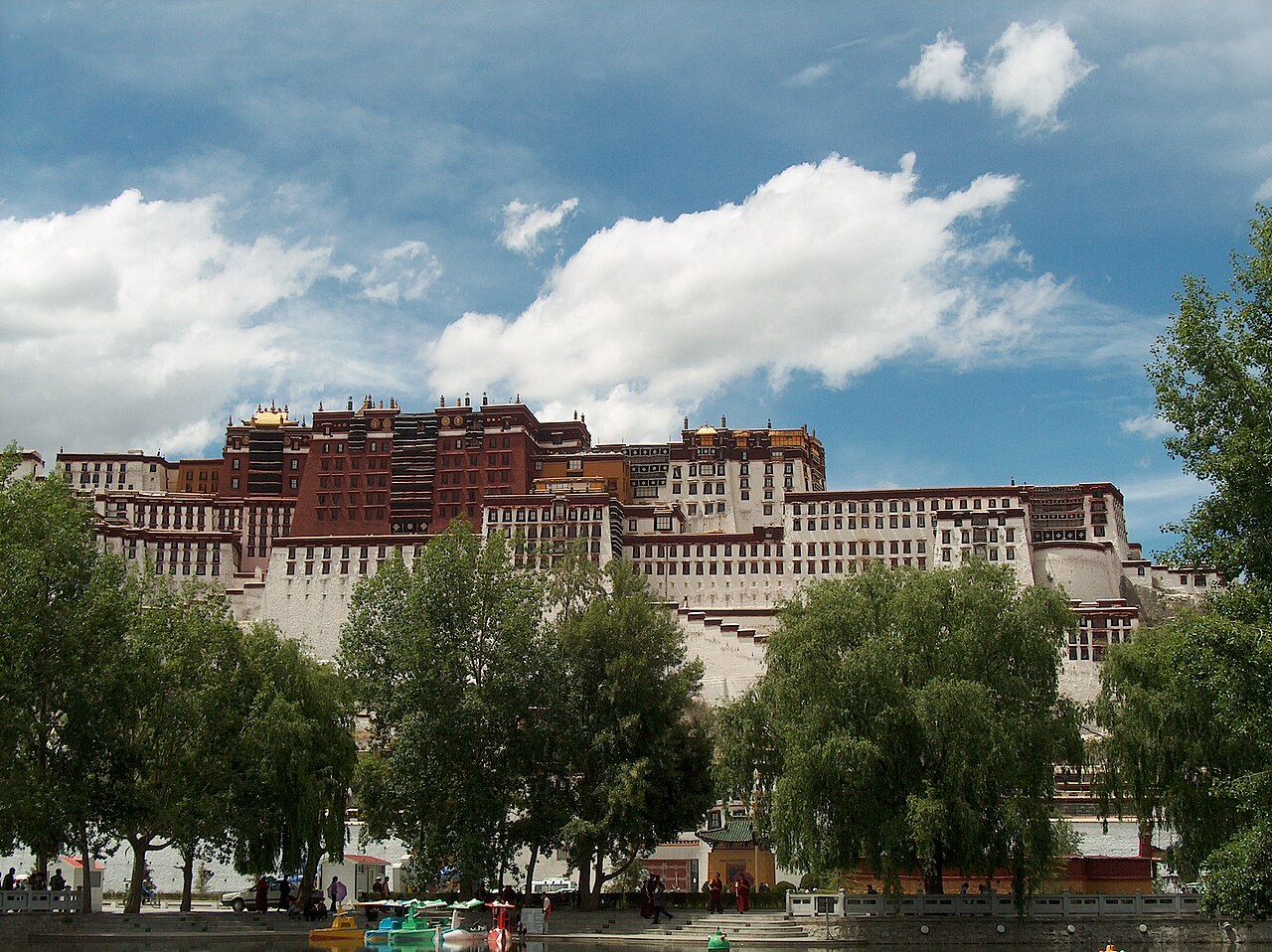
The Potala Palace is Tibet's most iconic monument and one of the most impressive buildings in Asia. It rises on Marpo Ri hill ('red hill'), dominating Lhasa with its white and red walls that climb in terraces to a height of about thirteen storeys. It was the winter residence of the Dalai Lamas and the seat of Tibetan government for centuries, as well as a great monastery. The current palace was commissioned by the Fifth Dalai Lama from 1645 onwards, although there had been fortifications on the same site since the time of King Songtsen Gampo, in the 7th century. The complex is divided into the White Palace (Potrang Karpo), which housed the administrative functions and the Dalai Lamas' living quarters, and the Red Palace (Potrang Marpo), devoted to religious study and prayer, with the spectacular funerary stupas (chorten) that hold the remains of several Dalai Lamas, some covered in gold and precious stones. Inside it is a labyrinth of chapels, assembly halls, libraries of Buddhist scriptures, murals and thousands of statues. From its terraces, the views of Lhasa and the valley are magnificent. It has been a UNESCO World Heritage Site since 1994. Visits are tightly regulated: there are daily quotas, limited time inside (usually around an hour once inside the palace proper) and many stairs to climb, which is quite tiring at this altitude. How it works: admission is arranged in advance (in practice, through your tour agency). Best time: in the morning; April to October. Tips: climb slowly because of the altitude, bring water, sunscreen and sunglasses; photography inside the chapels is forbidden; and acclimatise for a couple of days in Lhasa before visiting.
ℹ️ Distance: Central Lhasa, on Marpo Ri hill; walking distance from the old town · Best time to visit: Morning; April to October · Admission: 200 CNY in high season (May-October), 100 CNY in low season, verified July 2026; daily quota and advance booking (via agency). Source: TravelChinaGuide · Duration: 2 to 3 hours (including the climb)
2
Jokhang Temple and the Barkhor circuit
The holiest temple in Tibetan Buddhism and the bustling pilgrimage circuit around it.
Leer más ↓
The Jokhang Temple (Jokhang or Jowo Khang) is the holiest and most revered place in Tibetan Buddhism, the spiritual heart of Tibet. It was founded in the 7th century by King Songtsen Gampo to house Buddhist images, and its most precious treasure is the statue of Jowo Shakyamuni, an image of the Buddha which, according to tradition, came to Tibet with the Chinese princess Wencheng, one of the king's wives. For Tibetans it is the holiest image in the country, and the temple is the final destination of pilgrimages that can last for months. The atmosphere inside —half-light, yak-butter lamps, incense smoke, murmured prayers and pilgrims spinning prayer wheels— has an unforgettable spiritual intensity. It is a World Heritage Site. Around the temple runs the Barkhor, Lhasa's most famous pilgrimage circuit: a route encircling the Jokhang along which a river of pilgrims flows day and night, walking clockwise, many spinning hand prayer wheels or prostrating themselves full-length on the ground. The Barkhor is both a sacred route and a bustling market, with stalls selling religious items, crafts and souvenirs, and it is the best place to feel the pulse of traditional Lhasa. Getting there: in the heart of the old town, on foot. Best time: early morning or at dusk, when there are more pilgrims. Tips: always walk clockwise, like the pilgrims; be discreet and respectful when photographing people (ask permission); inside the temple there may be photography restrictions and a separate fee to take photos.
ℹ️ Distance: Lhasa old town; on foot · Best time to visit: Dawn or dusk, when there are more pilgrims · Admission: Jokhang Temple 85 CNY; interior photography permit extra (~90 CNY), verified July 2026. Barkhor, free. Source: Trip.com / VisitOurChina · Duration: 1,5 to 2 hours for the temple and the circuit
3
Sera Monastery
One of the great monasteries of the Gelug school, famous for its monks' lively philosophical debates.
Leer más ↓
Sera Monastery (Sera Gompa) is one of the three great monasteries of the Gelug school (the 'yellow hats', to which the Dalai Lamas belong) around Lhasa, along with Drepung and Ganden. Founded in the early 15th century, it once housed thousands of monks and was for centuries one of the great monastic universities of Tibetan Buddhism. It spreads out at the foot of a mountain, north of the city, with its assembly halls, chapels, colleges (dratsang) and monks' quarters stepped up the slope, all in the characteristic Tibetan architecture of white walls with ochre and gold details. Sera's big draw, and one of the most memorable experiences in Lhasa, is the monks' debates. Every afternoon (usually on weekdays), in a tree-lined courtyard, the monks gather to debate points of Buddhist doctrine in a very physical and theatrical way: the questioner stands and fires off his arguments, clapping one hand hard against the other, while the respondent stays seated, in a dialectical back-and-forth full of energy, gestures and laughter. It's a fascinating glimpse of living monastic life. Getting there: north of Lhasa, in the tour vehicle or by taxi. Best time: in the afternoon, to see the debates (check the days and times, usually Monday to Friday). Tips: be very respectful and quiet during the debates; there may be photography restrictions; combine it with a walk around the monastery before or after.
ℹ️ Distance: About 5 km north of the centre; by tour vehicle or taxi · Best time to visit: Afternoon, for the debates (generally Monday to Friday) · Admission: ~50 CNY per adult, verified July 2026 · Duration: 2 hours
4
Drepung Monastery
Once the largest monastery in the world, historic seat of the early Dalai Lamas.
Leer más ↓
Drepung Monastery (Drepung Gompa) was at its peak the largest monastery in the world, with up to about 10.000 monks, and is another of Lhasa's three great Gelug centres. Founded in 1416, its name means 'rice heap', after the look of its white buildings clustered on a mountainside west of the city, which from afar resemble a mound of grain. It was the residence of the early Dalai Lamas before the Potala was built, which gives it enormous historical weight. Exploring Drepung means entering a small monastic town: chapels, large assembly halls with rows of cushions for the monks, huge kitchens with enormous pots for making butter tea, colleges of Buddhist studies and stupas. It holds remarkable images, manuscripts and ritual objects. The monastery offers good views over the Lhasa valley. It is also the main stage of the Shoton festival, when a colossal thangka (religious painting) is unfurled on the hillside. Getting there: west of Lhasa, in the tour vehicle or by taxi, plus a climb on foot or by local minibus. Best time: in the morning; April to October. Tips: it involves walking and climbing at altitude, so take it easy; combine it with Sera on the same day (one in the morning and the other in the afternoon for the debates); respect places of worship and photography rules.
ℹ️ Distance: About 8 km west of the centre; by tour vehicle or taxi · Best time to visit: Morning; April to October · Admission: ~50 CNY per adult, verified July 2026 · Duration: 2 to 2,5 hours
5
Norbulingka Palace
The summer palace and garden of the Dalai Lamas, a green haven on the outskirts of Lhasa.
Leer más ↓
Norbulingka ('the jewel park') was the summer residence of the Dalai Lamas from the 18th century and is today a sprawling complex of palaces, pavilions and gardens west of Lhasa, a gentle contrast to the monumental severity of the Potala. It was built and expanded by successive Dalai Lamas as a place for rest, study and government during the warm months. The complex includes several palaces from different periods, halls decorated with murals, chapels and large tree-filled gardens with ponds, considered the largest man-made park in Tibet. It forms part of the World Heritage ensemble along with the Potala and the Jokhang. The most visited palace is usually the 'New Palace' (Takten Migyur Podrang), built in the mid-20th century, with rooms that preserve the furniture and decoration of the period and murals recounting the history of Tibet and the Dalai Lamas. It was from Norbulingka that the current Dalai Lama left for exile in 1959. Norbulingka is also the centre of the Shoton celebrations (the 'yoghurt festival'), one of Lhasa's great festivals, with Tibetan opera, picnics and a festive atmosphere. Getting there: west of the city, by vehicle or taxi. Best time: in summer, when the gardens are green; during Shoton to soak up the atmosphere. Tips: it's a calmer, more relaxed visit; ideal for strolling without the effort of so many stairs, though always slowly because of the altitude.
ℹ️ Distance: West of Lhasa; by tour vehicle or taxi · Best time to visit: Summer (green gardens) and the Shoton festival · Admission: ~60 CNY in high season, less in low season, verified July 2026 · Duration: 1,5 to 2 hours
6
Lake Yamdrok (day trip)
One of the three sacred lakes of Tibet, a dazzling turquoise among snow-capped mountains.
Leer más ↓
Lake Yamdrok (Yamdrok Tso) is one of the three great sacred lakes of Tibet and one of the most spectacular excursions from Lhasa. Lying at about 4.440 metres, south-west of the city, it is a freshwater lake of an intense turquoise colour with a winding, branching shape that snakes between bare mountains with snow-capped peaks in the background. For Tibetans it is a sacred lake, home to protective deities, and its otherworldly beauty has made it a magnet for travellers. The classic excursion climbs from Lhasa along a mountain road to the Kamba La pass (about 4.700 metres), from where a panoramic view opens onto the lake far below, its water an unreal blue. It is one of the great landscapes of the Tibetan plateau. Many itineraries combine Yamdrok with the Karola glacier and continue on to the town of Gyantse and Shigatse. Getting there: in the tour vehicle, by road (about 2-3 h to the viewpoints), as a day trip or as part of a longer route west. Best time: May to October, with clear skies. Tips: you go up very high, so you need to be well acclimatised; bring warm clothes (it's cold and windy up there even if it's sunny in Lhasa), sunscreen and sunglasses; and watch out for the animals 'for photos' at the viewpoints, which usually charge. It requires permits in addition to the Lhasa one: the agency arranges them.
ℹ️ Distance: About 100 km south-west; 2-3 h by road to the viewpoints (Kamba La pass) · Best time to visit: May to October, with clear skies · Admission: Viewpoint access ~60 CNY (depending on the spot), verified July 2026; included in many tours. Requires permits in addition to the Lhasa one · Duration: Full day
7
Ganden Monastery (day trip)
The first and foremost monastery of the Gelug school, on a spectacular mountain with a pilgrimage circuit.
Leer más ↓
Ganden Monastery (Ganden Gompa) is the third of Lhasa's three great Gelug monasteries and, in a sense, the most important, because it was the first one founded by Je Tsongkhapa, the reformer who gave rise to this school, in 1409. It lies about 45 km east of Lhasa, perched on a mountain at about 4.300 metres, in a natural amphitheatre of breathtaking beauty, with sweeping views of the Kyichu River valley. The name 'Ganden' refers to a heaven in Buddhist cosmology, the 'Pure Land' of the future Buddha Maitreya. The monastery is a complex of chapels, assembly halls and white buildings stepped up the hillside, with Tsongkhapa's tomb (chorten) among its most revered sites. Beyond visiting the complex, Ganden is famous for its 'kora', a pilgrimage circuit around the mountain, with spectacular views, prayer flags and pilgrims; doing the whole thing requires good fitness and acclimatisation to the altitude. Getting there: in the tour vehicle, along a mountain road with hairpin bends (~1,5-2 h from Lhasa). Best time: May to October, in good weather. Tips: you go up very high and it's cold and windy; bring warm clothes, sunscreen and comfortable shoes; take it slowly because of the altitude; and if you do part of the kora, gauge the effort carefully. It's usually combined with a day exploring the surrounding area.
ℹ️ Distance: About 45 km east; 1,5-2 h along a mountain road · Best time to visit: May to October · Admission: ~50 CNY per adult, verified July 2026 · Duration: Half day to full day
📶I have never landed without internet. I arrive and my phone connects to the strongest network in the country I am visiting: I can say I landed, sort out transport, book tours and keep posting, at a seriously good price. I always use the Maya eSIM — check their plans by clicking the banner.See plans →Maya Mobile eSIM — turn travel mode on
What nobody tells you

💵 Prices

Tickets

TypePrice
Palacio de Potala200 CNY high season (May-Oct), 100 CNY low season, verified July 2026; daily quota and advance booking (via agency)
Templo de Jokhang85 CNY per adult; interior photography permit ~90 CNY extra, verified July 2026
Monasterio de Sera~50 CNY per adult, verified July 2026
Monasterio de Drepung~50 CNY per adult, verified July 2026
Palacio de Norbulingka~60 CNY high season, verified July 2026
Monasterio de Ganden~50 CNY per adult, verified July 2026
Lago Yamdrok (miradores)~60 CNY depending on the spot, verified July 2026; requires permits in addition to the Lhasa one
Circuito de peregrinación de BarkhorFree (open access)
🔄 updated monthlyOfficial / reference values · double-check when buying

Activities and tours

Organised tour of Lhasa and its monasteries (guide mandatory for foreigners)
Duration3 to 5 days
OperatorAuthorised Tibet agencies (mandatory)
Price
Depends on the package; a multi-day Lhasa tour from ~3.000-6.000 CNY per person including permits, guide and transport, verified July 2026
Day trip to the sacred Lake Yamdrok
DurationFull day
OperatorAuthorised tour agency
Price
Included in many packages; ~600-1.200 CNY per person on its own, verified July 2026
Watch the monks' debates at Sera
PriceIncluded with monastery admission (~50 CNY), verified July 2026
Duration1,5 h
OperatorIn the afternoon, with the guide
Pilgrimage (kora) around the Barkhor or Ganden circuit
PriceFree (Barkhor); monastery admission at Ganden, verified July 2026
Duration1 h to half a day
OperatorOn your own (Barkhor) or with a guide
Yak butter tea and Tibetan food with a local guide
Price40–120 CNY per person, verified July 2026
Duration1 to 2 h
OperatorTibetan teahouses and restaurants
🔄 updated monthlyOfficial / reference values · double-check when buying

🚌 How to get there and distances

Getting around

On foot around the old town
Free
DurationVaries
Notes
The area around the Jokhang and Barkhor is best explored on foot, always taking it slowly because of the altitude (3.650 m). It's the best way to experience the pilgrims' Lhasa
Tour vehicle with guide
Included in the tour package
DurationVaries
Notes
Since foreigners must travel on an organised tour, transfers to Sera, Drepung, Norbulingka and excursions (Yamdrok, Ganden) are done in the agency's vehicle with the guide. This is standard and the most comfortable option
City bus and taxi
PriceBus 1-2 CNY; taxi from ~10 CNY, verified July 2026
DurationVaries
Notes
They're available for getting around the city, but in practice foreigners mostly use the tour vehicle. Pay by QR code or cash
Qinghai-Tibet Railway (China Railway)
DurationVaries
Price
Depends on origin and class (soft sleeper from several hundred CNY), verified July 2026
Notes
The highest railway in the world, with oxygen supplied in the carriages; it reaches Lhasa from Xining (~21 h), Chengdu, Chongqing, Xi'an and Beijing. Arriving by train helps you acclimatise to the altitude
Plane (Lhasa Gonggar Airport, LXA)
PriceDepends on origin; transfer to the centre ~62 km, verified July 2026
Duration~1 h to the centre
Notes
Flights from Chengdu, Chongqing, Xi'an, Beijing, Shanghai, Guangzhou and Kathmandu. Faster than the train, but the change in altitude is abrupt: you need to acclimatise in Lhasa before exerting yourself
🔄 updated monthlyOfficial / reference values · double-check when buying

How to get there

RouteAirlines / operatorsAvg. priceDuration
Lhasa Gonggar Airport (LXA) → centreAirport bus and tour vehicleBus ~30 CNY; tour transfer included, verified July 2026About 60 min (62 km)
Qinghai-Tibet train from Xining to LhasaChina Railway (Qinghai-Tibet line, carriages with oxygen)Depends on class (soft sleeper several hundred CNY), verified July 2026About 21 h from Xining; longer from Chengdu, Chongqing, Xi'an or Beijing
Flight to Lhasa from Chinese citiesChinese airlines (from Chengdu, Chongqing, Xi'an, Beijing, etc.)Depends on origin and how far ahead you book, verified July 2026Chengdu ~2 h; Xi'an ~2,5 h
Tibet Travel Permit (essential for foreigners)Authorised Tibet agencies (you cannot apply on your own)Arranged by the agency as part of the tour package, verified July 2026Apply weeks in advance
🔄 updated monthlyOfficial / reference values · double-check when buying

🏨 Where to stay

No exact prices: a scale from $ (budget) to $$$$$ (luxury), with 2-3 options per category.

Luxury (centre and Potala views)
Price$$$$$
Recommended options
1.000–2.500+ CNY per night, verified July 2026; high-end international hotels in Lhasa, some with views of the Potala Palace and oxygen in the rooms to help with the altitude. Book ahead in high season
Mid-range in the old town
Price$$$$$
Recommended options
300–650 CNY per night, verified July 2026; mid-range hotels near the Jokhang and Barkhor, within walking distance of the main sights. A good base for experiencing traditional Lhasa
Tibetan charm (traditional houses)
Price$$$$$
Recommended options
500–1.000 CNY per night, verified July 2026; boutique hotels in restored Tibetan houses in the old town, with traditional décor, courtyards and often terraces with views. A more cultural experience
Budget / hostels
Price$$$$$
Recommended options
60–130 CNY in dorms; 150–300 CNY for budget private rooms, verified July 2026. Simple hostels and guesthouses in the old town, popular with travellers on a tight budget; many help arrange tours (remember the tour is mandatory)

🍴 Where to eat

Cocina tibetana (momos, thukpa, tsampa)
Price$$$$$
Options / signature dish
30–80 CNY per dish, verified July 2026. Classic Tibetan food: momos (steamed dumplings filled with meat or vegetables), thukpa (noodle soup), tsampa (roasted barley flour, a staple food) and yak stew. Simple, comforting and suited to the altitude
Té de manteca de yak y casas de té
Price$$$$$
Options / signature dish
10–40 CNY, verified July 2026. Salted yak butter tea (po cha) and sweet tea (cha ngamo) are an essential part of Tibetan life. Lhasa's traditional teahouses are a good place to rest and watch local life go by
Restaurantes con vistas y cocina nepalí/india
Price$$$$$
Options / signature dish
60–150 CNY per person, verified July 2026. Around Barkhor there are restaurants with terraces overlooking the Jokhang, many with menus mixing Tibetan, Nepali, Indian and Western cooking, convenient for travellers
Cocina china (sichuanesa y otras)
Price$$$$$
Options / signature dish
40–100 CNY per dish, verified July 2026. Lhasa also has plenty of Chinese restaurants, especially Sichuanese, a common choice for a change. Eating light during the first few days helps you adjust to the altitude

📖 History of Lhasa

Origins, formation and what the sources say.

Songtsen Gampo and the birth of Lhasa (7th century)

The history of Lhasa as a city begins in the 7th century with one of the most important figures in Tibetan history: King Songtsen Gampo. At a time when the tribes and principalities of the Tibetan Plateau were scattered, Songtsen Gampo united them and founded the Tibetan Empire. This power would go on to rival Tang dynasty China and control large parts of Central Asia. He moved his capital to Lhasa, in the fertile valley of the Kyichu River, and ordered the city's first temples to be built.

Songtsen Gampo is also credited with a key role in bringing Buddhism to Tibet. According to tradition, his two most famous wives were Buddhists and brought sacred images of the Buddha with them: Princess Bhrikuti from Nepal, and Princess Wencheng from the Tang court of China. The Jokhang and Ramoche temples were built to house these images. The Jokhang holds the Jowo Shakyamuni image linked to Princess Wencheng. Over time it became the holiest temple in all of Tibetan Buddhism and the spiritual heart of Lhasa, a name that came to mean 'place of the gods'.

In those early centuries, the Buddhism that arrived from India and China gradually blended with Tibet's native beliefs, including the ancient Bön tradition. From that fusion, and from centuries of later development, came Tibetan Buddhism. Its schools, lineages and rich iconography still fill every corner of Lhasa today.

History and tradition around Songtsen Gampo
The figure of Songtsen Gampo mixes proven historical facts with traditional accounts full of religious meaning. The facts are that he unified Tibet and founded the Tibetan Empire in the 7th century. The traditional accounts present him as an incarnation of the bodhisattva Avalokiteshvara and credit his wives with bringing Buddhism to Tibet. Historians distinguish between the historical king and the idealised figure of later Buddhist tradition.
Source: https://es.wikipedia.org/wiki/Songtsen_Gampo

Tibetan Buddhism, the great schools and the Dalai Lamas

After the Tibetan Empire collapsed in the 9th century, Tibet went through centuries of political fragmentation, but also of intense religious life. Buddhism took firm root and split into several major schools: Nyingma, Kagyu, Sakya and, later, Gelug. Each had its own monasteries, lineages of teachers and practices. The monasteries became centres of power, culture and economic life as well as spiritual centres, and much of Tibet's social organisation revolved around them.

A turning point came in the early 15th century with Je Tsongkhapa, a great reformer who founded the Gelug school (the 'Yellow Hats'), with a strong focus on monastic discipline and study. This school gave rise to the three great monasteries around Lhasa: Ganden, Drepung and Sera. In time it also produced the institution that would shape Tibet's history, the Dalai Lamas. The title 'Dalai Lama' ('ocean of wisdom') became established in the 16th century. It rests on the belief that each Dalai Lama is the reincarnation of the one before, and an emanation of Avalokiteshvara (Chenrezig), the bodhisattva of compassion and patron of Tibet.

This system of reincarnations, along with that of other great lamas such as the Panchen Lama, gave Tibetan Buddhism a distinctive structure. Religious leadership, and sometimes political leadership, passes on through the search in each generation for the child in whom the late teacher has been reborn. Lhasa, with its great Gelug monasteries and sacred temples, became the centre of this whole spiritual world.

The reincarnation system (tulkus)
Identifying children as the reincarnations of deceased teachers (tulkus), including the Dalai and Panchen Lamas, is a distinctive feature of Tibetan Buddhism. It combines doctrine, namely belief in rebirth and in bodhisattvas, with traditional procedures for searching for and recognising the child. In modern times, the question of who has the authority to recognise these reincarnations has also become a politically sensitive matter.
Source: https://es.wikipedia.org/wiki/Dalai_lama

The Fifth Dalai Lama and the building of the Potala (17th century)

Lhasa became the religious and political capital of Tibet in the 17th century, under the Fifth Dalai Lama, Ngawang Lobsang Gyatso, known as 'the Great Fifth'. With military support from Mongol allies, he unified Tibet under the authority of the Gelug school. He set up a government, the Ganden Phodrang, in which the Dalai Lama held both spiritual and worldly leadership. He was a political figure of the first rank, as well as a scholar and a patron.

His most visible and lasting decision was to order the construction of the Potala Palace, starting in 1645, on Marpo Ri hill. Tradition placed fortifications from the time of Songtsen Gampo on that same site. The Potala, with its white and red walls rising in terraces above Lhasa, became the winter residence of the Dalai Lamas, the seat of the Tibetan government and a great monastery. To this day it remains the ultimate symbol of Tibet. Its Red Palace houses the magnificent funerary stupas of several Dalai Lamas.

Over the following centuries, Tibet had complex and shifting relations with neighbouring powers, especially the Mongols and China's Qing dynasty. At different times these powers exercised varying degrees of influence and protection over Lhasa, and imperial high commissioners (ambans) were stationed there. The exact nature of these relations is open to differing historical interpretations: guardianship, spiritual alliance or sovereignty. That question lies behind later debates on the status of Tibet.

The historical status of Tibet and its relationship with Qing China
The relationship between Tibet and the Qing dynasty (17th–20th centuries) has been interpreted in very different ways. Some readings describe it as a religious 'patron and priest' (chö-yön) relationship between emperor and lama, with wide Tibetan autonomy. Others present it as a form of Chinese sovereignty or guardianship. These historical interpretations are closely tied to present-day positions on the status of Tibet, so they should be handled with care and the debate acknowledged.
Source: https://en.wikipedia.org/wiki/Tibet_under_Qing_rule

The 20th century: incorporation into China and the Dalai Lama's exile

The 20th century deeply changed the history of Tibet. This chapter is best told soberly, sticking to the facts and acknowledging that there are conflicting interpretations. After the Qing dynasty fell in 1911, the 13th Dalai Lama declared Tibet's independence and exercised it in practice. For decades Tibet functioned as an autonomous territory with its own government in Lhasa, although its international status was never widely recognised.

In 1950, shortly after the founding of the People's Republic of China, the People's Liberation Army entered eastern Tibet. The following year, in 1951, the so-called 'Seventeen Point Agreement' was signed, incorporating Tibet into the People's Republic of China. The Tibetan government in exile maintains that the agreement was signed under duress. In 1959, after rising tensions, an uprising broke out in Lhasa and was put down. In the middle of that crisis, the current 14th Dalai Lama, Tenzin Gyatso, fled to India. He set up a Tibetan government in exile there and has lived there ever since. Tens of thousands of Tibetans followed him into exile.

The following decades were especially hard for Tibet's religious and cultural heritage, above all during the Cultural Revolution (1966-1976). Many monasteries across Tibet were damaged or destroyed, and religious practice was severely repressed throughout China. The Tibet Autonomous Region was officially created in 1965. Since then there has been a long and delicate political conflict over the status of Tibet, the rights and culture of the Tibetan people, and relations between the Chinese government and the Dalai Lama. The Chinese authorities, the Tibetan government in exile and various international observers hold very different positions.

Conflicting interpretations of 1950-1959
The events of 1950-1959 are told very differently depending on the source. The official Chinese version describes them as the 'peaceful liberation' and reincorporation of a historically Chinese territory, followed by social reforms. The Tibetan government in exile and many organisations describe them as an occupation and denounce human rights violations. Because this is a politically very sensitive subject, this guide only sets out the main facts, notes that interpretations differ, and points readers to reference sources.
Source: https://es.wikipedia.org/wiki/T%C3%ADbet

Lhasa today: heritage, pilgrimage and change

Today's Lhasa is a city of strong contrasts. On one hand, it is still the spiritual heart of the Tibetan people and a major Buddhist pilgrimage destination. Every day, thousands of pilgrims walk the Barkhor circuit around the Jokhang, turn prayer wheels, light yak-butter lamps and prostrate themselves before the temples. These scenes of deep, living faith leave a strong impression on any visitor. The Potala Palace, the Jokhang Temple and the Norbulingka palace together form a UNESCO World Heritage Site, recognised for their exceptional historical, artistic and spiritual value.

On the other hand, Lhasa has changed enormously in recent decades. The Qinghai–Tibet railway, the highest in the world, arrived in 2006. It linked the city by train to the rest of China and sped up its modernisation and growth, along with the arrival of tourism and investment. The city has spread out with avenues, modern buildings and new neighbourhoods around the traditional old town. This change has brought development and infrastructure. It has also raised debates over the preservation of Tibetan culture, the city's demographic make-up and the balance between modernisation and tradition. Views on these questions vary.

For travellers, Lhasa today is a destination as fascinating as it is unique. A visit means adjusting to the altitude of the 'roof of the world', getting the special Tibet permit and touring with a guide. It also calls for respect towards a living culture and for the sensitivity of the issues that run through it. In return, it offers one of the most intense and memorable experiences of any journey: a humble glimpse into one of the most extraordinary spiritual and cultural traditions on the planet.

Lhasa's World Heritage
The 'Historic Ensemble of the Potala Palace' is recognised as a World Heritage Site for its outstanding universal value. UNESCO later extended it to include the Jokhang (2000) and Norbulingka (2001). Both the authorities and international bodies pay attention to the conservation of these monuments and of Lhasa's traditional urban fabric in a fast-growing city.
Source: https://whc.unesco.org/es/list/707/

📚 Bibliography

  • Wikipedia (ES) — «Lhasa»: https://es.wikipedia.org/wiki/Lhasa
  • Wikipedia (ES) — «Tíbet»: https://es.wikipedia.org/wiki/T%C3%ADbet
  • Wikipedia (ES) — «Songtsen Gampo»: https://es.wikipedia.org/wiki/Songtsen_Gampo
  • Wikipedia (ES) — «Palacio de Potala»: https://es.wikipedia.org/wiki/Palacio_de_Potala
  • Wikipedia (ES) — «Budismo tibetano»: https://es.wikipedia.org/wiki/Budismo_tibetano
  • Wikipedia (ES) — «Dalái lama»: https://es.wikipedia.org/wiki/Dalai_lama
  • Wikipedia (ES) — «Tenzin Gyatso»: https://es.wikipedia.org/wiki/Tenzin_Gyatso
  • Wikipedia (EN) — «Tibet under Qing rule»: https://en.wikipedia.org/wiki/Tibet_under_Qing_rule
  • Wikipedia (EN) — «Annexation of Tibet by the People's Republic of China»: https://en.wikipedia.org/wiki/Annexation_of_Tibet_by_the_People%27s_Republic_of_China
  • UNESCO — «Historic Ensemble of the Potala Palace, Lhasa» (1994): https://whc.unesco.org/en/list/707/

❓ Frequently asked questions

Do I need a special permit to visit Tibet and Lhasa?+
Yes. As well as a visa or visa exemption to enter China, foreign travellers need the Tibet Travel Permit to enter the Tibet Autonomous Region. You can't apply for this permit on your own: you have to book a tour with an authorised agency, which arranges it and organises the trip with a guide. Without the permit you can't board the train or flight to Lhasa. Excursions beyond Lhasa (Yamdrok, Everest, Shigatse) require additional permits, which the agency also handles. It's best to plan weeks in advance.
How do I prepare for the altitude (altitude sickness)?+
Lhasa sits at 3.650 metres, so altitude sickness is real and needs to be taken seriously. Recommendations: for the first 1-2 days, rest and don't exert yourself; walk slowly, drink plenty of water, avoid alcohol and heavy meals; and consider asking your doctor before the trip about preventive medication (such as acetazolamide). Arriving by train helps you acclimatise gradually. If severe symptoms appear (intense headache, vomiting, difficulty breathing), tell your guide and don't go any higher. Many hotels have oxygen available.
How many days do I need in Lhasa?+
At least 3 or 4 days, both for everything there is to see and to acclimatise to the altitude before going higher. In 2-3 days you can cover the Potala Palace (200 CNY in high season), the Jokhang Temple and Barkhor, and the Sera and Drepung monasteries. With 1-2 more days you can add Norbulingka and excursions to Lake Yamdrok or Ganden Monastery. If your plan includes continuing to Shigatse or Everest, you'll need quite a few more days and permits.
What's the best time to travel to Lhasa?+
April to October, with spring (April-May) and autumn (September-October) being ideal for their mild weather and clear skies. Summer is the monsoon rainy season, but it usually rains little and mostly at night; it's high season. Winter is very cold but sunny, with few tourists. Solar radiation is extremely intense all year round at this altitude: sunscreen, sunglasses and a hat are always essential.
Can I explore Lhasa on my own like other Chinese cities?+
Within the city of Lhasa you can walk around the old town, Barkhor and the shopping areas, but for visits to monuments, monasteries and excursions foreigners must go with the guide from their organised tour, which is a condition of the Tibet permit. As a foreigner, it isn't possible to travel around Tibet fully independently. It's best to accept this from the start when planning and choose a good agency.
How should I behave in temples and monasteries?+
Respectfully, bearing in mind that they are living places of worship, not just attractions. Some guidelines: always walk clockwise around stupas, temples and on koras; dress modestly (shoulders and legs covered); take your hat off when entering; don't point at images with your finger; ask permission before photographing people and respect photography bans inside the chapels; and keep quiet and discreet, especially during prayers and the monks' debates.

More places in China

LuoyangPekínPingyaoShangháiSuzhouTaipéi
See every place in China →The history of China →
Sources consulted (17)
Still planning?
Explore more destinations in China
See all destinations →