Abéché is the city of stone and mud brick where the memory of an empire still beats. It was the capital of the Sultanate of Ouaddaï, a Muslim state that from the 17th century to the early 20th dominated the east of what is now Chad, minted its own currency, traded with Benghazi and Cairo across the Sahara and became one of the powers of the central Sahel. The sultans founded it in the second half of the 19th century when the wells of Ouara, the previous capital, ran dry.
What remains of that history is still standing: the sultan's rammed-earth palace, the tombs of the rulers, the great earthen mosques that earned it the nickname “city of minarets”, a market with a blacksmiths' quarter that smells of spices and leather, and the leatherwork, tanning and carpet workshops where people work as they have for generations. Sixty kilometres to the northwest lie the ruins of Ouara, with the fired-brick palace of Sultan Abdel-Kerim Ibn Djamé inside a walled enclosure some 325 metres across, on the UNESCO World Heritage Tentative List since 2005.
And then there's the present, which can't be glossed over. Abéché is today the logistics centre of the humanitarian response to the war in Sudan: this is where the agencies, the convoys and the hundreds of thousands of refugees who have crossed the border since April 2023 pass through. It is a city with an extraordinary history in a region facing an extraordinary emergency, and this guide tells the whole story.
Abéché was born as a replacement capital. Sultan Muhammad al-Sharif founded it in the second half of the 19th century to replace Ouara, the old capital of the Kingdom of Ouaddaï, hit by drought and short of wells. It became the heart of a sultanate that had been born in 1635, when Abd al-Karim overthrew the Tunjur dynasty, and that reached its peak in the 19th century with the opening of the caravan route to Benghazi and the alliance with the Senusi brotherhood. In 1909 the French army took the city and forced the sultan to abdicate: Abéché was then the most populous city in Chad, with about 28.000 inhabitants, but subsequent epidemics reduced it to about 6.000 by 1919. France restored the sultanate in 1935 under Muhammad Ourada. During the first Chadian civil war it was a rebel bridgehead on the road to the capital, and on 25 November 2006 UFDD rebels held it for a day before the army retook it. Since 2023 it has been the logistics centre of the Sudanese refugee crisis.
Read the full history ↓The land of the Wadai Sultanate, with Abéché as its caravan capital on the road to Benghazi. Today it is the border with Darfur and the region that takes in refugees from the war in Sudan.
Read the history of The Sahelian east →No exact prices: a scale from $ (budget) to $$$$$ (luxury), with 2-3 options per category.
Origins, formation and what the sources say.
Before there was Abéché there was Ouaddaï, and before Ouaddaï the Tunjur ruled. From around the 15th century, this strip east of Lake Chad (a crossroads between the Sahel, the Sahara and the Nile valley) was under the rule of the Tunjur kingdom. Then, in 1635, the Maba and other groups in the region rallied under the Islamic banner of Abd al-Karim and overthrew King Daud.
Abd al-Karim consolidated his power the classic Sahelian way. He made strategic marriages, including one to Meiram Aisa, daughter of the deposed king. He set up his capital at Ouara and proclaimed Islam the official state religion, while tolerating traditional beliefs among ordinary people. He founded the Kolak dynasty, which would rule for almost three centuries.
The 17th century was hard. After the founder's death came internal turmoil and conflicts with Bornu and Darfur, and for much of that period Ouaddaï paid tribute to the Darfur sultanate. Sultan Ya'qub Arus eventually broke that dependence: he refused to pay tribute and defeated the Darfuri forces on the battlefield.
The golden age came in the 19th century under Muhammad Sabun, who reigned from 1804 to around 1815. Under him Ouaddaï conquered Bagirmi in 1805, killed its ruler, and captured and sold twenty thousand people as slaves. That has to be said plainly: the sultanate was a military and slave-trading power, and slavery was one of the foundations of its economy. Sabun pushed the territory south as far as Dar Sila and Dar Runga. Around 1809 or 1810 he opened a new trade route north to Benghazi, which freed Ouaddaï from economic dependence on its rivals. He also minted his own coinage and brought in military technology and advisers from North Africa.
The sultanate's first capital was Ouara, about sixty kilometres northwest of present-day Abéché. There, around the 16th century, an Egyptian architect built the palace of Sultan Abdel-Kerim Ibn Djamé in fired brick. It was a two-storey building inside a walled enclosure about 325 metres in diameter, with a watchtower, quarters for the princess wives and the concubines, and an audience hall. A mosque, also of brick, stood outside the wall.
Ouara was the political and religious centre of the kingdom for generations, but it had a structural problem: water. When its wells and water sources began to run dry, the capital became unsustainable. In the second half of the 19th century Sultan Muhammad al-Sharif decided to move it. He founded Abéché on a site with better access to water and a better position on the caravan routes. Ouara was completely abandoned in the 19th century.
Abéché grew fast. Al-Sharif stepped up military campaigns (he even sacked Kukawa, the capital of Bornu, in 1846) and built ties with the Senussi brotherhood through meetings in Mecca. His successors, Ali ibn Muhammad Sharif and Yusuf ibn Muhammad Sharif, deepened that alliance, which brought economic stability and prosperity. By the end of the 19th century the Ouaddaï–Benghazi route had become a crucial trade link between the Sahel and the Mediterranean, with the Senussi guaranteeing its safety. At its height Abéché was a city of merchants, scholars and students, with great earthen mosques, tanneries and carpet workshops: the “city of minarets”.
Today the ruins of Ouara have been on UNESCO's World Heritage Tentative List since 21 July 2005, in the cultural category. In other words, they are a candidate, not yet inscribed.
The death of Sultan Yusuf in 1898 set off a succession crisis just as Ali Dinar was restoring the Darfur sultanate to the east and France was advancing from the west. Claims to the throne split between factions backed by Darfur and by the Senussi, and in the end Muhammad Salih, known as Dud Murra, came out on top.
France opened hostilities in 1906 and put forward Adam Asil as a puppet candidate. In 1909 French troops invaded the kingdom, took Abéché, set up a garrison and forced the sultan to give up the throne. Dud Murra escaped to Kapka and kept resisting until 1910. The sultanate was formally dissolved in 1912.
What followed was a demographic catastrophe. At the time of the conquest, Abéché was the most populous city in Chad, with about 28.000 inhabitants. Ten years later, in 1919, barely 6.000 were left, because the epidemics and famine that came with the occupation devastated the urban population. The city that had been the capital of an empire shrank to a quarter of its size.
In 1935 France restored the sultanate under its own sovereignty, with Muhammad Ourada at its head, following the indirect-rule model common in the colonial era. The institution outlived Chad's independence in 1960 as a non-sovereign monarchy within the Chadian state, and it still carries considerable symbolic and social weight in the east. The government appointed the current sultan, Cherif Abdelhadi Mahdi, in 2019, a decision many saw as interference with tradition. His powers were suspended in January 2022 and restored in April 2023 after protests.
The colonial period also left a curious literary trace. “Les heures d'Abéché”, Paul Fabre's autobiographical novel about the life of a young French teacher posted to the city, won the Grand Prix de la littérature coloniale in 1936.
Chad's independence in 1960 did not bring peace to the east. During the first Chadian civil war, in the 1960s and 1970s, Abéché served as the rebellion's bridgehead on the road to the capital. Goukouni Oueddeï, Hissène Habré and Idriss Déby all passed through the city in turn, three men who would go on to rule the country. Its position at the junction of the roads to Sudan, the desert north and N'Djamena made it a strategic prize for every side.
The city remained a barometer of Chad's stability into the 21st century. On 25 November 2006, during an offensive against President Idriss Déby, the Union of Forces for Democracy and Development (UFDD) took Abéché, while another rebel movement, the Rassemblement des Forces Démocratiques, seized nearby Biltine. The Chadian army retook both cities just a day later. In October of that same year rebel forces had also claimed the capture of Am Timan, further south, though the government denied it.
Abéché briefly made international headlines again in October 2007. Workers from a French humanitarian organisation were arrested there, accused of trying to take a group of children out of the country, in what became known as the L'Arche de Zoé case. The affair strained relations between Paris and N'Djamena.
Each of these episodes explains why the city still has a heavy security presence and why the Chadian authorities require a travel permit to move around Ouaddaï. This is not bureaucracy for show. It is the administrative result of sixty years of instability in the east.
On 15 April 2023 war broke out in Khartoum between the Sudanese army and the Rapid Support Forces. The conflict spread to Darfur and drove one of the world's largest waves of displacement into Chad. In January 2026 UNHCR counted around 1.334.595 Sudanese refugees in Chad. More than 900.000 of them were recent arrivals, concentrated in the provinces of Ouaddaï, Sila, Wadi Fira and Ennedi Est. Most are women and children.
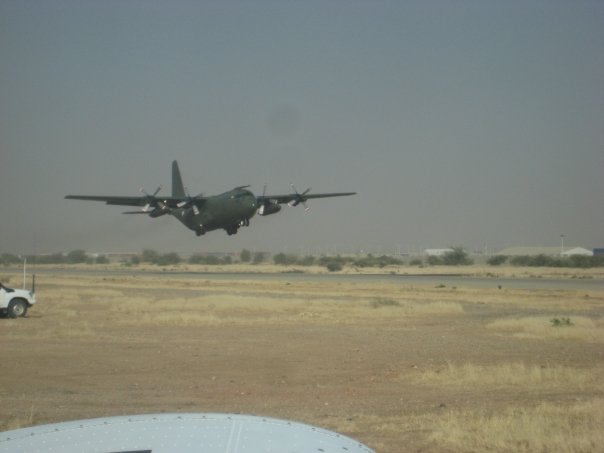
Abéché, the capital of Ouaddaï and the hub of the eastern road network, became the logistics centre of that response. The city filled with UN agency and NGO bases, warehouses, convoys and aid workers, and its airport saw traffic unusual for a city its size. The floating population far exceeded the 76.492 inhabitants recorded in the 2012 census. Housing prices, pressure on water and commercial activity all rose with it.
The security situation deteriorated at the same time. The UK Foreign Office advises against all travel within thirty kilometres of all of Chad's borders and points to rising insecurity on the eastern border, with reports of armed clashes and air strikes. The border with Sudan has been closed since February 2026. The US Department of State raised Chad to Level 4 (Do Not Travel) in April 2026.
And yet the historic city is still there. It has the great market with its blacksmiths' quarter, the three great mosques, the sultans' rammed-earth palace and their tombs, and workshops where hides are tanned and carpets woven as they were a century ago. Sixty kilometres away stands the brick palace of Ouara with its 325-metre wall. Abéché is one of the most historic cities in the central Sahel and, today, one of the hardest to visit. Both things are true at once.