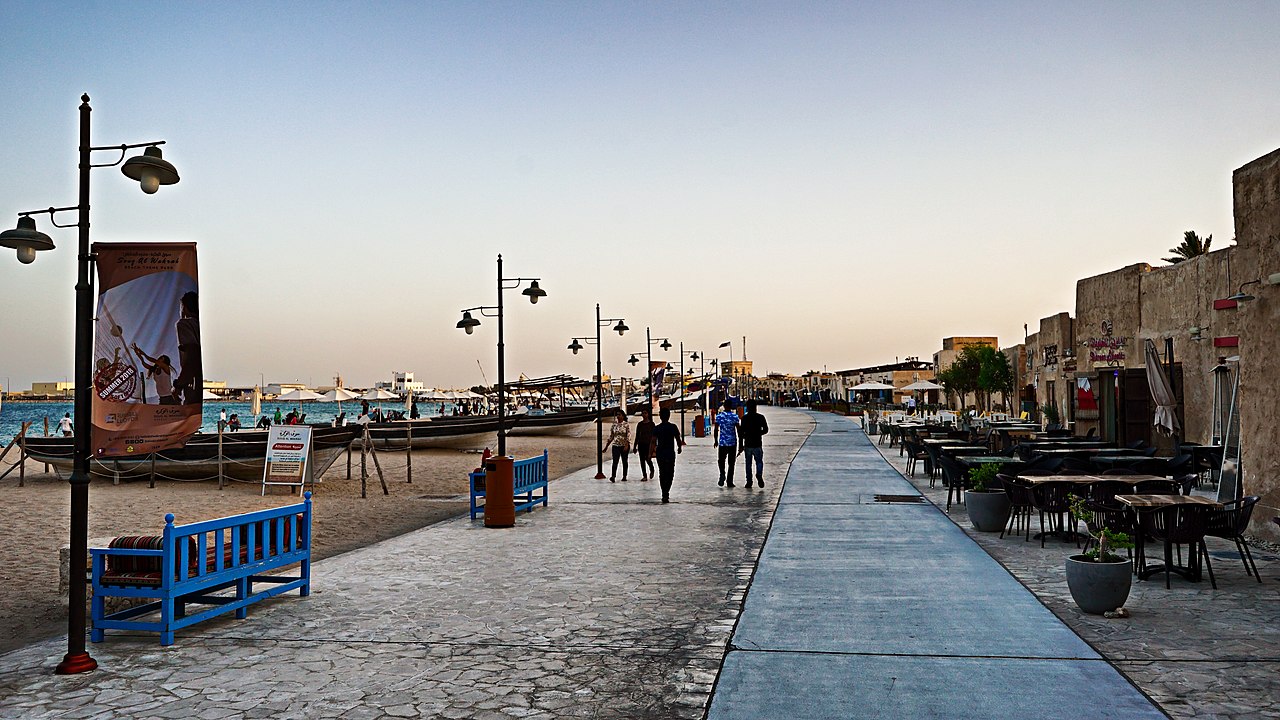
A short distance south of Doha, Al Wakrah shows a calmer, more traditional side of Qatar, closely tied to the sea. For centuries it was a village of fishermen and pearl divers, and that heritage is still alive in its harbour of wooden dhows, on its beach and, above all, in its restored souq: a maze of coral-and-mud houses by the water, turned into a market, boutique hotels and restaurants, with a long promenade for a sunset walk. It's a place to wander unhurried, eat well facing the sea and take in the country's coastal history.
But Al Wakrah also looks to the future. It is home to Al Janoub stadium, an architectural gem designed by Zaha Hadid and inspired by the sails and hulls of pearling dhows, which was one of the venues of the 2022 World Cup. That contrast (the souq of coral houses and the futuristic stadium, the memory of the sea and the World Cup) sums up contemporary Qatar well: a country able to honour its fishing past while surprising with cutting-edge buildings.
This guide helps you make the most of your visit: how to get there by metro or taxi, what to see in the souq and on the promenade, where to find the best sunset light, how to take a dhow trip, what to know about Al Janoub stadium and how to use Al Wakrah as a springboard to the south and the desert. Whether you come for the history, the beach, the food or the football, this coastal town is an easy and charming getaway from Doha.
Al Wakrah is one of the oldest settlements in Qatar: a coastal village that for centuries lived off fishing and pearl diving, the activity that sustained the country's economy before oil. Its coral-and-mud houses, its dhow harbour and its old mosque speak of that traditional life at sea, when every summer the fleets set out for the oyster beds and the community depended entirely on the Gulf. The collapse of the pearl trade in the early decades of the 20th century, brought on by the arrival of Japanese cultured pearls, hit villages like this one hard, until oil and gas transformed the whole country. In the 21st century, Qatar recovered and restored Al Wakrah's historic centre, opening the souq-heritage village by the sea in 2014, and chose the town as the site of Al Janoub stadium (by Zaha Hadid, 2019) ahead of the 2022 World Cup, inspired precisely by the pearling dhows. We tell that story, from pearl-diving village to World Cup venue, on our history page.
Read the full history ↓The old fishing town of Al Wakrah, with its restored souq of coral houses, is the gateway to the desert south and to Khor Al Adaid, the famous 'inland sea' where tall dunes slope straight down into the waters of the Gulf.
Read the history of The south and the desert: the inland sea →They depart from Doha, 15 km away. If you book from this link we earn a commission and you pay no more.
No exact prices: a scale from $ (budget) to $$$$$ (luxury), with 2-3 options per category.
Origins, formation and what the sources say.
Long before Doha existed as a metropolis, and long before oil or football stadiums, Al Wakrah was already a town. It sits on the east coast of the Qatari peninsula, about twenty kilometres south of today's capital, and is one of the oldest settlements in the country, with a history that goes back several centuries. Like almost everything in this land of scarce resources, its survival depended entirely on the sea.
Al Wakrah lived from fishing and pearl diving, the two great trades of the Gulf coast. Every summer, once the water warmed up, fleets of dhows (the traditional wooden boats) set sail for the oyster beds. For months the divers went down on a single breath, with a clip on the nose and a stone tied to the foot, to gather oysters from the seabed. Gulf pearls were prized for their lustre and were sold to merchants who took them to India and Europe, and that trade kept the community going.
That life at sea shaped the town itself. Al Wakrah filled up with coral-stone and mud houses, built with thick walls to keep out the heat, inner courtyards and wind towers (barjeel) that caught the breeze. A mosque and its minaret organised religious life, and the harbour, with its dhows and woodworkers, was the centre of activity. Even today, much of what you visit in Al Wakrah, such as the restored souq, the coral houses and the dhow harbour, comes from the fishing and pearling identity the town has had since its beginnings.
The world that kept Al Wakrah going fell apart in the first decades of the 20th century. The cause came from far away: in Japan, pearl cultivation had been perfected, meaning pearls could now be produced in a controlled way on pearl farms. Cultured pearls were cheaper and always available. In the 1920s and 30s they flooded the world market and crashed the price of natural Gulf pearls. For a town that relied almost entirely on pearl diving, the blow was brutal. Boats stayed tied up, many people lost their livelihood, and the community went through years of real hardship, made worse by the Great Depression.
The way out, as for the whole of Qatar, came from underground. First oil was found, and later the country began tapping the colossal North Field natural gas reserve. Within a few decades Qatar became one of the richest nations in the world per capita. With independence in 1971 and the hydrocarbon boom that followed, life changed completely: the economy turned away from the sea and pearls and towards energy, construction and services.
Along the way, many coastal towns like Al Wakrah were transformed. Their populations grew, they modernised and they became part of the expanding metropolitan area around Doha. Al Wakrah went from fishing village to one of the most populous cities in the country. But unlike other places, where the past disappeared under concrete, here people wanted to recover and honour the memory of the old pearling town. Decades later, that would lead to one of Qatar's best-loved heritage restorations.
In the 21st century, at the height of the gas boom and with an eye on tourism, culture and national identity, Qatar decided to restore Al Wakrah's historic centre instead of letting it disappear. The result was Souq Al Wakrah, also known as Heritage Village, which opened in 2014 around Qatar National Day. It wasn't just a facelift. The structures of the old waterfront were restored and rebuilt with traditional materials and techniques (stone, coral, mud and wood), staying true to classic Qatari architecture: thick walls, courtyards, wind towers and low-rise buildings.
The project turned the old centre into a living complex of more than a hundred units: craft shops, stores, cafés, restaurants and boutique hotels, all by the sea and linked by a long promenade. Replica dhows were even placed on the shore as a reminder of the town's seafaring past. The idea was that visitors could stroll through a restored, traditional Al Wakrah that was comfortable and well looked after, without losing the soul of the fishing village.
The restoration was a success and quickly became one of the favourite day trips from Doha. Souq Waqif in the capital is lively and authentic. Al Wakrah's souq is calmer, with the bonus of the waterfront, the beach and the dhow harbour just steps away. It shows how Qatar has used its gas wealth not only on skyscrapers and megaprojects but also on preserving and showcasing its heritage and coastal memory, giving visitors a window onto traditional life in the Gulf.
If the souq looks back to the past, Al Janoub Stadium carries Al Wakrah into the future and onto the world stage. Curiously, it also takes its inspiration from tradition. It was designed by the studio of the celebrated Iraqi-British architect Zaha Hadid, together with the firm AECOM, and opened in 2019. Its flowing, wrap-around shape draws directly on local heritage: on the sails and, above all, on the hulls of the dhows, the pearling boats that defined life in Al Wakrah for centuries. Its white curves suggest those boats turned upside down to give shelter, an architectural tribute to the town's seafaring identity.
Al Janoub was built as one of the venues for the 2022 FIFA World Cup, the first World Cup held in the Middle East and the Arab world. With room for about 40,000 spectators and a cooling system, the stadium hosted several matches and put Al Wakrah in front of a global audience of billions. It was part of the huge infrastructure push Qatar made for the event, alongside new stadiums, hotels, the Doha Metro and the city of Lusail.
That contrast sums up today's Al Wakrah. Within a few kilometres of each other stand the souq's coral houses, which bear witness to the pearling town, and the futuristic stadium that recalls the dhows of those same pearl divers. Past and present, sea and spectacle, memory and innovation, all tied together by the dhow. The city's most modern landmark draws on its oldest tradition, and that says a lot about how Qatar sees its own development: looking ahead without fully letting go of its roots.
Today's Al Wakrah is full of contrasts that sit well together: coastal history and modern life side by side, without any clash. On one side, the restored souq, the promenade, the beach and the dhow harbour make for a calm, traditional outing. It's ideal for a stroll at sunset, fresh fish by the sea and a feel for the old pearling town. On the other, Al Janoub Stadium and the city's growth remind you that this is also a modern city, part of Qatar's fast-moving present.
That mix makes Al Wakrah a well-rounded, easy trip from Doha. It's only twenty kilometres away and well connected by metro and road. In a single afternoon you can take in the country's seafaring memory, with its coral houses, dhows and wind towers, and then, almost right away, see one of the most celebrated buildings of the 21st century. The city is also a gateway to the south and the desert: further down the coast lie the Sealine dunes and the inland sea of Khor Al Adaid.
Knowing this history makes the visit richer. As you walk through the souq beside the dhows, remember that you're in one of Qatar's oldest towns. It lived from pearl diving when pearls were all the wealth the country had, it suffered when the pearl trade collapsed, it was reborn with gas, and today it proudly shows off both its restored past and a World Cup stadium inspired by those very pearling boats. From dhow to stadium, Al Wakrah tells Qatar's big story on a small scale.