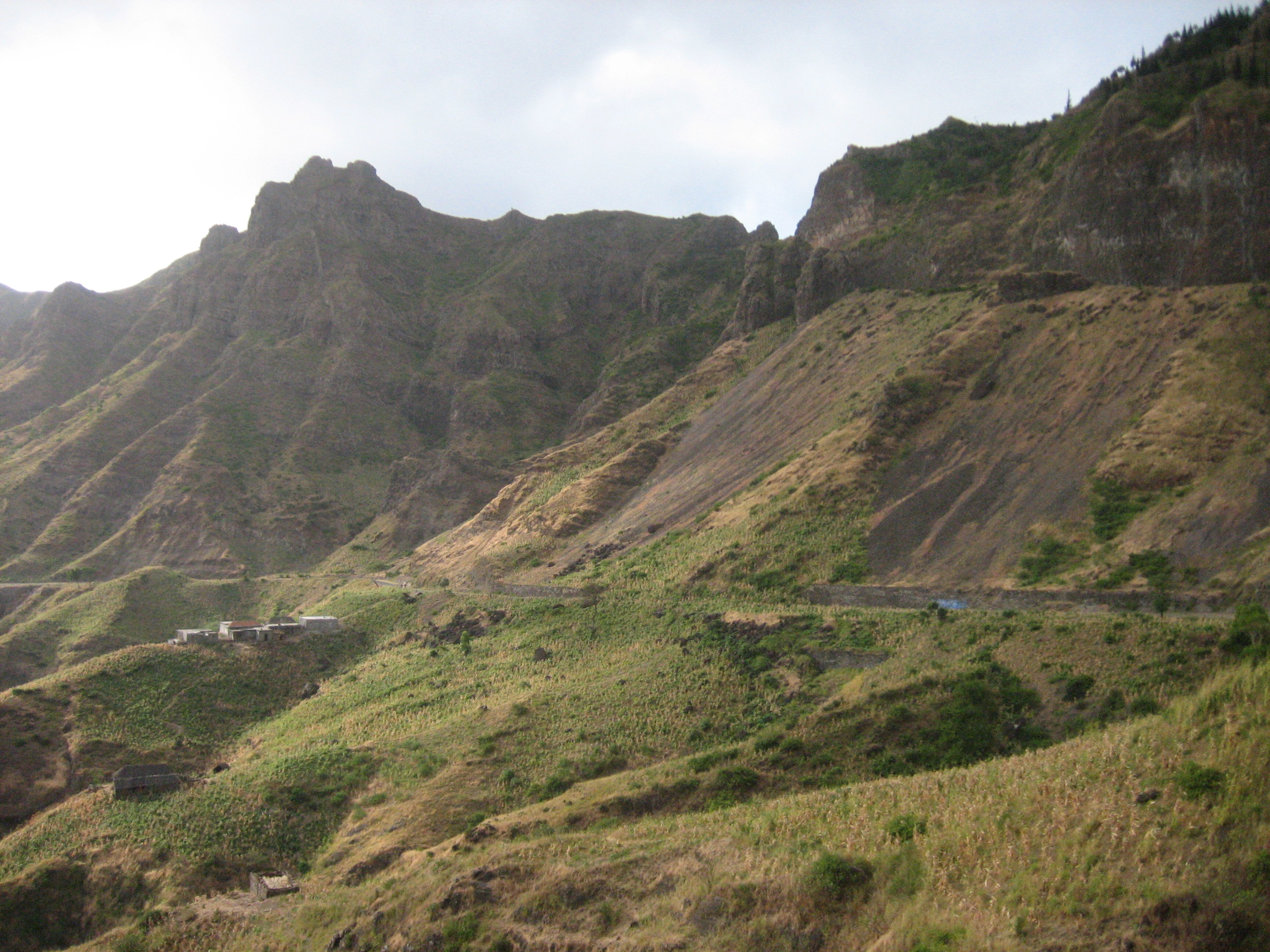
Assomada and Serra Malagueta are the deep heart of Santiago island, the most rural and African face of Cape Verde. Far from the resort beaches, this is where you discover farming Cape Verde: the bustling Assomada market, where people from the interior come down to buy and sell; green hills covered in terraced crops; and the Creole traditions of batuque and tabanka, rooted in the country's African heritage.
Assomada is the capital of Santiago's interior, a mountain town at 500 metres with a market that is an experience in itself. A few kilometres away, the Parque Natural de Serra Malagueta protects a range of peaks, valleys and microclimates. Its trails offer some of the best walks and views on the island, among pine trees, endemic shrubs and small farming villages.
This guide covers Assomada and Serra Malagueta from a practical angle: the market and the museums of Creole culture, walks in the natural park, getting there from Praia, combining the visit with the route to Tarrafal, and how to immerse yourself in rural Santiago, the island where Cape Verde's badiu soul is best preserved.
During the colonial era, the interior of Santiago was a refuge for runaway slaves and free peasants. In its hard-to-reach valleys and mountains, the country's African heritage survived most strongly. That 'badiu' world gave rise to Cape Verde's deepest traditions, such as batuque (a women's music and dance with African roots) and tabanka, with its brotherhoods and processions. Assomada grew into the main centre of this farming interior, and Serra Malagueta was protected as a natural park in 2003. Its full story is told on our history page.
Read the full history ↓The historic and most African heart of Cape Verde: here the first European city in the tropics was born in 1462, here lies the capital, Praia, and here the badius held out with their batuque.
Read the history of Santiago (the capital island) →They depart from Praia, 26 km away. If you book from this link we earn a commission and you pay no more.
No exact prices: a scale from $ (budget) to $$$$$ (luxury), with 2-3 options per category.
Origins, formation and what the sources say.
To understand Assomada and the interior of Santiago island, you have to go back to colonial times and to geography. While Portuguese power was concentrated on the coast —first in Ribeira Grande (Cidade Velha), then in Praia—, the island's mountainous interior, with its deep valleys and hard-to-reach hills, became a world apart: the land of farmers, of runaway slaves and of the African heritage that survived there more strongly than anywhere else in the archipelago.
Over centuries of colonisation and slave trade, many enslaved Africans who managed to escape the plantations took refuge in the mountains of Santiago's interior, forming free communities. This rural population of the interior, with markedly African roots, is known as 'badiu' (from the Portuguese 'vadio', 'vagrant', a derogatory term that the people proudly made their own). The badius of Santiago preserved their language, their music and their traditions in the face of colonial acculturation.
That cultural resistance is the key to the identity of Santiago's interior. These valleys gave birth to and preserved the most African expressions of Cape Verde: batuque, funaná and tabanka, very different from the melancholic, Europeanised morna of the northern islands. Assomada, at the heart of that region, would become the great centre of this rural, Creole world.
Assomada grew as the main urban centre of Santiago's interior, capital of the municipality of Santa Catarina, one of the most populated and agricultural in the country. Set at around 500 metres above sea level, in a relatively fertile area with a cooler climate than the coast, it became the meeting and trading point for all of rural Santiago: this is where farmers from the mountain villages came down —and still do— to sell their produce and stock up.
Its market is the heart of that role. It is one of the largest and most authentic in Cape Verde, a place where the produce of the fertile interior comes together: maize, beans, cassava, sugar cane, fruit, goat's cheese, artisanal grogue. On market days, Assomada's market is a spectacle of life, colour and 'badiu' Creole, very different from the tourist atmosphere of the beach islands.
The town also keeps alive the memory of the interior's Creole traditions. The Tabanka Museum, devoted to the festive brotherhoods of African roots typical of Santiago, and the living presence of batuque in the surrounding villages make Assomada a centre of the country's deepest cultural identity, the one that held out for centuries in the mountains.
The two great traditions that Assomada and the interior of Santiago preserve are batuque and tabanka, expressions of Cape Verde's African heritage that survived centuries of colonisation. Batuque is a music and dance performed by women: seated in a circle, they beat a roll of cloth ('txabeta' or 'tchabeta') held tight between their legs, setting a hypnotic rhythm over which they sing while a soloist dances with hip movements. It is one of the oldest and most genuine cultural expressions in the country, with direct roots in West Africa.
Tabanka, for its part, is a social, religious and festive phenomenon specific to Santiago. These are popular brotherhoods or confraternities that, between May and June (around the feast days of saints such as Saint John and Saint Peter), organise processions with flags, drums, conch shells ('búzios') and characteristic figures. It recalls the old slave brotherhoods and blends the Catholic devotion imposed by the colonisers with forms of organisation and expression of African origin.
For a long time, these traditions were looked down on by the colonial and urban elites, who associated them with the 'primitive' and the African. With independence and the revival of pride in Creole identity, batuque and tabanka were reclaimed as cultural treasures. Today they are symbols of Santiago's authenticity and draw those looking for the deeper Cape Verde, beyond the beaches.
North of Assomada rises Serra Malagueta, one of the most important mountain ranges on Santiago island, with peaks above 1,000 metres. Its name refers to 'malagueta', a spice (grains of paradise) historically linked to the African trade. For generations, its slopes were worked by badiu farmers, who built the characteristic landscape of cultivation terraces clinging to the hillsides to make the most of every patch of fertile soil and every drop of rain.
The range holds remarkable biodiversity for such an arid archipelago: its high-altitude microclimates, wetter and cooler, are home to pines, endemic shrubs and birds unique to Cape Verde, in a setting very different from the general dryness of the islands. That natural wealth, together with the scenic and agricultural value of the area, led to its official protection.
In 2003, Cape Verde created the Serra Malagueta Natural Park, covering some 774 hectares across the municipalities of Santa Catarina, São Miguel and Tarrafal. The park combines nature conservation with the development of ecotourism and support for local communities: it has a visitor centre and a network of trails that make it one of the best places for hiking on Santiago, offering walks among mountains, cultivated valleys and spectacular views.
Today, Assomada is a lively, growing town, the second most important urban area on Santiago island after Praia, and it still plays its historical role as the centre of the rural interior. Its market remains one of the most authentic in the country, and the town keeps a markedly rural and Creole identity, very different from the tourist Cape Verde of the beach islands.
For the curious traveller, the interior of Santiago has become the gateway to the most genuine Cape Verde: that of batuque and tabanka, of terrace farming and mountain villages, of the purest 'badiu' Creole. It is a different kind of tourism, cultural and nature-based, that values authenticity over resort comfort, and that finds in Serra Malagueta a first-class natural setting.
In short, Assomada and Serra Malagueta represent the memory and resistance of African Cape Verde. Where the colonisers concentrated their power on the coast, the interior kept the soul of the people for centuries: their music, their language, their way of working the land and of celebrating. Exploring them means understanding that Cape Verde is not just postcard beaches, but also green mountains, bustling markets and a deep, proud African heritage beating at the heart of the country's largest island.