Viajá con Gus
HomeBrazilSalvador de Bahia
Salvador de Bahia
🇧🇷 Brazil · Northeast

Salvador de Bahia

Jump to what you need
📌State
Bahia (Bahia, Brazil). Salvador is the capital of the state of Bahia and the first capital Brazil ever had, from its founding in 1549 until 1763. It sits on a peninsula, on the shore of the Bahía de Todos os Santos (Brazil's largest bay), in the Northeast. They call it the 'Black Rome' for being the country's greatest centre of Afro-Brazilian culture, and also 'the capital of joy'. It's one of the biggest and oldest cities in Brazil, with more than 2.4 million people, and the city with the highest proportion of Black and mixed-race population outside Africa
📌Service city
Salvador itself has everything: Salvador–Deputado Luís Eduardo Magalhães International Airport (SSA), some 25-28 km from the historic centre; the rodoviária (long-distance bus terminal); the São Joaquim ferry terminal (ferry to Itaparica) and the Terminal Náutico opposite the Mercado Modelo (launches). It has a metro (lines 1 and 2), hotels for every budget, ATMs, hospitals and tourist offices (Bahiatursa). It's the base for exploring the Pelourinho and the Barra and for heading out to Praia do Forte, the Ilha de Itaparica and the Costa do Dendê
📌Best time
Salvador has a warm tropical climate all year, with temperatures usually between 24°C and 31°C. The driest, most pleasant season runs from October/November to February/March, ideal for the beach and for wandering the historic centre. The rainy season is concentrated between April and July (May is the wettest month, sometimes with more than 300 mm), though the rain tends to come as heavy short bursts, almost always in the afternoon, leaving clear mornings. Carnival (February/March, movable dates) is peak season: the city bursts with people and prices shoot up; you have to book very far in advance
📌Suggested days
Three days cover the essentials: the Pelourinho and the historic centre (Terreiro de Jesus, São Francisco, Rosário dos Pretos), the Elevador Lacerda, the Mercado Modelo, the Farol da Barra with its beaches, and a good dose of Bahian food and living culture (capoeira in the street, a percussion show). With 5 to 7 days you add a trip to Praia do Forte and the Projeto Tamar, a day on the Ilha de Itaparica crossing the Bahía de Todos os Santos, the Senhor do Bonfim, the Dique do Tororó and, if the timing works, a night of candomblé or samba de roda
💱 BRL exchange rate
Loading rate…
🌤️ Weather in Salvador de Bahia
Loading weather…

Looking out over the Bahía de Todos os Santos, on a cliff that splits the city into two levels, Salvador de Bahia is the first capital Brazil ever had and the heart of Afro-Brazilian culture. Founded in 1549 by Tomé de Sousa, it was for more than two centuries the seat of Portuguese colonial power in the Americas and the main port of entry for enslaved people brought from Africa. From that painful, fertile crossing a unique city was born: the 'Black Rome', where candomblé, capoeira, axé, dendê cooking and a contagious joy fill every corner.

The tourist soul of Salvador is the Pelourinho, the historic centre declared a UNESCO World Heritage Site in 1985: the largest colonial architectural ensemble in all of Latin America. Its cobbled streets, colourful mansions, gold-covered baroque churches and largos (squares) are an open-air museum. Here you'll find the dazzling Igreja de São Francisco, the moving Igreja do Rosário dos Pretos —built by enslaved people—, the Terreiro de Jesus with the cathedral, and the icon that links the city's two levels: the Elevador Lacerda, the first urban lift in the world.

But Salvador is far more than its old town. It's the Farol da Barra and the most watched sunset in the city; it's the warm water of the beaches at Porto da Barra; it's the Mercado Modelo with its crafts; it's the syncretic faith of the Senhor do Bonfim and its coloured ribbons; it's the orixás of the Dique do Tororó; and it is, above all, a living culture that explodes in its Carnival —the biggest in the world with trio elétrico— and beats all year in its candomblé terreiros, its capoeira circles and its music. Few cities in the Americas embrace you this hard.

📖 History of Salvador de Bahia

Long before the city, the shores of the Bahía de Todos os Santos were inhabited by the Tupinambá, who called that great inner bay 'Kirimurê'. The bay got its Christian name when a Portuguese reconnaissance expedition, with Amerigo Vespucci on board, sighted it on 1 November 1501, All Saints' Day. In those first years appears the legendary figure of the shipwrecked Portuguese sailor Diogo Álvares 'Caramuru', who lived among the Tupinambá and married Paraguaçu. The city was formally born on 29 March 1549, when Tomé de Sousa, the first governor general of Brazil, arrived with a fleet and King Dom João III's order to found a fortress city, São Salvador, as the capital of the whole colony. For more than two centuries Salvador was the capital of colonial Brazil and the largest port in the South Atlantic: through here entered the vast majority of the enslaved Africans brought for the sugar mills (engenhos) of the Recôncavo. From that suffering sprang an immense cultural legacy —candomblé, capoeira, syncretic religion, dendê cooking— that defines the city's identity. In 1763, by decision of the Portuguese Crown in the time of the Marquis of Pombal, the capital moved to Rio de Janeiro, following the shift of the economic axis towards the gold of Minas Gerais. Salvador went through centuries of relative decline, until in the 20th century its Afro-Brazilian pride was reborn: Carnival, the trio elétrico (invented by Dodô and Osmar in 1950), axé and the assertion of Black identity turned it into the cultural capital it is today. The full story is on our history page.

Read the full history ↓

🏛️ Salvador de Bahia is in Bahia

The cradle of Brazil: this is where Cabral landed in 1500 and where Salvador was founded, the country's first capital for more than two centuries. The heart of Afro-Brazilian culture —candomblé, capoeira, axé— and of a coastline that runs from the Chapada Diamantina to the beaches of Porto Seguro.

Read the history of Bahia →

🗺️ What to see

1
Pelourinho and the historic centre (UNESCO World Heritage)
The largest colonial architectural ensemble in Latin America, heart of the historic centre listed as a World Heritage Site.
The Pelourinho is the absolute must-see of Salvador and the symbol of its historic centre, declared a UNESCO World Heritage Site in 1985. It's the largest colonial architectural ensemble in all of Latin America: a maze of cobbled streets, ladeiras (slopes), becos (alleys) and largos (squares) lined with 16th to 19th century mansions painted in bright colours, with iron balconies, Portuguese tiles and baroque churches. The name 'pelourinho' comes from the pillory or post where enslaved people were once publicly punished, a reminder of the painful past on which all this beauty stands. The city was conceived on two levels, following the Portuguese model of a city on an acropolis: the Cidade Alta, on top of the cliff, held the administrative, religious and residential functions; the Cidade Baixa, by the sea, held the port and the trade. The Pelourinho is in the Cidade Alta and links the great 'largos': the Terreiro de Jesus, the Largo do Pelourinho proper and the Largo do Cruzeiro de São Francisco. Today those mansions work as hotels, cultural centres, restaurants, craft shops and museums. The Pelourinho isn't only architecture: it's living culture. Walking around you'll come across capoeira circles, percussion groups such as Olodum rehearsing, baianas in their turbans selling acarajé, artists and musicians. Take it slowly, get lost in the little streets, look into the churches and let the rhythm carry you. It's the best introduction to the deeper Salvador, the one that mixes Portuguese and African into a unique identity. Getting there: it's right in the historic centre, in the Cidade Alta; you can walk if you're staying nearby, take a taxi/app, or come up from the Cidade Baixa on the Elevador Lacerda or the Plano Inclinado Gonçalves. Best time: daytime for the churches and museums; as evening falls it fills with life and music. Practical tips: it's a tourist area but look after your belongings, don't carry much cash in view and, at night, stick to busy, well-lit streets. A guided tour is well worth it to understand the history behind each façade.
ℹ️ Distance: Right in the historic centre, Cidade Alta (on foot) · Best time: Daytime for churches/museums; early evening for music and atmosphere · Admission: Walking the streets is free; the churches and museums charge ~R$ 5–15 each (verified July 2026; see each attraction). Check when you visit · Duration: Half a day to a full day
2
Elevador Lacerda
The first public urban lift in the world, linking the Cidade Alta with the Cidade Baixa, with views over the bay.
The Elevador Lacerda is one of Salvador's great icons and a piece of engineering with a world record: when it opened on 8 December 1873, it was considered the first public urban lift in the world and, at more than 60 metres, the tallest of its day. It was built between 1869 and 1873 and driven by the businessman Antônio de Lacerda, of the Bahia Commercial Association, whose name it took. Originally hydraulic (people nicknamed it 'Parafuso', the screw), it switched to electricity in 1906; its towers were given the Art Deco silhouette they have today in 1930. Its function is essential and very practical: it connects the city's two levels. At the top, in the Cidade Alta, it lets you out at the Praça Tomé de Sousa (Praça Municipal), steps from the Pelourinho; at the bottom, in the Cidade Baixa, it comes out beside the Mercado Modelo and the Bahía de Todos os Santos. It has four cars holding around 27 people each and covers the vertical run in barely 30 seconds. It works as city public transport and carries tens of thousands of people a day. Beyond its usefulness, the ride is worth it for the view: from the top a spectacular panorama opens over the Bahía de Todos os Santos, the Mercado Modelo and the Forte de São Marcelo cut out against the water. It's one of the most photographed lookouts in Salvador, above all at sunset. Getting there: the upper entrance is on the Praça Municipal, in the Cidade Alta (historic centre); the lower one is beside the Mercado Modelo, in the Cidade Baixa. Best time: any moment of the day; late afternoon, for the light over the bay. Tips: the ticket costs just a few centavos of a real (it's subsidised public transport, which is why it's so cheap; check the current price at the booth). There can be queues at rush hour. It's an alternative to the Plano Inclinado Gonçalves, another historic funicular nearby that also connects the two levels.
ℹ️ Distance: Historic centre; connects Praça Municipal (upper) with the Mercado Modelo (lower) · Best time: Sunset for the view; avoid rush hour · Admission: R$ 1 for tourists (up from R$ 0.15); free for SalvadorCard holders (source: Prefeitura de Salvador, verified July 2026) · Duration: The ride takes about 30 seconds; the lookout, as long as you like
3
Igreja e Convento de São Francisco (the golden church)
The high point of Brazilian baroque, with an interior lined in gold-covered carving.
The Igreja e Convento de São Francisco is, for many, the most impressive church in Brazil and the supreme work of baroque in Bahia. The convent was founded in 1585 by the Franciscans, and the complex we see today went up between the 17th and 18th centuries. Its interior takes your breath away: the walls, columns, altars and ceilings are literally lined with wood carving (talha) covered in gold dust, in a baroque excess of leaves, flowers, pelicans, angels and cherubs. That golden profusion earned it the nickname 'the church of gold'. Beyond the gold, there are unique details. The central nave, one of three (unusual in the Franciscan churches of the Northeast, which usually have only one), and above all the cloister and the sacristy, clad in thousands of blue-and-white Portuguese tiles —some 55,000 by most accounts— reproducing biblical scenes, moral allegories and episodes from the life of Saint Francis of Assisi. The complex is protected by IPHAN and is considered one of the Seven Wonders of Portuguese Origin in the World. Visiting São Francisco is understanding just how far the wealth of colonial sugar and gold was poured into faith and art. It's a place to look at slowly, head tipped back, letting yourself be struck by every carved centimetre. Next to it, on the same largo, is the Igreja da Ordem Terceira de São Francisco, with its carved stone façade in the plateresque style, another jewel not to be missed. Important (verified July 2026): on 5 February 2025 part of the central nave's ceiling collapsed onto visitors, and the tragedy cost the life of a 26-year-old tourist (Giulia Panchon, from São Paulo). Since then the church has been CLOSED. IPHAN has commissioned the restoration with Novo PAC funds (a first phase of some R$ 34.7 million, with total estimates that would exceed R$ 80 million), but the works are long: reopening is only expected in 2029. For now the interior CANNOT be visited; you can admire the façade and the neighbouring Igreja da Ordem Terceira de São Francisco from the largo. Getting there: it's on the Largo do Cruzeiro de São Francisco, right in the Pelourinho; you can walk from anywhere in the historic centre. Best time: daytime, with good light for the details. Practical tips: before the collapse it charged a conservation fee (~R$ 10–15); as it's a working church, dress respectfully and keep quiet during mass times.
ℹ️ Distance: Largo do Cruzeiro de São Francisco, Pelourinho (on foot) · Best time: Daytime, with good natural light · Admission: CLOSED for restoration after the ceiling collapse of Feb 2025 (which caused one death). Reopening only expected in 2029 (source: IPHAN / Correio 24h / Agência Brasil, verified July 2026). Only the façade can be seen · Duration: 45 minutes to 1 hour
4
Igreja Nossa Senhora do Rosário dos Pretos
The blue church built by enslaved people, symbol of Black faith and resistance in the Pelourinho.
In the heart of the Largo do Pelourinho, among the colourful mansions, stands the sky-blue façade of the Igreja de Nossa Senhora do Rosário dos Pretos. It's one of the most moving churches in Salvador, because the story of its construction is the story of Black resistance itself. It was built by the Irmandade do Rosário dos Pretos —one of the first brotherhoods of Black men in Brazil, formally constituted in 1685—, since the official Church didn't allow enslaved and freed people to pray in the same buildings as whites. Work began around 1704 and took almost a century to finish, because the enslaved could only work on it in the few free hours they had, often at night, after their forced day's labour. That effort shows in every stone. The blue rococo façade, with bulb-topped towers and tiled surfaces, was completed around 1781. Inside there are late 18th-century Portuguese tiles and altars with images of Black saints and of Our Lady of the Rosary. Behind the church there was a cemetery for enslaved people, another reminder of its role as a space of dignity for a community denied everything. Today the Rosário dos Pretos is a symbol of syncretism and Afro-Brazilian culture: percussion echoes through its masses, and ceremonies are held that speak to African-rooted religions and to the memory of the ancestors. Stepping inside is one of the strongest moments of any visit to the Pelourinho. Getting there: it's on the Largo do Pelourinho, right in the historic centre; you can walk. Best time: daytime to see it properly; if you catch a mass with percussion, it's a one-of-a-kind experience. Practical tips: a small contribution or admission fee is usually asked for its upkeep (ask on site). It's worth checking the mass times, which have a very special, open character.
ℹ️ Distance: Largo do Pelourinho, historic centre (on foot) · Best time: Daytime; masses with percussion for a one-of-a-kind experience · Admission: Contribution/admission of ~R$ 5–6 for upkeep (verified July 2026). Check when you visit · Duration: 30 to 45 minutes
5
Terreiro de Jesus and the Catedral Basílica
The great founding square of the Pelourinho, with the imposing 17th-century Jesuit cathedral.
The Terreiro de Jesus is the great square at the entrance to the Pelourinho and one of the most history-laden spaces in Salvador. Its name comes from the Jesuits of the Society of Jesus who, in the first years after the city's founding in 1549, settled here and built their college and church. Led by Father Manuel da Nóbrega, the Jesuits made this terreiro the centre of evangelisation and education in colonial Brazil. The square's greatest piece is the Catedral Basílica de Salvador, built by the Jesuits between 1652 and 1672 as the church of their college. It's the last surviving building of the great Jesus College complex and is considered one of the most imposing 17th-century churches in Brazil. Its mannerist façade, raised with blocks of lioz stone brought from Portugal, dominates the square. Inside it holds thirteen altars, baroque carving, tiles and a valuable body of sacred art; it has been restored and reopened, revealing treasures of the country's history. Around the Terreiro de Jesus are other notable churches, such as the Igreja da Ordem Terceira de São Domingos Gusmão and the Igreja de São Pedro dos Clérigos, plus museums such as the Museu Afro-Brasileiro. It's where tours of the Pelourinho usually start, a place full of movement, with street performers, baianas and the typical energy of the historic centre. Getting there: it's right in the Pelourinho, next to the Largo do Pelourinho; walkable from anywhere in the centre. Best time: daytime, for the cathedral and the museums. Practical tips: the cathedral usually charges admission (check the price and hours); it's a good starting point for a guided walking tour of the historic centre. Take the chance to visit the Museu Afro-Brasileiro, which helps you understand Bahia's African heritage.
ℹ️ Distance: Terreiro de Jesus, entrance to the Pelourinho (on foot) · Best time: Daytime, for the cathedral and museums · Admission: The square is free; the Catedral Basílica costs ~R$ 10 (under 12s free); Museu Afro-Brasileiro ~R$ 6 (verified July 2026). Check when you visit · Duration: 1 to 2 hours with the cathedral and a museum
6
Igreja do Senhor do Bonfim and the fitinhas
The best-loved church of Bahians, home of the famous wish ribbons and of the Lavagem.
The Igreja do Senhor do Bonfim, on the Colina Sagrada in the Cidade Baixa, is the most popular and best-loved church in Salvador and a symbol of Bahia's syncretic faith. It was built from 1745 (the interior was completed in 1754 and the exterior in 1772) and is dedicated to the Senhor do Bonfim, patron of Bahians. Its devotion mixes Catholicism with candomblé: the Senhor do Bonfim is syncretised with Oxalá, the orixá of creation, which is why it draws both Catholics and followers of African-rooted religions. From this church came the famous 'fitinhas do Bonfim', the coloured ribbons that are one of the most iconic souvenirs of Brazil. They were born in 1809 as the 'Medida do Bonfim': they measured 47 cm, the length of the right arm of the image of the Senhor do Bonfim. Tradition says you tie the ribbon around your left wrist with three knots, making a wish at each knot; the wishes come true when the ribbon breaks off by itself through wear. Don't cut it: let it fall apart in its own time. The church is also the stage for the Lavagem do Bonfim, the second biggest popular festival in Salvador after Carnival, held on the second Thursday of January. It's a huge procession in which baianas, dressed in white, wash the church steps with scented water, in a ritual that joins the Catholic and the Afro-Brazilian. Inside, don't miss the Sala dos Milagres, packed with ex-votos (replicas of body parts, photos, objects) left by the faithful in thanks for favours received. Getting there: it's in the Bonfim district, in the Cidade Baixa, a few kilometres from the Pelourinho; take a taxi/app or a bus. Best time: any day; the second Thursday of January for the Lavagem (huge crowds). Practical tips: entry to the church is free; the ribbons cost a few reais at the stalls outside (ask on site). It pairs well with a visit to the nearby Igreja da Boa Viagem and the beach.
ℹ️ Distance: Bonfim district, Cidade Baixa (by taxi/app or bus from the centre) · Best time: Any day; the second Thursday of January for the Lavagem do Bonfim · Admission: Free entry to the church; the fitinhas do Bonfim cost ~R$ 1–3 each at the stalls outside (verified July 2026) · Duration: 1 to 1.5 hours
7
Mercado Modelo
Bahia's great crafts market, beside the bay and the Elevador Lacerda, with its historic basement.
The Mercado Modelo is one of the big tourist stops in Salvador and the classic place to take a piece of Bahia home. It's in the Cidade Baixa, in the Comércio district, facing the Bahía de Todos os Santos and at the foot of the Elevador Lacerda. It's reckoned that the vast majority of tourists who reach the city visit it. The neoclassical building, protected by IPHAN, was originally the Casa da Alfândega (the customs house), built in 1861 to control the goods coming in through the bay; the crafts market moved in there in 1912. Inside, across its two floors and hundreds of shops, you'll find the widest range of Bahian craftwork: capoeira instruments (berimbaus), orixá figures, fitinhas do Bonfim, lace, hammocks, spices, cachaças, candomblé objects, clothes and every kind of souvenir. Haggling is expected: the opening price almost always comes down. On the upper floor there are two traditional Bahian restaurants with decades of history, where you can eat a good moqueca with a view over the bay. Its basement (porão) is a chapter of its own, wrapped in legend. For years the story was told that those underground galleries had been used to lock up and torture enslaved people. Today historians question that version: given the building's construction date and the water table, the cellar was most likely intended as a store for wine and cachaça and not as a prison. Either way, the basement can be visited and has been turned into an art gallery that helps tell the city's story. Getting there: it's at the foot of the Elevador Lacerda, in the Cidade Baixa; come down from the Pelourinho on the lift or take a taxi/app. Best time: daytime, during business hours. Practical tips: entry to the market is free; you pay for what you buy or eat. Haggle in good spirit, look after your belongings and, if you fancy, have lunch upstairs looking at the water. Right opposite is the Terminal Náutico, with launches to Itaparica and trips around the bay.
ℹ️ Distance: Cidade Baixa, at the foot of the Elevador Lacerda (on foot from the lift) · Best time: Daytime, during business hours · Admission: Free access; you pay for what you buy or eat (haggle; moqueca at the upstairs restaurants ~R$ 90–160 for 2). Check when you visit · Duration: 1 to 2 hours (more if you have lunch)
8
Farol da Barra and Porto da Barra beach
The oldest lighthouse in the Americas with its nautical museum, next to one of the prettiest city beaches in Salvador.
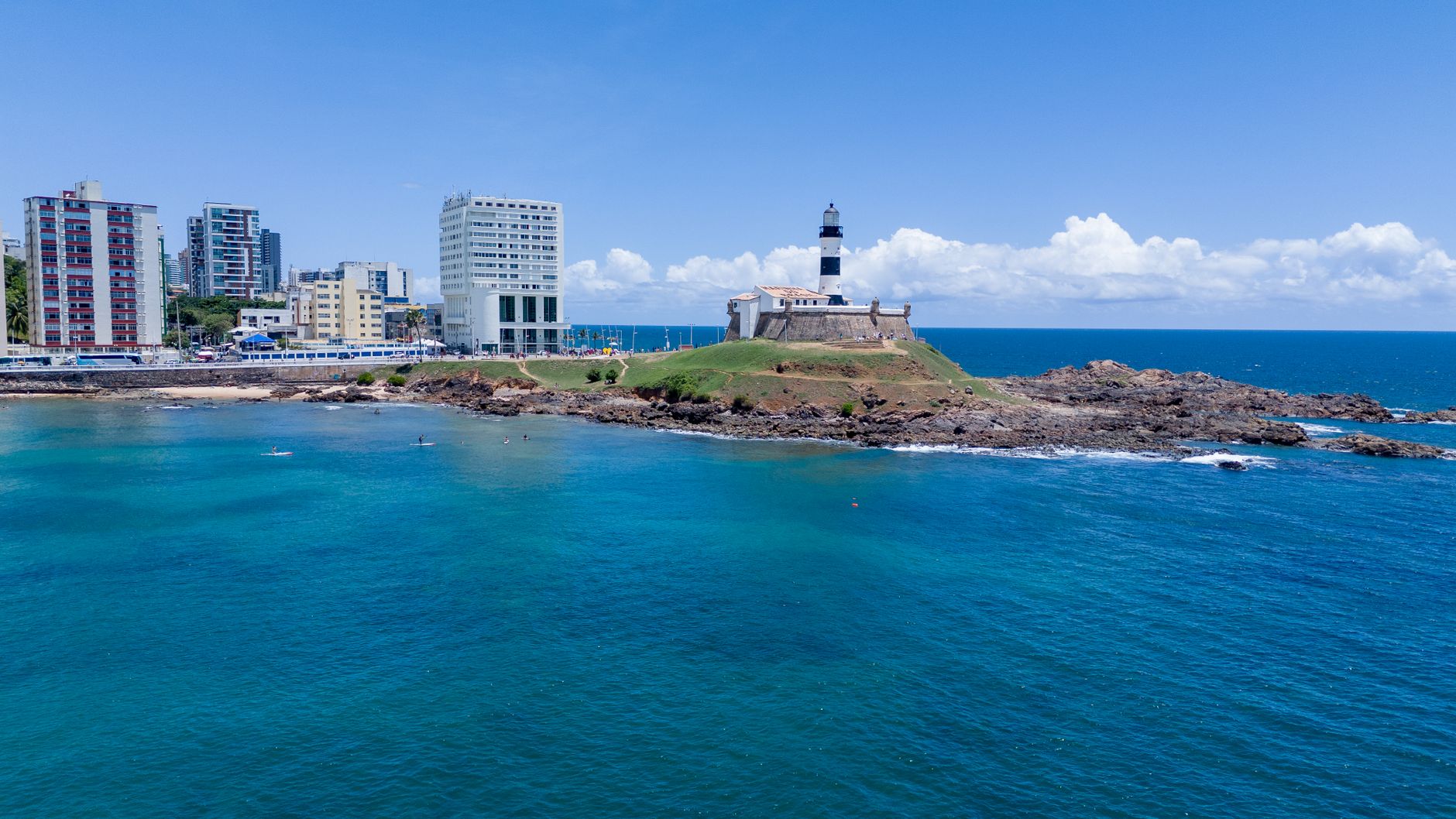
The Farol da Barra is one of the best-loved images of Salvador and the setting for the most watched sunset in the city. It stands on the Ponta de Santo Antônio, at the tip of the peninsula, inside the Forte de Santo Antônio da Barra. It holds a notable record: it was the first nautical signalling system to enter service anywhere in the Americas, installed in 1698 and originally fuelled with whale oil, which makes it the oldest working lighthouse on the continent. The current tower, from 1839, is about 22 metres tall, painted in black and white bands, and its light is visible tens of kilometres out to sea. The fort around the lighthouse today houses the Museu Náutico da Bahia, with navigation charts, instruments, pieces from shipwrecks and the maritime history of the Bahía de Todos os Santos. But beyond the museum, what wins people over is the whole scene: the lighthouse cut against the sea, the terraces looking out over the ocean and, at sundown, a crowd that gathers to applaud the sunset. It's one of those collective rituals that define Salvador's cheerful spirit. Steps from the lighthouse is the Praia do Porto da Barra, considered one of the prettiest and safest city beaches in Salvador: a cove of calm, warm water, ideal for swimming, with kiosks, coconut water sellers and the same spectacular sunset. It's a meeting point for locals and tourists, busy all day. The Barra district also has hotels, restaurants, bars and the shopping centre, and is one of the handiest areas to stay. Getting there: the Barra district is a few kilometres from the Pelourinho; take a taxi/app or a bus along the seafront. Best time: daytime for the beach and the museum; above all at sunset, for the classic show. Practical tips: the Museu Náutico charges admission (check the price and hours). At the beach, carry little cash, look after your things and enjoy the coconut water. The walk along the seafront from the Barra towards Ondina is lovely.
ℹ️ Distance: Barra district, a few km from the Pelourinho (taxi/app or bus) · Best time: Daytime for the beach and museum; sunset for the show · Admission: Beach free; Museu Náutico da Bahia (Farol da Barra) R$ 20 full price and R$ 10 for students, teachers, over-60s and Salvador residents (the resident ticket is only valid until 4:00 p.m.); online sales for the same day close at 5:00 p.m. and entry at 5:30 p.m. (official ticket office of the Museu Náutico da Bahia, museunauticodabahia.org.br, checked 08/08/2026) · Duration: Half a day (beach + lighthouse + sunset)
9
Dique do Tororó (the orixás on the water)
A city lagoon with giant sculptures of the candomblé orixás, a postcard of Afro-Brazilian identity.
The Dique do Tororó is one of the most original and best-loved images of Salvador: a large city lagoon of some 110,000 square metres, right in the heart of the city, from which rise eight enormous sculptures of the orixás, the deities of candomblé. Seeing them float above the water, colourful and solemn, is to grasp at a glance how far African-rooted culture is the soul of Bahia. The lagoon is old —an 18th-century colonial dike that supplied the city with water— but the sculptures are modern work by the Bahian artist Tatti Moreno, installed in 1996 and restored by the government of Bahia in 2022. Each figure is about 7 metres tall and represents an orixá: Oxalá, Iemanjá, Oxum, Ogum, Oxóssi, Xangô, Nanã and Iansã. Around the dike four more sculptures were added, paying tribute to Oxumaré, Ossain, Logun-Edé and Ewá. It's a place to walk quietly along the edge, take photos —especially at sunset, when the light gilds the figures— and learn a little of the candomblé pantheon: each orixá has its colour, its day, its food, its element and its personality. The setting is designed as a promenade, with a bike lane and green areas, and it's a good counterpoint to the old town for understanding contemporary Salvador and its Afro-Brazilian pride. Getting there: it's in the Tororó district, near the Fonte Nova stadium; a few minutes by taxi/app from the centre. Best time: mid-afternoon and sunset, for the light. Practical tips: walking the edge is free and open; it pairs very well with a visit to the Arena Fonte Nova. It's an open-air spot, so bring water, a cap and sunscreen. Better to go during the day for safety.
ℹ️ Distance: Tororó district, near the Arena Fonte Nova (taxi/app) · Best time: Mid-afternoon and sunset, for the light · Admission: Free and open access · Duration: 45 minutes to 1 hour
10
Solar do Unhão and MAM Bahia
A colonial complex facing the bay, restored by Lina Bo Bardi, now the Museum of Modern Art.
The Solar do Unhão is one of the most beautiful and least predictable corners of Salvador: a 16th-17th century colonial complex on the shore of the Bahía de Todos os Santos, made up of a manor house (solar), a chapel, an old mill house and warehouses, all facing the water. It was a property tied to the sugar trade; today it houses the Museu de Arte Moderna da Bahia (MAM-BA), one of the oldest modern art museums in Brazil. The person most responsible for its current character was the Italian-Brazilian architect Lina Bo Bardi, who led the complex's restoration in the 1960s (the MAM moved there in 1963). Lina chose not to freeze the building in one period but to weave in the traces of its history, and left behind a now legendary intervention: a great solid wood staircase, assembled only with joints and no nails, inspired by those used on ox carts. The result is a lovely dialogue between the colonial, the vernacular and the modern. The MAM's collection brings together paintings, sculptures, photographs and drawings by major names in Brazilian art —Tarsila do Amaral, Portinari, Di Cavalcanti, Carybé, Mário Cravo, Rubem Valentim and many more. But even if you don't go into the galleries, the place is worth it: the grounds facing the bay are one of the best spots in the city to watch the sunset, with the sea behind. On Saturdays there's usually a music gathering (the 'Jam no MAM') that has become a tradition. Getting there: it's in the Cidade Baixa, on the seafront, not far from the centre; best reached by taxi/app. Best time: early evening, for the sunset over the bay; check the museum's opening days and hours. Practical tips: museum entry is usually free or by donation (ask on site). It pairs very well with the nearby Museu de Arte Sacra. For safety, move around by taxi/app, above all at night.
ℹ️ Distance: Cidade Baixa, on the seafront (taxi/app) · Best time: Sunset; Saturdays for the 'Jam no MAM' · Admission: MAM-BA: free entry (by donation; 2025). Check the days and hours · Duration: 1 to 2 hours
11
Praia do Forte and Projeto Tamar (day trip)
A beach village north of Salvador with Brazil's most important sea turtle conservation centre.
Praia do Forte is the classic beach trip from Salvador: a charming seaside village in the municipality of Mata de São João, on the Costa dos Coqueiros, some 75-80 km north of the city (about an hour and a half away). Its pedestrian main street, full of restaurants, shops and guesthouses, ends at beaches of clear water, white sand and natural pools that form among the reefs at low tide. The big draw is the Projeto Tamar, the most important visitor centre of Brazil's sea turtle conservation programme. Tamar was founded in 1980 by researchers worried about the extinction of turtles on the Brazilian coast, and the one at Praia do Forte is the country's first and largest. In its tanks and pools you can see turtles of several species up close, plus rays, sharks and other marine species, while learning about nesting on the beaches and the protection work. It's an ideal visit with children and for building environmental awareness. Beyond Tamar, in Praia do Forte you can swim in the natural pools, walk the village, visit the Castelo Garcia D'Ávila (the ruins of a 16th-century fortified house, one of the oldest buildings in Brazil) and enjoy the food facing the sea. Many tours combine Praia do Forte with the nearby beach of Guarajuba. Getting there: on an organised tour with a transfer from Salvador, by rental car or by bus; Salvador airport is about 50 km away. Best time: daytime and at low tide for the natural pools (check the tide table). The Projeto Tamar usually opens every day during daylight hours (check the times). Practical tips: Tamar charges admission (check the price); bring swimwear, sunscreen and reef-friendly products if you can, a cap and water. As it's a long day, set out early.
ℹ️ Distance: Some 75-80 km north of Salvador (about 1.5 h) · Best time: Daytime and at low tide for the natural pools · Admission: Projeto Tamar ~R$ 50 for adults (concessions available; Passaporte Família ~R$ 135 for 2 adults + 2 children); beaches free (verified July 2026). Check when you visit · Duration: A full day (day trip)
12
Ilha de Itaparica (Bahía de Todos os Santos)
The largest island in the bay, with quiet beaches and a colonial air, a ferry or launch ride from the city.
The Ilha de Itaparica is the largest island in the Bahía de Todos os Santos and a perfect escape from Salvador's bustle, a short boat ride away. Facing the city skyline, it offers calm, warm-water beaches, mangroves, fishing villages, springs whose water tradition considers medicinal, and a relaxed colonial charm. It's ideal for a day out or for stretching your stay a few nights at a slower pace. Getting there is part of the experience and there are two main options. The ferry (balsa) leaves from the São Joaquim ferry terminal, in the Cidade Baixa, and crosses in about an hour to the Bom Despacho terminal on the island; it takes cars and is the option if you're driving. The fast launch (catamaran) leaves from the Terminal Náutico, opposite the Mercado Modelo, and reaches Mar Grande in about 40 minutes. The system is run by the concession holder Internacional Travessias Salvador. Departures are usually hourly and increase in summer. (Note: the future Ponte Salvador-Itaparica project is under way, set to be one of the longest bridges over water in Latin America.) Once on the island, the plans are beaches and villages: the village of Mar Grande, the beaches of Penha, Berlinque or Cacha-Pregos, the historic centre of Itaparica with its church and its spring, and good seafood facing the sea. Many escuna (schooner) trips around the Bahía de Todos os Santos include a stop on the island and on other islets, combining sailing, snorkelling and beach in a single outing. Getting there: by ferry from São Joaquim (cars) or by fast launch from the Terminal Náutico (opposite the Mercado Modelo). Best time: days with good weather, above all in the dry season. Practical tips: check up-to-date ferry and launch times, especially the last crossings of the day so you don't get stranded; in summer and at weekends there can be queues for the car ferry. A comfortable alternative is booking an escuna trip that already includes the crossing.
ℹ️ Distance: Crossing by ferry (1 h, from São Joaquim) or launch (40 min, from the Terminal Náutico) · Best time: Days with good weather; the dry season · Admission: São Joaquim ferry ~R$ 6–8 per person (cars ~R$ 130–160); fast launch from the Terminal Náutico ~R$ 15–25; islands and beaches free (verified July 2026). Check when you visit · Duration: A day (or more, with a night on the island)
13
Living culture: Carnival, capoeira and candomblé
More than a place, the Afro-Brazilian experience beating in the street: the world's biggest Carnival, the circles and the terreiros.
Salvador can't be understood through monuments alone: its greatest attraction is its living culture, which explodes in the street and beats all year. The best known is the Carnival of Salvador, considered the biggest popular festival in the world and a Guinness record holder as the largest carnival with trio elétrico. Over six days, some two million people follow the trios —truck-stages with enormous sound systems, invented by Dodô and Osmar in 1950— along official circuits such as the Dodô (Barra-Ondina, facing the sea), the Osmar (Campo Grande, the most traditional) and the Batatinha (Historic Centre, more cultural). The soundtrack is axé, the Bahian genre mixing Afro-Brazilian rhythms with pop; 'axé' comes from Yoruba and means energy and life force. If you go at Carnival, you can buy an abadá to join a bloco or experience it as 'pipoca' (in the street, free). To learn its history any time of year, there's the Casa do Carnaval da Bahia, in the Pelourinho. Capoeira was born precisely in Salvador: a mix of martial art, dance and acrobatics created by enslaved Africans as a form of resistance, disguised as a game to the rhythm of the berimbau. In 1932, the legendary Mestre Bimba opened the first academy in the city, which helped the state stop persecuting it and recognise it as cultural heritage. In the Pelourinho and on the beach it's easy to come across a capoeira circle; many academies offer classes or demonstrations for visitors. Candomblé is the African-rooted religion that gives Salvador its spiritual identity. It was born among the enslaved —above all from Yoruba, Fon and Bantu traditions— and worships the orixás, the deities of nature, through drums, songs and dances. To survive colonial persecution, its followers syncretised the orixás with Catholic saints. The terreiros (temples), many led by women (mães and ialorixás), are the heart of that faith; some, such as the Casa Branca, are listed heritage. Attending a ceremony is possible, always with respect and, ideally, with someone to brief you on the rules (wear white, don't take photos without permission). How to experience it: in the street (Pelourinho, Barra), at the Casa do Carnaval, at capoeira academies and, respectfully, at candomblé terreiros. Best time: Carnival for the party; the rest of the year for everyday culture. Practical tips: for candomblé, read up on the protocol beforehand; many cultural tours and local guides help you approach it with sensitivity. A good percussion show (like Olodum's) or Afro dance rounds out the experience.
ℹ️ Distance: All over the city: Pelourinho, Barra, terreiros in the neighbourhoods · Best time: Carnival (Feb/Mar) for the party; all year for living culture · Admission: The street is free; a bloco abadá at Carnival ~R$ 400–3,000 depending on the bloco and the artist; an Olodum/Balé Folclórico show ~R$ 50–90; a capoeira class ~R$ 50–120 (verified July 2026). Check when you book · Duration: From a short capoeira circle to the six days of Carnival
Advertisements
What nobody tells you

💵 Prices

Tickets

TypePrice
Walking the Pelourinho and the largos (streets and squares)Free (open access)
Igreja e Convento de São Francisco (the golden church)CLOSED for restoration after the ceiling collapse of Feb 2025 (which caused one death); reopening only expected in 2029 (source: IPHAN/Correio 24h, verified July 2026). Only the façade can be seen
Catedral Basílica de Salvador~R$ 10 (under 12s free) (verified July 2026)
Igreja do Rosário dos Pretos~R$ 5–6 contribution for upkeep (verified July 2026)
Elevador LacerdaR$ 1 for tourists; free for SalvadorCard holders (source: Prefeitura de Salvador, verified July 2026)
Museu Náutico da Bahia (Farol da Barra)R$ 20 full admission. R$ 10 for students, teachers, over-60s and Salvador residents —the resident ticket is promotional and only valid until 4:00 p.m.—; there's also a corporate ticket of R$ 16. Online purchase for the same day closes at 5:00 p.m., with entry until 5:30 p.m. (official ticket office of the Museu Náutico da Bahia, museunauticodabahia.org.br, checked 08/08/2026)
Museu Afro-Brasileiro / Museu de Arte Sacra~R$ 6 for the Afro-Brasileiro; ~R$ 15 for the Arte Sacra (verified July 2026; check)
MAM Bahia (Solar do Unhão)Free entry / by donation (verified July 2026)
Projeto Tamar (Praia do Forte)~R$ 50 for adults; Passaporte Família ~R$ 135 (2 adults + 2 children) (source: Fundação Projeto Tamar, verified July 2026)
Dique do TororóFree (open walk)
🔄 updated monthlyOfficial / reference values · double-check when buying

Activities and tours

ActivityPriceDurationOperator
City tour of the historic centre (Pelourinho, churches, Elevador Lacerda)~R$ 80–180 per person (verified July 2026)Half a day (3-4 h)Local agencies and guides
Day trip to Praia do Forte and Projeto Tamar~R$ 150–280 per person with transfers (Tamar admission separate ~R$ 50) (verified July 2026)Full daySalvador agencies
Escuna (schooner) trip around the Bahía de Todos os Santos with island stops~R$ 100–180 per person (verified July 2026; lunch and drinks separate)Full dayBoat operators at the Terminal Náutico
Capoeira class or demonstration~R$ 50–120 per person (verified July 2026)1-2 hLocal capoeira academies
Afro-tourism tour / guided visit to a candomblé terreiro~R$ 120–300 per person (verified July 2026)Half a dayGuides specialising in Afro-Brazilian culture
Percussion / Afro dance show (e.g. Olodum, Balé Folclórico da Bahia)~R$ 50–90 per person (verified July 2026)1-2 hCultural groups in the Pelourinho
Carnival: abadá to join a bloco with a trio elétrico~R$ 400–3,000 a night depending on the bloco and the artist (verified July 2026)One night per circuitBlocos and official sellers
🔄 updated monthlyOfficial / reference values · double-check when buying
Advertisements

🚌 How to get there and distances

Getting around

ModePriceDurationNotes
Salvador metro (lines 1 and 2)~R$ 5.20 a ticket (verified July 2026)VariableConnects the airport and the neighbourhoods; Lapa station is the closest to the centre. Comfortable and cheap, but it doesn't reach the Pelourinho directly
City bus (Integra Salvador)~R$ 5.20 a ticket (verified July 2026)VariableA wide network across the city and the seafront; lines to Praça da Sé, Campo Grande, Lapa and Barra
Taxi / apps (Uber, 99)Short rides in town ~R$ 15–40; to the airport from the centre ~R$ 70–110 (verified July 2026)VariableThe most comfortable and advisable option, above all at night and for going to Bonfim, Tororó or the MAM
Elevador Lacerda and Plano InclinadoLift R$ 1 for tourists (free with SalvadorCard); Plano Inclinado ~R$ 0.15–1 (source: Prefeitura de Salvador, verified July 2026)SecondsThey connect the Cidade Alta with the Cidade Baixa; the lift is an attraction in itself
On foot in the historic centreFreeThe Pelourinho is walkable; comfortable shoes for the cobbles and the slopes. Better to stick to busy streets
🔄 updated monthlyOfficial / reference values · double-check when buying

How to get there

RouteAirlines / operatorsAvg. priceDuration
SSA airport → centre / Pelourinho (by taxi or app)Taxis with a fixed fare and apps (Uber, 99)~R$ 70–120 depending on the destination and traffic (verified July 2026)25 to 40 min depending on traffic (some 25-28 km)
SSA airport → centre (by metro, with a shuttle bus)Metrô (CCR Metrô Bahia) + shuttle bus to the stadium/station~R$ 5.20 (metro) (verified July 2026)About 1 h (with a change at Acesso Norte → line 1 → Lapa)
SSA airport → centre (city bus)City lines (e.g. towards Praça da Sé)~R$ 5.20 (verified July 2026)45 min to 1 h
Arriving by long-distance bus (Salvador rodoviária)National bus companies (Águia Branca, Itapemirim and others)Recife-Salvador ~R$ 150–280; Rio-Salvador ~R$ 250–450 one way (verified July 2026)Depends on origin (Recife ~12 h, Rio ~26 h, São Paulo ~30 h)
Domestic flights to Salvador (SSA) from São Paulo, Rio, Brasília, RecifeLATAM, GOL, AzulSão Paulo/Rio-Salvador ~R$ 350–900 one way depending on how far ahead you book (verified July 2026)Depends on origin
🔄 updated monthlyOfficial / reference values · double-check when buying

🏨 Where to stay

No exact prices: a scale from $ (budget) to $$$$$ (luxury), with 2-3 options per category.

CategoryPriceRecommended options
High end / charming boutique$$$$$Boutique hotels in Pelourinho mansions (e.g. Fera Palace, Pestana Convento do Carmo) and upmarket hotels in the Barra and along the seafront (Ondina, Rio Vermelho): ~R$ 600–1,500 a night (far more at Carnival). Book ahead (verified July 2026)
Mid-range (central and well located)$$$$$Guesthouses and mid-range hotels in the Pelourinho/Santo Antônio (with bay views), in the Barra and in the Comércio: ~R$ 200–450 a night (verified July 2026)
Budget / hostels$$$$$Hostels and cheap pousadas in Santo Antônio Além do Carmo, the Pelourinho and the Barra: ~R$ 50–110 a hostel bed, ~R$ 130–250 for a double room (verified July 2026)

🍴 Where to eat

TypePriceOptions / signature dish
Traditional Bahian food (moqueca, bobó de camarão, seafood)$$$$$Classic places in Rio Vermelho (the food district), the Barra and the Mercado Modelo. Moqueca de camarão or de peixe (for 2) ~R$ 90–180; bobó de camarão ~R$ 70–120 (verified July 2026)
Acarajé de tabuleiro (baianas in the street)$$$$$The baianas' acarajé, fried in dendê and filled with vatapá, caruru and dried shrimp, at stalls in Rio Vermelho (e.g. Acarajé da Dinha), the Pelourinho and Porto da Barra: ~R$ 12–25 each (verified July 2026)
Contemporary and chef-driven cooking$$$$$Places reinterpreting Bahian cooking with local produce, above all in Rio Vermelho and along the seafront: ~R$ 60–150 for a main course (verified July 2026)
Budget / market and beach food$$$$$Beach kiosks with coconut water (~R$ 6–10) and fried snacks, lanchonetes and markets; cocadas, mungunzá and the baianas' sweets ~R$ 5–15; prato feito ~R$ 20–35 (verified July 2026)
Advertisements

📖 History of Salvador de Bahia

Origins, formation and what the sources say.

The Tupinambá and the Portuguese arrival in the Bahía de Todos os Santos (1501-1502)

For more than two centuries, Salvador wasn't just another Brazilian city: it was THE city, the country's first capital, the largest port in the South Atlantic and the gateway through which the vast majority of enslaved Africans brought to Portuguese America entered. That double condition —capital of colonial power and epicentre of the trade in people— explains the intense, painful, culture-soaked city it is today. But to understand it you have to start much earlier, when there was neither city nor Portuguese.

The shores of the great bay where Salvador now stands were inhabited by the Tupinambá, a people of the Tupi family. They called that huge inner bay 'Kirimurê', which in their language meant something like 'great inland sea'. They lived from fishing, hunting, gathering and growing cassava, in villages spread along the coast and the islands of what would become the Bahía de Todos os Santos.

The bay entered written European history on 1 November 1501. That day, a Portuguese reconnaissance expedition —sent by the Crown to map the lands Pedro Álvares Cabral had sighted in 1500, and carrying the navigator and cartographer Amerigo Vespucci— reached the mouth of the bay. As it was All Saints' Day in the Catholic calendar, they named it 'Baía de Todos os Santos', the name it keeps today.

In those first decades of contact appears a figure half historical, half legendary: the shipwrecked Portuguese sailor Diogo Álvares Correia, known as 'Caramuru'. He is said to have been wrecked on the nearby reefs around 1509-1511, surviving among the Tupinambá, who named him after a fish that lived among the rocks. Caramuru joined Indigenous society and married Paraguaçu, the daughter of a local chief, later baptised Catarina. His story, a mix of fact and myth, stands for the first encounter —unequal and violent, but also a mixing— between the Tupi and Portuguese worlds on these shores.

The place name Kirimurê
Various historical and linguistic sources record that the Tupinambá called today's Bahía de Todos os Santos 'Kirimurê' (sometimes transcribed kirimurê), read as 'great inland sea'. The Christian name came later, with the 1501 expedition.
Source: https://pt.wikipedia.org/wiki/Ba%C3%ADa_de_Todos_os_Santos
The origin of the name 'Caramuru'
According to the tradition recorded by chroniclers, the Tupinambá called Diogo Álvares 'Caray-muru' (Caramuru) for his appearance out of the sea among the rocks, linking him to a long-bodied fish that lived among the stones. The exact date of the shipwreck (1509 or 1511) and the details vary between sources.
Source: https://bahia.ws/en/historia-da-ilha-de-itaparica/

The founding of Salvador and Brazil's first capital (Tomé de Sousa, 1549)

The city of Salvador was formally born on 29 March 1549. That day a Portuguese fleet under Tomé de Sousa, appointed by King Dom João III as the first governor general of Brazil, reached the Bahía de Todos os Santos. He came with six vessels —naus, caravels and a brigantine— and a threefold mandate: to be captain of the bay region, governor of the captaincy of Bahia and, above all, first governor general of all the captaincies and lands of Brazil.

His mission was specific: to found a fortress city to serve as capital and seat of Portuguese government in the colony. The new city was called São Salvador da Bahía de Todos os Santos, and it was built to a design by the architect Luís Dias, on a cliff overlooking the bay. That geography explains the city's character: it was conceived on two levels, following the Portuguese model of a city on an acropolis. The upper part (Cidade Alta) held the administrative, religious and residential functions; the lower part (Cidade Baixa), by the water, the port and the trade. That duality still marks Salvador today.

With Tomé de Sousa came the first Jesuits too, led by Father Manuel da Nóbrega, who settled in what would become the Terreiro de Jesus and began the work of evangelisation and education. For more than two centuries —from 1549 to 1763— Salvador was the capital of colonial Brazil, the political, administrative, religious and commercial centre of Portugal's largest colony in the Americas. It was, in many senses, the country's first great city.

Slavery, sugar and the African legacy (candomblé, capoeira, religion)

Salvador's colonial splendour was built on the sugar economy and on slave labour. In the Recôncavo —the fertile region ringing the Bahía de Todos os Santos— the engenhos (sugar mills) multiplied, and to keep them running the Portuguese imported an enormous number of enslaved Africans. For centuries, Salvador was the main port of entry for enslaved people in all of Brazil: hundreds of thousands of Africans passed across its dock, brought above all from the Guinea Coast, the Gulf of Benin, Angola and the Congo, from Yoruba, Fon and Bantu peoples.

Out of that suffering came, paradoxically, one of the richest cultural legacies in the Americas. To survive, Africans and their descendants rebuilt and reinvented their spiritual traditions in candomblé, a religion that worships the orixás —the deities of nature— through drums, songs and dances. Since the Church and the Crown persecuted these practices, the faithful turned to syncretism: they linked each orixá to a Catholic saint (Oxalá with the Senhor do Bonfim, Iemanjá with the Virgin, and so on) so they could keep practising their faith under a Christian appearance.

Slave resistance also gave birth to capoeira, that mix of martial art, dance and game that Africans developed as a form of fighting disguised as dancing, to the rhythm of the berimbau. And the African legacy soaked into everything: dendê cooking (acarajé, vatapá, caruru, moqueca), the music, the rhythms, the language, popular religion. That's why Salvador is known as the 'Black Rome': it's the country's greatest centre of Afro-Brazilian culture and the city with the largest population of African origin outside Africa. Even its most beautiful architecture hides that history: the Igreja do Rosário dos Pretos was built by enslaved people themselves in their free hours, over almost a century.

Salvador as the main slave port
The sources agree in identifying Salvador as the colony's largest port of entry for enslaved Africans, tied to the sugar economy of the Recôncavo. The overall figures for the slave trade into Bahia are historical estimates (figures of more than a million people over the centuries are cited), so they should be taken as approximations from the studies.
Source: https://es.wikipedia.org/wiki/Esclavitud_en_Brasil
Origins of candomblé and syncretism
Candomblé is thought to have developed among Afro-Brazilian communities during the Atlantic slave trade (16th-19th centuries), from the fusion of traditional African religions (Yoruba, Fon, Bantu) and, out of the need to survive persecution, through syncretism with Catholic saints. Many terreiros were and still are led by women.
Source: https://en.wikipedia.org/wiki/Candombl%C3%A9

The move of the capital to Rio de Janeiro (1763) and the decline

In 1763, after more than two centuries as capital, Salvador lost its rank as the centre of colonial power: by decision of King Dom José I of Portugal, the capital of Brazil moved to São Sebastião do Rio de Janeiro. It was an enormous blow, symbolic and practical, for the city that had been the country's first and foremost.

The reasons were several and they combined. The main one was the shift of the colony's economic axis: through the 18th century, wealth had moved from the sugar of the northeast to the gold and diamonds of Minas Gerais, in the centre-south. Rio de Janeiro was the better-placed port for channelling that mining wealth to Portugal, which made it strategically more logical as capital. Add military reasons —Rio made it easier to support Portuguese forces in the disputes with Spain over the south of the continent— and the administrative logic of the moment, shaped by the reforms of the powerful Sebastião José de Carvalho e Melo, the future Marquis of Pombal, secretary of state seeking to rationalise the running of the empire.

With the loss of capital status, Salvador entered a long period of relative decline and of lost national prominence, though it remained an important Brazilian city and the largest in the northeast. It lived through key episodes of the country's history —such as Bahia's independence, on 2 July 1823, a date still celebrated as one of the region's most deeply felt— but its colonial shine was slipping away. Much of the heritage in the historic centre we admire today was left, for a long time, abandoned and decaying, until the restoration efforts of the 20th century.

The causes of the 1763 move
Historians point to a combination of factors: the shift of the economic axis towards the gold of Minas Gerais (better served by the port of Rio), strategic and military reasons against Spain in the south, and the administrative rationalisation driven in the time of the Marquis of Pombal under Dom José I.
Source: https://www.correiobraziliense.com.br/brasil/2023/01/5069014-como-foi-a-mudanca-da-capital-do-brasil-de-salvador-ao-rio-de-janeiro-ha-260-anos.html

Modern Afro-Brazilian culture: Carnival, axé and Black identity

If the 18th century and much of the 19th were a political decline, the 20th century brought Salvador's rebirth from its greatest strength: its Afro-Brazilian identity. The city reinvented itself as Brazil's cultural capital, and its Carnival became the stage for that transformation. A key moment was 1950, when the musicians Dodô and Osmar invented the trio elétrico: a truck fitted with a powerful sound system and a stage on wheels, which revolutionised the party by letting the music 'walk' through the streets and pull in crowds. From then on, the Carnival of Salvador grew into the biggest popular festival in the world, with millions of people and a Guinness record as the largest carnival with trio elétrico.

Out of that mix came axé, the Bahian musical genre blending Afro-Brazilian rhythms with pop; the word 'axé' itself comes from Yoruba and means energy, strength, good vibes. But Carnival was also, above all from the 1970s, a space for asserting Black identity. The blocos afros appeared, such as Ilê Aiyê (founded in 1974), and groups such as Olodum, which proudly claimed African roots, Black aesthetics and Black history, in dialogue with the movements for civil rights and against racism.

Today that living culture is Salvador's greatest wealth and what makes it unique in the Americas. Candomblé is still present in hundreds of terreiros —some, such as the Casa Branca, listed heritage—; capoeira is taught and played in the squares; dendê cooking defines the Bahian table; and Afro-Brazilian music, dance and religion set the everyday pulse. The city that was the port of the pain of slavery became, over time, the great capital of Black culture in Brazil: the 'Black Rome', proud of a legacy it turned into art, faith and joy.

The invention of the trio elétrico (1950)
The sources credit the creation of the trio elétrico to the duo Dodô and Osmar in 1950, in Salvador, as the invention that transformed the Bahian Carnival and gave rise, over time, to the axé genre. In 2025 the Carnival of Salvador was recognised by Guinness as the largest in the world with trio elétrico.
Source: https://bahia.ws/en/historia-do-trio-eletrico/

📚 Bibliography

  • Wikipedia (ES) — «Salvador (Bahía)»: https://es.wikipedia.org/wiki/Salvador_(Bah%C3%ADa)
  • Wikipedia (EN) — «Salvador, Bahia»: https://en.wikipedia.org/wiki/Salvador,_Bahia
  • Wikipedia (PT) — «História de Salvador»: https://pt.wikipedia.org/wiki/Hist%C3%B3ria_de_Salvador
  • Wikipedia (PT) — «Baía de Todos os Santos»: https://pt.wikipedia.org/wiki/Ba%C3%ADa_de_Todos_os_Santos
  • IPHAN — «Centro Histórico de Salvador»: http://portal.iphan.gov.br/pagina/detalhes/241/
  • UNESCO / Wikipedia (EN) — «Historic Center of Salvador (de Bahia)»: https://en.wikipedia.org/wiki/Historic_Center_of_Salvador
  • RTP Ensina — «A fundação de Salvador, na Baía de Todos os Santos»: https://ensina.rtp.pt/artigo/a-fundacao-de-salvador-na-baia-de-todos-os-santos/
  • Aventuras na História — «Tomé de Souza e a (re)fundação do Brasil»: https://aventurasnahistoria.com.br/noticias/reportagem/historia-brasil-biografia-tome-de-souza.phtml
  • Crônica Histórica — «Américo Vespúcio e a Expedição de Reconhecimento de 1501/1502»: https://cronicahistorica.com.br/1501/americo-vespucio-e-a-expedicao-de-reconhecimento-de-1501-1502/
  • Wikipedia (ES) — «Esclavitud en Brasil»: https://es.wikipedia.org/wiki/Esclavitud_en_Brasil
  • Wikipedia (EN) — «Candomblé»: https://en.wikipedia.org/wiki/Candombl%C3%A9
  • National Geographic LA — «Salvador de Bahía: expresiones culturales de raíces africanas»: https://www.nationalgeographicla.com/viajes/2019/03/salvador-de-bahia-expresiones-culturales-de-raices-africanas-en-la-costa-brasilena
  • Câmara dos Deputados (Rádio Câmara) — «Em 1763 a capital do Brasil foi transferida de Salvador para o Rio de Janeiro»: https://www.camara.leg.br/radio/programas/394447-em-1763-a-capital-do-brasil-foi-transferida-de-salvador-para-o-rio-de-janeiro/
  • Correio Braziliense — «Como foi a mudança da capital do Brasil de Salvador ao Rio de Janeiro há 260 anos»: https://www.correiobraziliense.com.br/brasil/2023/01/5069014-como-foi-a-mudanca-da-capital-do-brasil-de-salvador-ao-rio-de-janeiro-ha-260-anos.html
  • Bahia.ws — «História e evolução do Trio Elétrico em Salvador da Bahia»: https://bahia.ws/en/historia-do-trio-eletrico/
  • BrazilArtes — «Carnaval de Salvador: a energia dos trios elétricos e a magia do axé»: https://brazilartes.com/carnaval-de-salvador-a-energia-dos-trios-eletricos-e-a-magia-do-axe/

❓ Frequently asked questions

How many days do I need to see Salvador?+
Three days cover the essentials (Pelourinho, historic centre, Elevador Lacerda, Mercado Modelo, Farol da Barra and the beach). With 5 to 7 days you can add Praia do Forte and the Projeto Tamar, the Ilha de Itaparica, the Senhor do Bonfim, the Dique do Tororó and cultural experiences such as capoeira or candomblé.
When is the best time to go?+
The driest, most pleasant season runs from October/November to February/March. The rainy season is concentrated between April and July (May is the wettest), but it usually comes as short afternoon bursts. Carnival (February/March, movable dates) is spectacular but very expensive and packed: you have to book far in advance.
What is the Pelourinho and why does it matter so much?+
It's the historic centre of Salvador, the largest colonial architectural ensemble in Latin America, declared a UNESCO World Heritage Site in 1985. It combines colourful mansions, baroque churches, cobbled streets and an intense living Afro-Brazilian culture (capoeira, percussion, baianas).
How do I get from the airport to the centre?+
The easiest is a taxi or app (Uber/99), about 25-40 minutes to the Pelourinho, for ~R$ 70–120 (verified July 2026). There's also the metro (with a shuttle bus) reaching Lapa station, near the centre, for ~R$ 5.20, and city bus lines. Check the prices when you travel.
What do I absolutely have to eat?+
The acarajé (a black-eyed pea fritter fried in dendê, filled with vatapá, caruru and shrimp) that the baianas sell in the street, and a good moqueca (a fish or shrimp stew with coconut milk and dendê) served in a clay pot. Also vatapá, caruru, bobó de camarão and, for something sweet, cocada and quindim.
Is Salvador safe?+
Salvador is a big city with sharp inequalities, so take basic precautions: don't carry much cash in view, look after your phone, move around at night by taxi/app, avoid quiet areas and stick to the busy, well-lit streets of the historic centre and the seafront. With common sense it's hugely enjoyable.
Can I attend a candomblé ceremony?+
Yes, many terreiros receive visitors, but you should go respectfully and, ideally, with a guide or Afro-tourism tour who explains the protocol (you're usually asked to wear white, not take photos without permission and follow the house's instructions). It's a deep cultural experience, not a show.
Which day trips are worth it?+
Praia do Forte with the Projeto Tamar (sea turtles) to the north; the Ilha de Itaparica, crossing the Bahía de Todos os Santos by ferry or launch; and the escuna trips around the bay. All of them work comfortably as a day out from Salvador.
Sources consulted (27)
Still planning?
Explore more destinations in Brazil
See all destinations →
Advertisements