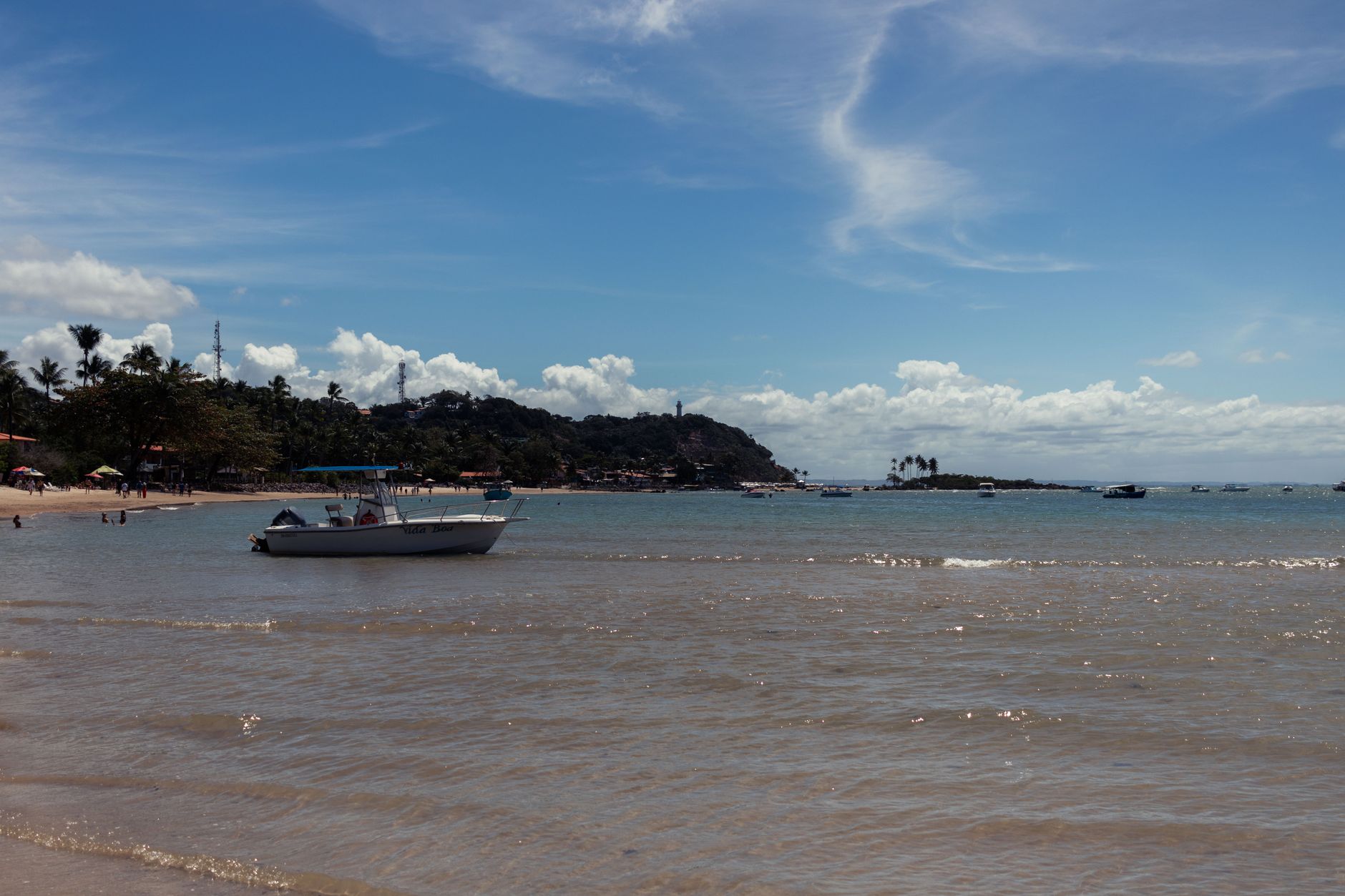
Morro de São Paulo is a car-free village at the northern tip of Ilha de Tinharé, on the southern coast of Bahia, and one of the most famous beach destinations in Brazil. Its beaches, numbered from the First to the Fifth, run south one after another, lined with coconut palms and coral reefs that form natural pools at low tide, ideal for snorkelling. Since no motor vehicles circulate in its core, you get around on foot or in the little tractors and carts that carry the luggage, which gives the place a pace that's relaxed and festive at once.
The village belongs to the municipality of Cairu and keeps a visible colonial history: the Fortaleza de Tapirandú, whose construction began in 1630 to defend the entrance of the Bay of All Saints from pirates and enemy fleets, crowns the hill and is today the best sunset viewpoint. For centuries Morro lived off small-scale fishing; only in the 1980s and 1990s did tourism — brought first by backpackers and surfers — turn the village into the icon it is today, popular with Brazilians and with travellers from Argentina and Europe.
This guide covers the essentials of Morro de São Paulo with a practical eye: how to get here from Salvador (catamaran and light aircraft), the compulsory TUPA tourist fee, what to see and do on each beach, the zip line, the 'volta à ilha' boat trips and the outing to Boipeba, where to sleep and eat on any budget, and how to use the tide for snorkelling. Paradise beaches, colonial history, protected nature and a party: that's Morro de São Paulo.
Founded in the shadow of the Fortaleza de Tapirandú — whose construction began in 1630 under governor general Diogo Luís de Oliveira to defend the 'false bar' of the Bay of All Saints — Morro de São Paulo was for centuries a fishing village on Ilha de Tinharé, in the municipality of Cairu. A strategic point against pirates and Dutch fleets, it keeps 678 m of walls protected as national heritage. Its isolation — reachable only by sea — preserved its character as a car-free village until, from the 1980s on, tourism turned it into one of the best-loved beach destinations in Bahia. The full story is on our history page.
Read the full history ↓The cradle of Brazil: this is where Cabral landed in 1500 and where Salvador was founded, the country's first capital for more than two centuries. The heart of Afro-Brazilian culture —candomblé, capoeira, axé— and of a coastline that runs from the Chapada Diamantina to the beaches of Porto Seguro.
Read the history of Bahia →If you book from here we earn a commission and you pay no more. Prices and availability come from Civitatis.
No exact prices: a scale from $ (budget) to $$$$$ (luxury), with 2-3 options per category.
Origins, formation and what the sources say.
Centuries before the boats brought tourists and before anyone numbered the beaches from 1 to 5, a people had already chosen this archipelago for the same reason it is irresistible today: the sea. In the maze of islands, channels and mangroves of the southern coast of Bahia — the so-called Baixo Sul — the Tupinambá, Tupi speakers, lived from fishing, from gathering oysters and shellfish, from hunting and from growing cassava. Ilha de Tinharé, where Morro de São Paulo sits, was for them a territory rich in food and well sheltered, long before any European set foot on the coast.
The island's own name, Tinharé, is of Tupi origin, like so many place names on the Brazilian coast, and confirms that Indigenous presence before colonisation. The abundance of mangroves, oysters and fish made this area a very old site of human settlement. When Portuguese navigators began exploring the Bahia coast in the 16th century, after Pedro Álvares Cabral reached the shores of Bahia in 1500, they found in these islands both resources and a strategic position for controlling navigation towards the south of the captaincy.
The history of Morro de São Paulo therefore begins like that of so many points on the Northeast coast: an Indigenous territory of great natural wealth that, with the arrival of the Portuguese, would be absorbed into the colonial system of captaincies, sugar mills and fortifications that Portugal set up to secure its hold on the new land. And in this particular case, that system would leave a mark that still crowns the hill: a fortress.
The strategic importance of Morro de São Paulo was sealed in 1630, when work began on the Fortaleza de Tapirandú on the orders of governor general Diogo Luís de Oliveira. The aim was to defend the so-called 'false bar' of the Bay of All Saints — an alternative entrance through which an enemy fleet could try to surprise Salvador — and to protect the shipping that linked the sugar region of the Recôncavo with the Baixo Sul of Bahia. The raised position of the morro, on a cliff commanding the sea, was ideal for watching and firing on any ship that came close.
The construction belongs to a period of high tension in the South Atlantic: Portugal was contesting control of the coasts of colonial Brazil with the Dutch, the French and other powers, and Bahia, with its capital Salvador, had been temporarily occupied by the Dutch in 1624-1625. To protect the routes and the sugar mills, several fortifications were raised along the coast; the one at Morro de São Paulo, built of stone and mortar, became one of the largest colonial defensive complexes in Brazil. Even today it keeps some 678 metres of curtain wall and ruins, protected as national historic heritage.
What survives of that fortress is the Portal with its coat of arms and old cannons pointing out to sea, at one of the loveliest viewpoints in the village, especially at sunset. Those remains are the main historical witness of Morro de São Paulo and a reminder that, long before it was a destination of paradise beaches, this corner was a key military point in the defence of the Bahia coast. It's no accident that legend speaks of the island as a former pirate refuge: whoever controlled this channel controlled one of the gateways to Salvador.
Through the colonial centuries, the Tinharé archipelago and the Cairu region were part of the farming economy of the southern Bahia coast. The neighbouring town of Cairu, founded in the 16th century and raised to the rank of vila in 1608, was one of the first Portuguese settlement centres in southern Bahia and keeps valuable colonial heritage, including a Franciscan convent. The region lived off sugar cane and cassava, the base of the farinha that fed much of the colony, as well as off fishing and shellfish gathering in its extensive mangroves.
Morro de São Paulo, in this context, worked for a long time as a small fishing community in the shadow of the fortress. Life ran to the rhythm of the tides, fishing and subsistence crops, far from the bustle of the major centres. The population was a mix of descendants of Portuguese settlers, of Indigenous people and, above all, of enslaved Africans brought to work in the region's sugar economy, an inheritance that left a deep Afro-Brazilian mark on the local culture, music and cooking.
This condition of an isolated village, reachable almost only by sea, held for centuries and explains why Morro de São Paulo kept its character as a fishing town so well until recent times. The lack of direct road access — even today the village has no car streets in its core — preserved a way of life and a landscape that, paradoxically, would later become its greatest tourist draw.
For most of the 20th century, Morro de São Paulo remained a quiet fishing village, practically unknown to mainstream tourism. The change began to take shape in the 1970s and 1980s, when backpackers, surfers and an alternative movement — partly heir to hippie culture — 'discovered' its warm-water beaches, its natural pools and its relaxed feel. Word spread from mouth to mouth and the village slowly became a cult destination for anyone looking for paradises that were still unspoiled.
From the 1990s and, above all, in the first decades of the 21st century, tourism became the main economic activity. The old fishermen's houses came to sit alongside pousadas, restaurants, bars and shops, and the numbered beaches — Primeira, Segunda, Terceira and Quarta Praia — became the heart of tourist life. Segunda Praia turned into the epicentre of the party and the nightlife, while the more distant beaches kept a quieter atmosphere. Despite the growth, the village held on to two traits that make it unique: the ban on cars in its core — you get around on foot, with tractors and carts for the luggage — and arrival mainly by sea, on a fast boat (catamaran) from Salvador or on the crossing from Valença.
Today Morro de São Paulo is one of the most famous beach destinations in Bahia and in all of Brazil, popular with Brazilians and with travellers from Argentina, Europe and the rest of the world. The village has largely managed to keep its charm as a car-free town while developing a full tourist infrastructure, in a balance that isn't always easy between preserving its character and the pressure of growth.
Morro de São Paulo makes no sense without its archipelago. Ilha de Tinharé and neighbouring Boipeba island form, together with the mainland part of Cairu, a group of islands, mangroves, restingas and Mata Atlântica forest of enormous environmental value. Much of this region is protected within the Área de Proteção Ambiental (APA) das Ilhas de Tinharé e Boipeba, a conservation designation that seeks to reconcile tourism and fishing with the preservation of fragile ecosystems that are very rich in biodiversity.
That environmental protection is key to understanding the destination's present and future. The mangroves play a fundamental role as nurseries for fish, crustaceans and molluscs — on which the traditional fishing communities depend — and as a natural barrier for the coast. The beaches, the reefs and the natural pools that draw visitors are, at the same time, the ecosystems that disorderly tourist growth can threaten, which has prompted debate about the limits of development in the village.
The municipality of Cairu, to which Morro de São Paulo belongs, also keeps notable historic heritage at its mainland seat, with churches and a Franciscan convent of colonial origin. The archipelago thus combines three layers of value: the historical (the fortresses and the colonial towns), the natural (the mangroves and the protected Mata Atlântica) and the tourist (the paradise beaches). That combination, plus its character as a car-free village reachable by sea, is what makes Morro de São Paulo a singular destination on the Bahia coast.