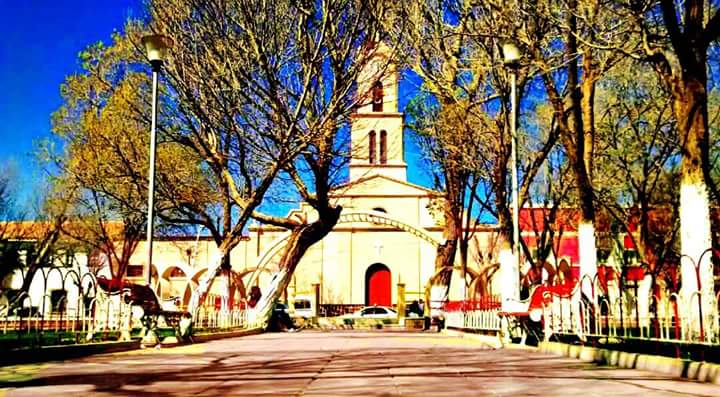
At the far south of the Bolivian altiplano, 3,440 meters up and pressed against the border with Argentina, Villazón is one of those cities almost every traveler in the region knows, if only in passing. Separated from Argentina's La Quiaca by nothing more than an international bridge, it forms with it one of the busiest border pairs between the two countries: a place of crossing, trade and constant movement of people and goods.
More than a classic tourist destination, Villazón is a crucial logistical hub: the point where you cross between northern Argentina (Jujuy, Salta) and southern Bolivia (Tupiza, Uyuni, Potosí). Traders, backpackers, families and travelers of every kind move through its streets, in the atmosphere of a border city, with its bus terminal, its train station, its exchange houses and its heavy commerce. It is a practical, lively place with a strong altiplano stamp.
This guide covers Villazón with a practical, honest eye: how the border crossing with La Quiaca works, what services the city has, how to connect on to Tupiza, Uyuni and the rest of Bolivia or into Argentina, and what to keep in mind about the altitude, the cold and the paperwork. For most people Villazón will be a stopover; knowing how it works helps make that transit as smooth as possible.
Villazón is a relatively young city, born and grown on the back of the border and the railway. It lies at the far south of the department of Potosí, on the boundary with Argentina, facing the Jujuy town of La Quiaca, from which it is separated by the border river and an international bridge. The city carries the name of the Bolivian politician and diplomat Eliodoro Villazón, president of Bolivia in the early 20th century, the period in which the settlement took shape and gained importance. Its development was closely tied to the arrival of the railway, which connected southern Bolivia with the Argentine network and made Villazón–La Quiaca a key crossing for trade and transport between the two countries. Being a border town marked its whole history: goods, travelers and workers passed and still pass through here, in an intense exchange that gave the city its commercial, restless character. The region, like the whole south of Potosí, has strong Andean and Quechua-Aymara roots, and formed part of the old altiplano circuits and of the mining economy of Potosí, whose historical axis was the silver of the Cerro Rico. Today Villazón is, above all, a living border city and an essential transit point between Bolivia and Argentina, rather than a tourist destination in itself. The full history is on our history page.
Read the full history ↓The department of silver and of the salt flats: home of the Cerro Rico that financed the Spanish Empire and of the Casa de la Moneda, of the Salar de Uyuni —the largest salt desert in the world and one of the great lithium reserves— and of the colored lagoons of the Eduardo Avaroa Reserve, on the highest and most desolate altiplano in the country, cradle of the hero Eduardo Avaroa.
Read the history of Potosí →They depart from Tupiza, 73 km away. If you book from this link we earn a commission and you pay no more.
No exact prices: a scale from $ (budget) to $$$$$ (luxury), with 2-3 options per category.
Origins, formation and what the sources say.
Every morning, before the sun has finished rising over the altiplano, hundreds of people are already crossing on foot the international bridge that joins Villazón to La Quiaca: traders with bundles, schoolchildren, porters, backpackers with their packs shouldered. Few know they are crossing a border that has barely a century of formal existence, but which as a place of passage has been there for millennia. The region where Villazón stands today, at the far south of the department of Potosí, has a long Andean history that predates the city itself: this part of the altiplano, strongly Quechua and Aymara in origin, formed part of the old circuits of the Andean world and, through colonial and republican times, was tied to the enormous mining economy of Potosí, whose axis was the silver of the famous Cerro Rico. The southern roads, the llama caravans and the trade routes crossed these high, arid lands long before any formal border post existed.
Being a boundary zone is, in fact, what would most shape the region's fate. Southern Potosí stretches to the border with Argentina, across territory that was historically one of contact and exchange between the Bolivian altiplano and northwestern Argentina —regions that share landscape, Andean culture and a long relationship of trade and migration. The border line, drawn in republican times, turned this sector into a strategic crossing point between the two countries.
So, before it was a city, the place was already part of a territory of passage: an Andean corridor where people, goods and routes crossed. That calling for transit and exchange would be the seed of the future Villazón, which would be born precisely to organize and make use of that border crossing.
Villazón has a birth certificate: on 2 May 1910, president Eliodoro Villazón Montaño signed the Supreme Decree ordering the expropriation of the land needed to found a town on the border, facing the brand-new terminal station of Argentina's Ferrocarril Central Norte. And here comes the detail few people know: the new Bolivian settlement was first called 'La Quiaca Boliviana', a mirror of the Argentine La Quiaca founded three years earlier, in 1907, when the rails climbing up from Jujuy reached the very edge of the international line. Only later did the town take the name of the president who had created it.
That origin explains why Villazón is a young city: unlike old colonial towns such as Potosí, which grew up around silver, it was born in the 20th century, the child of an agreement between the Bolivian and Argentine governments to join their rail networks. Its name points not to a saint or a colonial founding but to a statesman of Bolivia's liberal era: Eliodoro Villazón, a Cochabamba lawyer who led the country between 1909 and 1913, years of railway expansion and of consolidating the national borders.
The choice of name reflects the context of the time: a moment when the Bolivian state was seeking to shore up its presence in the border regions. Naming the new city after the president was, in a way, planting the flag of sovereignty at that strategic point on the line with Argentina.
The great engine of Villazón's growth was the railway, and its history has a date of glory: on 6 August 1925, the day of Bolivia's centenary, the 203-kilometer stretch of track between Atocha and Villazón was opened, the missing piece that finally joined the Argentine and Bolivian rail networks. On the Argentine side, the rails of the Ferrocarril Central Norte had reached La Quiaca back in 1907; on the Bolivian side, the line coming down from Uyuni and Tupiza took almost two decades more to close the gap. When it did, something extraordinary for the period became possible: boarding a train in Buenos Aires and getting off in La Paz —and from there, connecting with the Lake Titicaca steamer, carrying on into Peru.
The arrival of the train turned a place of passage into a continental communications hub. Minerals from southern Potosí moved through here toward the ports, Argentine goods toward the altiplano, along with passengers and seasonal workers heading down to the harvests of northern Argentina. The city grew to the rhythm of that movement, with its station, its customs sheds and its border trade. Villazón–La Quiaca established itself as one of the most important land crossings between the two countries, a role it still holds today, even after road transport took over and the passenger train was reduced to the Bolivian stretch (the Argentine branch to La Quiaca stopped running in the early 1990s).
That railway and border origin shaped the city's character: commercial, restless, full of traffic and mixture. Villazón became, above all, a border city, defined by the crossing, the exchange and the constant passage of people between two nations. That identity, born with the railway, is still the essence of the place: today Villazón station is the southern head of the Expreso del Sur and the Wara Wara, the trains that still link the border with Uyuni and Oruro.
Today Villazón is, above all, a living border city and an essential transit point between Bolivia and Argentina. Separated from La Quiaca by nothing more than an international bridge, it remains one of the busiest land crossings between the two countries, with an intense movement of people, traders and goods passing daily in both directions.
The city's economy turns on trade and the border: markets, fairs, exchange houses and shops both formal and informal give it its noisy rhythm. For the traveler, Villazón is the gateway into southern Bolivia from northern Argentina, and the departure point for destinations such as Tupiza, Uyuni and Potosí; or, going the other way, the last Bolivian stop before crossing into Argentina toward Jujuy and Salta.
Rather than a destination of monuments or landscapes of its own, Villazón makes sense as a link in a wider route: a place of passage where the shared cultures, currencies and languages of the Andean world cross. Its history —young, border-bound and railway-built— keeps being written every day in the coming and going of the people who cross its bridge, at one of the most dynamic borders in South America.