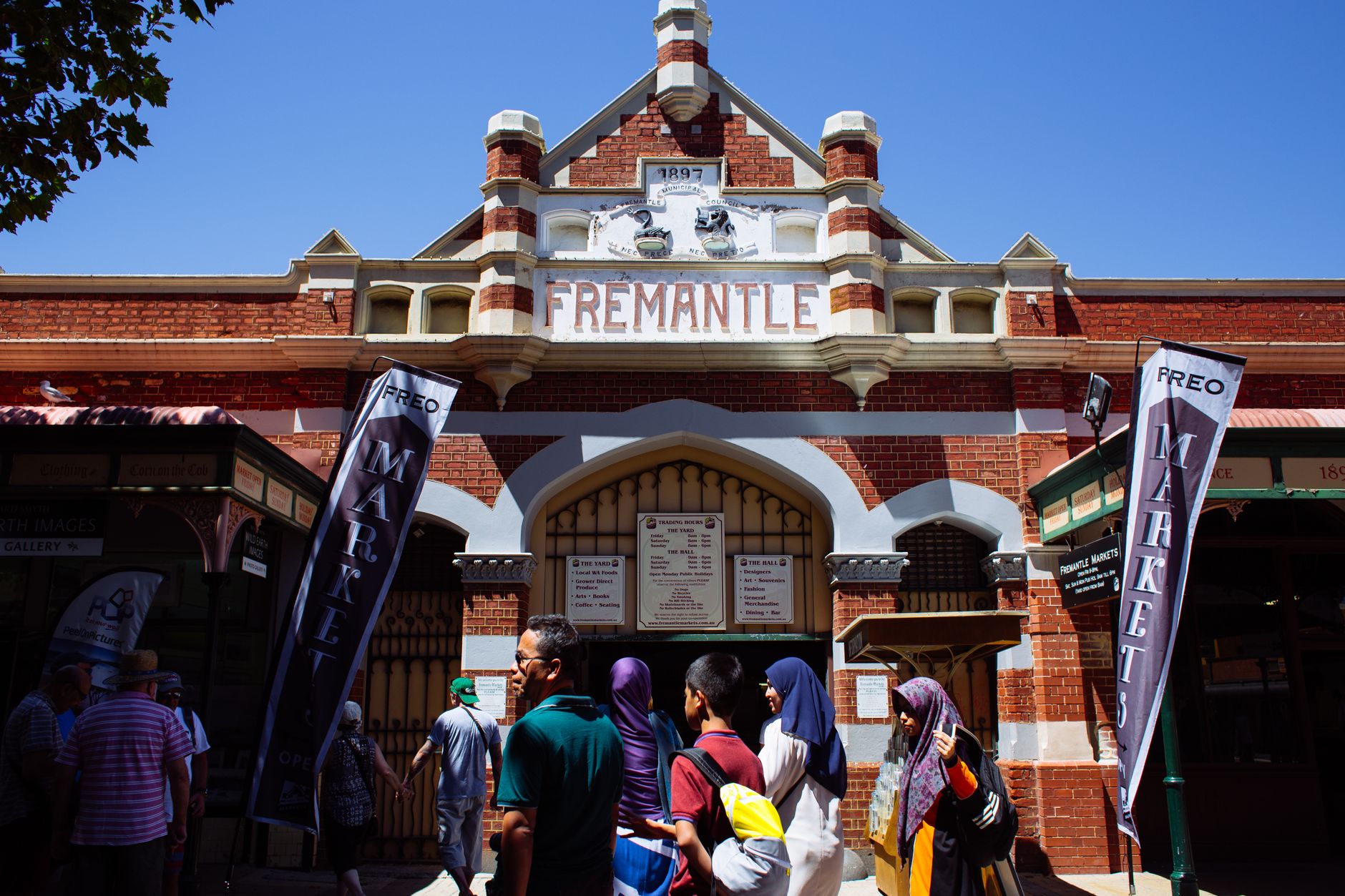
Fremantle is the bohemian port soul of Perth: a historic town at the mouth of the Swan River where Western Australia's colonial past is alive on every corner. "Freo", as the locals affectionately call it, has one of the best-preserved collections of 19th-century Victorian architecture in the world, with entire streets of limestone buildings that seem frozen in time, plus a creative, alternative and relaxed energy that sets it apart from the gloss of central Perth.
This is home to Fremantle Prison, the only site in Western Australia on the World Heritage List, an imposing convict-built jail that you can now explore on fascinating (and sometimes chilling) tours. A few steps away, the Fremantle Markets, a covered market from the late 19th century, overflow with food stalls, crafts and produce; the "Cappuccino Strip" on South Terrace buzzes with alfresco cafés; the Round House, the oldest building in WA, has been watching over the sea since 1831; and the waterfront is home to museums that tell the epic story of shipwrecks and seafarers.
This guide covers the essentials of Fremantle with a practical eye: how to get there by train or ferry from Perth, how to get around on foot or on the free CAT buses, which history and flavours not to miss, and how to use Freo as a springboard to Rottnest Island. It's a destination with a character all its own, ideal for lovers of history, coffee, craft beer and port-town atmosphere, and one of the best day trips (or longer) from Perth.
Fremantle is Walyalup, "the place of the walyo" (a small rat-kangaroo), to the Whadjuk Noongar people, whose connection to this land goes back more than 50,000 years; the area around Arthur Head hill was called Manjaree, "fair exchange", a place for meeting and trading. In 1829 the settlers of the Swan River Colony landed here, and the town was founded as Perth's port, named after Captain Charles Fremantle. Convict labour built the Round House (1831) and, later, the great Fremantle Prison. The town prospered with the 1890s gold rush and the new inner harbour, and in the 20th century it was the gateway for waves of immigrants. The full story is on our history page.
Read the full history ↓Australia's largest state, covering almost a third of the continent: the ancestral land of the Noongar people and dozens of desert nations, colonised from the Swan River Colony in 1829, transformed by Kalgoorlie gold and today a global iron ore powerhouse. Its capital, Perth, is the most isolated major city on the planet.
Read the history of Western Australia →Some places make no sense on your own; with someone explaining them, they change completely. We look ours up on Civitatis: guided in Spanish and booked online with no fuss. They have 13 activities in Perth. And there are free tours here: you book without paying and tip the guide whatever you think at the end, so trying one costs you nothing. Three are below so you get the idea: tap any of them and they all open.
They depart from Perth, 16 km away. If you book from this link we earn a commission and you pay no more.
No exact prices: a scale from $ (budget) to $$$$$ (luxury), with 2-3 options per category.
Origins, formation and what the sources say.
Before it was called Fremantle, this headland by the sea at the mouth of the Swan River was Walyalup to the Whadjuk Noongar people, whose connection to this land goes back more than 50,000 years. The name Walyalup means "the place of the walyo", referring to the woylie, or brush-tailed bettong, a small hopping marsupial similar to a rat-kangaroo that was once plentiful in the area. For the Whadjuk, this was a living place with a name, a history and a meaning, long before any British ship dropped anchor.
The area around the limestone hill of Arthur Head and today's Bathers Beach had a particularly telling name: Manjaree, which in the Whadjuk dialect translates as "fair exchange". It was a place where groups met to trade and hold ceremonies, where goods were swapped, agreements were made and the people of the region came together. As a meeting and trading place, it oddly foreshadowed Fremantle's future role as a port: the place where goods and people come and go, and where trade with the world happens.
The Whadjuk lived in harmony with this coastal and river landscape. They fished in the Derbarl Yerrigan (the Swan) and in the sea, gathered food in the wetlands and along the coast, and organised their lives around the six seasons of the Noongar calendar. According to their Dreaming tradition, the river was created by the Waugal, the rainbow serpent. When the settlers arrived in 1829, this land was not empty: it was inhabited and cared for. In recent decades the city has begun to reclaim and honour its name, Walyalup, through institutions such as the Walyalup Aboriginal Cultural Centre.
Fremantle's colonial history began at almost the same moment as Perth's. In 1829, when Captain James Stirling established the Swan River Colony, he decided to found two settlements: a capital inland, Perth, and a port at the mouth of the river that would be the colony's gateway to the world. That port was named Fremantle after Captain Charles Fremantle of HMS Challenger, who had formally taken possession of Australia's west coast for the British Crown shortly before, in May 1829.
So Fremantle was born as the landing point. Ships arrived there with settlers, supplies and hopes, and from there people travelled up the river to Perth. But the early days were very hard. The sandbar at the river mouth made navigation extremely difficult, and the sandy soil and harsh conditions brought the whole colony close to failure in its first few years. The settlers had come for the promise of land and prosperity, but what they found was a hostile environment.
One of the first signs that the settlement meant to stay was the Round House, built in 1830–1831 on the hill of Arthur Head (Manjaree to the Noongar). This small twelve-sided jail would become the oldest building still standing in Western Australia. It was used to lock up both settlers who broke the law and Aboriginal prisoners, and it captures the two sides of the founding well: the birth of a city and, at the same time, the beginning of the repression and dispossession of the Whadjuk people, some of whom were jailed there before being sent to Rottnest Island.
Like neighbouring Perth, Fremantle owes much of its look to convicts. The colony was stalling for lack of labour, so Western Australia asked Britain to send it prisoners, and around 10,000 convicts arrived between 1850 and 1868. This forced labour built much of the city's infrastructure: roads, jetties, public buildings and, above all, the imposing Fremantle Prison.
Fremantle Prison (originally the Convict Establishment) went up in the 1850s, built from limestone quarried on the hill itself by the same prisoners who would be locked up inside it. It is a huge complex of cells, yards and walls that served as a prison for almost 140 years, until 1991. The convicts also built the Commissariat (now home to the Shipwreck Galleries) and many of the solid limestone buildings that give Fremantle its unmistakable character. This Victorian architecture, made from the warm local stone, has survived almost intact and is now one of the best-preserved groups of 19th-century colonial buildings in the world.
Thanks to the convicts' labour and the arrival of more settlers, Fremantle grew as a port and as a town. Fremantle Prison and the network of roads and jetties laid the groundwork for the big leap that would come at the end of the century. Built on the suffering of convicts and the dispossession of the Whadjuk, the limestone city was getting ready for its golden age, which would come thanks to gold and a visionary engineer.
Fremantle's fortunes changed for good at the end of the 19th century, when two things happened almost at once: the gold rush and the building of a new port. In the 1890s, huge gold deposits were discovered in inland WA (Coolgardie, Kalgoorlie). As the colony's main port, Fremantle became the gateway through which tens of thousands of fortune-seekers arrived and the wealth was shipped out. The town boomed.
The great historical obstacle, the sandbar blocking the river mouth, was overcome by the brilliant engineer C. Y. O'Connor. From 1892 he designed and built the Fremantle Inner Harbour, dredging and reshaping the mouth of the Swan to create a deep-water port able to take large ships. It was a bold piece of engineering that turned Fremantle into one of Australia's most important ports and the country's western gateway.
Throughout the 20th century, that port made Fremantle the first piece of Australia that millions of immigrants set foot on. After the Second World War especially, waves of Europeans (Italians, Greeks, Portuguese, Croatians and many more) landed in Fremantle looking for a new life. Their arrival gave the city its multicultural, Mediterranean character, its love of coffee (the Cappuccino Strip grew out of the Italian cafés) and its cosmopolitan port-town identity. In 1987 Fremantle had its moment of global fame when it hosted the defence of the America's Cup after the yacht Australia II's historic win in 1983, which sparked a major restoration of its heritage.
Today's Fremantle has such a strong character that locals defend it with an almost tribal pride. "Freo" is a working port, a gem of Victorian heritage, a creative hub for artists, musicians and brewers, and one of Perth locals' favourite getaways. Its mix of history, bohemian spirit, coffee, craft beer and seaside atmosphere makes it unlike anywhere else in Western Australia.
Its historical treasures are protected and celebrated. Fremantle Prison, WA's only World Heritage Site, draws visitors from all over the world. The Fremantle Markets, open since 1897, are as lively as they were over a century ago. The Round House has watched over the sea since 1831. And the maritime museums hold everything from the America's Cup yacht to the timbers of the Batavia, wrecked in 1629. Street art, festivals, live music and a multicultural food scene keep the city lively and young.
More and more, Fremantle is also facing its full history, including the story of this land's first owners. The name Walyalup is heard alongside Fremantle again, the Walyalup Aboriginal Cultural Centre shares Whadjuk culture, and there is recognition that Manjaree, the "place of fair exchange", was a Noongar meeting place for thousands of years before it became a colonial port. Walking around Freo today means walking through a port built by convicts, one that welcomed millions of immigrants and that stands on a sacred meeting place. It's a patch of limestone where a few streets by the sea hold a large part of Western Australia's history.