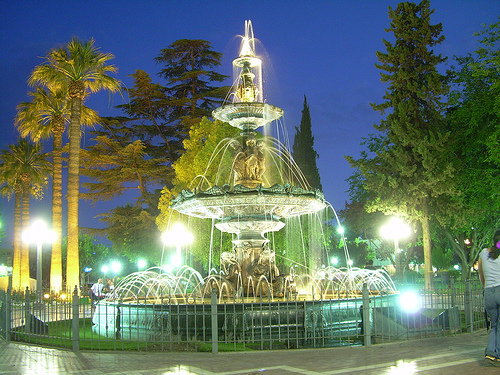
Maipú is one of the wine hearts of Mendoza, a department of Greater Mendoza famous for its wineries, its olive groves and its 'Caminos del Vino' (Wine Roads), where you can work your way through a remarkable concentration of vineyards and wineries, many of them historic and open to visitors. It is one of the most classic and accessible wine-tourism destinations in the country, and it is even good to tour by bike.
Unlike newer high-end areas such as the Uco Valley, Maipú stands out for its tradition: this is where you find some of the oldest and most emblematic wineries in Mendoza, alongside olive-oil mills and makers of preserves and jams, which lets you pair wine tasting with regional products. All of it a very short hop from the city of Mendoza, which makes it very easy to visit.
This guide covers Maipú from a practical angle: the Caminos del Vino and the wineries, the bike ride among the vines, the olive groves and regional products, how close it is to the city of Mendoza, and the details you need to get there, taste, eat, sleep and get around in one of the most traditional and best-loved wine areas of Cuyo.
Maipú is a historic department of the Greater Mendoza oasis and the cradle of the modern Argentine wine industry: many of the first big wineries set up here in the late 19th century, driven by the railway, irrigation and European immigration. Today it is one of the country's great wine-tourism centers, with its traditional Caminos del Vino. The full story is on our history page.
Read the full history ↓The land of sun and good wine: a Huarpe oasis at the foot of Aconcagua, cradle of San Martín's Army of the Andes, rebuilt after the 1861 earthquake and turned into the world capital of Malbec and the high mountains.
Read the history of Mendoza →If you book from here we earn a commission and you pay no more. Prices and availability come from Civitatis.
No exact prices: a scale from $ (budget) to $$$$$ (luxury), with 2-3 options per category.
Origins, formation and what the sources say.
Cycling for ten minutes between rows of malbec in Maipú and running into a century-old bare-brick winery with barely a sign out front is a scene that sums up, better than any brochure, what this patch of desert turned vineyard really is. Because before the tastings, the bicycles and the restaurants with a view of the Andes, Maipú was sand: a dry fragment of the Andean piedmont that only the human obsession with water managed to make fertile. That tension between desert and oasis — and the quiet engineering that resolved it — is the key to understanding why this area, and not another, ended up as one of the great names in Argentine wine.
Maipú is part of the historic Greater Mendoza oasis, an arid region turned into fertile land by the ingenious use of snowmelt from the mountains. Long before the Spanish arrived, the Indigenous peoples — among them the Huarpe, skilled farmers of the piedmont — were already farming with irrigation in these oases, using acequias and canals that drew water from the Andean rivers, above all the Mendoza river. That knowledge of irrigation, inherited and refined over centuries, was the foundation on which every later farming economy in the region was built, winemaking included.
With the founding of the city of Mendoza in 1561 and Spanish colonization came the grapevine, brought by conquistadors and missionaries, which found exceptional conditions in the Mendoza oasis: plenty of sun for most of the year, a dry climate that keeps plant disease down, a wide temperature swing between day and night — key to concentrating aromas in the grape — and snowmelt water available for irrigating at exactly the right moment. Through the colonial period and the first decades of independence, wine production grew on a craft scale, supplying mostly regional consumption and, later, markets such as Buenos Aires and Chile via the mule trains that crossed the mountains, while Maipú settled into its role as one of the oasis's farming areas, given over to vines, fruit trees and olives.
The area was thus marked from the start by the culture of water, oasis agriculture and the grapevine, the three elements that would define its identity and that would in time make it one of the hearts of Argentine winemaking.
The big leap for Maipú and for all of Mendoza came in the second half of the 19th century and the early 20th, when three decisive factors converged: the arrival of the Ferrocarril Andino in 1885, which connected Mendoza with Buenos Aires and the huge consumer market of the Litoral in a couple of days' travel instead of weeks by cart; mass European immigration, above all Italian and Spanish, which brought winemaking know-how built up over generations in the Old World; and the expansion and modernization of the irrigation system, with new canals that widened the oasis's farmable area. In barely two or three decades, that combination turned craft wine production, aimed at local consumption, into a genuine industry of national scale.
Maipú was one of the epicenters of that process. Many of Argentina's first big modern wineries were set up on its land, founded by immigrant families and entrepreneurs who imported techniques, European grape varieties — among them malbec, brought from France by the agronomist Michel Aimé Pouget in the mid-19th century — and machinery that was state of the art for the day. That gave rise to landmark establishments, many of them now a century old and listed as heritage assets, with Italianate main buildings, century-old oak barrels and underground cellars, which made Maipú one of the cradles of Argentine winemaking and a symbol of the drive behind Mendoza wine. Bodega Trapiche, founded in 1883 and today one of the most visited in the department, is one of the best examples of that period winery architecture. Alongside wine, olive groves and olive-oil production also thrived, another mark of the region that still shares the Maipú landscape with the vines today.
Through the 20th century, Mendoza consolidated its place as the country's great wine province — today responsible for more than two thirds of Argentine wine production — and Maipú as one of its traditional hearts, along with Luján de Cuyo. Wine culture soaked into the life, the landscape and the economy of the department: the harvest festivals, the rituals of the vendimia and the landscape of poplars and acequias lining the vineyards became part of local identity, laying the groundwork for the tourism that would follow.
In recent decades, the formidable growth in the international standing of Argentine wine — and especially of Mendoza malbec, which from the 1990s went from secondary grape to national emblem in export markets — drove the development of wine tourism, and Maipú became one of its most classic and accessible destinations. Wineries that had once been geared solely to production began opening their doors to the public, offering guided visits, tastings, paired lunches and experiences that combine the wine with the vineyard landscape and, in many cases, with the heritage architecture of their own late-19th-century buildings.
The so-called Caminos del Vino (Wine Roads) organized and promoted that offering, linking the department's dense cluster of wineries, olive groves and regional-produce workshops into circuits designed for visitors. Maipú also popularized a very particular and enjoyable format that sets it apart from other wine areas in the country: touring the wineries by bike, pedaling along dirt and paved roads lined with poplars, between acequias and trellised vines, from winery to winery. Operators such as Maipú Bikes, which today rents bicycles with map, helmet and mechanical support included, turned that circuit into one of the most recommended experiences in all of Mendoza on traveler platforms, adding a distinctive and democratic draw — far cheaper than a private tour with a driver — to the area's wine tourism.
The Museo Nacional del Vino y la Vendimia, housed in a historic winery in the department, rounded out the offering with a more educational angle: old harvest tools, photographs of the early-20th-century vintages and the story of how Mendoza went from farming oasis to the undisputed wine capital of South America. Today Maipú combines its rich historic legacy — century-old wineries, a culture of water and wine, an Italian and Spanish immigrant inheritance — with a solid tourism calling, helped by how close it is to the city of Mendoza, barely twenty or thirty minutes from downtown. It is one of Argentina's great wine-tourism destinations, where the winemaking tradition, the olive groves and the regional flavors are laid out for the visitor amid sun, vines and the snowy Andes behind.
The department owes its name to the Battle of Maipú, fought on April 5, 1818 on the Maipo plain, in Chile. There the Army of the Andes under General José de San Martín, together with the Chilean forces of Bernardo O'Higgins, won a decisive victory that sealed Chile's independence and consolidated the San Martín campaign that had begun in Mendoza. In tribute to that battle, fundamental to South American emancipation, the Mendoza department took the name Maipú.
That link to San Martín's story is no accident: it was precisely in Mendoza that San Martín assembled the Army of the Andes that would cross the mountains, and the oasis — with Maipú among its farming districts — supplied resources for the undertaking. The department's identity is therefore bound up with the epic of American independence as well as with its farming and winemaking calling.
Through the 19th and 20th centuries, Maipú grew into one of the most populous and productive departments of Greater Mendoza, part of the provincial capital's metropolitan area. Its economy combined winemaking, olive growing, fruit farming and, later, industry and services, while wine tourism gave it a new prominence. Today Maipú is at once a modern department of the Mendoza urban belt and a keeper of the winemaking tradition that made it famous.