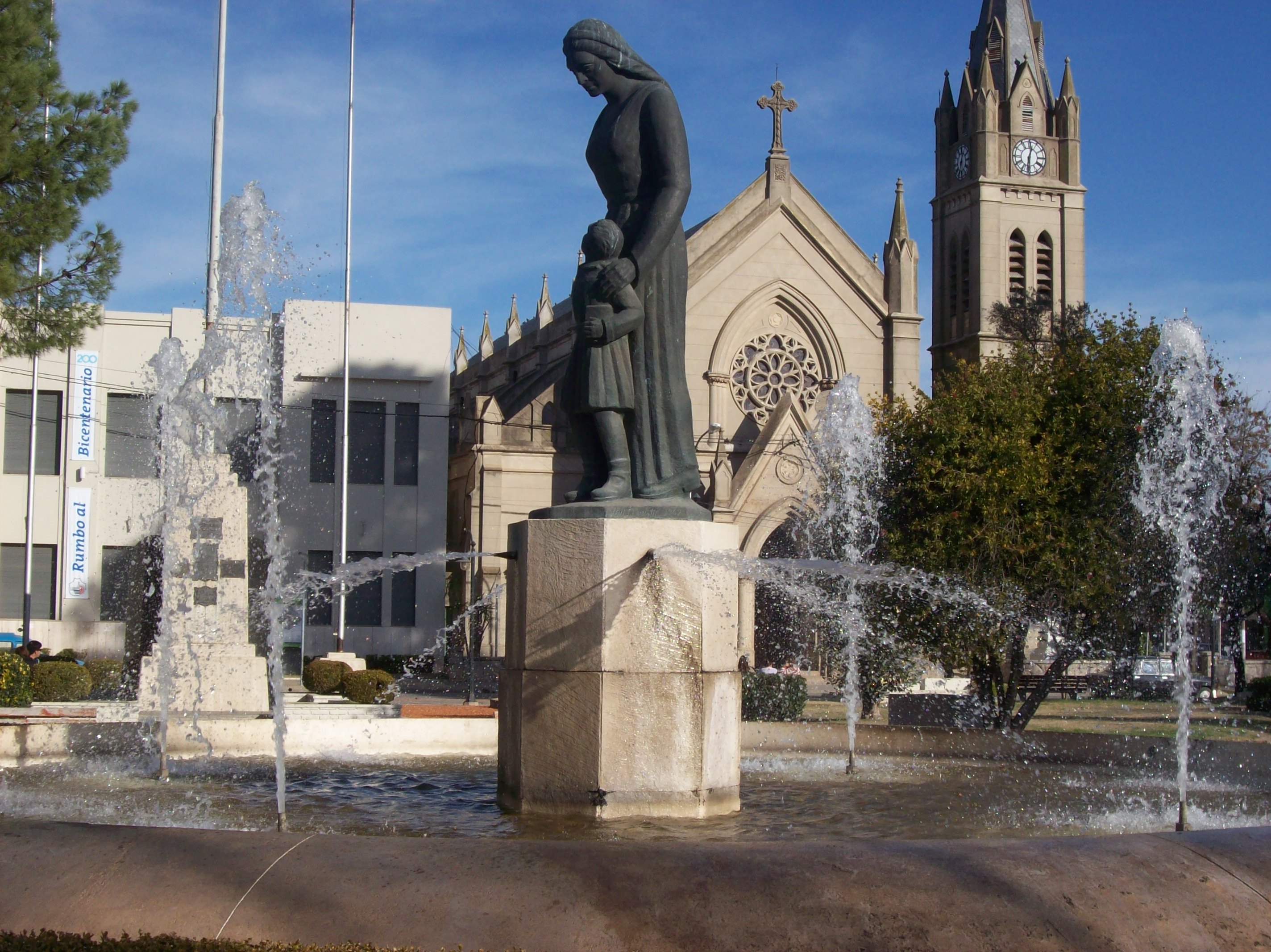
Lobos is a town and district in the north-center of Buenos Aires province, in the heart of the pampa húmeda, a little over a hundred kilometers from the City of Buenos Aires. It is a classic weekend escape, combining gaucho and Buenos Aires country tradition with the recreational draw of the Laguna de Lobos, a lagoon much loved for fishing, water sports and rest.
The town also has a strong historical dimension: it is the birthplace of Juan Domingo Perón, the most influential Argentine political leader of the 20th century, whose birth house is preserved as a provincial museum and a National Historic Monument. To that are added the historic center, the estancias of the area and the easy atmosphere of a country town, with its criollo traditions. Lobos is also the National Capital of Skydiving, with one of the oldest schools in the country.
This guide covers the essentials of Lobos from a practical angle: the Laguna de Lobos and its activities, Perón's birth house and the historical heritage, the estancias and country tourism, skydiving, where to eat and sleep, and how to get there. It is an ideal destination for a break from Buenos Aires in search of a lagoon, countryside, history and quiet.
Lobos began on the 18th-century Buenos Aires frontier: the town was founded on 2 June 1802 by José Salgado and his wife Pascuala Rivas, who paid for the first chapel of Nuestra Señora del Carmen. It consolidated as a country town given over to livestock and farming, and the arrival of the railway on 25 May 1871 drove its growth. Its greatest historical fame comes from being the birthplace of Juan Domingo Perón, born there in 1895, whose birth house is today a provincial museum and a National Historic Monument. The Laguna de Lobos rounds out its profile as a recreational destination on the pampas. The full story is on our history page.
Read the full history ↓The agro-export heart of Argentina: the endless pampa that was the land of the Querandí and the Pampa peoples, the domain of governor Rosas, the engine of cattle and wheat with La Plata as its purpose-built capital, cradle of the gaucho and of the Atlantic Coast where the whole country spends its summer.
Read the history of Buenos Aires Province →If you only have one day, take a guided tour on the first one: it sets up the rest of your trip and saves you a lot of walking. We look ours up on Civitatis: guided in Spanish and booked online with no fuss. They have over 50 activities in Ciudad De Buenos Aires. And there are free tours here: you book without paying and tip the guide whatever you think at the end, so trying one costs you nothing. Three are below so you get the idea: tap any of them and they all open.
They depart from Ciudad De Buenos Aires, 92 km away. If you book from this link we earn a commission and you pay no more.
No exact prices: a scale from $ (budget) to $$$$$ (luxury), with 2-3 options per category.
Origins, formation and what the sources say.
There is something curious about Lobos: it is at once one of the most traditional country towns on the Buenos Aires pampas and the birthplace of one of the figures who stirred the most argument in 20th-century Argentine history. Walk two blocks from the main square, with its church and its early 20th-century mansions, and you reach a modest house where Juan Domingo Perón was born in 1895. That combination — a peaceful town of lagoon and countryside, the cradle of a leader who still divides opinion — is what gives Lobos its particular identity on the Buenos Aires tourist map.
Like so many towns in the center of Buenos Aires province, Lobos has its roots in the era of the frontier with the indigenous peoples. Towards the end of the 18th century, in this part of the pampa húmeda, a frontier guard post was set up to strengthen the Spanish-criollo presence and to hold back indigenous advances into the countryside. The formal founding of the town has a precise date and precise names: on 2 June 1802, José Salgado — who had received land from the viceroy — and his wife Pascuala Rivas founded the settlement and paid for the first chapel, dedicated to Nuestra Señora del Carmen, where the first services were held on 9 June 1803. The name came from the area of the Laguna de Lobos.
The settlement grew as a country town, given over to livestock and farming, in one of the most fertile regions of the pampas. Life turned on the estancias, the cattle and rural work, within the criollo and gaucho culture that defined the Buenos Aires countryside. In 1805, the Cabildo of Buenos Aires appointed the first alcalde de la Santa Hermandad, Fructuoso Velásquez, the first step in the administrative organization of the area, and the town consolidated as the head of a rich productive region.
The Lobos pampas were living frontier land: raids, post houses, pulperías and small forts were part of the everyday landscape well into the 19th century. That identity as a country town, tied to the land, livestock and gaucho tradition, is still an essential part of the character of Lobos.
The great transformation of Lobos, like that of almost every town on the Buenos Aires pampas, came with the railway: the Lobos station of the Ferrocarril Oeste opened on 25 May 1871. The line that linked the region with Buenos Aires connected Lobos to the port and the markets, and turned the town into a trading hub for the farm produce of its rich hinterland.
With the train came European immigration, urban growth, trading houses, institutions and the public buildings that still shape the historic center today. Lobos went from a frontier fort to a prosperous, orderly town, with its square, its church and its mansions, within the agro-export model of the Argentina of the day.
The lagoon, which for centuries had been a natural resource of the area, also began to acquire recreational value: over time it became a place of rest and sport for people from the region and for visitors arriving from Buenos Aires, taking advantage of how close it was and of the train.
The event that gave Lobos its greatest place in Argentine history happened on 8 October 1895: in a house in the town, Juan Domingo Perón was born, who in time would become one of the most influential and decisive political figures in the country through the whole 20th century. A career soldier, Perón was three times president of Argentina and gave his name to Peronism, the political movement that deeply transformed Argentine society and politics and that remains alive today.
As with any figure who stirs passion, even his birth has its controversy: the researcher Hipólito Barreiro argued that Perón was in fact born two years earlier, in 1893, in the settlement of Roque Pérez, and that the 1895 Lobos record regularized the registration late; historiography and official documents, however, keep the date of 8 October 1895 in Lobos. The Perón family left Lobos while Juan Domingo was still a child, but the town's link with his figure was sealed forever. In 1953, during his second presidency, the birth house was turned into a museum and Perón himself visited it. Later it was declared a National Historic Monument and today it is a provincial museum, with rooms holding documents, photographs and personal objects of the family, plus the Patio de Placas and the 'Historic Fig Tree' from 1890.
Perón's birth house in Lobos is a place of visit and, for many, of pilgrimage. There the leader's origins and his times are evoked, preserving the memory of an event that tied the name of Lobos to national history forever.
Through the 20th century, Lobos consolidated its profile as a getaway for the people of Buenos Aires. The Laguna de Lobos, a few kilometers from the center, established itself as a center for pejerrey fishing, water sports and time outdoors, with clubs, lagoon-side spots and campsites along its shores, such as the historic Club de Pesca Lobos, which for decades was a meeting point for anglers from across the metropolitan region.
The town also acquired a singular sporting identity: skydiving. At the Aeroclub Fortín Lobos, the Club Escuela de Paracaidistas Argentinos (CEPA) and, later, Skydive Lobos set up shop, schools with decades of activity that turned the town into a hub of sport and recreational skydiving in the country. That tradition earned Lobos the title of National Capital of Skydiving, and today tandem first jumps — a free fall of about fifty seconds from 3.800 meters, at speeds close to 250 km/h, before the parachute opens and a ten-minute flight down to the landing — are one of its most sought-after attractions for those who come from Buenos Aires looking for a shot of adrenaline just over an hour from the capital.
Perón's legacy, for its part, remains a living chapter of the town's identity. The birth house, a museum since 1953, goes through different cycles depending on the country's political climate: there are years with more visitors linked to Peronism, and others with a lower profile, but the house is still there, with its historic fig tree and its rooms of personal objects, as testimony that something that happened in a Buenos Aires country town ended up changing the course of 20th-century Argentine politics.
So Lobos today combines several layers of its history: that of the country town and gaucho tradition, with its estancias and its Sunday asado; that of the railway and the progress of the pampas, still visible in the street layout and in the Sarmiento train that still links the town with Buenos Aires; that of Perón's birthplace and his decisive weight in national history; and that of a recreational destination of lagoon, estancias and extreme adventure in the air. An unusual mix that sets it apart among the destinations near the capital and that keeps drawing visitors after nature, countryside, history and, for the bolder ones, a view of the entire pampas from almost four thousand meters up.