Viajá con Gus
Home › Uzbekistan › Margilan
Margilan
🇺🇿 Uzbekistan · Fergana Valley

Margilan

🪪 What do I need to enter Uzbekistan?Pick your citizenship and we tell you the visa, the days and the paperwork, with the official source.

By leaving your email and citizenship you agree to receive the documents you asked for and weekly travel news. You can unsubscribe whenever you want. How we handle your data.
Jump to what you need
📍Region
Margilan (Marg'ilon) lies in the heart of the Fergana Valley in eastern Uzbekistan, a few kilometres from the city of Fergana and close to the border with Kyrgyzstan. It is the historic capital of Uzbek silk: for more than two thousand years, people here have spun and dyed the vibrant ikat (adras and khan-atlas) using craft techniques that UNESCO has recognised as intangible cultural heritage. It isn't a city of grand monuments. It's a city of workshops, looms and bazaars, a place to see how one of Central Asia's most famous fabrics is made.
📌Best time
Spring (April-May) and autumn (September-October) are the best times to visit: mild weather, orchards in bloom or heavy with fruit, and ideal days for walking through bazaars and workshops. Summer (June-August) is very hot in the valley, often above 35-40 °C, though the mulberry trees and canals give some shade. Winter is cold and grey. If you want to see the famous Kumtepa bazaar in full swing, keep in mind that its big day is Sunday (and to a lesser extent Thursday).
📌Suggested days
One day is enough for the essentials: the Yodgorlik silk factory and its full production tour, the Said Ahmad-Khoja madrasa and mosque, the Pir Siddiq mausoleum and a stroll through the bazaar. If you're there on a Sunday, add a morning at the huge Kumtepa bazaar. Many travellers use nearby Fergana as a base and cover Margilan, Kokand and Rishtan (the ceramics town) in two or three days, exploring the valley at an easy pace.
📌Getting there
Margilan is about 12 km from Fergana and 65 km from Kokand. From Tashkent, the fast Afrosiyob train goes through the spectacular Kamchik tunnel (which cuts through the mountains into the valley) and stops at Margilan station, the rail gateway to the Fergana area: the journey takes about 4 to 5 hours. There are also short flights from Tashkent to Fergana, plus marshrutkas (minibuses) and shared taxis that cross the mountain pass. Within the valley, shared taxis and marshrutkas link Margilan with Fergana, Kokand and Rishtan.
📌Getting around
Margilan is small, and the centre is easy to walk, but the Yodgorlik factory, the Kumtepa bazaar (5 km west) and the train station are a bit further out, so it's best to mix walking with taxis. Local taxis are cheap and plentiful, and there are also city marshrutkas. To get between Margilan, Fergana and the other towns in the valley, the most practical option is shared taxis that leave from fixed points (you pay per seat), or the Yandex Go app where it works.
📌Language and currency
Uzbek is spoken (along with plenty of Tajik and Russian in the valley); English is limited outside the guides at the silk factory. The currency is the Uzbek som (UZS). As of July 2026, 1 USD is around 12.000-12.600 som and 1 EUR about 13.500-14.500 som (indicative exchange rate). It's best to carry cash in som for bazaars, taxis and workshops, although more and more shops accept cards and app payments (Click, Payme). There are ATMs in Fergana and Margilan, and the larger shops take cards for silk and crafts.
💱 UZS exchange rate
Loading rate…
🌤️ Weather in Margilan
Loading weather…

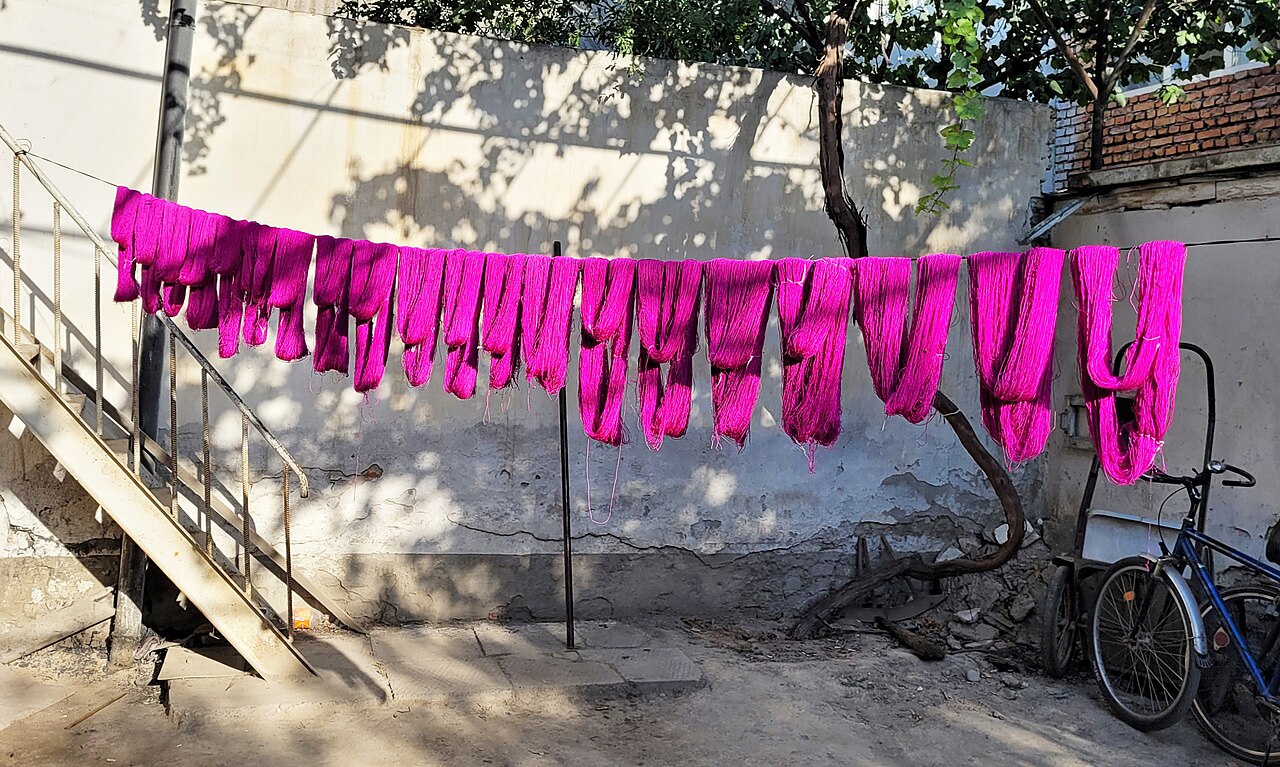
If there's one city where you can touch, smell and understand the Silk Road, it's Margilan. For more than two millennia, in this corner of the Fergana Valley, people have raised silkworms among mulberry trees, boiled the cocoons, spun the finest threads and dyed them with the ikat technique to create khan-atlas and adras: fabrics with bursting colours and patterns that seem to blur at the edges, famous across Central Asia. Margilan doesn't dazzle with minarets or monumental squares. It dazzles with wooden looms, skeins of thread hanging in the sun and the buzz of a bazaar where fabric is still sold by the metre.

The highlight is the Yodgorlik silk factory, where a guide takes you through the whole process, from cocoon to finished shawl, just as it was done centuries ago, with spinning wheels, hand looms and natural dyes. Around it are the central bazaar, the old Said Ahmad-Khoja madrasa and mosque, the Pir Siddiq mausoleum and, above all, the legendary Sunday bazaar of Kumtepa, one of the most authentic markets in the country, where you'll see old men in chapan (quilted robes) and mountains of fabric, spices and fruit.

This guide helps you make the most of Margilan in a practical way: how to get there through the Kamchik tunnel, what to see at the factory and how to buy real silk without falling for imitations, which days to go for the bazaar, how much everything costs and how to combine the city with Fergana, Kokand and Rishtan. It's a short stop but a very rich one, perfect if you want to see the handmade, human side of Uzbekistan, far from the postcards of Samarkand.

📖 History of Margilan

Margilan is one of the oldest cities in the Fergana Valley. Legend links it to Alexander the Great passing through, but what's certain is that it was already a Silk Road hub in the first centuries AD, when the valley exported horses and silk to China and Persia. For centuries it was a centre of weaving and trade, part of the Khanate of Kokand until the Russian conquest of 1876. Its fame has always rested on the same thing: silk. This is where the ikat technique was perfected, dyeing the threads before weaving to create those patterns with blurred outlines, and this is where the fabrics worn by nobles and peasants across Central Asia came from. In the Soviet era production was industrialised, but workshops like Yodgorlik kept the handmade technique alive, and today it is recognised by UNESCO. Its story, from the silkworm to today's looms, is told on our history page.

Read the full history ↓

🏛️ Margilan is in Fergana Valley

Uzbekistan's orchard: a fertile, densely populated valley, cradle of silk and ceramics, the former heart of the Khanate of Kokand, famous for the ikat of Margilan and the palaces and madrasas of Kokand.

Read the history of Fergana Valley →

🗺️ What to see

1
Yodgorlik Silk Factory
Uzbekistan's most famous craft workshop, where you can see the entire silk process done by hand, from cocoon to finished khan-atlas.
Leer más ↓
Yodgorlik ('souvenir', 'legacy') is the jewel of Margilan and the reason many travellers make the detour to the Fergana Valley. Founded in 1972, it is the largest silk factory in Uzbekistan that still works by hand, and it offers a guided tour (in several languages, depending on availability) through every stage of traditional production: unwinding the cocoons in hot water, spinning, dyeing with natural dyes (pomegranate, indigo, walnut husk, cochineal) and, above all, the ikat technique, in which the threads are tied and dyed before weaving to create the blurred patterns of adras and khan-atlas. The tour is fascinating because it isn't a shop-window demonstration: you see weavers working at wooden looms, dyers with colour-stained hands and skeins hanging in the sun in the courtyard. It's best to go early in the morning (between 8 and 10) to find every stage in progress. The tour ends at the showroom shop, housed in a former mosque, where you can buy silk and adras (a silk-cotton blend) by the metre or already made into shawls, ties, rugs and clothing. The workshop visit and guided tour are usually free or by donation (a tip for the guide is appreciated); what you pay for is whatever you buy. It's the best place in the country to understand where the famous Silk Road silk comes from and to buy directly from the producer, with no middlemen.
ℹ️ Distance: In Margilan, about 12 km from Fergana; by taxi from the centre or from Fergana · Best time: Early morning (8-10 am) to see every stage in action; open almost every day · Admission: Free guided tour or by donation (tip for the guide); you only pay for what you buy (verified July 2026) · Duration: 1 to 1.5 hours
2
Kumtepa Bazaar (Qumtepa)
The Fergana Valley's great Sunday bazaar, one of the most authentic and photogenic markets in Uzbekistan.
Leer más ↓
The Kumtepa bazaar, about 5 km west of central Margilan, is one of the most famous traditional markets in Central Asia and a must if you're there on a Sunday (its big day; there's also trading on Thursdays). It's a huge weekly market that draws farmers and traders from all over the valley, and it sells everything: mountains of ikat fabric, chapan (the typical quilted robes) and rugs, as well as spices, dried fruit and nuts, melons, livestock, tools and steaming street food. What makes it unique is the human atmosphere: white-bearded old men in turbans or doppi caps, women in bright dresses, endless haggling and teapots that never stop pouring. It's the ideal place to buy authentic silk fabric from the valley (often cheaper than in the tourist shops), but also just to wander, look around and take photos (always respectfully and asking people's permission). Go early in the morning, when it's at its liveliest. As in any bazaar, haggle with a smile, keep an eye on your belongings in the crowd and carry cash in small notes. It's a direct window onto everyday life in the Fergana Valley, very different from the monumental Uzbekistan of Samarkand or Bukhara.
ℹ️ Distance: About 5 km west of Margilan; by taxi (cheap) or marshrutka · Best time: Sunday (the big day) and Thursday, early in the morning · Admission: Free (verified July 2026) · Duration: 1 to 2 hours
3
Said Ahmad-Khoja Madrasa and Mosque
Margilan's main religious complex, from the 19th century, with a courtyard, a mosque with carved wooden columns and artisan workshops.
Leer más ↓
The Said Ahmad-Khoja madrasa (sometimes spelled Saidakhmad-Khodja) is Margilan's most important historic monument. Built in the late 19th and early 20th centuries, it is a traditional Fergana Valley madrasa, with a rectangular courtyard surrounded by cells (hujras) that once housed theology students and today are largely home to artisan workshops: embroiderers, potters, weavers and silk sellers. The complex includes a winter mosque and an elegant summer mosque with an aivan (open gallery) held up by carved wooden columns and painted ceilings, very typical of the valley's religious architecture. It's a quiet place, rarely crowded, ideal for seeing traditional woodwork and decoration up close and for chatting with the artisans working in the old cells. The visit pairs very well with a walk through Margilan's central bazaar, which is nearby. Dress modestly and respect the prayer areas. Admission is usually free or a token amount.
ℹ️ Distance: In central Margilan, near the bazaar; on foot · Best time: All year; morning or mid-afternoon · Admission: Free or a token amount (tip for the caretakers) (verified July 2026) · Duration: 30 to 45 minutes
4
Pir Siddiq Mausoleum and Complex (Khonakhoh)
A small local pilgrimage shrine, with a legend of sacred doves, in a peaceful corner of the city.
Leer más ↓
The Pir Siddiq mausoleum, also known as the Khonakhoh complex, is a modest but much-loved local pilgrimage site in Margilan. It is dedicated to a Sufi saint and linked to a popular legend in which doves saved the saint by hiding him, which is why the birds are considered sacred here; they still flutter around the courtyard and are part of the site's charm. The complex includes the mausoleum, a small mosque and a tree-shaded courtyard with old graves, all on a human scale and with the intimate feel of the Fergana Valley's neighbourhood shrines, very different from the great monumental mausoleums of Samarkand. It's a place to see everyday Uzbek religious life: families coming to pray, to ask for good health or children, and to tie strips of cloth as offerings. It only takes a few minutes to visit and fits in well with the madrasa and the bazaar. As at any shrine, be discreet, dress modestly and don't photograph people praying without permission.
ℹ️ Distance: In Margilan, near the centre; on foot or a short taxi ride · Best time: All year; quieter on weekdays · Admission: Free (voluntary tip) (verified July 2026) · Duration: 20 to 30 minutes
5
Ikat Workshops and Ikat House Craft Centre
Small family workshops where you can see ikat dyeing and weaving up close and buy directly from the artisan.
Leer más ↓
Beyond the big Yodgorlik factory, Margilan is full of small family workshops where ikat is still woven and dyed by hand, and many of them welcome visitors. Some, such as those linked to the Ikat House project / local craft centres, offer more intimate demonstrations of tying and dyeing the threads, the most delicate and spectacular part of the process, in which a single thread takes several colours so that the characteristic blurred pattern appears once it's woven. The advantage of visiting these small workshops is that you see the work up close, understand the effort behind every metre of fabric and buy directly from the families who make it, supporting the local economy. They're scattered around the city and many guides and taxi drivers know them; the Yodgorlik factory and the tourist offices can also point you in the right direction. It's a good way to compare quality and prices before buying: pure silk (khan-atlas) is shinier and more expensive; adras, a silk-cotton blend, is tougher and cheaper. Haggle respectfully and be wary of suspiciously cheap 'silk' fabrics, which are usually synthetic.
ℹ️ Distance: Scattered around Margilan; on foot or a short taxi ride · Best time: Working hours, in the morning; check before going · Admission: Free visit or by donation; you pay for what you buy (verified July 2026) · Duration: 30 to 60 minutes per workshop
6
Day Trip to Rishtan, the Ceramics Town
Uzbekistan's great pottery centre, halfway between Margilan and Kokand, famous for its turquoise-blue ceramics.
Leer más ↓
About 50 km west of Margilan, on the way to Kokand, lies Rishtan, the capital of Uzbek ceramics and one of the oldest and most famous pottery centres in Central Asia. Rishtan is renowned for its glazed ceramics in shades of blue and turquoise, achieved with ash glazes (ishkor) and natural pigments, and decorated with floral and geometric motifs and pomegranates. The especially good local red clay and centuries of tradition have made this town a place of pilgrimage for craft lovers. You can visit master potters' workshops (some internationally recognised, such as the Rustam Usmanov family or the ceramics centre), watch them shape plates on the wheel, decorate them by hand and fire them in traditional kilns, and buy pieces directly. It's a natural trip to combine with Margilan and Kokand on a tour of the Fergana Valley. Getting there: by shared or private taxi from Margilan, Fergana or Kokand (Rishtan is halfway between Margilan and Kokand). Ideal for half a day, combined with the journey between those cities.
ℹ️ Distance: About 50 km west of Margilan, on the way to Kokand; by shared or private taxi · Best time: All year, during workshop hours; spring and autumn for the weather · Admission: Workshop visits free or by donation; you pay for what you buy (verified July 2026) · Duration: Half a day (combined with the journey)
📶I have never landed without internet. I arrive and my phone connects to the strongest network in the country I am visiting: I can say I landed, sort out transport, book tours and keep posting, at a seriously good price. I always use the Maya eSIM — check their plans by clicking the banner.See plans →Maya Mobile eSIM — turn travel mode on
What nobody tells you

💵 Prices

Tickets

TypePrice
Fábrica de seda Yodgorlik (recorrido guiado)Free or by donation (tip for the guide), 2026
Bazar de KumtepaFree, 2026
Madraza y mezquita de Said Ahmad-KhojaFree or a token amount, 2026
Mausoleo de Pir Siddiq (Khonakhoh)Free (voluntary tip), 2026
Talleres de ikat y cerámica (Rishtan)Free visit; you pay for what you buy, 2026
Seda y adras por metro (en Yodgorlik y bazar)Adras/silk from ~100.000-300.000 som per metre depending on quality (approx. 8-25 USD), 2026
🔄 updated monthlyOfficial / reference values · double-check when buying

Activities and tours

ActivityPriceDurationOperator
Production tour at the Yodgorlik factoryFree or by donation, 20261 to 1.5 hYodgorlik factory (in-house guides)
Morning at the Kumtepa bazaar (Sunday)Free (shopping extra), 20261 to 2 hWeekly market
Day trip to Rishtan (ceramics) from MargilanReturn taxi from ~150.000-300.000 som depending on negotiation, 2026Half a dayLocal taxis (agree on the price)
Valley crafts circuit (Margilan, Rishtan, Kokand)Private tours with driver from ~60-100 USD per day, 20261 to 2 daysAgencies in Fergana/Tashkent (check)
Ikat dyeing workshop or craft classDepends on the workshop; often by donation or from ~10-20 USD, 20261 to 2 hFamily workshops (ask ahead)
🔄 updated monthlyOfficial / reference values · double-check when buying

🚌 How to get there and distances

Getting around

Local taxi (around town and to the factory/bazaar)
DurationVariable
Price
Short trips ~10.000-25.000 som; a little more to Kumtepa or Yodgorlik, 2026
Notes
The most practical option. Agree on the price before getting in, or use Yandex Go where it works. Very cheap by Western standards
Shared taxi to Fergana, Kokand and Rishtan
PricePer seat, from ~15.000-40.000 som depending on destination, 2026
Duration20 min to 1.5 h
Notes
They leave from fixed points once full (4 passengers). The usual way to travel between towns in the valley
Marshrutka (minibus)
PriceCity and intercity trips from ~2.000-6.000 som, 2026
DurationVariable
Notes
Very cheap but slow and sometimes crowded. Good for short hops within the valley
On foot around the centre
Free
DurationVariable
Notes
The central old town, the madrasa and the central bazaar are easy to explore on foot. For Yodgorlik and Kumtepa it's best to take a taxi
🔄 updated monthlyOfficial / reference values · double-check when buying

How to get there

RouteAirlines / operatorsAvg. priceDuration
Tashkent → Margilan by train (Afrosiyob)Uzbekistan Railways (O'zbekiston temir yo'llari); Afrosiyob high-speed train through the Kamchik tunnelDepending on class, from ~90.000-200.000 som approx., 2026~4 to 5 h
Tashkent → Fergana/Margilan by planeUzbekistan Airways (Fergana airport, ~15 km away)One way from ~300.000-700.000 som depending on season, 2026~1 h flight
Tashkent → Fergana Valley by shared taxiShared taxis over the Kamchik pass/tunnelPer seat, from ~120.000-200.000 som, 2026~4,5 to 5,5 h
Fergana ↔ MargilanTaxi or marshrutkaTaxi ~20.000-40.000 som; marshrutka from ~3.000 som, 202620 to 30 min
🔄 updated monthlyOfficial / reference values · double-check when buying

🏨 Where to stay

No exact prices: a scale from $ (budget) to $$$$$ (luxury), with 2-3 options per category.

Comfort (hotels and boutique)
Price$$$$$
Recommended options
~350.000-800.000 som per night (≈ 30-65 USD), 2026. The best choice is in nearby Fergana (comfortable, modern hotels); Margilan has a hotel or two and family-run guesthouses, many of them next to silk workshops
Budget (guesthouses and B&Bs)
Price$$$$$
Recommended options
~150.000-350.000 som per night (≈ 12-28 USD), 2026. Family homes and small guesthouses with breakfast, some linked to silk artisans; a warm welcome and a great way to get to know everyday life in the valley
Recommended base: Fergana
Price$$$$$
Recommended options
Fergana, 12 km away, has most of the valley's hotels (from budget to 4-star). Many travellers sleep there and visit Margilan, Kokand and Rishtan on day trips, 2026

🍴 Where to eat

Comida uzbeka del valle de Fergana
Price$$$$$
Options / signature dish
Dishes ~30.000-70.000 som (≈ 2,50-6 USD), 2026. The valley is famous for its plov (Fergana rice is among the most prized in the country), samsas, laghman (noodles), shashlik and tandoor bread. Simple restaurants and chaikhanas (teahouses) all over town
Chaikhanas (casas de té) y comida callejera
Price$$$$$
Options / signature dish
Snacks and dishes ~10.000-40.000 som (≈ 1-3,50 USD), 2026. Chaikhanas are the social heart of the valley: green tea, bread, skewers and stews, served on tablecloths spread over platform beds (topchan). Cheap, authentic and really tasty
Restaurantes y cafés en Fergana
Price$$$$$
Options / signature dish
Dishes ~40.000-100.000 som (≈ 3,50-8 USD), 2026. Nearby Fergana has a wider range of restaurants, modern cafés and international options for a slightly more comfortable dinner after a day of sightseeing

📖 History of Margilan

Origins, formation and what the sources say.

The city where the Silk Road's silk is born

Some cities are remembered for their palaces, others for what people make with their hands. Margilan belongs to the second kind. In this corner of the Fergana Valley, at the far eastern end of Uzbekistan, there is no monumental square to take your breath away like Samarkand's Registan. There is something quieter and older: creaking wooden looms, skeins of thread hanging in the sun, steaming vats of natural dye and the hum of a craft passed down from parents to children for two thousand years. Margilan is the historic capital of Uzbek silk, and its story is, at heart, the story of a thread.

As often happens in Central Asia, local legend ties the city's founding to Alexander the Great's passage in the 4th century BC. He was supposedly offered chicken (murgh) and bread (nan), and that is said to be where the name 'Margilan' comes from. It's a colourful etymology and probably a false one, but it shows how old the city considers itself. What archaeology and the sources do confirm is that Margilan already existed in the first centuries AD as a caravan hub on the network of routes linking China with Persia and the Mediterranean, the network that much later would be called the Silk Road.

en.wikipedia.org · Margilancentral-asia.guide · Margilan

The Fergana Valley: heavenly horses and caravans

To understand Margilan, you have to look at the valley around it. The Fergana Valley is a large, fertile basin, watered by the Syr Darya and its tributaries and ringed by mountains (the Tian Shan and the Pamir-Alay). It's a farming oasis in the middle of Central Asia's steppes and deserts. That fertility made it a coveted place and a crossroads from ancient times.

In the 2nd century BC, when the Chinese envoy Zhang Qian reached the region, he was dazzled by the valley's horses: tall, powerful animals that sweated 'blood' (because of a parasite), which the Chinese called 'heavenly horses'. The Han court's desire for those horses was one of the forces that opened the trade routes to the West. In exchange for horses, the valley received Chinese silk. So from the very start, Fergana sat at the heart of the trade that gave the Silk Road its name.

One after another, the valley saw the Greco-Bactrian kingdoms, the Kushan Empire, the Sasanians, the Arab conquerors who brought Islam in the 8th century, the Samanids of Bukhara, the armies of Genghis Khan in the 13th century and Tamerlane's empire in the 14th. Each wave left its mark, but the valley's calling, farming and crafts, stayed the same. Margilan, at the centre of that rich land, thrived as a city of weavers and merchants, and its silk became famous throughout the Islamic world.

en.wikipedia.org · Fergana Valleyen.wikipedia.org · Margilan

The art of ikat: dyeing before weaving

Margilan's fame rests on a precise and difficult technique: ikat. In Uzbekistan it produces the fabrics called adras (a silk and cotton blend) and khan-atlas (pure silk). These are the fabrics with explosive colours (reds, yellows, greens, indigos) and blurred-edged patterns that look as if they've run. That effect isn't a flaw or an aesthetic whim. It comes straight from the way they're made.

In ikat, unlike almost any other patterned fabric, the design is dyed into the threads before weaving. Artisans tightly bind sections of the warp threads to protect them, dip the skein in dye, untie them and bind other parts, dye again in another colour, and so on. When the threads finally go onto the loom and weaving begins, the pattern appears little by little. Since it's impossible to line up thousands of separately dyed threads with millimetre precision, the edges end up slightly blurred. That shimmer is the signature of true ikat.

Traditional dyes were all natural: indigo for blue, pomegranate and walnut husk for yellows and browns, cochineal and madder root for reds. The whole process (raising silkworms among mulberry trees, boiling the cocoons, spinning, binding, dyeing and weaving) could involve entire families and several specialised trades. In 2022 UNESCO added the traditional technologies for making atlas and adras to its list of Intangible Cultural Heritage. The recognition acknowledges precisely that in places like Margilan this knowledge is still alive and hasn't become a museum piece.

en.wikipedia.org · Ikatich.unesco.org · Atlas and adras making traditional…craftnculture.uz · Margilan silk ikat weaving uzbekistan

From the Khanate of Kokand to the Russian conquest

For much of its modern history, Margilan belonged to the great states of the valley. In the 18th and 19th centuries it became part of the Khanate of Kokand, the power that ruled the Fergana Valley from its capital of the same name. Under the khans, the valley's cities saw trade and crafts flourish, and Margilan's silk travelled across the region and beyond.

That world broke apart as the Russian Empire expanded. Throughout the 19th century, Russia pushed into Central Asia in the rivalry with Britain that historians called the 'Great Game'. In 1876, after years of wars, internal revolts and unequal treaties, the tsar abolished the Khanate of Kokand and annexed the whole valley, which became the Fergana Oblast of Russian Turkestan. The Russians founded a new administrative city a few kilometres away (today's Fergana, then called Skobelev and later New Margilan), while old Margilan remained the traditional centre of crafts.

The Russians brought the railway, early industrialisation and a growing demand for cotton, which began to compete with silk for the valley's land and water. Even so, silk weaving didn't disappear. Margilan's workshops kept producing adras and atlas for local and regional markets, adapting to the new times without losing the technique.

britannica.com · Khanate of Kokanden.wikipedia.org · Margilanen.wikipedia.org · Fergana

The Soviet era and the craft revival

The 20th century transformed the valley once again. Under Soviet rule came the 1917 revolution and the harsh crackdown on the anti-communist Basmachi movement in Fergana during the 1920s. After that, the economy was collectivised and turned massively to growing cotton, the 'white gold' that Moscow demanded from Central Asia at the cost of enormous water consumption. Silk production was industrialised too: large mechanised factories went up in Margilan, turning out kilometres of mass-produced fabric.

With everything geared to mass production, handmade silk was at risk of disappearing, swept away by industry. It survived largely thanks to workshops like Yodgorlik, founded in 1972. Yodgorlik kept the traditional hand techniques alive (spinning, binding, dyeing with natural dyes, the wooden loom) at a time when almost everything else was done by machine. Looking back, it was a visionary decision.

With Uzbekistan's independence in 1991 and, above all, the rise of cultural tourism in recent decades, this craft knowledge gained new value. Today Margilan proudly presents itself as the capital of Uzbek silk. It welcomes visitors from all over the world at Yodgorlik and dozens of family workshops, hosts international atlas and adras festivals, and is watching its ikat come back into fashion, on catwalks and in design shops. The city that lived off a thread for millennia still lives off it, and its old skill of turning cocoons into fabrics that look like paintings is now, more than ever, a source of identity and livelihood.

en.wikipedia.org · Margilanadvantour.com · Silk factoryich.unesco.org · Atlas and adras making traditional…

📚 Bibliography

  • Wikipedia (EN) — «Margilan»: https://en.wikipedia.org/wiki/Margilan
  • Wikipedia (EN) — «Fergana Valley»: https://en.wikipedia.org/wiki/Fergana_Valley
  • Wikipedia (EN) — «Ikat»: https://en.wikipedia.org/wiki/Ikat
  • Wikipedia (EN) — «Khanate of Kokand»: https://en.wikipedia.org/wiki/Khanate_of_Kokand
  • Unesco — «Atlas and Adras making traditional technologies»: https://ich.unesco.org/en/RL/atlas-and-adras-making-traditional-technologies-01903
  • Britannica — «Khanate of Kokand»: https://www.britannica.com/place/khanate-of-Kokand
  • Advantour — «Margilan Silk Factory»: https://www.advantour.com/uzbekistan/margilan/silk-factory.htm
  • Craft & Culture — «Margilan Silk: Uzbekistan's Ikat Weaving Tradition»: https://craftnculture.uz/blog/margilan-silk-ikat-weaving-uzbekistan
  • Central Asia Guide — «Margilan»: https://central-asia.guide/uzbekistan/destinations-uz/margilan/
  • Eurasia Travel — «Yodgorlik Silk Factory, Margilan»: https://eurasia.travel/uzbekistan/margilan/yodgorlik/

❓ Frequently asked questions

Is it worth the detour to the Fergana Valley to see Margilan?+
If you're into crafts, silk and everyday Uzbek life away from the tourist postcards, it's well worth it. Margilan doesn't have the great monuments of Samarkand or Bukhara, but it offers something different and very authentic: watching silk being made by hand at the Yodgorlik factory, getting lost in the Kumtepa bazaar and travelling through a fertile, hospitable valley. It's usually combined with Kokand and Rishtan (ceramics). If your trip is short and you're only after monumental architecture, you might save it for a second visit; if you have the days and the curiosity, you'll love the valley.
Which day is best to see the Kumtepa bazaar?+
The big day at the Kumtepa bazaar is Sunday, when people come from all over the valley and the market is at its liveliest; Thursdays are fairly busy too. Go early in the morning, when it's most lively and still cool. The rest of the week the bazaar is much quieter. If you can plan your stop in Margilan to fall on a Sunday, the experience is much richer.
How do I tell real silk from imitation when shopping?+
Pure silk (khan-atlas) is shiny, soft and relatively expensive; adras is a silk-and-cotton blend, more matte and hard-wearing, and cheaper. Be wary of suspiciously cheap 'silk' fabrics or ones that are too shiny and uniform, as they're usually synthetic. Buying at the Yodgorlik factory or at well-known workshops gives you more peace of mind, and they can explain and show you the process there. A classic trick is the burn test on a thread (real silk smells like burnt hair and leaves ash that crumbles), but the simplest thing is to buy from trusted places and compare. Bargain respectfully, especially at the bazaar.
How much time do I need in Margilan and what should I combine it with?+
Half a day to a full day is enough to see the essentials of Margilan: the Yodgorlik factory, the Said Ahmad-Khoja madrasa, the Pir Siddiq mausoleum and the bazaar (Kumtepa if it's a Sunday). The usual approach is to use Fergana as a base and spend two or three days in the valley, adding Kokand (the Khan's palace) and Rishtan (ceramics). That way you see the best of the Fergana Valley at an easy pace.
Is it safe and easy to travel to the Fergana Valley?+
Yes. The Fergana Valley is a calm and very hospitable area with little crime; the main nuisances are the summer heat and the distances. The Afrosiyob train from Tashkent, through the Kamchik tunnel, is comfortable and safe, and within the valley shared taxis and marshrutkas link the towns well. English is scarce outside of guides, so it helps to have place names written in the local alphabet or a translation app, and to carry cash in som for bazaars and taxis.

More places in Uzbekistan

MoynaqNukusNurataSamarcandaShakhrisabzTashkent
See every place in Uzbekistan →The history of Uzbekistan →
Sources consulted (12)
Still planning?
Explore more destinations in Uzbekistan
See all destinations →
Image credits
Photos from Wikimedia Commons, each under its own licence (CC BY, CC BY-SA or public domain). Open each file to see its author and licence.
Silk factory in Margilan