Viajá con Gus
Home › Uganda › Murchison Falls National Park
Murchison Falls National Park
🇺🇬 Uganda · The north: the wild Nile

Murchison Falls National Park

🪪 What do I need to enter Uganda?Pick your citizenship and we tell you the visa, the days and the paperwork, with the official source.

By leaving your email and citizenship you agree to receive the documents you asked for and weekly travel news. You can unsubscribe whenever you want. How we handle your data.
Jump to what you need
📍Region
Murchison Falls National Park is Uganda's largest and oldest: some 3,840 km² of savannah, forest and wetlands in the north-west of the country, crossed by the Victoria Nile on its way to Lake Albert. Its heart is Murchison Falls, where the mighty Nile is squeezed into a gorge just 7 metres wide and plunges down with tremendous force. Together with the neighbouring Bugungu and Karuma reserves, it forms a huge northern savannah ecosystem, home to elephants, lions, Rothschild's giraffes, hippos and enormous Nile crocodiles.
📌Best time to go
The dry seasons, from December to February and from June to September, are the best for safari: wildlife gathers near the Nile, the tracks are firm, and game drives and boat cruises are at their best. In the rainy season (March-May and October-November) the park turns green and spectacular and is excellent for birds, although some tracks get difficult. The falls are impressive all year round but carry even more water after the rains. It is a warm lowland region, hot during the day.
📌Suggested days
2 or 3 days is plenty to enjoy it: a dawn game drive on the north bank (Buligi sector), the must-do Nile cruise to the foot of the falls, the hike to the top of the falls and, with more time, the delta cruise towards Lake Albert (to look for the shoebill) and chimpanzee trekking in Budongo Forest, to the south. Many people combine Murchison with Ziwa Rhino Sanctuary, which is on the way from Kampala.
📌Getting there
The park is about 300-320 km from Kampala (5-6 h by road, mostly paved), passing Ziwa Rhino Sanctuary, a usual stop on the way. It is reached through several gates (Kichumbanyobo, Bugungu, Tangi, Chobe), and the central point is Paraa, where a ferry crosses the Nile between the south and north banks. You get there in a safari operator's 4x4 or in your own vehicle; there are also scheduled/charter flights from Entebbe/Kajjansi to the Pakuba or Bugungu airstrips (approx. 1-1.5 h).
📌Getting around
Inside the park you get around by 4x4 on the network of tracks (game drives), especially on the north bank of the Nile (Buligi sector), the richest in wildlife. The Nile is explored on the launch boats that leave from Paraa, both towards the falls and towards the delta. A ferry crosses the river at Paraa, connecting both banks. The Budongo chimpanzees and the hike to the top of the falls are done on foot with guides. There is no public transport inside the park: you go with an operator or in your own 4x4.
📌Language and currency
Uganda's official languages are English and Swahili; local languages such as Alur, Acholi and Lugbara are spoken in the region, and guides work in English. The currency is the Ugandan shilling (UGX); as of July 2026 the exchange rate is around 3,700-3,750 UGX per US dollar. Park admission and Uganda Wildlife Authority activities (cruises, chimpanzees) are charged in dollars to non-residents. It's a good idea to carry US dollars in cash for fees and tips, plus some shillings for small expenses.
💱 UGX exchange rate
Loading rate…
🌤️ Weather in Murchison Falls National Park
Loading weather…

Murchison Falls National Park is the giant among Uganda's parks: the largest, the oldest and one of the most spectacular, crossed by the Nile along one of its most dramatic stretches. Its jewel is the waterfall that gives it its name, where the world's longest river, after crossing half a continent, is choked into a crack just 7 metres wide and roars down a drop considered the most powerful on the planet for the force of its water.

But Murchison is much more than its waterfall: it is a great safari park where the northern savannah fills with elephants, lions, buffalo, Uganda kob and the elegant Rothschild's giraffes (the best place in the world to see them), while the Nile teems with hippos and giant crocodiles. The river cruise to the foot of the falls, past the wildlife on the banks, is one of the most memorable experiences in East Africa.

This Murchison Falls guide explains how the park and its Uganda Wildlife Authority fees work, when to go, how to do the cruise to the falls and the hike to the top, where to see the big savannah wildlife on the north bank, what the delta cruise to look for the shoebill is like, chimpanzee trekking in Budongo Forest, and how to combine the park with Ziwa Rhino Sanctuary on the way from Kampala.

📖 History of Murchison Falls National Park

For centuries the Nile and its falls were part of the world of the peoples of northern Uganda, until in 1864 the British explorer Samuel Baker, searching for the source of the Nile, reached the great waterfall and named it Murchison in honour of Roderick Murchison, president of the Royal Geographical Society. The area was protected as a national park in 1952, became one of Africa's great safari destinations and then suffered the devastation of poaching during the war years of the 1970s-80s, when almost all the elephants and rhinos were lost. Since then it has recovered to become the country's star park once again. That story, from the exploration of the Nile to conservation, is told on our history page.

Read the full history ↓

🏛️ Murchison Falls National Park is in the north: the wild Nile

Uganda at its wildest and most remote: at Murchison Falls the Nile bursts through a 7-metre gorge, and in the isolated Kidepo Valley, next to South Sudan, one of Africa's finest savannahs survives.

Read the history of The north: the wild Nile →

🗺️ What to see

1
Murchison Falls
The point where the Nile is squeezed into a 7-metre gorge and plunges down with the greatest water force on the planet.
Leer más ↓
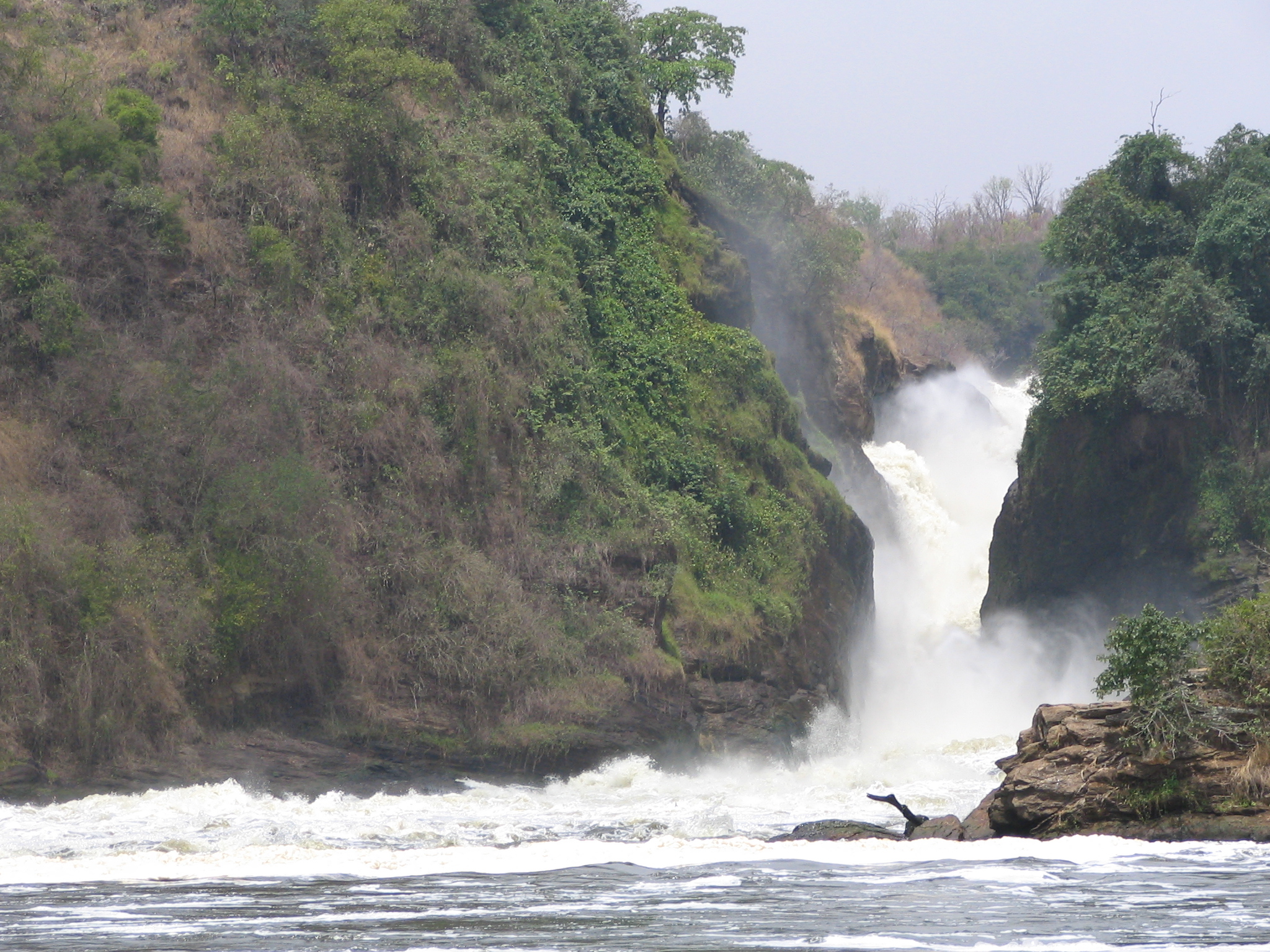
Murchison Falls is the heart and symbol of the park, and one of the most impressive natural spectacles in Africa. Here the Victoria Nile, carrying the water of half a continent, arrives wide and full and is suddenly forced through a crack in the rock just 7 metres wide, rushing through it with a deafening roar and a cloud of spray as it drops some 43 metres. That brutal compression is why Murchison is considered the most powerful waterfall in the world for the force of its water, not its height. You can see it from below, arriving by boat on the Nile almost to the foot of the falls, where the water boils and leaps; or from above, on the hike to the top ('top of the falls'), where you look over the exact spot where the river smashes into the gorge, in a dizzying, deafening view. Next to the main fall is Uhuru Falls, a second channel of water. The power and energy of the place are overwhelming. It is an essential stop, best combining the view from the boat and from the top. Getting there: by boat from Paraa or overland to the upper viewpoint. Best time: all year; even more water after the rains. Tips: do the cruise to the foot and the hike to the top on the same day; bring a light rain jacket for the spray; watch out for slippery rocks at the top.
ℹ️ Distance: In the centre of the park, on the Victoria Nile · Best time to go: All year; peak flow after the rains · Admission: Included in park admission (non-resident USD 45/day; UWA, tariff Jul 2024-Jun 2026, expired 30/06/2026 with no replacement published; checked 08/2026) · Duration: Half a day, combined with the cruise and the hike
2
Nile cruise to the foot of the falls
The upriver boat trip from Paraa to almost the foot of the falls, past hippos, giant crocodiles and birds.
Leer más ↓
The Nile cruise to the foot of the falls is Murchison's star activity and one of the best wildlife river experiences in Africa. The launch boats leave from Paraa and travel about 17 km upriver to get as close as possible to the point where the water plunges, on a trip of about 3 hours there and back. Along the way, the banks offer a constant parade of wildlife: huge gatherings of hippos, enormous Nile crocodiles basking in the sun, elephants and buffalo coming down to drink, and a very rich variety of waterbirds. As it nears the end, the boat stops before the spectacle of water leaping and roaring between the rocks, with the cloud of spray and the thunder of the falls: a sight you won't forget. The trip is calm and lets you photograph wildlife very close up and from water level, a privileged angle. The sunset cruise is especially beautiful for the light. It is an experience suitable for all ages and the perfect complement to game drives. Getting there: cruises leave from the Paraa jetty. Best time: all year; the afternoon gives the best light. Tips: book in advance; there are shared and private launches; bring a hat, water, binoculars and a camera with a telephoto lens.
ℹ️ Distance: From the Paraa jetty, upriver · Best time to go: All year; best in the afternoon · Admission: Non-resident cruise about USD 30 per person (UWA shared boat), plus park admission (check when visiting, July 2026) · Duration: About 3 hours (return)
3
Game drive on the north bank (Buligi sector)
The savannah safari across the plains north of the Nile, with lions, elephants, buffalo and plenty of antelope.
Leer más ↓
The north bank of the Nile, in the Buligi sector (between the river and the delta), is the main stage for Murchison's land safari and one of the best savannah areas in Uganda. Its rolling grasslands, dotted with borassus palms and acacias, hold abundant wildlife: herds of elephants, buffalo, Uganda kob, Jackson's hartebeest, oribi and waterbuck, and the predators that follow them, above all lions (seen relatively easily here) and, with luck, leopards and hyenas. Dawn game drives, when the animals are most active and the light is golden, are the most rewarding; you cross on the Paraa ferry from the south bank and explore the northern track network with a guide. It is a classic, rewarding safari in an open, photogenic landscape, with the Nile always nearby. There is also the option of night drives in some areas to look for nocturnal wildlife. The north is a must for anyone who wants to see the big savannah wildlife and the big cats. Getting there: crossing on the Paraa ferry to the north bank; Buligi sector. Best time: dry seasons; game drive at dawn. Tips: get up early and take the first ferry; bring binoculars and a telephoto lens; hire a ranger-guide who knows where the lions are.
ℹ️ Distance: North bank of the Nile (Buligi sector), crossing at Paraa · Best time to go: Dry seasons; best at dawn · Admission: Included in park admission; ferry and vehicle extra (UWA, check when visiting, July 2026) · Duration: Game drive of 3 to 4 hours
4
Rothschild's giraffes
The best place in the world to see the endangered Rothschild's giraffe, with large herds on the northern plains.
Leer más ↓
Murchison Falls is the world's great refuge for the Rothschild's giraffe (also called the Nubian or Ugandan giraffe), one of the most endangered giraffe subspecies in Africa, recognisable by its unspotted 'white' legs, as if it were wearing stockings. The park holds the largest population of these giraffes on the planet, and seeing them is practically guaranteed: on the plains of the north bank they move in herds, browsing the acacias with their unmistakable elegance, often silhouetted against the sky or beside the borassus palms. The story of these giraffes in Murchison is also a conservation story: after almost disappearing from the park during the poaching years, they recovered, and animals have been moved from here to restock other areas of Uganda, making Murchison a lifeline for the species. Watching them up close, in large groups, is one of the great pleasures of a safari here. They are seen on the northern game drives, often alongside elephants, buffalo and antelope. Getting there: plains of the north bank (Buligi). Best time: dry seasons; they are easy to see all year. Tips: bring a telephoto lens; the best photos are of giraffes with palms or at sunset; ask your guide about the biggest groups.
ℹ️ Distance: Plains on the north bank of the Nile · Best time to go: All year; game drive at dawn or sunset · Admission: Included in park admission (UWA, check when visiting, July 2026) · Duration: During game drives
5
Delta cruise and the shoebill
The downriver boat trip towards the Nile delta and Lake Albert, the best place to look for the prehistoric-looking shoebill.
Leer más ↓
As well as the cruise to the falls, Murchison offers a different boat trip: the delta cruise, downriver from Paraa towards the point where the Victoria Nile opens into a swampy delta before flowing into Lake Albert. These calm waters and their papyrus banks are one of the best places in Uganda (and the world) to spot the shoebill, one of the most sought-after and strangest birds on the planet: a huge, grey, prehistoric-looking bird with a gigantic clog-shaped bill, which hunts motionless in the swamps. The delta cruise, slower and quieter than the one to the falls, is a paradise for birdwatchers: besides the shoebill, you can see many waterbird species, kingfishers, fish eagles, herons and migratory birds, alongside hippos and crocodiles. It is especially recommended for birders and nature lovers, best at dawn, when the shoebill is most active. It is a calm and very special experience, a complement to the classic cruise. Getting there: by boat from Paraa, towards the delta and Lake Albert. Best time: all year; dawn for the shoebill. Tips: book the delta cruise specifically (it is not the same as the one to the falls); bring binoculars and patience; an expert bird guide is recommended.
ℹ️ Distance: From Paraa, downriver towards the delta and Lake Albert · Best time to go: All year; dawn for the shoebill · Admission: Delta cruise depending on route, from about USD 30-45 per person, plus park admission (UWA/operators, check when visiting, July 2026) · Duration: 3 to 4 hours
6
Chimpanzee trekking in Budongo Forest
Tracking wild chimpanzees in Budongo Forest, south of the park, one of the largest mahogany forests in East Africa.
Leer más ↓
At the southern end of the park, Budongo Forest is a great tropical rainforest (the largest mahogany forest in East Africa) that is home to a population of wild chimpanzees and an extraordinary diversity of birds and primates. In the Kaniyo Pabidi sector you can go chimpanzee trekking, following the trackers through the forest until you find these close relatives of humans, in an experience similar to Kibale but on the way to the falls and the savannah. Budongo is also famous for the 'Royal Mile', a stretch of forest considered one of the best places in Africa for forest birdwatching, which draws birders from all over the world. The mix of chimpanzees, birds and an imposing forest makes it a perfect complement to Murchison's savannah safari, adding primates and forest to the Nile and plains wildlife experience. The trek is done with guides and requires a permit; chimpanzee sightings are good, though not as guaranteed as in Kibale. Getting there: Kaniyo Pabidi sector, south of the park, on the Masindi road. Best time: dry seasons for the trails. Tips: book the permit in advance; bring boots, rain gear and repellent; combine it with birdwatching on the Royal Mile.
ℹ️ Distance: Budongo Forest (Kaniyo Pabidi), south of the park · Best time to go: Dry seasons · Admission: Non-resident chimpanzee permit in Budongo, around USD 120-130 per person (UWA, check when visiting, July 2026) · Duration: Half a day (2 to 4 hours)
📶I have never landed without internet. I arrive and my phone connects to the strongest network in the country I am visiting: I can say I landed, sort out transport, book tours and keep posting, at a seriously good price. I always use the Maya eSIM — check their plans by clicking the banner.See plans →Maya Mobile eSIM — connect before you land
What nobody tells you

💵 Prices

Tickets

TypePrice
Entrada al parque (no residente, adulto, por día)USD 45 per person/day non-resident (category A+; children USD 25; foreign resident USD 35, rest of Africa USD 30, East Africa UGX 25.000) (UWA, tariff Jul 2024-Jun 2026, expired 30/06/2026 with no replacement published; checked 08/2026)
Crucero por el Nilo hasta las cataratas (no residente, barco compartido)About USD 30 per person (UWA, check when visiting, July 2026)
Crucero del delta (pico zapato)From about USD 30-45 per person (UWA/operators, check when visiting, July 2026)
Permiso de chimpancés en el bosque de Budongo (no residente)Around USD 120-130 per person (UWA, check when visiting, July 2026)
Ferry de Paraa (cruce del Nilo)Depending on vehicle/passenger (UWA, check when visiting, July 2026)
Vehículo de safari (según capacidad)Separate vehicle fee depending on seats (UWA, check when visiting)
🔄 updated monthlyOfficial / reference values · double-check when buying

Activities and tours

ActivityPriceDurationOperator
Nile cruise to the foot of the fallsAbout USD 30 per person on a shared boat (check when visiting)~3 hUganda Wildlife Authority (Paraa launches)
Hike to the top of the falls (top of the falls)With a ranger-guide, depending on activity; park admission (check when visiting)1 to 2 hUganda Wildlife Authority
Savannah game drive (north bank, Buligi)Included in the package; admission + ferry + vehicle (check when visiting)3 to 4 hSafari operators / UWA
Delta cruise (shoebill watching)From about USD 30-45 per person (check when visiting)3 to 4 hUWA / safari operators
Chimpanzee trekking in Budongo (Kaniyo Pabidi)Permit around USD 120-130 non-resident (check when visiting)Half a dayUganda Wildlife Authority
Birdwatching (Budongo's Royal Mile, delta)With a specialist guide, depending on activity (check when visiting)Half a dayBird guides / UWA
🔄 updated monthlyOfficial / reference values · double-check when buying

🚌 How to get there and distances

Getting around

ModePriceDurationNotes
Safari 4x4 with guide (game drives)Included in the safari package (check when visiting)VariableThe usual way to explore the park; a 4x4 is needed; the best wildlife is on the north bank (Buligi)
Nile launch (falls and delta)From about USD 30 per person shared (check when visiting)3 to 4 hDeparting from the Paraa jetty; shared or private option; there is a cruise to the falls and a delta cruise
Paraa Ferry (Nile crossing)Per vehicle/passenger (check on arrival)Short crossing at fixed timesConnects the south bank (access points, lodges) with the north bank (game drives); check the schedule
Scheduled/charter flight to Pakuba or BugunguDepends on route (Aerolink and charters, check on arrival)~1 to 1.5 h from Entebbe/KajjansiSaves the hours on the road; lodges arrange the transfer from the airstrip
🔄 updated monthlyOfficial / reference values · double-check when buying

How to get there

RouteAirlines / operatorsAvg. priceDuration
Kampala → Murchison Falls National Park by roadSafari operators in 4x4s; buses to MasindiDepends on package; bus to Masindi from about UGX 25.000-40.000 (check on arrival)5 to 6 h (300-320 km, via Ziwa)
Ziwa Rhino Sanctuary → Murchison FallsSafari operatorsDepends on package (check on arrival)2 to 3 h (Ziwa is on the way from Kampala)
Entebbe/Kajjansi → Pakuba / Bugungu (flight)Aerolink Uganda and chartersDepends on airfare (check on arrival)~1 to 1.5 h
Masindi → park gates (Kichumbanyobo/Bugungu)Operator or 4x4Depends on transport (check on arrival)1 to 2 h
Murchison Falls → Kibale / Queen Elizabeth (circuit)Safari operatorsDepends on package (check on arrival)Kibale/Fort Portal 5-6 h; long transfer west
🔄 updated monthlyOfficial / reference values · double-check when buying

🏨 Where to stay

No exact prices: a scale from $ (budget) to $$$$$ (luxury), with 2-3 options per category.

Luxury lodges and tented camps
Price$$$$$
Recommended options
From about USD 250-700+ per person/night (full board and safaris); examples include Paraa Safari Lodge (historic, overlooking the Nile), Chobe Safari Lodge or Nile Safari Lodge, with river views
Mid-range lodges and camps
Price$$$$$
Recommended options
Approx. USD 100-250 per person/night; comfortable options in and around the park such as Murchison River Lodge, Pakuba Safari Lodge or Fort Murchison
Budget bandas, hostels and campsites
Price$$$$$
Recommended options
From about USD 30-100 per person/night; UWA bandas, campsites inside the park and guesthouses in Masindi, used by budget safaris and groups

🍴 Where to eat

Comedores de lodge (pensión completa)
Price$$$$$
Options / signature dish
Included in the rate; buffets and set menus at the lodge, dinners overlooking the Nile, safari breakfasts and picnic boxes for game drives
Restaurantes de campamentos y lodges de gama media
Price$$$$$
Options / signature dish
From about USD 10-25 per person; international and Ugandan food in and around the park
Comida local en Masindi y pueblos de acceso
Price$$$$$
Options / signature dish
From about USD 3-10; Ugandan food (matoke, posho, beans, goat, Nile tilapia) and chapati at restaurants and stalls in Masindi

📖 History of Murchison Falls National Park

Origins, formation and what the sources say.

The Nile and the gorge of the falls

The natural history of Murchison is, above all, the story of the Nile. After rising from Lake Victoria at Jinja, the world's longest river crosses Uganda as the Victoria Nile until it reaches this north-western region, where it meets a geological barrier: the edge of the Albertine Rift, the great fracture in the Earth's crust that runs through East Africa. There, hard rock forces the mighty river to squeeze through a cleft barely 7 metres wide, through which it plunges with tremendous force.

That gorge and its drop are the result of millions of years of erosion and of tectonic activity along the Rift. The outcome is one of the most powerful waterfalls on the planet: not the tallest, but one with the greatest force of concentrated water, enough to create a deafening roar and a permanent cloud of spray. Below the falls, the Nile calms down, widens and forms a swampy delta before emptying into Lake Albert. From there it continues its journey north as the Albert Nile, towards Sudan, Egypt and the Mediterranean.

This stretch of the Nile, with its waterfall, its river full of hippos and crocodiles and its delta rich in birdlife, is the axis around which all life in the park is organised. The water draws the wildlife, shapes the routes of safaris and boat cruises, and gives Murchison its unique character as a park crossed by one of the most legendary rivers in human history.

en.wikipedia.org · Murchison Fallsen.wikipedia.org · Murchison Falls National Park

Samuel Baker and the search for the source of the Nile

For the European world, the falls entered history in the 1860s, at the height of the race to find the source of the Nile, one of the great geographical puzzles of the age. The British explorer Samuel White Baker, together with his wife Florence (a remarkable woman who joined him on all his expeditions), travelled up the Nile from the north in search of its origins. In 1864 he reached this area, where he 'discovered' for the West the great lake he named Lake Albert and the mighty waterfall.

Baker named the falls Murchison, in honour of Sir Roderick Murchison, then president of the Royal Geographical Society in London, the institution driving the exploration of Africa. It was one of many names European explorers gave to places that African peoples had known and named for centuries, but this is how they were recorded on the maps of the empire. The Bakers' feat, told in their books, made the region famous in Europe.

Those years of exploration, with figures such as Speke, Burton, Livingstone, Stanley and the Bakers, marked the start of European interest in the Great Lakes region, which would eventually lead to colonisation. The Nile and its falls, sought for so long, became symbols of 19th-century geographical adventure, and Murchison Falls was etched into the popular imagination as one of the great landmarks in the exploration of Africa.

en.wikipedia.org · Samuel Bakeren.wikipedia.org · Murchison Falls

The birth of a great safari park

In the 20th century, under British colonial rule, the region's extraordinary wealth of wildlife led to its protection. The area was first declared a game reserve and, in 1952, it was established as Murchison Falls National Park, the largest in Uganda and one of the first. In its early decades the park became one of the great safari destinations of East Africa, famous for its huge populations of elephants, hippos, rhinos, giraffes and lions, and for the spectacle of the Nile and its waterfall.

In those golden years, Murchison welcomed distinguished travellers and film stars. Scenes from films were shot here, and figures such as Ernest Hemingway (who survived two light-aircraft crashes nearby in 1954) added to its fame. The historic Paraa Safari Lodge, overlooking the Nile, and the river cruises were symbols of the classic African safari. The park seemed to have it all: abundant wildlife, a legendary river and a spectacular waterfall.

In many ways it was the jewel in the crown of Uganda's parks, a place where African nature showed itself in all its splendour. But that golden age was about to give way to one of the darkest chapters in its history, when politics and war swept over Uganda and, with it, over its wildlife.

en.wikipedia.org · Murchison Falls National Parkugandawildlife.org · Murchison falls national park

War, poaching and devastation

The 1970s and 1980s were catastrophic for Murchison, as they were for all of Uganda's wildlife. Idi Amin's dictatorship (1971-1979) and the wars that followed plunged the country into chaos and violence, and the protected areas were left defenceless against large-scale poaching. Soldiers, militiamen and hunters decimated the park's wildlife with automatic weapons: elephants were slaughtered for their ivory, and the rhinos disappeared completely, killed down to the very last one.

Under Amin's regime the park was even renamed Kabalega Falls, after a king of Bunyoro who resisted the British, although it later got its original name back. Animal populations collapsed: of the tens of thousands of elephants and the great herds of other species, only remnants survived. The tourist infrastructure fell into ruin, the lodges decayed, and Murchison, once the pride of East Africa, was left empty and devastated.

The loss of the rhinos was especially symbolic and painful: both the white and the black rhino went extinct across the whole of Uganda during those years. Bringing back that lost wildlife would take decades, and some animals, like the rhinos, could only return through costly reintroduction programmes, such as the one at the Ziwa sanctuary, well into the 21st century. Murchison thus became a painful example of what war and greed can do to nature.

en.wikipedia.org · Murchison Falls National Parkugandawildlife.org · Murchison falls national park

Murchison today: recovery and a star park

With the return of stability to Uganda from the late 1980s onwards, Murchison began a slow but remarkable recovery. Under the management of the Uganda Wildlife Authority, better anti-poaching patrols, the natural recovery of wildlife and the revival of tourism allowed the park to fill with life again. Elephant numbers grew once more, Rothschild's giraffes thrived to the point of making Murchison their main stronghold in the world, and lions, buffaloes and antelopes rebuilt their populations.

Today Murchison Falls is once again Uganda's star park: the largest, one of the most visited and one of the most complete. In a single destination it offers a savannah safari with lions, elephants and giraffes, the spectacle of the Nile at its most powerful waterfall, boat cruises among hippos and crocodiles, the shoebill of the delta and the chimpanzees of Budongo Forest. Its recovery is one of the great success stories of Ugandan conservation.

The park does face new challenges, though, such as the pressure from oil exploration and extraction in the Lake Albert basin, which raises questions about the future of this ecosystem. Even so, the story of Murchison, from the exploration of the Nile to the golden age of safari, and from the devastation of war to recovery, sums up the journey of conservation in Uganda: a country that came close to losing its most iconic wildlife and that, against all odds, managed to bring its largest park, and the banks of its most legendary river, back to life.

ugandawildlife.org · Murchison falls national parken.wikipedia.org · Murchison Falls National Park

📚 Bibliography

  • Uganda Wildlife Authority — Murchison Falls National Park: https://ugandawildlife.org/national-parks/murchison-falls-national-park/
  • Wikipedia (ES) — «Cataratas Murchison»: https://es.wikipedia.org/wiki/Cataratas_Murchison
  • Wikipedia (EN) — «Murchison Falls National Park»: https://en.wikipedia.org/wiki/Murchison_Falls_National_Park
  • Wikipedia (EN) — «Murchison Falls»: https://en.wikipedia.org/wiki/Murchison_Falls
  • Wikipedia (EN) — «Samuel Baker»: https://en.wikipedia.org/wiki/Samuel_Baker
  • Wikipedia (EN) — «Rothschild's giraffe»: https://en.wikipedia.org/wiki/Rothschild%27s_giraffe
  • Wikipedia (EN) — «Budongo Forest»: https://en.wikipedia.org/wiki/Budongo_Forest
  • Uganda Tourism Board — Murchison Falls NP: https://utb.go.ug/
  • Diary of a Muzungu — UWA conservation fees 2024 to 2026: https://www.muzungubloguganda.com/conservation/uwa-revises-conservation-fees-2024-to-2026/
  • Britannica — «Murchison Falls»: https://www.britannica.com/place/Murchison-Falls

❓ Frequently asked questions

Why are Murchison Falls famous?+
Because they are one of the most powerful waterfalls in the world: the Victoria Nile, wide and full, is forced through a gap in the rock barely 7 metres wide and plunges some 43 metres with tremendous force and a deafening roar. They don't stand out for their height, but for the sheer volume of water squeezed into such a small space. You can see them from below (by boat, getting almost to the foot of the falls) and from above (on the hike to the top), and both views are impressive.
Is the Nile cruise worth it?+
Yes, it's the park's star activity. The cruise heads up the Nile from Paraa for about 17 km to near the foot of the falls, in around 3 hours, and along the way you see huge numbers of hippos, giant Nile crocodiles, elephants, buffalo and lots of birds, all from the water and up close. It costs about USD 30 per person on a shared boat (plus park entry). There is also a delta cruise, downriver, ideal for spotting the shoebill. It's one of the best river-based wildlife experiences in Africa.
What animals can you see in Murchison Falls?+
On the northern savannah (Buligi sector) you'll see elephants, lions, buffalo, Uganda kob, hartebeest, oribi and Rothschild's giraffes — Murchison is the best place in the world to see them. On the Nile, loads of hippos and giant crocodiles; in the delta, the prehistoric-looking shoebill and plenty of birds; and in Budongo Forest, to the south, chimpanzees. There are no rhinos inside the park (to see them, visit Ziwa Rhino Sanctuary, on the way from Kampala). It's a very complete park, with more than 450 bird species.
Can I see chimpanzees in Murchison?+
Yes, in Budongo Forest, in the south of the park (Kaniyo Pabidi sector). Chimpanzee trekking requires a permit from the Uganda Wildlife Authority (around USD 120-130 for non-residents), and you follow the trackers through the forest. Sightings are good, though not as guaranteed as in Kibale. Budongo is also one of the best places in Africa for forest birdwatching (the famous 'Royal Mile'). It's a great add-on to bring primates and forest into a savannah and Nile safari.
How do I get to Murchison and what can I combine on the way?+
It's about 300-320 km from Kampala (5-6 hours by road, mostly paved), and on the way you pass Ziwa Rhino Sanctuary, an almost essential stop to see rhinos on foot (there are none in the park). You can get there by 4x4 with an operator or your own vehicle, or by light aircraft to Pakuba/Bugungu. With 2-3 days you can enjoy the falls, the cruise, the northern game drives and, with more time, the delta and Budongo's chimpanzees. It's a destination you can do on its own or as part of a wider circuit.

More places in Uganda

Parque Nacional Reina IsabelParque Nacional del Valle de KidepoSantuario de Rinocerontes de ZiwaEntebbeFuente del NiloJinja
See every place in Uganda →The history of Uganda →
Sources consulted (6)
Still planning?
Explore more destinations in Uganda
See all destinations →
Image credits
Photos from Wikimedia Commons, each under its own licence (CC BY, CC BY-SA or public domain). Open each file to see its author and licence.
Murchison Falls - by Boschlech