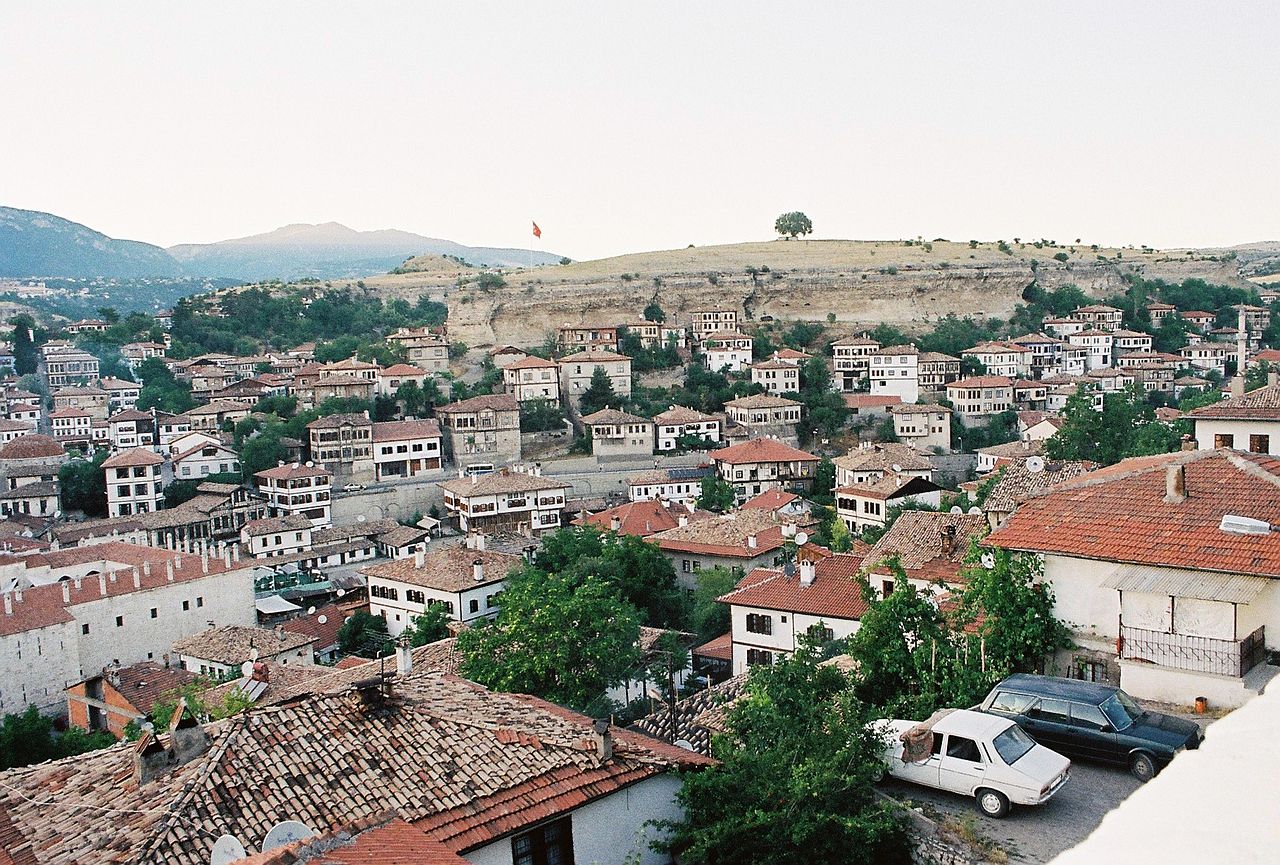
Stepping into Safranbolu's old town is like walking through a door into the past. At the bottom of a valley, among the hills of northern Anatolia, an 18th- and 19th-century Ottoman town survives almost intact: hundreds of timber and adobe houses with bay windows jutting over the streets, red-tiled roofs, courtyards with fountains, mosques, Turkish baths, an old caravanserai and cobbled streets once travelled by merchants' caravans. It is one of the best-preserved ensembles of Ottoman domestic architecture in the world, which is why UNESCO declared it a World Heritage Site.
Safranbolu owes its name and much of its history to saffron, the world's most expensive spice, grown in the surrounding fields and the source of its merchants' wealth. It was an important trading centre on the caravan routes between the Black Sea and the interior, and that wealth turned into the beautiful mansions (konak) we admire today, many of them now charming hotels and tea houses. Strolling through its bazaars of blacksmiths, shoemakers and artisans, having tea in an Ottoman courtyard or sleeping in a two-hundred-year-old house is a journey back in time.
This guide helps you make the most of your visit: which houses and monuments to see, where to find the best viewpoint, what to buy (saffron, sweets, copper), where to stay in a historic konak, which trips to take in the surroundings (villages, canyons, caves) and how to get there from Ankara or Istanbul. Safranbolu is a perfect getaway for anyone who wants to experience the most authentic Ottoman Turkey, away from the crowds, and get lost in a period setting that is still alive and lived in. A town with soul, ideal for switching off for a couple of days.
Safranbolu has very ancient roots —Hittites, Phrygians, Lydians, Romans and Byzantines all passed through the area— but its present appearance was shaped in the Ottoman era. Located on a caravan route linking the Anatolian interior with the port of Sinop on the Black Sea, the town prospered between the 17th and 19th centuries thanks to trade and crafts (tanners, blacksmiths, shoemakers, coppersmiths) and, above all, to saffron cultivation, from which it took its name. That prosperity allowed its merchants to build the magnificent timber houses that survive to this day. The town had distinct quarters: the bazaar quarter (Çarşı), in the valley, inhabited mainly by Muslims; and the upper quarter (Kıranköy), home to a large Greek Orthodox community that left with the population exchange of 1923. Bypassed by the new routes and by industrial development (which concentrated in neighbouring Karabük with its steelworks), Safranbolu was 'frozen' in time, which saved its historic centre. In 1994 it was declared a World Heritage Site. The whole story is told on our history page.
Read the full history ↓The heart of the Anatolian plateau: the land of Hittites and Phrygians, Atatürk's capital of Ankara, the Christian Cappadocia of the rock-cut churches, the Konya of the dervishes and Ottoman Safranbolu.
Read the history of Central Anatolia and the Black Sea →They depart from Ankara, 147 km away. If you book from this link we earn a commission and you pay no more.
No exact prices: a scale from $ (budget) to $$$$$ (luxury), with 2-3 options per category.
Origins, formation and what the sources say.
The valley where Safranbolu lies hidden has been inhabited since very ancient times. Hittites, Phrygians and Lydians all passed through this part of northern Anatolia, between the plateau and the Black Sea mountains, followed in classical antiquity by Greeks, Romans and Byzantines. There was a settlement here in Roman and Byzantine times; the region was part of Paphlagonia, a mountainous and somewhat remote land. But the town we admire today, with its unmistakable Ottoman feel, is the product of a much later period and of a very specific geography: its location on a caravan route.
Safranbolu stood on the road linking inner Anatolia with the port of Sinop, on the Black Sea coast, and with the trade routes that crossed the region. That flow of merchants and goods was the key to its prosperity. The town became a centre of trade and craftsmanship, with guilds of tanners, blacksmiths, shoemakers, saddlers and coppersmiths. It was also a stop where caravans rested in large fortified inns (the han, or caravanserais), such as the Cinci Han, which still survives.
And then there was saffron. In the surrounding fields people grew, and still grow, saffron (safran in Turkish), the most expensive spice in the world. It comes from the delicate stigmas of a flower harvested by hand during a short window in autumn. This valuable crop gave the town its name, Safranbolu ('the city of saffron'), and added to its wealth. Trade, craftsmanship and saffron: these three pillars gave rise to the Safranbolu that flourished in Ottoman times.
It was under the Ottoman Empire, especially between the 17th and 19th centuries, that Safranbolu reached its height and took on the look that makes it unique today. Thriving trade and crafts allowed the town's wealthy families to build the magnificent wooden houses (konak) that make up its historic centre. These are two- or three-storey mansions with timber frames filled with adobe, bay windows jutting out over the streets, wide eaves, inner courtyards, carved wooden ceilings, built-in cupboards and even fountains in the reception rooms. They are among the best-preserved examples of Ottoman domestic architecture.
The town was divided into districts with different roles. At the bottom of the valley lay the Çarşı, the bazaar quarter, with workshops, guild markets, caravanserais, Turkish baths and mosques. This was the commercial and working heart of the town, home mostly to Muslims and to the winter houses. On the hillsides, in the Bağlar quarter ('the vineyards'), stood the airier summer houses with their gardens. And in the upper area of Kıranköy lived a large community of Greek-speaking Orthodox Christians, who lived alongside the Muslim majority and had their own churches.
Safranbolu was also the birthplace of distinguished figures of the Empire. It produced several grand viziers (the sultan's heads of government), such as İzzet Mehmet Paşa and members of the famous Köprülü family, who paid for mosques and other works in their home town. That political and economic weight showed in the quality of its monuments. The town enjoyed centuries of prosperous, stable life, its rhythm set by the caravans, the guilds, saffron and the seasons. Nobody suspected that one day its greatest treasure would be precisely the fact that it had stood still in time.
As in many Ottoman towns in Anatolia, communities of different faiths lived side by side in Safranbolu for centuries. Alongside the Turkish Muslim majority, a prosperous community of Greek-speaking Orthodox Christians lived in the upper quarter of Kıranköy, also working in trade and crafts. They had their own churches, schools and community life, and they took part in the town's economy. This mix of faiths and cultures was part of the character of Ottoman Safranbolu, a diverse world typical of the empire.
That world came to an end in the first quarter of the 20th century. After the fall of the Ottoman Empire, the First World War and the Greco-Turkish War (1919-1922), Greece and Turkey signed the Treaty of Lausanne (1923). It included a compulsory population exchange based on religion: the Orthodox Christians of Anatolia were sent to Greece, and the Muslims of Greece to Turkey. The Greek Orthodox people of Safranbolu had to leave, abandoning their houses and churches in the Kıranköy quarter. It was a painful uprooting that ended centuries of coexistence.
The churches of Kıranköy remained. Some were turned into mosques, while others survive as a reminder of that vanished community. The departure of the Greeks, together with the economic changes that followed, cost Safranbolu part of its population and its energy. It was the start of a decline that, paradoxically, would save its heritage: with growth and new building at a standstill, the old Ottoman houses were neither demolished nor replaced by modern buildings.
The 20th century brought a decisive change to the region, but it happened next door rather than in Safranbolu itself. In the 1930s, the young Republic of Turkey decided to build a large steelworks, one of the first in the country, in the nearby town of Karabük, just a few kilometres away. Karabük grew into a modern industrial city that drew in the area's development, industry, jobs and urban expansion. Safranbolu, on the other hand, was left out of that modernisation.
Without anyone planning it, this was a huge stroke of luck for its heritage. Because it neither grew nor industrialised, Safranbolu escaped the wave of demolitions and concrete apartment blocks that swept away the historic centres of so many Turkish towns during the 20th century. Its hundreds of wooden Ottoman houses stayed standing. Some were lived in and some were abandoned, but as a whole they survived intact. The town was 'frozen' in time, keeping its street plan, its atmosphere and its architecture like a time capsule of the Ottoman past.
From the 1970s and 1980s onwards, as people began to value historic heritage, Safranbolu was recognised as a treasure. Plans were launched to protect and restore its houses, and in 1994 Unesco made it a World Heritage Site as an outstanding example of an Ottoman town, with its traditional architecture, layout and way of life preserved. What had been an economic decline became its greatest asset: an almost intact Ottoman town, unique in the world.
Since it became a World Heritage Site in 1994, Safranbolu has been reborn through tourism, but in a way that has kept its character. Many of its Ottoman mansions have been carefully restored and turned into charming hotels, restaurants, tea houses and museums, giving the old town new life without spoiling it. Today visitors can sleep in a two-hundred-year-old house, drink tea in an Ottoman courtyard, bathe in a 17th-century hammam and stroll through bazaars where blacksmiths and craftspeople are still at work.
The town has become one of the favourite destinations for Turkish domestic tourists and for travellers from neighbouring countries and all over the world, especially as a weekend getaway from Ankara or Istanbul. It still produces its famous saffron and its sweets (Safranbolu lokum is well known), and it keeps its craft traditions alive, which are now a tourist attraction too. The surroundings, with the Ottoman village of Yörük Köyü and the area's canyons and caves, round out what it has to offer.
The challenge for Safranbolu today is to balance its success with tourists against protecting its heritage and authenticity, so that it doesn't become an empty stage set. So far it has managed this quite well: it is a lived-in town, with residents and a life of its own, not just a museum. Walking its cobbled streets at sunset, with the wooden houses glowing golden in the light and the smell of bread and sweets in the air, is one of the most endearing experiences of a trip to Turkey. It is a journey back in time to an Ottoman way of life that, here, you can still reach out and touch.