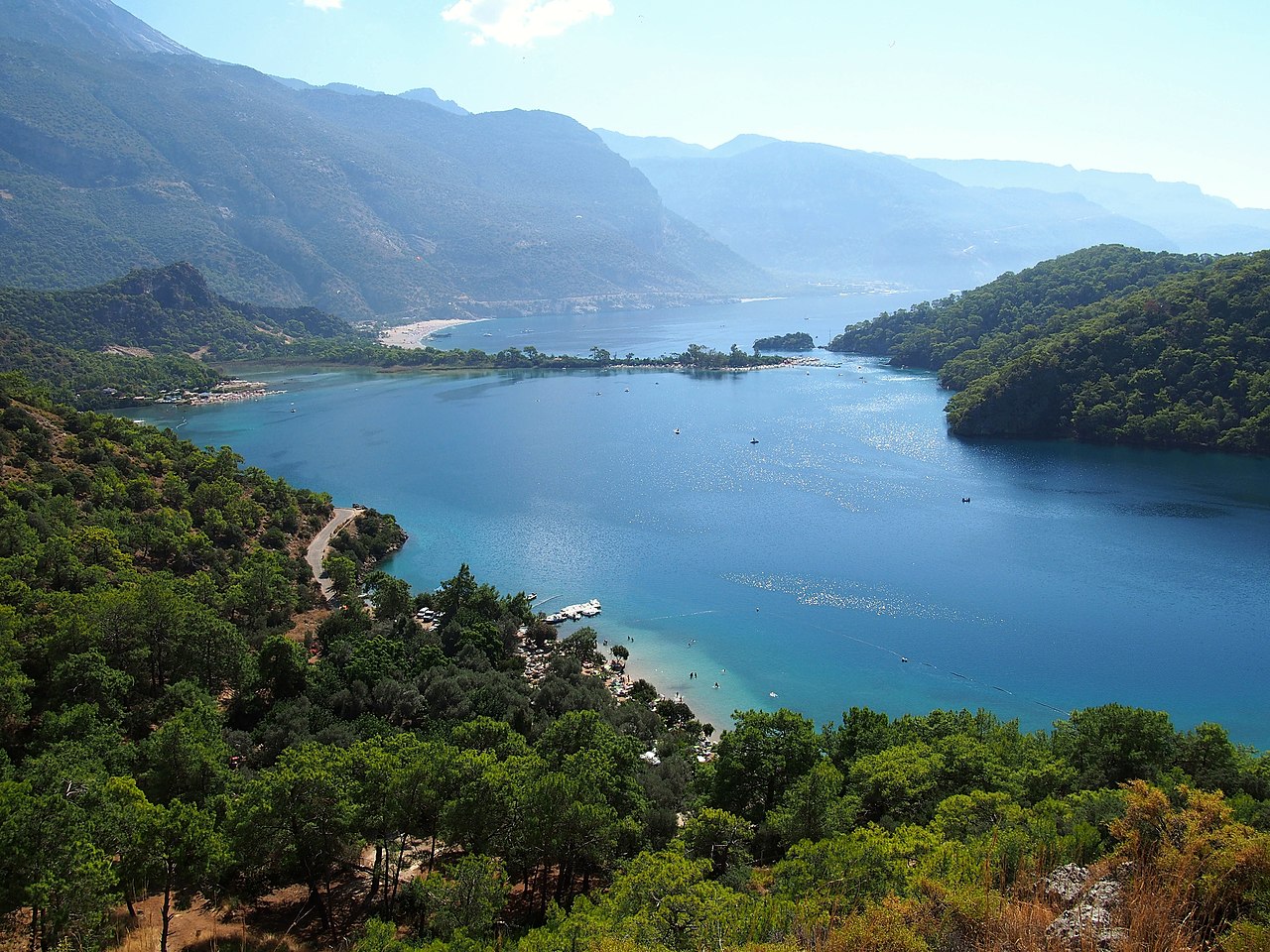
Fethiye is the grand gateway to the Turquoise Coast, the stretch of south-west Turkey's coastline where the sea changes colour as if it had a life of its own. Its signature view is Ölüdeniz: a lagoon of calm, green and blue water, tucked between pine-covered mountains and separated from the open sea by a spit of sand and pebbles. It is one of the most famous beach landscapes in the country, and above it, almost all day long, dozens of paragliders glide down after taking off from Mount Babadağ, at almost 2,000 metres. But Fethiye is much more than its star lagoon.
The town itself is a lively port, with a marina, a fish market, bars and a small old quarter overlooked by Lycian tombs carved into the rock more than two thousand years ago. From here you can take the classic boat trips around the 12 islands of the gulf, and reach the spectacular Saklıkent Canyon, the ghost village of Kayaköy and dreamy coves such as Butterfly Valley or Kabak. And through its mountains runs the Lycian Way, one of the most beautiful long-distance trails in the Mediterranean, following the coast past ancient ruins, hidden beaches and villages.
This guide helps you organise all of that with concrete details: how much paragliding costs and when to go, which boat to choose, how to get to the blue lagoon and the canyons, where to sleep and eat well without being overcharged, and how to get around the area by dolmuş. Fethiye is one of those places that works just as well for lazing around on the beach for a few days as for heading out to hike and snorkel in an incredible sea. A destination that combines relaxation, adventure and ancient history on the shores of Turkey's most beautiful sea.
Fethiye stands on the site of ancient Telmessos, one of the most important cities of Lycia, the federation of peoples who lived on this coast in antiquity and were famous for their independence and their monumental rock-cut tombs. The most impressive, the Tomb of Amyntas, from the 4th century BC, with a facade like a Greek temple, still overlooks the town from the hillside. Telmessos was renowned in the ancient world for its soothsayers; it passed through Persian, Greek, Roman and Byzantine hands, and later came under Ottoman rule under the name Meğri. In the 20th century it was renamed Fethiye in honour of an aviator, and two major earthquakes (1856 and 1957) destroyed much of the old town. Until 1923 the area had a large Greek Orthodox population, which left during the population exchange between Greece and Turkey, leaving entire villages empty, such as nearby Kayaköy. All of that history, from the Lycians to the present day, is told on our history page.
Read the full history ↓The Turkish Riviera: the coast of Pamphylia and Lycia, with Antalya and its Roman ruins, the Lycian rock-cut tombs, the Turquoise Coast and the land of the real Saint Nicholas.
Read the history of Mediterranean →If you book from here we earn a commission and you pay no more. Prices and availability come from Civitatis.
No exact prices: a scale from $ (budget) to $$$$$ (luxury), with 2-3 options per category.
Origins, formation and what the sources say.
Before it was Fethiye, this city was called Telmessos and was one of the strongholds of Lycia, one of the most original civilisations of the ancient world. The Lycians lived on this mountainous coast of south-western Anatolia from at least the second millennium BC; Hittite texts mention them as the 'Lukka', and Homer lists them among the allies of Troy in the Iliad. They spoke their own language, related to ancient Anatolian, which was written in an alphabet derived from Greek and is still only partly understood today.
What made the Lycians famous was the way they buried their dead. They believed that souls were carried away by winged beings, so they carved monumental tombs high up on the cliffs, with façades that imitated the wooden houses of the living or Greek temples, so that the eternal home would be as close to the sky as possible. Fethiye's gem is the Tomb of Amyntas, from the 4th century BC, cut into the rock face above the city, with two Ionic columns and a sculpted pediment: a masterpiece you can still climb up to see. Around the streets of the old town you'll also come across Lycian stone sarcophagi, with lids shaped like an upturned ship's keel.
In ancient times Telmessos was famous for something else as well: its seers. The city's priests were said to be masters at reading the flight of birds and interpreting dreams, and kings and generals came to consult them, including, according to tradition, the court of Alexander the Great. Lycia was a federation of cities with shared institutions — a kind of parliament — that many historians consider one of the earliest examples of representative government, a model that the drafters of the United States Constitution admired centuries later.
Like the rest of Lycia, Telmessos passed through the hands of the great powers that fought over the eastern Mediterranean. It was under the Persian Empire until 334 BC, when Alexander the Great conquered it on his march east. After the Macedonian's death, the city fell into the orbit of his successor generals — the Ptolemies of Egypt and the Seleucids of Syria — and later the Kingdom of Pergamon, until the whole region came under Roman rule in the 2nd century BC.
Under Roman rule, Lycia enjoyed centuries of prosperity. Telmessos was a busy port city, with trade, a theatre and public buildings, some of whose remains survive today. The Lycian League, the old federation, carried on as a form of local organisation within the Empire, a rare case of institutional continuity. When the Roman Empire split, the city became part of the Byzantine Empire and the seat of a Christian bishopric; in this period its name changed to Anastasiopolis and later to Makri (or Meğri, 'distant'), the name it would keep throughout the Middle Ages.
The region gradually lost importance as trade routes shifted and raids and the decline of Byzantium took their toll on the coast. From the 11th and 12th centuries, with the arrival of the Seljuk Turks in Anatolia, and later the beyliks (Turkish principalities) and the Ottoman Empire, Lycia stopped being a centre of power and became a land of fishing and farming villages, with ancient ruins peeking out among the pine forests. The old Telmessos, now Meğri, remained a small but lively port.
During the Ottoman centuries, Meğri was a port town on the Anatolian coast home to two communities living side by side: Muslim Turks and Orthodox Greeks. The Greeks, distant heirs of the region's Byzantine population, made up a large share of the merchants, craftsmen and farmers, and had their own churches, schools and neighbourhoods. The most visible example was neighbouring Levissi (today Kayaköy), a prosperous Greek village of stone houses climbing up the hillside, with thousands of inhabitants, two large churches and a busy community life.
That coexistence came to an abrupt end in the early 20th century. After the First World War, the Ottoman defeat and the Greco-Turkish War (1919-1922), which ended in victory for the Turkish national movement led by Mustafa Kemal Atatürk, the two countries signed the Treaty of Lausanne (1923), which included a compulsory population exchange. Around one and a half million Orthodox Greeks from Anatolia were sent to Greece, and several hundred thousand Muslims from Greece to Turkey. It was a massive, traumatic uprooting, decided by the states on the basis of religion, which tore entire communities apart.
In Meğri, the Greeks had to leave. In Levissi, the Muslim settlers who were meant to replace them — many of them from Greece — barely settled in, partly because they weren't used to the local farming, and the village gradually emptied. An earthquake in 1957 sealed its abandonment. That's how the 'ghost town' of Kayaköy was born, with its hundreds of roofless houses and ruined churches, today one of the most evocative places on the Turquoise Coast and a silent monument to that lost coexistence and to the wounds of forced population exchanges.
In the young Republic of Turkey, founded in 1923, the city was given its current name. In 1934, Meğri was renamed Fethiye in honour of Fethi Bey (Tayfur Sadık, known as Fethi), one of the first Turkish military pilots, who died in a plane crash in 1914. It was part of the new republic's policy of renewing names and symbols, leaving the Ottoman era behind and strengthening Turkish national identity. The ancient name, Telmessos, was kept for the archaeological site.
Fethiye's 20th-century history is marked by earthquakes. The city sits in a seismic zone, and two major quakes hit it hard. The 1856 earthquake had already damaged old Meğri, but the powerful 1957 one almost completely destroyed the city, much of which had to be rebuilt. That's why Fethiye's town centre is mostly modern, and the little that survived from the ancient past — the Tomb of Amyntas, the Lycian sarcophagi, some remains of the medieval castle of the Knights of Rhodes — sits alongside new buildings.
For decades, Fethiye remained a quiet port of fishermen and farmers, living off agriculture (cotton, tobacco, citrus fruit) and the sea. Nothing suggested that this corner of the coast would become, by the end of the 20th century, one of Turkey's great tourist destinations. The key lay just a few kilometres away: a turquoise lagoon called Ölüdeniz, and a mountain perfect for launching yourself into thin air.
Fethiye took off as a destination with Turkey's coastal tourism boom in the 1980s and 1990s. The image of the blue lagoon at Ölüdeniz, one of the most photographed beaches in the country, travelled the world on brochures, postcards and tourism campaigns, and turned this stretch of coastline into a byword for the 'Turquoise Coast'. The fishing villages filled up with hotels, guesthouses and restaurants, and Fethiye's marina became the base for the fleet of wooden gulets that run blue cruises along the coast.
Two activities made its name internationally. The first was paragliding: Mount Babadağ, almost 2,000 metres high right above Ölüdeniz, turned out to be one of the best take-off spots in the world, with flights gliding over the lagoon before landing on the beach. Fethiye became a global mecca for tandem paragliding, with thousands of flights a year. The second was hiking: in the late 1990s, British researcher Kate Clow waymarked the Lycian Way, a trail of more than 500 km that follows the coast past ancient ruins and coves, with Fethiye/Ölüdeniz at one end. It has been named several times among the best long-distance trails on the planet.
Today Fethiye is a mature destination that combines sun-and-beach tourism with adventure, history and nature. It welcomes visitors from all over Europe — lots of Britons, Germans and Eastern Europeans — as well as a growing number of Turks and travellers from around the world. The city is trying to balance that success with protecting places like Ölüdeniz, Kayaköy and Saklıkent Canyon, all of which are now protected. From the tombs of the Lycians to the paragliders crossing the sky, Fethiye sums up more than three thousand years of history on the shores of one of the most beautiful seas in the Mediterranean, and it's still an ideal gateway for travellers to discover coastal Turkey.