Viajá con Gus
Home › Sri Lanka › Kandy
Kandy
🇱🇰 Sri Lanka · Mountains and highlands

Kandy

🪪 What do I need to enter Sri Lanka?Pick your citizenship and we tell you the visa, the days and the paperwork, with the official source.

By leaving your email and citizenship you agree to receive the documents you asked for and weekly travel news. You can unsubscribe whenever you want. How we handle your data.
Jump to what you need
📍Region
Kandy is Sri Lanka's second city and the country's cultural and spiritual capital. It sits in the foothills of the central highlands, about 500 metres up, around an artificial lake and surrounded by green hills. It was the last capital of the independent Sinhalese kings, who held out here against the Portuguese and the Dutch until they fell to the British in 1815. Its jewel is the Temple of the Sacred Tooth (Sri Dalada Maligawa), which holds the relic of the Buddha's tooth, the most revered object in Sinhalese Buddhism. Kandy is a World Heritage Site and also hosts the spectacular Esala Perahera procession.
📌Best time
Thanks to its altitude, Kandy has a cooler, more pleasant climate than the lowlands (18-30 °C), but it gets quite a lot of rain. The driest periods are usually January to April and July to September. The highlight of the year is the Esala Perahera, the great procession of the tooth, held in July or August (it follows the lunar calendar and runs for about ten days up to the Esala full moon). If your dates match, it's a unique spectacle, but the city fills up and prices rise, so book well in advance. The rest of the year, Kandy is fine to visit in any season, as long as you keep an umbrella handy.
📌Suggested days
One full day covers the essentials: the Temple of the Tooth, a walk around the lake and the old town, a Kandyan dance show and, if there's time, the Bahirawakanda Buddha at sunset. With 2 days you can add the superb Peradeniya Botanical Gardens, the temples in the surrounding area (Gadaladeniya, Lankatilaka, Embekka), a walk in the Udawattakele forest and more time in the city. Kandy is also where the legendary mountain train to Nuwara Eliya and Ella starts, so many travellers use it as the hinge between the Cultural Triangle and the tea highlands.
📌Getting there
Kandy has very good connections. By train, the mountain line links it with Colombo (about 2,5-3,5 h, a lovely ride), and above all it's the start of the famous scenic stretch to Nanu Oya (Nuwara Eliya) and Ella. By car or bus, Colombo is ~3-4 h away by road, Dambulla ~2-2,5 h, Sigiriya ~2,5-3 h and Nuwara Eliya ~2,5-3 h. Buses run very frequently in every direction. Kandy station is in the centre. Important: Cyclone Ditwah (December 2025) damaged sections of the mountain line and services were limited, so check the state of the train before you travel (verified July 2026).
📌Getting around
Central Kandy, around the lake and the Temple of the Tooth, is easy to explore on foot, though the city has heavy traffic and a few hills. For longer distances (Bahirawakanda, Peradeniya, the station, the temples in the surrounding area), a tuk-tuk is the most practical option. Use the PickMe app, which fixes the fare, or agree on the price before you get in. There are also cars with drivers and cheap city buses. At the Temple of the Tooth you need modest clothing (shoulders and legs covered), and you take your shoes off inside the sacred area.
📌Language and currency
Sinhala and Tamil are spoken, and English works well in hotels, restaurants, shops and with guides. The currency is the Sri Lankan rupee (LKR, Rs). As of July 2026, 1 USD is around 300 Rs and 1 EUR about 330 Rs (approximate exchange rate). Carry cash in small notes for tuk-tuks, admissions, tips and food. There are plenty of ATMs in the centre, and cards are accepted in hotels, restaurants and mid- to upper-range shops, but cash is better for transport, temples and stalls.
💱 LKR exchange rate
Loading rate…
🌤️ Weather in Kandy
Loading weather…

Kandy is the Sinhalese soul of Sri Lanka. Perched in the foothills of the central mountains, around a calm lake and surrounded by jungle-covered hills, it was the last capital of the island's independent kings. It was the stronghold that held out against the Portuguese and the Dutch for centuries, long after the whole coast had fallen into European hands. That's why it keeps the heart of Sinhalese and Buddhist identity like no other city: its language, dances, architecture, traditions and, above all, its most sacred relic.

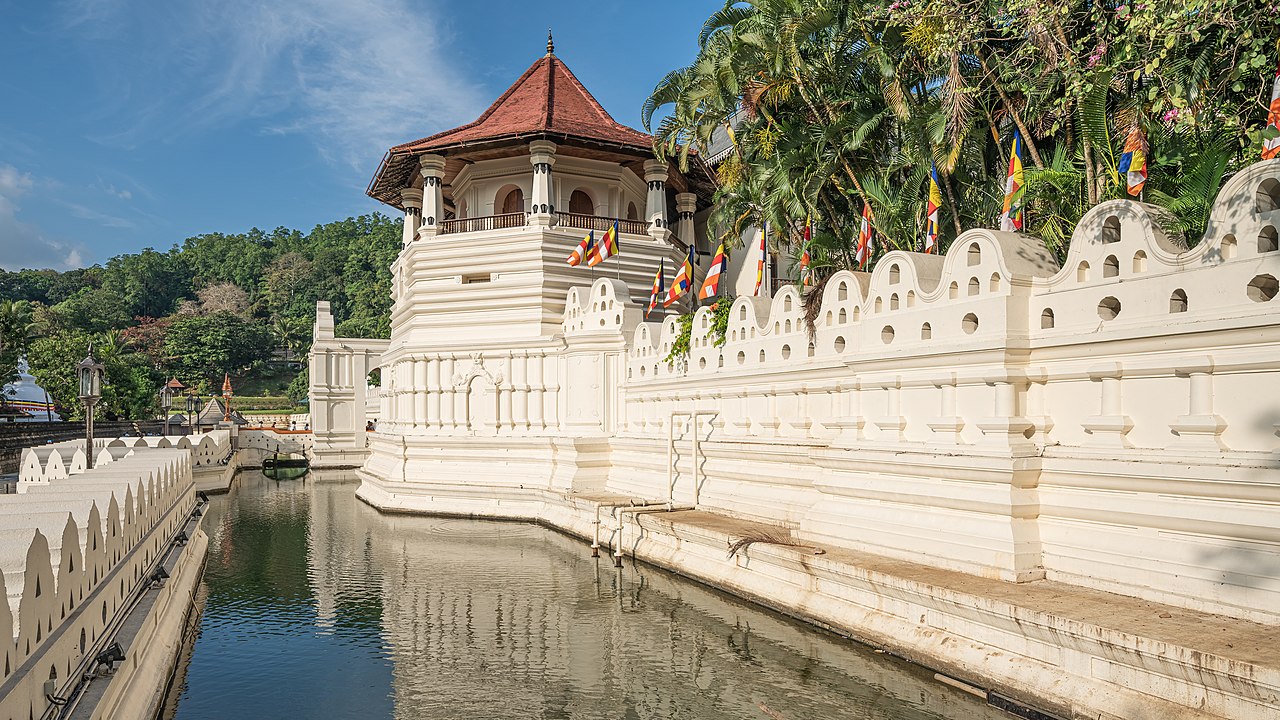
In the centre of the city, beside the lake, stands the Temple of the Sacred Tooth (Sri Dalada Maligawa). It guards what Sinhalese Buddhists consider the most revered object in the country: a tooth of the Buddha himself. For centuries, owning this relic meant having the right to rule the island. Today it's still the centre of Kandy's religious life and the reason for the Esala Perahera, one of the most spectacular processions in Asia, in which dozens of decorated elephants, dancers, drummers and fire-bearers parade through entire nights in honour of the relic.

This guide helps you get the most out of Kandy in practical terms. It covers how to visit the Temple of the Tooth and when to see the puja ceremony, where to watch Kandyan dance, how to reach the superb Peradeniya Botanical Gardens and the temples in the surrounding area, and how to catch the legendary mountain train to the tea country of Nuwara Eliya and Ella. Kandy is the perfect hinge for a trip around the island: the place where the history of the Sinhalese kings, Buddhist spirituality and the beauty of the mountains all come together in one city.

📖 History of Kandy

Kandy was the last capital of Sri Lanka's independent kingdom. The city became a centre of power in the mountainous interior around the 15th century, and it and its kingdom became the refuge of Sinhalese sovereignty as the European powers (the Portuguese, the Dutch and the British) took over the coast. Protected by mountains and jungle, the Kingdom of Kandy resisted every attempt at conquest for more than three centuries. More than one expedition managed to take and burn the city but failed to subdue the kingdom. Possession of the Buddha's tooth relic gave its kings a sacred legitimacy. In the end, weakened by internal conflict between the king and the nobility, the kingdom fell to the British in 1815 through the so-called Kandyan Convention, ending more than two thousand years of Sinhalese monarchy. Under British rule a major rebellion broke out in 1817-1818 and was harshly suppressed. Today Kandy keeps its Temple of the Tooth, its lake (built by the last king), its dance and its great procession, and it's a World Heritage Site as the 'Sacred City of Kandy'. The full story is on our history page.

Read the full history ↓

🏛️ Kandy is in Mountains and highlands

The mountainous interior: Kandy, the last capital of the Sinhalese kingdom and home of the Tooth of the Buddha; Nuwara Eliya, the tea country's 'Little England'; and Ella, among plantations and the colonial railway.

Read the history of Mountains and highlands →

🗺️ What to see

Tours you can book

If you book from here we earn a commission and you pay no more. Prices and availability come from Civitatis.

1
The Temple of the Sacred Tooth (Sri Dalada Maligawa)
The shrine that holds the relic of the Buddha's tooth, the most revered place in Sinhalese Buddhism, beside Kandy's lake.
Leer más ↓
The Temple of the Sacred Tooth (Sri Dalada Maligawa, 'the palace of the tooth relic') is the heart of Kandy and one of the most sacred places in Buddhism. It holds the relic of the Buddha's left tooth, which tradition says was brought to the island in the 4th century AD. Throughout history the relic was a symbol of royal power: whoever held the tooth was believed to have the legitimate right to rule the country. That's why the relic followed each successive Sinhalese capital until it ended up here, in the palace complex of the Kandyan kings beside the lake. The temple is a beautiful example of Kandyan architecture, with tiled roofs, carved wood and gilded details. It's built around the inner shrine where the relic is kept. The relic itself isn't shown directly: it sits inside a series of stupa-shaped caskets, one inside another. Three times a day there's a 'puja', a ceremony with drums and flutes during which the relic chamber is opened for worship. These are the best times to visit, with an atmosphere of intense devotion. The complex also includes halls with offerings, museums, paintings and the royal precinct. Wear modest clothing (shoulders and legs covered), and take your shoes off inside the sacred area. There are security checks at the entrance. Try to go during one of the puja times to experience the ceremony, even though it's busier. It's an essential and very moving visit, and the best place to understand the central role of Buddhism and of this relic in Sri Lanka's history and identity.
ℹ️ Distance: In central Kandy, beside the lake; on foot from the centre or by tuk-tuk · Best time: During the puja ceremonies (morning, midday and afternoon/evening); early for fewer crowds · Admission: Adult foreigner ~2.000 Rs approx. (according to current rates); barefoot and in modest clothing. Very busy during the Esala Perahera (verified July 2026) · Duration: 1 to 2 hours
2
Kandy Lake and the old town
The calm artificial lake built by order of the last king, ringed by a pleasant promenade, with the historic city all around.
Leer más ↓
Kandy Lake (Kiri Muhuda, 'the sea of milk') defines the city centre and is one of its most peaceful spots. It isn't a natural lake but an artificial reservoir that the last king of Kandy, Sri Vikrama Rajasinha, had built in the early 19th century, shortly before the kingdom fell. The project is said to have caused some resentment among the nobility and the people because of the effort it required at a delicate moment for the monarchy. Today it's Kandy's green, quiet heart, with a promenade all the way around, a small island in the middle and water birds. The historic city spreads out around the lake: the Temple of the Tooth and the old royal complex, the pedestrian promenade, colonial buildings, markets and the bustle of the centre. Walking along the shore, especially at sunset, with the temple reflected in the water and the hills behind, is a simple and very pleasant plan. Next to the temple is the picturesque 'cloud wall' (Walakulu Bemma), a wavy wall typical of Kandyan architecture. Kandy's old town, with its mix of Sinhalese, colonial and commercial architecture, is worth getting lost in for a while: the central market, gem and craft shops, smaller temples and British buildings. It's a lively and somewhat chaotic city, with traffic, but full of character. The lake and its surroundings are the best starting point and landmark for exploring on foot.
ℹ️ Distance: Right in central Kandy; explored on foot · Best time: At sunset, for a walk along the shore with the temple reflected in the water · Admission: Free to walk around the lake and the old town (verified July 2026) · Duration: 1 to 2 hours
3
Kandyan dance show
A traditional Kandy dance and drumming performance, with acrobats, masks and a fire-walking finale.
Leer más ↓
Kandyan dance is one of Sri Lanka's most important artistic traditions, historically linked to the rituals of Kandy's royal court and temples. Going to a dance show is an enjoyable, colourful way into this culture. Several venues in the city put on daily performances (usually in the late afternoon, around 17:00-18:00) that bring together different styles of dance and percussion from the island, with elaborate costumes, geta bera drums, acrobatic moves and leaps. A typical show includes several pieces: ritual dances, mask dances (descended from the healing and exorcism rituals of the country's south), acrobatic numbers with hoops and balancing acts, the drummers' percussion and, as the grand finale, the impressive fire walking, in which the dancers cross a bed of burning coals barefoot. It's showy, energetic and designed for an audience, a good introduction to the island's folklore. Shows last around an hour and tickets are cheap. Arrive early to get a good seat. Although it's a 'stage' version of these traditions, it keeps genuine elements of Kandyan dance and music alive, both recognised as part of the country's cultural heritage. It's an ideal plan for late afternoon and pairs very well with a visit to the Temple of the Tooth (some venues are nearby) and dinner in the centre afterwards.
ℹ️ Distance: At several venues in central Kandy, near the lake and the temple; on foot or by tuk-tuk · Best time: Daily shows in the late afternoon (around 17:00-18:00); arrive early for good seats · Admission: ~1.000-1.500 Rs per person approx. (depending on venue), 2026 (verified July 2026) · Duration: ~1 hour
4
Royal Botanic Gardens, Peradeniya
One of the most beautiful botanical gardens in Asia, in a bend of the Mahaweli River, with huge trees and a spectacular collection.
Leer más ↓
About 6 km from central Kandy, in Peradeniya, are the Royal Botanic Gardens, considered one of the most beautiful and complete botanical gardens in Asia. They cover about 60 hectares inside a large bend of the Mahaweli, the island's longest river. Their history goes back to the time of the Kandyan kings, although the British laid them out as a formal botanical garden in the 19th century. Today they hold thousands of species of trees, palms, orchids and plants from across the tropical world. Highlights include the impressive avenue of royal palms, the orchid collection, the giant Java fig tree whose canopy covers an enormous area, the avenue of commemorative trees (planted by kings, presidents and public figures over the years) and the colonies of flying foxes (large fruit bats) hanging from the trees. It's a spacious, quiet, green place, ideal for walking for hours, having a picnic or simply resting in the shade, a break from the bustle of the city. You can get there by tuk-tuk, bus or car from Kandy in about 15-20 minutes. Give it at least half a day and bring water, sun protection and comfortable shoes (distances inside the gardens are long). Admission for foreigners is around 3.500 Rs. It's one of the most worthwhile visits in Kandy, especially for nature and plant lovers, and a perfect contrast to the city's temples and history.
ℹ️ Distance: About 6 km from the centre, in Peradeniya; by tuk-tuk, bus or car (15-20 min) · Best time: In the morning or late afternoon; open every day · Admission: Adult foreigner ~3.500 Rs approx. (including taxes), 2026 (verified July 2026) · Duration: Half a day (2 to 4 hours)
5
The Bahirawakanda Buddha and the viewpoints
The great white Buddha statue on a hilltop, with the best panoramic views of Kandy and its lake, ideal at sunset.
Leer más ↓
On one of the hills around Kandy stands the Bahirawakanda Buddha (Bahirawakanda Vihara Buddha Statue), a huge white statue of the Buddha seated in meditation, about 25 metres tall, which overlooks the city and can be seen from many places. Built in recent decades, it's part of a modern Buddhist temple and has become one of Kandy's most popular viewpoints, especially at sunset, when the light turns the city golden and you see the lake down below, ringed by hills. You get up by tuk-tuk on a steep road (or on foot, a demanding climb) to the temple grounds, where there's a splendid panoramic view over all of Kandy: the lake, the Temple of the Tooth, the city's rooftops and the amphitheatre of green mountains. You can walk around the statue (barefoot, as it's a sacred area) and visit the small temple. It's a short stop but very rewarding, especially for photos and the sunset. Kandy has other viewpoints in the surrounding hills too, such as Arthur's Seat (Kandy View Point), which you can reach by tuk-tuk. For nature lovers, right next to the centre is the Udawattakele forest reserve, the old royal forest behind the Temple of the Tooth, with trails, birds, monkeys and a jungle feel just steps from the city. Together, the viewpoints and the forest show Kandy's green, mountainous side, which complements its historical and religious riches.
ℹ️ Distance: Bahirawakanda is on a hill west of the centre; by tuk-tuk (steep climb) · Best time: At sunset, for the best light and panoramic views · Admission: Temple with a cheap admission (~200-500 Rs approx.); barefoot inside the grounds (verified July 2026) · Duration: 1 hour
6
The temples in the surrounding area (Gadaladeniya, Lankatilaka, Embekka)
Three 14th-century gems of Kandyan art near Kandy: two stone and wood temples and the famous carved pavilion at Embekka.
Leer más ↓
In the hills west of Kandy, around Peradeniya, there's a trio of 14th-century temples that are true gems of the island's art and architecture, and many people visit them together on a half-day trip. They date from the Gampola kingdom, before Kandy's heyday, and show a fascinating mix of Sinhalese Buddhist, Hindu and South Indian styles. Gadaladeniya Temple is an elegant stone temple on a large rock, in the Dravidian style (a South Indian influence), with a Buddhist shrine and Hindu details. Lankatilaka Temple, nearby, is an imposing image house built on a rock, with high walls, a large Buddha and frescoes, in a spectacular position overlooking rice paddies and mountains. And Embekka Temple (Embekka Devalaya) is famous for its extraordinary wood carvings: its columns and beams are covered in reliefs of dancers, musicians, wrestlers, animals and mythological motifs, considered some of the finest wood carvings in Sri Lanka. You can visit all three by tuk-tuk or car from Kandy, often combined with the Peradeniya Botanical Gardens, which are on the way. They're quiet visits in a lovely rural setting of rice paddies and hills, far from the city bustle. They show the artistic richness of the highlands before and during the Kandyan kingdom, and they're an excellent choice for a second day in the area, especially if you enjoy history, architecture and rural landscapes.
ℹ️ Distance: Around Peradeniya, west of Kandy; by tuk-tuk or car (can be combined with the Botanical Gardens) · Best time: In the morning or late afternoon; lovely rural setting · Admission: Cheap admission for foreigners at each temple (~200-500 Rs approx.); barefoot (verified July 2026) · Duration: Half a day for all three
7
The start of the legendary train journey through the tea highlands, one of the most beautiful rail routes in the world.
Leer más ↓
Kandy is the starting point for one of Sri Lanka's great experiences: the train ride along the mountain line that climbs into the tea highlands, through Nanu Oya (the station for Nuwara Eliya), Haputale, Ella and Badulla. The route slowly winds up between tea plantations, bridges, tunnels, waterfalls and misty valleys. It's extraordinarily beautiful and considered one of the loveliest train journeys on the planet. Many travellers say it was the most memorable moment of their whole time on the island. From Kandy, the stretch to Nanu Oya (Nuwara Eliya) takes about 3-4 hours, and Ella about 6-7 hours in total, through the heart of Ceylon tea country. You can book a first-class seat (with panoramic windows, or observation class) or travel in second and third class, which are cheaper and more of an 'adventure', with the windows and sometimes the doors open and the classic photos of people leaning out over the scenery. Book ahead in high season, because the reserved-seat classes sell out. An important note: Cyclone Ditwah, in December 2025, damaged sections of the mountain line and caused limited services or closures, so check the current state of the train and the track before planning your trip (verified July 2026). Even if you don't do the whole route, taking at least the scenic stretch from Kandy is well worth it. It's also the ideal way to link Kandy with the rest of the highlands: Nuwara Eliya and Ella.
ℹ️ Distance: From Kandy station, in the centre; mountain line to Nanu Oya, Ella and Badulla · Best time: Drier periods (January-April, July-September) for better views; book ahead in high season · Admission: 2nd/3rd class very cheap; reserved 1st class/observation more expensive. Check services after the 2025 cyclone (verified July 2026) · Duration: Kandy-Nanu Oya ~3-4 h; Kandy-Ella ~6-7 h
📶I have never landed without internet. I arrive and my phone connects to the strongest network in the country I am visiting: I can say I landed, sort out transport, book tours and keep posting, at a seriously good price. I always use the Maya eSIM — check their plans by clicking the banner.See plans →Maya Mobile eSIM — download, install, go
What nobody tells you

💵 Prices

Tickets

TypePrice
Templo del Diente Sagrado (Sri Dalada Maligawa) — foreigner adulto~2.000 Rs approx. (according to current rates), 2026
Espectáculo de danza kandiana~1.000-1.500 Rs per person, 2026
Jardines Botánicos Reales de Peradeniya — foreigner adulto~3.500 Rs approx. (including taxes), 2026
Buda de Bahirawakanda (templo)~200-500 Rs approx., 2026
Templos de los alrededores (Gadaladeniya, Lankatilaka, Embekka)~200-500 Rs approx. each, 2026
Lago de Kandy y ciudad viejaFree, 2026
🔄 updated monthlyOfficial / reference values · double-check when buying

Activities and tours

ActivityPriceDurationOperator
Visit to the Temple of the Tooth during puja hoursAdmission ~2,000 Rs, 20261 to 2 hOn your own; optional guides at the entrance
Kandyan dance show~1,000-1,500 Rs per person, 2026~1 hCultural halls in the centre (check showtimes)
Trip to the Peradeniya Botanical GardensAdmission ~3,500 Rs + transport, 2026Half dayTuk-tuk, bus or car from Kandy
Three temples tour (Gadaladeniya, Lankatilaka, Embekka)Admission + transport (tuk-tuk/car), 2026Half dayTuk-tuk or car with driver
Sunset at the Bahirawakanda BuddhaTemple admission ~200-500 Rs + tuk-tuk, 20261 hTuk-tuk from the centre
Scenic train ride to Nanu Oya/Ella2nd/3rd class cheap; reserved 1st/observation class more expensive, 20263 to 7 hSri Lanka Railways / apps (check after the 2025 cyclone)
Walk in the Udawattakele forestInexpensive admission, 20261 to 2 hOn your own (forest reserve behind the temple)
🔄 updated monthlyOfficial / reference values · double-check when buying

🚌 How to get there and distances

Getting around

On foot around the centre and the lake
Free
DurationVariable
Notes
The centre, the lake and the Temple of the Tooth are easy to explore on foot. There's traffic and some uphill and downhill stretches; wear comfortable shoes and bring an umbrella (Kandy is rainy)
Tuk-tuk via app (PickMe) or hailed on the street
PriceShort rides ~200-600 Rs; more to Peradeniya or Bahirawakanda, 2026
DurationVariable
Notes
The most practical way to reach Bahirawakanda, Peradeniya, the station and the temples nearby. Use PickMe to lock in the fare or agree on the price before getting in
Car with driver
Depends on route and day, 2026
DurationVariable
Notes
Comfortable for day trips (temples, gardens) and for transfers to the Cultural Triangle or the highlands, with flexible timing
Train (hill country line)
DurationVariable
Price
2nd/3rd class cheap; reserved 1st/observation class more expensive, 2026
Notes
To get to and from Colombo and, above all, for the scenic stretch to Nuwara Eliya and Ella. Book ahead in high season; check services after the 2025 cyclone
Public bus
Very cheap (tens of Rs), 2026
DurationVariable
Notes
Kandy is a major bus hub: frequent services to Colombo, Dambulla, Nuwara Eliya and the whole island, plus city buses to Peradeniya. Cheap but crowded
🔄 updated monthlyOfficial / reference values · double-check when buying

How to get there

RouteAirlines / operatorsAvg. priceDuration
Colombo → Kandy by train or carSri Lanka Railways (hill country line); cars with driver and busesTrain 2nd/3rd class cheap; reserved 1st class more expensive; car depends on route, 2026Train ~2.5-3.5 h; car ~3-4 h
Dambulla / Sigiriya → Kandy by bus or carVery frequent buses; cars with driverBus very cheap; car depends on route, 2026Dambulla ~2-2.5 h; Sigiriya ~2.5-3 h
Nuwara Eliya → Kandy by train or carSri Lanka Railways (scenic stretch); cars and busesTrain cheap; car depends on route, 2026Train ~3-4 h; car ~2.5-3 h
Colombo Airport (CMB) → Kandy by carCars with driverDepends on operator (transfer of several hours), 2026~3.5-4.5 h
🔄 updated monthlyOfficial / reference values · double-check when buying

🏨 Where to stay

No exact prices: a scale from $ (budget) to $$$$$ (luxury), with 2-3 options per category.

Luxury and boutique with hill views
Price$$$$$
Recommended options
From ~120-350 USD per night approx., 2026. Boutique and luxury hotels in the hills around Kandy, with pools, lake or valley views and a peaceful atmosphere; some are in old mansions or have a designer touch
Mid-range hotels and lake-view hotels
Price$$$$$
Recommended options
~50-110 USD per night approx., 2026. A good choice of comfortable hotels in the centre and on the hillsides, many with lake or city views and breakfast; handy for walking to the Temple of the Tooth
Guesthouses and homestays
Price$$$$$
Recommended options
~25-55 USD per night approx., 2026. Family homes and cosy guesthouses in the hills, with warm hospitality, home-made breakfast and good views; the most authentic and charming option
Backpacker hostels
Price$$$$$
Recommended options
Dorm bed ~8-18 USD; budget private room ~18-40 USD, 2026. Hostels with a traveller vibe near the centre, a good base for exploring Kandy and arranging the train to the highlands

🍴 Where to eat

Rice and curry y cocina kandiana
Price$$$$$
Options / signature dish
Dishes ~400-1,200 Rs (≈ 1.50-4 USD), 2026. Local eateries and guesthouses serving generous classic 'rice and curry', kottu, hoppers and roti; tasty, cheap and very vegetarian-friendly. Kandy keeps traditional hill country recipes alive
Restaurantes con vista y cocina internacional
Price$$$$$
Options / signature dish
Dishes ~700-2,000 Rs (≈ 2.50-7 USD), 2026. Traveller-friendly restaurants and cafés with lake or city views, local and international food, good Ceylon coffee, and vegetarian and breakfast options
Dulces, té y comida callejera
Price$$$$$
Options / signature dish
Snacks ~100-800 Rs (≈ 0.30-2.50 USD), 2026. Kandy is famous for its sweets and its tea; there are stalls and shops with roti, kottu, samosas, Sinhalese sweets and good tea to try at any time of day
Restaurantes de hotel y alta cocina
Price$$$$$
Options / signature dish
Set menus from ~2,500-6,000 Rs (≈ 8-20 USD), 2026. Boutique and luxury hotels offer more refined Sri Lankan and international cuisine, dinners overlooking the lake or the valley and dining experiences for a special night

📖 History of Kandy

Origins, formation and what the sources say.

The kingdom hidden in the mountains

Kandy was born of geography and the instinct to survive. After the fall of Anuradhapura and Polonnaruwa, the centre of Sinhalese power gradually withdrew towards the southwest of the island to escape invasions from the north. In the mountains of the interior it found a natural refuge that was almost impregnable. Ringed by mountain ranges, dense jungle, rivers and gorges, the Kandy region was a natural fortress, hard to reach and easy to defend. There, around the 15th century, a kingdom took shape that would become the last bastion of Sinhalese sovereignty.

The name 'Kandy' is a European corruption of 'Kanda Uda Rata' (the land of the mountains) or 'Senkadagala', the city's traditional name. It sits at about 500 metres above sea level, around a valley where the lake would later be built, which gave it a cooler climate than the lowlands and an excellent strategic position. While the European powers began prowling the island's coasts in search of cinnamon and trade routes, a kingdom was taking root in the mountainous interior that would hold out for more than three centuries.

What gave Kandy its sacred aura and its legitimacy was not just its geography, but an object: the relic of the tooth of the Buddha. Since ancient times, people in Sri Lanka had believed that whoever held the sacred tooth had the rightful claim to rule the island. The relic had travelled with each successive Sinhalese capital, and when power retreated into the mountains, the tooth went with it. Kandy thus became the guardian of the most revered relic in Sinhalese Buddhism, and its king became the protector of the faith. Political and religious power were fused together in the city of the mountains.

Three centuries of resistance: the Portuguese and the Dutch against the mountains

Above all, the story of the Kingdom of Kandy is an epic of resistance. First the Portuguese (16th century) and then the Dutch (17th century) captured the coastal strongholds one by one —Colombo, Galle, Jaffna, Negombo— and took control of the cinnamon trade, yet the Kingdom of Kandy stayed independent in its mountain stronghold. The Kandyan kings shrewdly played one European power off against another: they allied with the Dutch to drive out the Portuguese, then resisted the Dutch themselves when they tried to push into the interior.

The mountains and the jungle were their best allies. More than once, European armies managed to break into the kingdom and even take and burn the city of Kandy itself, whose inhabitants, as a deliberate tactic, would abandon it and withdraw into the mountains. But time and again the invading troops, worn down by ambushes, tropical diseases, hunger and hostile terrain, had to pull back without having subdued the kingdom. The most famous defeat of this kind was suffered by the Portuguese, and the Dutch also learned to respect the limits of the land of the mountains.

During those centuries of isolation and resistance, Kandy became the keeper of a 'pure' Sinhalese culture, less influenced by the European presence than the coastal lowlands. This is where Kandyan architecture (with its tiled roofs, carved wood and undulating walls), Kandyan dance tied to the rituals of court and temple, goldsmithing, drumming and Buddhist traditions were preserved and flourished. Curiously, in its final period, the throne of Kandy passed to a dynasty of Tamil origin from South India, the Nayakkars, who fully embraced Sinhalese Buddhist culture and were the island's last kings.

The fall of 1815: the end of two thousand years of monarchy

The kingdom that had held out against the Portuguese and the Dutch for more than three centuries finally fell, not so much by force of arms as through its own internal divisions. By the early 19th century, the British had pushed the Dutch out of control of Ceylon's coasts and were eager to complete their conquest of the island with the independent kingdom in the interior. The last king of Kandy, Sri Vikrama Rajasinha, of the Nayakkar dynasty, ruled in an increasingly despotic way and clashed with the powerful Kandyan nobility, the traditional chiefs who shared power with the crown.

That conflict between the king and his nobles was the crack the British exploited. In 1815, with the support of much of the Kandyan aristocracy, who were unhappy with the monarch, British troops entered Kandy with almost no resistance. The king was captured and sent into exile in India, where he died. That same year the Kandyan Convention was signed, a treaty under which the Kandyan chiefs ceded the kingdom's sovereignty to the British Crown in exchange for guarantees that their privileges, their laws and, above all, the Buddhist religion and the tooth relic would be respected.

It was a hugely significant moment: with the fall of Kandy in 1815, for the first time in history the whole island of Sri Lanka came under a single power, and that power was foreign. More than two thousand years of independent Sinhalese monarchy came to an end, an exceptional dynastic continuity by world standards. The lost independence would not be regained until 1948. The Kandyans, who soon felt betrayed by Britain's broken promises, rose up in a great rebellion in 1817-1818, which was harshly crushed. The dream of the last Sinhalese kingdom was over.

The sacred tooth and the great procession: the spiritual heart

Although the kingdom fell, Kandy's sacred soul survived, and it is still alive today: the relic of the tooth of the Buddha. Kept in the Temple of the Tooth (Sri Dalada Maligawa), the shrine-palace beside the lake, the relic is the most revered object in Sinhalese Buddhism. Tradition says the tooth was rescued from the Buddha's funeral pyre in India and brought to the island in the 4th century AD, hidden, according to legend, in a princess's hair. From then on it travelled with the Sinhalese capitals as a symbol of legitimate power, until it found its permanent home in Kandy.

Devotion to the relic shapes the city's religious life. Three times a day, the puja ceremony is held, with drums and flutes, before the chamber where the tooth is kept (it is not shown directly: it rests inside a series of gold stupa-shaped caskets). But the big moment of the year is the Esala Perahera, one of the most spectacular religious processions in the world. For about ten days in July or August, on the nights leading up to the full moon, dozens of elephants draped in embroidered cloth and lights parade through the streets of Kandy in honour of the relic, alongside Kandyan dancers, drummers, torchbearers, whip-crackers and dignitaries. The lead elephant, the 'tusker', carries a replica of the tooth casket. It is an overwhelming spectacle, a direct heir to the court rituals of the old kingdom.

That ritual continuity —the daily puja ceremony, the great annual procession, Kandyan dance and music— makes Kandy a place where the past is not just memory but living practice. The kings are gone, but the relic that legitimised their power is still venerated by crowds, and the traditions that flourished under the independent kingdom remain an essential part of Sinhalese identity.

Kandy today: cultural capital and World Heritage Site

Modern Kandy is Sri Lanka's second city and its undisputed cultural and spiritual capital. In 1988, UNESCO inscribed the 'Sacred City of Kandy' on the World Heritage List, recognising its value as the last capital of the Sinhalese kingdom and as a living centre of Buddhism, with the Temple of the Tooth at its heart. The city still has its lake —the work of the last king, Sri Vikrama Rajasinha, completed shortly before the kingdom fell—, its Kandyan architecture, its temples and its mountain atmosphere.

But Kandy is not a museum city: it is a bustling place, with traffic, shops, universities and an intense pace of life, wedged between green hills. Around the historic core spread the modern city, the markets, the hillside neighbourhoods and nearby gems such as the splendid Peradeniya Botanical Gardens —descended from an old royal garden and laid out by the British— or the exquisite medieval temples of Gadaladeniya, Lankatilaka and Embekka, famous for their wood carvings. From a hilltop, the great white Buddha of Bahirawakanda watches over the city.

For travellers, Kandy is an essential stop and also a perfect geographical hinge: this is where the Cultural Triangle ends and the tea highlands begin, and its station is the starting point of the legendary mountain train to Nuwara Eliya and Ella, one of the most beautiful journeys in the world. Walking along the lakeside at sunset, with the Temple of the Tooth reflected in the water and the sound of the puja drums drifting through the hills, is a glimpse into the very heart of Sri Lanka's identity: the city that, protected by its mountains, kept the last flame of Sinhalese sovereignty alive for three centuries, and that still guards, with the same devotion as ever, the sacred relic that was its reason for being.

📚 Bibliography

  • Wikipedia (EN) — «Kandy»: https://en.wikipedia.org/wiki/Kandy
  • Wikipedia (ES) — «Kandy»: https://es.wikipedia.org/wiki/Kandy
  • Wikipedia (EN) — «Kingdom of Kandy»: https://en.wikipedia.org/wiki/Kingdom_of_Kandy
  • Wikipedia (EN) — «Temple of the Tooth»: https://en.wikipedia.org/wiki/Temple_of_the_Tooth
  • Wikipedia (EN) — «Kandyan Convention»: https://en.wikipedia.org/wiki/Kandyan_Convention
  • Wikipedia (EN) — «Sri Vikrama Rajasinha»: https://en.wikipedia.org/wiki/Sri_Vikrama_Rajasinha
  • Wikipedia (EN) — «Esala Perahera of Kandy»: https://en.wikipedia.org/wiki/Esala_Perahera_of_Kandy
  • UNESCO World Heritage Centre — «Sacred City of Kandy»: https://whc.unesco.org/en/list/450/
  • Encyclopaedia Britannica — «Kandy»: https://www.britannica.com/place/Kandy-Sri-Lanka

❓ Frequently asked questions

How much does it cost to enter the Temple of the Tooth and how does it work?+
Admission to the Temple of the Sacred Tooth Relic is around 2,000 Rs for foreign adults (about 7 USD, verified July 2026). You pay at the ticket office in the complex. It's best to go during one of the three daily puja ceremonies (morning, midday and afternoon/evening), when the relic chamber is opened and the drums play: the atmosphere is far more intense. You must have your shoulders and legs covered, take off your shoes in the sacred area and go through security checks. During the Esala Perahera (July-August) it gets very crowded.
How many days should I spend in Kandy?+
With 1 full day you can see the essentials: the Temple of the Tooth (at puja time), a stroll around the lake and the town, a Kandyan dance show and the Bahirawakanda Buddha at sunset. With 2 days you can add the magnificent Peradeniya Botanical Gardens, the temples nearby (Gadaladeniya, Lankatilaka, Embekka) and the Udawattakele forest. Kandy is also the ideal link between the Cultural Triangle and the tea highlands, so many people use it as a 2-night stop before taking the scenic train to Nuwara Eliya and Ella.
What is the Esala Perahera and when is it held?+
The Esala Perahera is one of the most spectacular religious processions in Asia: for about ten days in July or August (following the lunar calendar, up to the Esala full moon), Kandy honours the Buddha's tooth relic with night parades featuring dozens of decorated elephants, dancers, drummers, fire-bearers and whip-crackers. It's a unique show that draws huge crowds. If your trip coincides with it, it's well worth it, but the city fills up, accommodation sells out and prices rise: you need to book many months ahead and, to see the procession properly, pay for seats in the stands.
Is the train from Kandy to Ella worth it and how do I take it?+
Yes, absolutely: the mountain stretch from Kandy to Nanu Oya (Nuwara Eliya) and Ella is one of the most beautiful train rides in the world, through tea plantations, bridges and misty valleys. From Kandy it takes about 3-4 h to Nanu Oya and 6-7 h to Ella. You can book on the Sri Lanka Railways website or through apps (12Go, GetYourGuide), ideally weeks ahead in high season, because the reserved-seat classes (1st and observation) sell out; 2nd and 3rd class are cheaper and more of an 'adventure'. Important: check the state of the line after Cyclone Ditwah in December 2025, which damaged sections of the track.
When is the best time to visit Kandy?+
Kandy has a cool, pleasant climate thanks to its altitude, but it's fairly rainy all year round. The driest periods are usually January to April and July to September. The big event is the Esala Perahera (July-August), which needs to be planned well in advance if you want to be there for it. Apart from that, Kandy is fine to visit in any season, always with an umbrella to hand. At around 500 m, the nights are cool: bring a light layer.
How should I dress and behave at the Temple of the Tooth?+
It's the most sacred site in Sinhalese Buddhism, so you need to dress modestly: shoulders and legs covered (no shorts or tank tops; bring trousers or a skirt below the knee and something to cover up with). You have to take off your shoes in the sacred area, and there are security checks at the entrance. Inside, be respectful and quiet, don't turn your back on the relic or Buddha images for photos, and follow the staff's instructions. The same goes for the other temples in the city and the surrounding area.

More places in Sri Lanka

MirissaNegomboNuwara EliyaPolonnaruwaSigiriyaTrincomalee
See every place in Sri Lanka →The history of Sri Lanka →
Sources consulted (13)
Still planning?
Explore more destinations in Sri Lanka
See all destinations →