Viajá con Gus
Home › Rwanda › Nyungwe National Park
Nyungwe National Park
🇷🇼 Rwanda · The southwest and the Nyungwe forest

Nyungwe National Park

🪪 What do I need to enter Rwanda?Pick your citizenship and we tell you the visa, the days and the paperwork, with the official source.

By leaving your email and citizenship you agree to receive the documents you asked for and weekly travel news. You can unsubscribe whenever you want. How we handle your data.
Jump to what you need
📍Region
Nyungwe National Park protects 1.019 km² of montane rainforest in south-western Rwanda, across the Western and Southern Provinces, along the border with Burundi and the Democratic Republic of the Congo. It is one of the oldest and largest mountain (Afromontane) forests in Africa, with altitudes ranging from 1,600 to 2,950 metres. Since 2023 it has been a UNESCO World Heritage Site, and it is managed by the Rwanda Development Board together with African Parks.
📌Best time to go
The dry seasons (June to mid-September and mid-December to February) are the best for chimpanzee trekking and hiking, with firmer trails and less rain. Because it is a mountain rainforest, it can rain at any time of year and it is cool, so bring a rain jacket and warm layers. Chimpanzees are easier to see in the dry season, when they come down to look for fruit.
📌Suggested days
Two or three days are enough to make the most of the park: one day for chimpanzee trekking (early start), another for the Uwinka canopy walk plus a colobus or waterfall hike, and time for the tea plantations next to Gisakura. Bird and primate lovers can add more days. Many visitors combine Nyungwe with Lake Kivu to the north.
📌Getting there
Nyungwe is about 5-6 hours by road from Kigali (around 220 km to the south-west, via Huye/Butare). There are buses to Huye and onward transport to the park, but the most comfortable option is a private transfer or a tour. You can also arrive from Lake Kivu (Kibuye/Rusizi) along the southern section of the Congo Nile Trail. There is a small airfield in the area for charter flights. The main gates are Uwinka (centre) and Gisakura (west).
📌Getting around
Inside the park, activities are guided and on foot: all treks (chimpanzees, colobus, waterfalls) leave with park guides from the Uwinka or Gisakura centres. To move between the gates and your accommodation you need your own vehicle or a transfer. Permits and activities are booked in advance through the RDB (online platform) or tour operators.
📌Language and currency
Rwanda's official languages are Kinyarwanda, English, French and Swahili; park guides speak English and often French. The currency is the Rwandan franc (RWF); as of July 2026 the exchange rate is around 1.400 RWF to the dollar. Park fees are quoted in dollars and paid by card or bank transfer; bring some cash in francs for tips and expenses outside the park.
💱 RWF exchange rate
Loading rate…
🌤️ Weather in Nyungwe National Park
Loading weather…

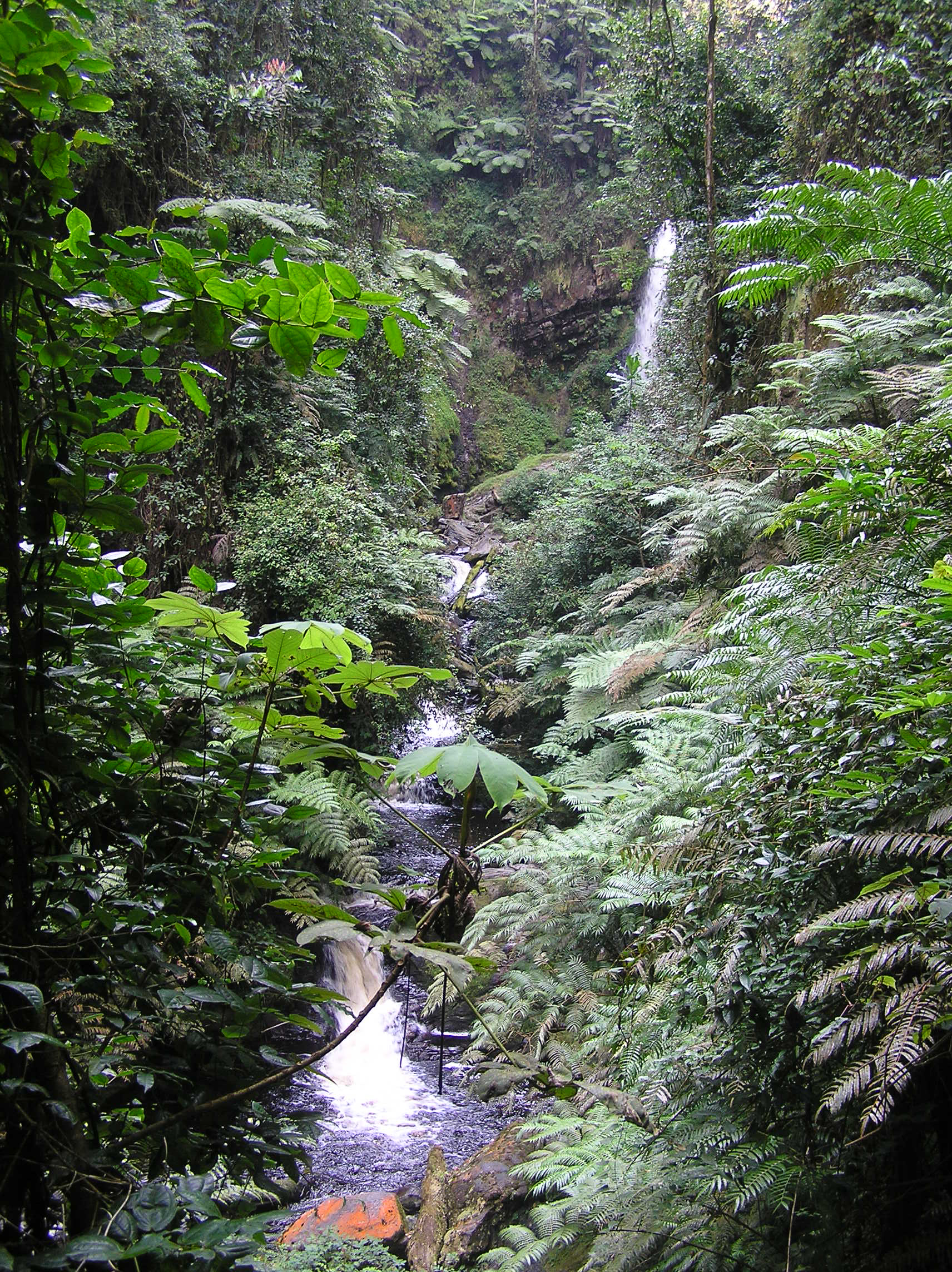
Nyungwe National Park is one of Rwanda's great natural treasures: more than a thousand square kilometres of ancient mountain rainforest, an ocean of green climbing the slopes of the country's south-west. It is one of the oldest and best-preserved Afromontane forests in Africa, a world of giant trees, ferns, orchids, bamboo and mist, where water springs up everywhere: rivers that feed both the Congo and the Nile basins rise here.

Its wildlife is its greatest treasure: thirteen primate species, including chimpanzees (which you can track on foot on an unforgettable trek) and the huge troops of Rwenzori black-and-white colobus, which can number in the hundreds. Add to that more than 300 bird species, many of them endemic to the Albertine Rift, and the famous Uwinka canopy walk, which crosses the void 70 metres above the treetops.

This guide takes a practical look at Nyungwe: how to go chimpanzee and colobus trekking, how to visit the canopy walk, which hikes and waterfalls to choose, how much the official permits cost, where to stay and how to get there. A forest for walking slowly, looking up and letting yourself be wrapped in one of the richest and most ancient ecosystems on the African continent.

📖 History of Nyungwe National Park

Nyungwe is a mountain forest that survived the ice ages and sheltered countless species for tens of thousands of years, which explains its extremely high biodiversity and many endemic species. Inhabited and used by local communities for centuries, it was declared a forest reserve in the colonial era and upgraded to a national park in 2004 to halt deforestation. In 2023 UNESCO inscribed it as a World Heritage Site for its outstanding natural value. Today it is managed by the Rwanda Development Board and African Parks.

Read the full history ↓

🏛️ Nyungwe National Park is in the south-west and Nyungwe Forest

One of the oldest mountain forests in Africa: chimpanzees, dozens of primates, a suspended walkway through the treetops and a sea of tea plantations.

Read the history of The south-west and Nyungwe Forest →

🗺️ What to see

Tours nearby, in Kigali

A local guide tells you in half an hour what no sign at the site will ever explain. We look ours up on Civitatis: guided in Spanish and booked online with no fuss. They have 7 activities in Kigali. And there are free tours here: you book without paying and tip the guide whatever you think at the end, so trying one costs you nothing. Have a look below: tap any of them to see them all.

They depart from Kigali, 111 km away. If you book from this link we earn a commission and you pay no more.

1
Chimpanzee trekking
Tracking a community of wild chimpanzees on foot through the rainforest, Nyungwe's star experience.
Leer más ↓
Nyungwe is home to around 500 chimpanzees, and trekking to find them is the park's most sought-after activity. At dawn, trackers locate a community and guides lead small groups of visitors along steep and sometimes muddy trails until they find them. Watching these close relatives of humans feeding, moving through the canopy and calling to each other is an intense and unforgettable experience. The trek requires good fitness: the terrain is rugged and the walk can last from one to several hours, depending on where the chimpanzees are that day. It starts very early from the Uwinka or Gisakura gates. Sightings are not 100% guaranteed, but they are very likely in the dry season. Getting there: meet at dawn at Uwinka or Gisakura. Best time: dry season (the chimpanzees come down for fruit). Tips: book your permit in advance, and bring boots, a rain jacket, gardening gloves for the vines, and water.
ℹ️ Distance: Departures from Uwinka or Gisakura, at dawn · Best time to go: Dry season (June-September, December-February) · Admission: Non-resident permit USD 150 per person; EAC resident USD 75; Rwandan/EAC citizen USD 25 (RDB, verified July 2026) · Duration: Half a day (2 to 6 h of walking)
2
Uwinka Canopy Walk
A 90-metre suspension bridge 70 metres above the rainforest canopy, unique in East Africa.
Leer más ↓
Nyungwe's canopy walk, opened in 2010 at the Uwinka centre, is one of the park's most famous attractions and one of the few of its kind in Africa. The route combines a forest trail with three suspended walkway sections (the longest is 90 metres) that cross a valley about 70 metres up, level with the treetops. From there you look out over a sea of vegetation and, with luck, spot birds and primates. The full walk (trail plus walkway) takes about 2 hours and is of moderate difficulty. The walkway sways a little, so it is not ideal if you suffer from vertigo, but walking among the treetops of an ancient rainforest is a unique experience. Getting there: from the Uwinka centre. Best time: clear mornings in the dry season. Tips: wear comfortable shoes and bring a rain jacket; it is done with a guide at set times, so book ahead.
ℹ️ Distance: Uwinka visitor centre · Best time to go: Dry season; morning · Admission: Non-resident USD 60; EAC resident USD 50; Rwandan/EAC citizen ~5.000 RWF (RDB, verified July 2026) · Duration: About 2 hours (trail + walkway)
3
Rwenzori colobus trekking
Seeking out the huge troops of black-and-white colobus, which in Nyungwe can exceed 300 individuals.
Leer más ↓
Nyungwe is famous for its giant troops of Rwenzori black-and-white colobus (Angolan colobus), one of the few places in the world where these monkeys gather in 'super-troops' of 300 or more. Watching them move en masse through the canopy, with their striking tails and black-and-white coats, is quite a show. The trek to find them is easier than the chimpanzee trek and a great option for families or anyone who prefers a less demanding walk. Besides the colobus, eleven other primate species live in the park (L'Hoest's monkeys, blue monkeys, mangabeys, nocturnal galagos), making Nyungwe a paradise for primate lovers. Getting there: guided departures from Uwinka or Gisakura. Best time: dry season. Tips: colobus are usually easier to see than chimpanzees; a good plan for a second day in the park.
ℹ️ Distance: Departures from Uwinka or Gisakura · Best time to go: Dry season; morning · Admission: Non-resident USD 40 per person (primate/hiking activity); Rwandan/EAC citizen USD 5 (RDB, verified July 2026) · Duration: Half a day
4
Isumo Waterfall Trail
A rainforest hike to a beautiful waterfall, past tea plantations, ferns and birds.
Leer más ↓
The Isumo Waterfall Trail is one of Nyungwe's most popular hikes. It starts near Gisakura and descends through the forest, crossing tea plantations on the park's edge, to a waterfall surrounded by lush vegetation. Along the way it is easy to spot birds, butterflies and, with luck, primates, in a dense, humid rainforest setting. The route has steep, slippery sections, especially on the final descent to the falls, and the way back is all uphill, so you need to be reasonably fit. It is an excellent way to immerse yourself in the forest without doing a primate trek. Getting there: from the Gisakura gate, with a guide. Best time: dry season. Tips: wear boots with good grip and bring water and some food; the climb back is demanding.
ℹ️ Distance: From the Gisakura gate · Best time to go: Dry season; morning · Admission: Non-resident USD 40 (hiking activity); Rwandan/EAC citizen USD 5 (RDB, verified July 2026) · Duration: 3 to 5 hours return
5
Birdwatching
One of Africa's best destinations for montane birds and Albertine Rift endemics.
Leer más ↓
With more than 300 recorded species, many of them endemic to the Albertine Rift, Nyungwe is one of the continent's top birdwatching destinations. Sought-after species such as the Rwenzori turaco, the regal sunbird, Handsome's francolin and various owls and raptors draw birders from all over the world. The forest is also home to birds that are hard to see anywhere else. Birding outings are led by specialist guides early in the morning, along trails such as Uwinka's or the Kamiranzovu area, a large high-altitude wetland. It is a quiet activity, ideal to combine with primate hikes. Getting there: with a guide from Uwinka or Gisakura. Best time: all year round; the wet season brings more activity for some species. Tips: bring binoculars and a field guide; hire a specialist guide to get the most sightings.
ℹ️ Distance: Uwinka, Kamiranzovu and Gisakura trails · Best time to go: All year round; early morning · Admission: Non-resident USD 40 (guided activity); Rwandan/EAC citizen USD 5 (RDB, verified July 2026) · Duration: Half a day or more
6
Kamiranzovu Swamp
The park's largest high-altitude swamp, an ecosystem of orchids, birds and mist, with its own waterfall.
Leer más ↓
Kamiranzovu is Nyungwe's largest high-altitude wetland, a vast mountain swamp that acts as a sponge and water source for the whole region. Its name means something like 'the one that swallows elephants', a reminder of the forest elephants that once lived here. It is a magical place, shrouded in mist, with wild orchids, giant ferns and a great variety of birds. The Kamiranzovu trail runs along the edge of the swamp and reaches a waterfall. It is a moderately difficult hike, much loved by birdwatchers and by anyone looking for the forest's most primeval atmosphere. Humidity is high, so come well equipped. Getting there: with a guide from Uwinka. Best time: dry season for the trails; the swamp is always wet. Tips: a rain jacket and boots are essential; ideal for lovers of plants and birds.
ℹ️ Distance: Kamiranzovu sector, from Uwinka · Best time to go: Dry season; morning · Admission: Non-resident USD 40 (hiking activity); Rwandan/EAC citizen USD 5 (RDB, verified July 2026) · Duration: Half a day
📶I have never landed without internet. I arrive and my phone connects to the strongest network in the country I am visiting: I can say I landed, sort out transport, book tours and keep posting, at a seriously good price. I always use the Maya eSIM — check their plans by clicking the banner.See plans →Maya Mobile eSIM — turn travel mode on
What nobody tells you

💵 Prices

Tickets

TypePrice
Trekking de chimpancés (no residente)USD 150 per person (RDB, verified July 2026)
Trekking de chimpancés (residente de la CEA / ciudadano ruandés-CEA)USD 75 resident; USD 25 citizen (RDB, verified July 2026)
Pasarela colgante / Canopy Walk (no residente)USD 60 per person; EAC resident USD 50; Rwandan/EAC citizen ~5.000 RWF (RDB, verified July 2026)
Otras actividades (colobos, cascadas, birding, senderos, no residente)USD 40 per person per activity; Rwandan/EAC citizen USD 5 (RDB, verified July 2026)
🔄 updated monthlyOfficial / reference values · double-check when buying

Activities and tours

ActivityPriceDurationOperator
Chimpanzee trekkingNon-resident USD 150 (RDB, verified July 2026)Half a day (early start)Rwanda Development Board / park guides
Uwinka Canopy WalkNon-resident USD 60 (RDB, verified July 2026)About 2 hoursRwanda Development Board
Rwenzori colobus trekkingNon-resident USD 40 (RDB, verified July 2026)Half a dayPark guides
Isumo Waterfall TrailNon-resident USD 40 (RDB, verified July 2026)3 to 5 hoursPark guides
Birdwatching safariNon-resident USD 40 plus specialist guide (RDB, verified July 2026)Half a day or morePark birding guides
🔄 updated monthlyOfficial / reference values · double-check when buying

🚌 How to get there and distances

Getting around

Own vehicle or private transfer
PriceDepends on operator and distance (verified July 2026)
DurationVariable
Notes
Needed to get between the gates (Uwinka, Gisakura) and your accommodation; the activities themselves are on foot
Park guides (on foot)
PriceIncluded in the activity fee; tip extra (verified July 2026)
DurationDepends on the trek
NotesAll hikes are done with official RDB guides; mandatory
Motorbike taxi around Gisakura
DurationA few minutes
NotesUseful for short trips outside the park; agree on the price first
Price
Short trips from about 500-2.000 RWF (USD 0,4-1,5, verified July 2026)
🔄 updated monthlyOfficial / reference values · double-check when buying

How to get there

RouteAirlines / operatorsAvg. priceDuration
Kigali → Nyungwe (via Huye/Butare)Private transfer, tours, buses to HuyeKigali-Huye buses from around 3,000-4,000 RWF (USD 2-3); final stretch extra (verified July 2026)5 to 6 hours (about 220 km)
Lake Kivu (Kibuye/Rusizi) → NyungwePrivate transfer, toursDepends on the operator (verified July 2026)2 to 4 hours depending on starting point
Huye/Butare → park gates (Uwinka/Gisakura)Local transport, transferDepends on the mode of transport (verified July 2026)About 2 hours
Charter flight to the Nyungwe areaCharter aviation operatorsDepends on the flight (verified July 2026)Under 1 hour from Kigali
🔄 updated monthlyOfficial / reference values · double-check when buying

🏨 Where to stay

No exact prices: a scale from $ (budget) to $$$$$ (luxury), with 2-3 options per category.

Luxury (high-end lodge)
Price$$$$$
Recommended options
From around USD 300-700+ per night; One&Only Nyungwe House, a luxury lodge set on a tea plantation next to the forest, is the benchmark in the area
Mid-range (hotels and lodges)
Price$$$$$
Recommended options
Approx. USD 80-180 per night; comfortable options near the park such as Nyungwe Top View Hill Hotel and hotels in and around Gisakura
Budget (guesthouses)
Price$$$$$
Recommended options
From around USD 25-60 per night; simple guesthouses such as Gisakura Guesthouse, popular with trekkers and birdwatchers

🍴 Where to eat

Restaurantes de lodge y hotel
Price$$$$$
Options / signature dish
From around 8,000-20,000 RWF (USD 6-14) per dish; varied menus at the lodges near the park, often full board
Comedores locales de Gisakura y alrededores
Price$$$$$
Options / signature dish
About 2,500-6,000 RWF (USD 2-4); Rwandan buffets of rice, beans, plantain and vegetables in the nearby villages
Té y café de la región
Price$$$$$
Options / signature dish
Token price; Gisakura tea and highland coffee from the southwest, to try at lodges and tea estates

📖 History of Nyungwe National Park

Origins, formation and what the sources say.

A forest that took refuge through the last Ice Age

Nyungwe is an extremely old forest, one of the few in Africa that survived the great climate swings of the last ice age. Elsewhere on the continent, the rainforest shrank back during the cold, dry glacial periods. These mountains of the Albertine Rift stayed humid and warm enough for the forest to hold on. That is why scientists call it a Pleistocene 'refuge': an ark that kept species alive for tens of thousands of years.

That very long continuity explains its exceptional biodiversity and its very high number of endemic species. Nyungwe is home to more than 1,100 plant species, around 85 mammal species and over 300 bird species, many of them found only in the Albertine Rift. It also has a huge variety of amphibians, butterflies and orchids. Thirteen primate species, including chimpanzees and the colobus supertroops, live in its more than a thousand square kilometres of montane rainforest.

The forest also plays a vital role in the water cycle: rivers rise on its slopes that feed both the Congo basin and the Nile basin. Some expeditions have even identified one of Nyungwe's springs as one of the most remote sources of the Nile, the longest river in the world.

en.wikipedia.org · Nyungwe Forestwhc.unesco.org

Peoples, kings and the use of the forest

For centuries, Nyungwe forest marked the south-western edge of the Kingdom of Rwanda and of the lands of its neighbouring peoples. The farming and herding communities living on its edges used it in traditional ways. They gathered medicinal plants, honey, wood and bamboo, hunted, and cleared small patches of land. The Batwa, hunter-gatherers considered the region's first inhabitants, had an especially close bond with the forest.

The forest was also a place of refuge, ritual and legend. Its name and the names of places within it, such as Kamiranzovu, 'the one that swallows elephants', recall a time when herds of forest elephants and other large animals lived here. Hunting and human pressure have since wiped them out of the area.

Over time, population growth in Rwanda, one of the most densely populated countries in Africa, ate away at the forest's edges. Farming, logging, fires and small-scale mining shrank its area. The process sped up in the 20th century and threatened to break this unique ecosystem into fragments.

en.wikipedia.org · Nyungwe Forestafricanparks.org · Nyungwe

From forest reserve to national park

Formal protection of Nyungwe began in the colonial era. In 1933, under Belgian administration, the forest was declared a forest reserve, a first attempt to curb its exploitation. Even so, the reserve lost a great deal of forest during much of the 20th century. The chaos surrounding the 1994 genocide and its aftermath added to the pressure on the area, with fires and land occupation.

In the early 21st century, post-war Rwanda made nature tourism and conservation a driver of development. In 2004 the government made Nyungwe a National Park, covering some 1,019 km². It also backed professional management, anti-poaching work and the restoration of degraded areas. Chimpanzee communities were habituated to visitors and tourist facilities were built, which turned the park into a top-tier destination.

In 2010 the spectacular Uwinka canopy walk opened, the first of its kind in East Africa, letting visitors walk 70 metres above the treetops. In 2020 the Rwanda Development Board signed an agreement with the NGO African Parks to manage the park over the long term, strengthening its protection and sustainable development.

en.wikipedia.org · Nyungwe Forestafricanparks.org · Nyungwe

UNESCO World Heritage Site

International recognition came in September 2023, when UNESCO added Nyungwe National Park to the World Heritage List for its outstanding natural value. It is one of Africa's oldest and most biodiverse montane forests, home to threatened species. It is also a key conservation site in the Albertine Rift, one of the most species-rich places on the continent.

Today Nyungwe combines conservation with high-value, low-impact tourism, the model Rwanda has chosen. Chimpanzee trekking, the canopy walk, colobus walks, waterfalls and birdwatching draw travellers from all over the world. The income is reinvested in protecting the forest and in developing neighbouring communities. Many of those communities grow tea on the edges of the park, as in Gisakura.

The big challenge is still balancing Rwanda's huge population pressure with protecting this natural treasure. Nyungwe's recent history, from threatened reserve to national park and World Heritage Site, also stands for Rwanda's commitment to nature as part of its rebuilding and its future.

whc.unesco.orgafricanparks.org · Nyungwe

📚 Bibliography

  • UNESCO World Heritage Centre — «Nyungwe National Park»: https://whc.unesco.org/en/list/1697/
  • African Parks — «Nyungwe National Park»: https://www.africanparks.org/the-parks/nyungwe
  • Wikipedia (EN) — «Nyungwe Forest»: https://en.wikipedia.org/wiki/Nyungwe_Forest
  • Visit Nyungwe (RDB / African Parks): https://visitnyungwe.org/
  • Rwanda Development Board — Tourism & Conservation: https://www.rdb.rw/
  • Wikipedia (EN) — «Albertine Rift montane forests»: https://en.wikipedia.org/wiki/Albertine_Rift_montane_forests
  • The Canopy Walk — Nyungwe Forest National Park: https://www.nyungweforestnationalpark.org/the-canopy-walk/
  • Africa Geographic — «Nyungwe National Park»: https://africageographic.com/stories/nyungwe-national-park/
  • Wikipedia (EN) — «Kamiranzovu»: https://en.wikipedia.org/wiki/Nyungwe_Forest
  • Britannica — «Rwanda: Plant and animal life»: https://www.britannica.com/place/Rwanda

❓ Frequently asked questions

How much does the chimpanzee trekking permit cost and where do I book it?+
The chimpanzee trekking permit costs USD 150 per person for non-residents, USD 75 for East African Community (EAC) residents and USD 25 for Rwandan/EAC citizens (RDB rates verified in July 2026). Book in advance through the Rwanda Development Board (online platform) or a tour operator. It's best to book early in high season, as daily slots are limited.
What's the difference between chimpanzee trekking and the canopy walk?+
They're two different experiences. Chimpanzee trekking is a demanding early start to track these primates on foot through the forest, with a hard hike and sightings that aren't 100% guaranteed; it costs USD 150. The canopy walk is a hike of about 2 hours that includes crossing a suspension bridge 70 metres above the treetops; it costs USD 60 and suits almost everyone, except people with a serious fear of heights. If you have time, do both.
What fitness level do I need for the hikes?+
It depends on the activity. Chimpanzee trekking is the most demanding: steep, muddy terrain and hikes that can last several hours; you need to be in good shape. The canopy walk and colobus trekking are moderate. The waterfall hike (Isumo) has tough sections, especially the climb back up. In every case, boots with good grip, a rain jacket and water are essential because of the forest's humidity.
How many days should I stay in Nyungwe?+
2 or 3 days is enough to make the most of it: one for the chimpanzees, another for the canopy walk plus a colobus or waterfall hike, and time for the Gisakura tea plantations. Bird and primate enthusiasts can add more days. Since Nyungwe is far from Kigali (5-6 h), it's not worth going for just one activity: it's usually combined with Lake Kivu or Huye on the same trip.
How do I get to Nyungwe and where do I stay?+
Nyungwe is about 5-6 hours from Kigali by road, via Huye/Butare, or 2-4 hours from Lake Kivu. The easiest option is a private transfer or a tour; by public transport you can get to Huye and then on to the park. For accommodation, there's everything from the luxurious One&Only Nyungwe House (on a tea plantation) to mid-range hotels and budget guesthouses such as the one in Gisakura, popular with trekkers. Book ahead in high season.

More places in Rwanda

Parque Nacional de los VolcanesRubavu (Gisenyi)Congo Nile TrailPlantaciones de té de GisakuraHuye (Butare)Kibuye (Karongi)
See every place in Rwanda →The history of Rwanda →
Sources consulted (6)
Still planning?
Explore more destinations in Rwanda
See all destinations →