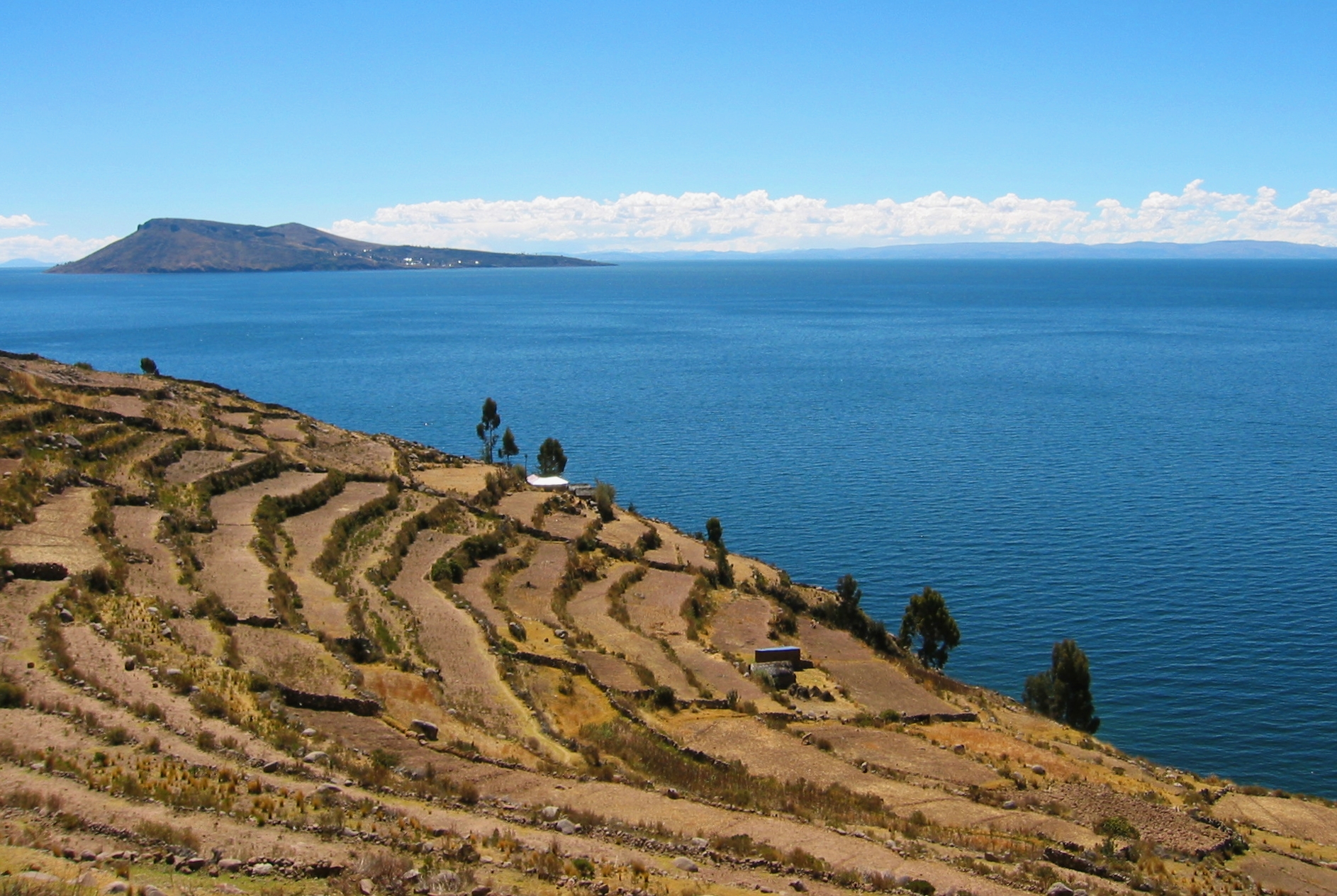
In the middle of the immense Lake Titicaca, the highest navigable lake in the world, Isla Amantaní offers one of the most authentic and moving experiences in all of Peru: community-based tourism. There are no big hotels or mass attractions here, just Quechua communities that open the doors of their homes to share their daily life with the traveler. Sleeping in a local family home, eating what they grow and taking part in their customs is the real reason to come to this island at almost 3,820 meters of altitude.
Amantaní is the largest of the Peruvian islands on Titicaca, an island of farming terraces, stone paths and a bare, luminous landscape that drops into the deep blue water of the lake. It is crowned by two sacred hills with pre-Hispanic temples on their summits: Pachatata ('Father Earth') and Pachamama ('Mother Earth'), which people climb for unforgettable sunsets over the lake and the distant mountains, and where ancestral rituals are still held.
This guide gathers the practical side of a visit: how to get there from Puno, how community-based tourism and the night in a family home work, what to see on the island, how to combine it with the Uros and Taquile, and what to keep in mind about the altitude and the cold. Amantaní is for anyone after fewer postcards and more human encounter: one of those experiences you remember for life.
Isla Amantaní has been inhabited since pre-Hispanic times, as the ceremonial temples on the summits of its two sacred hills, Pachatata and Pachamama, attest, linked to cultures both earlier than and contemporary with the Incas. The Titicaca region was the cradle of early Andean civilizations (such as Pukara and, above all, Tiwanaku, in the lake basin) and later of the Colla and Lupaca Aymara kingdoms, before being incorporated into the Tahuantinsuyo. The Quechua-speaking inhabitants of Amantaní maintained through the centuries —even under Spanish colonial rule— a strong communal identity based on terrace farming, fishing and textiles, and on veneration of the Pachamama and the apus. In recent decades, the island has become a benchmark for community-based tourism in Peru, with families receiving visitors in their homes, generating income for the community and giving the traveler direct, respectful contact with the Quechua culture of the lake. The full story, the rituals of the hills and the communal tradition are on our history page.
Read the full history ↓Folklore capital of Peru, on the shores of Lake Titicaca: Aymara and Quechua land of chullpas and floating islands, cradle of the legend of Manco Cápac and stage of the Diablada of the Candelaria.
Read the history of Puno →A local guide tells you in half an hour what no sign at the site will ever explain. We look ours up on Civitatis: guided in Spanish and booked online with no fuss. They have 12 activities in Islas Uros. Three are below so you get the idea: tap any of them and they all open.
They depart from Islas Uros, 32 km away. If you book from this link we earn a commission and you pay no more.
No exact prices: a scale from $ (budget) to $$$$$ (luxury), with 2-3 options per category.
Origins, formation and what the sources say.
On top of two twin hills, on an island lost in the highest navigable lake in the world, ceremonies to Mother Earth are still held that began before the Incas existed. Amantaní is no tourist set: it is a Quechua community of almost 4,000 people who still climb to the temples of Pachatata and Pachamama to ask for good harvests, just as their ancestors did centuries ago. To understand that continuity you first have to look at the lake around it. Titicaca, sitting at around 3,810 meters of altitude on the border between Peru and Bolivia, is the highest navigable lake in the world and one of the great points of origin of Andean civilization. Its shores and its waters have been inhabited for millennia, and in its basin some of the oldest and most influential cultures of the Andes flourished.
Chief among them is Tiwanaku (Tiahuanaco), a civilization centered on the southern shore of the lake (in present-day Bolivia) that came to exert enormous cultural, religious and political influence over much of the altiplano and the central Andes for centuries, before its decline around 1000 AD. The Pukara culture also developed, to the north of the lake. Titicaca was, moreover, a place of deep mythical meaning: according to Andean and Inca traditions, from its waters (from the Isla del Sol) emerged Manco Cápac and Mama Ocllo, the mythical founders of the Inca empire.
The islands of the lake, Amantaní among them, sit within this context of extremely high cultural and symbolic density. Their people were part of that Andean lake world, marked by adaptation to life at altitude, terrace farming, fishing and a spirituality bound to the earth, the water and the mountains. The archaeological remains on the island, especially the temples on its hills, testify to that deep pre-Hispanic root.
The most singular feature of Amantaní is the two pre-Hispanic temples crowning its twin hills: Pachatata ('Father Earth') and Pachamama ('Mother Earth'). Their names hold one of the fundamental principles of the Andean worldview: complementary duality. In Andean thought the universe is ordered in pairs that complete each other —the masculine and the feminine, sky and earth, what is above and what is below (hanan and hurin)— and the two hills of Amantaní embody that idea, standing for the father and the mother, the sky that fertilizes and the earth that bears fruit.
On the summits stand stone ceremonial enclosures, tied to the veneration of earth, water and the apus (the sacred mountains), which secured the fertility of the crops and the prosperity of the community. For the people of Amantaní these temples are not mere ruins: they remain sacred, active places where ancestral rituals are held, especially around key dates in the farming calendar. One of the most important ceremonies takes place on these hills to ask for good harvests and wellbeing.
The survival of these rituals shows the cultural continuity of the community: despite centuries of Christianization, the practices of venerating the Pachamama and the apus endured, often interwoven with Catholic elements in a syncretism characteristic of the Andes. Climbing the hills at sunset, as visitors do, is a glimpse not only of an extraordinary landscape but of a living, thousand-year-old spirituality.
After the decline of Tiwanaku, the Titicaca region was dominated by a series of Aymara kingdoms or lordships, known generically as the Colla kingdoms. In the western part of the lake the Lupaca and the Colla stood out, warrior and herding societies that controlled large herds of camelids (llamas and alpacas) and extensive territories. The islands and shores of the lake, Amantaní included, belonged to this altiplano world of strong Aymara and Quechua identity.
In the 15th century the Inca Empire (Tahuantinsuyo), in full expansion, brought the Titicaca region under its rule. Conquering the Colla kingdoms was not straightforward and took military campaigns, but in the end the altiplano came under Inca control, integrated into the empire's administrative and road network. Titicaca, because of its sacred character in Inca mythology, held an especially venerated place within the Tahuantinsuyo.
With the Spanish conquest in the 16th century came a new order. The indigenous population of the altiplano was subjected to the colonial system, with its encomiendas, its evangelization and, later, the brutal mining 'mita' that sent many altiplano people to the mines of Potosí. Even so, island communities such as Amantaní managed to keep much of their communal organization, their language, their terrace farming and their traditions. That cultural resilience explains why, centuries later, the island still holds such a strong Quechua identity and such living customs.
The culture of Amantaní has been forged over centuries around community life and adaptation to the demanding environment of the lake altiplano. The island is traditionally organized into communities that share work and land according to principles of Andean reciprocity, such as 'ayni' (mutual aid) and 'minga' (communal work), inherited from the pre-Hispanic world. This collective organization has been key to surviving in a setting where the altitude, the cold and the slope of the ground make life hard.
The base of the island economy is terrace farming, or andenes, an ancient technique that makes use of the slopes to grow crops at altitude. Potatoes grow there (in many varieties), along with ocas, broad beans, barley, quinoa and other cold-resistant crops. Added to that is fishing on the lake —especially species such as pejerrey and trout— and the raising of sheep and other animals. Food is simple and based on what the island itself produces.
Another pillar is textile and craft work: as on other Titicaca islands, the families of Amantaní keep up weaving and spinning traditions, along with work in stone. Women and men make garments with techniques and designs passed down from generation to generation. This combination of farming, fishing, textiles and community life, sustained with remarkable continuity, is exactly what makes Amantaní so attractive for community-based tourism: the visitor does not find a museum but a living culture.
In recent decades, Amantaní has become one of the benchmarks for community-based tourism in Peru. Against mass tourism and big hotels, this model proposes something different: that the visitor stays in local family homes, shares their meals and their daily life, and gets to know the community culture first hand. The island families organized themselves to receive travelers on a rotating basis, so that tourism income is distributed more fairly among the population.
This kind of tourism offers mutual benefits. For the communities it means a source of income alongside farming and fishing, which helps slow the migration of young people to the cities and encourages people to value their own culture. For travelers it means a deeply human and authentic experience, far from the conventional circuits: sleeping under the starry altiplano sky, sharing a dinner of potatoes and quinoa by the stove, joining an evening of music and dancing dressed in the island's typical clothing.
Like all community tourism, it demands respect and responsibility from the visitor: accepting the simplicity of the comforts, valuing the privilege of being welcomed into a home, buying crafts directly from the families and looking after the fragile setting of the island. Done well, community-based tourism on Amantaní is an example of how travel can be a genuine encounter between cultures, and one of the reasons so many travelers remember the island as one of the most special moments of their time in Peru.