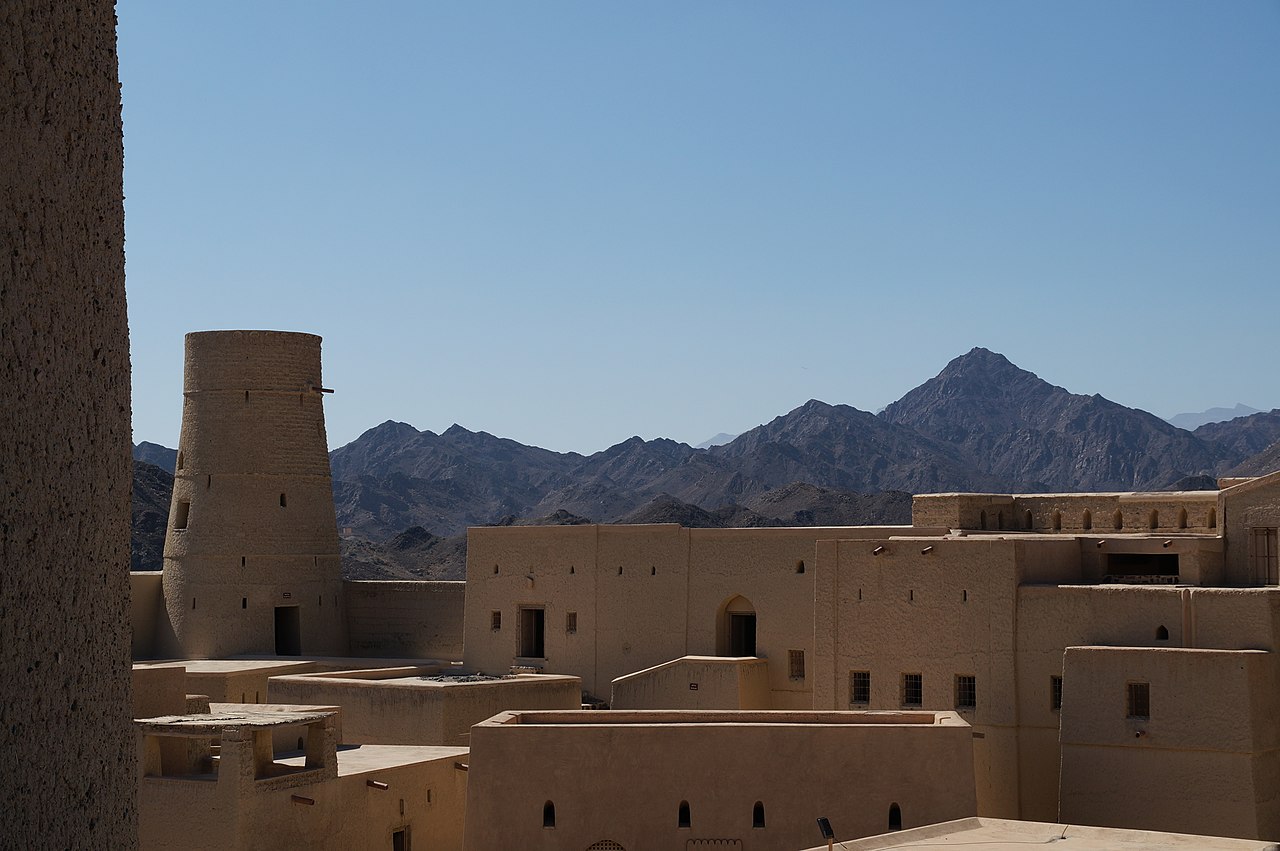
Bahla is one of those places where history and legend blend until you can't tell them apart. This old oasis in the interior of Oman, at the foot of the Hajar Mountains, holds a colossal mud-brick fort —the first site in the country declared a World Heritage Site—, kilometres of mud wall that, as the story goes, the djinn built in a single night, and a pottery tradition thousands of years old. It's no coincidence that Bahla is known as 'the city of the djinn': its reputation as a land of magic and genies dates back to the Middle Ages and is still alive in the Omani imagination.
The star is the fort (Qala'at Bahla): a mass of mud, straw and stone rising above the town with towers, walls and courtyards, which after decades of restoration you can now explore inside. Around it, the oasis keeps its palm groves, its falaj, a traditional souq under domes and workshops where people still fire the unglazed pottery typical of the area, made with local clay for thousands of years.
This guide gives you the practical side of the visit: how much the fort costs and when it opens (watch out for the limited hours), how to combine Bahla with nearby Jabrin Castle, where to see the wall and the pottery, and why it pays to get up early to dodge the heat on the mud brick. Bahla is a short stop but packed with history, perfect as part of a day touring the great forts of the interior.
Bahla is one of the oldest settlements in Oman: there are traces of life in its oasis going back to the third millennium BC. Between the 12th and 15th centuries it was the capital of the Banu Nabhan tribe (the Nabhani dynasty), a power that ruled much of the interior independently of the Ibadi imams, and in that period it flourished as a centre of caravan trade, learning and crafts. Its great mud-brick fort and the kilometres of wall surrounding the oasis bear witness to that power. Popular tradition credits the djinn with building the wall, and for centuries Bahla has carried a reputation as a land of magic. In 1987 its fort became the first site in Oman inscribed by Unesco on the World Heritage list. We tell the whole story, somewhere between fact and legend, on our history page.
Read the full history ↓The historical and spiritual heart of Oman: Nizwa, cradle of the Ibadi imamate, with its great fort and round tower; Bahla and its mud-brick fortress, a UNESCO World Heritage Site; and the palace-castle of Jabrin, the jewel of the Ya'ruba dynasty.
Read the history of The interior: Nizwa and the great forts →They depart from Al Hamra, 17 km away. If you book from this link we earn a commission and you pay no more.
No exact prices: a scale from $ (budget) to $$$$$ (luxury), with 2-3 options per category.
Origins, formation and what the sources say.
Before there were imams, sultans or even Islam, people were already living in Bahla. This oasis in the interior of Oman, tucked between the Hajar Mountains and the foothills of Jebel Akhdar, is one of the oldest settlements in the country: archaeological finds confirm a human presence from the third millennium BC, that is, about five thousand years ago.
The reason is simple, and it's the same one that explains all the great oases of the interior: water. Bahla has springs and a system of channels, the falaj, that distributes water by gravity among the orchards, plus soil that, when well watered, produces dates and crops in the middle of the arid land. Millennium after millennium, the life of the community was organised around that scarce and precious resource, and so was the need to defend it.
That age isn't just a fact for archaeologists. You can feel it in the very material of the place: the mud used to build the fort and the wall is the same mud people in the region have been building with for millennia, and Bahla's pottery —its unglazed ceramics, famous throughout Oman— has its roots in that ancient tradition of working the local clay. Bahla is, quite literally, a town kneaded from the earth around it.
Bahla's golden age came in the Middle Ages, when it became the capital of the Nabhani dynasty. The Banu Nabhan (or Nabahina) were a powerful tribal family that ruled much of the interior of Oman between the 12th and 15th centuries —with ups and downs that stretch into the 17th— alongside, and often in tension with, the institution of the Ibadi imams. Unlike the imamate, which chose its leaders for their virtue and learning, the Nabhani held a more dynastic and worldly power, backed by force of arms and control of the trade routes.
Under the Nabhani, Bahla flourished as a political, military and economic centre. Its position on the caravan routes crossing the interior made it a trading hub; its oasis fed it; and its role as a stronghold took shape in the great adobe fort and the kilometres of wall surrounding the settlement. The walled town of that era, with its towers, markets and workshops, must have been one of the most important in Oman.
The greatest surviving testimony to that power is still standing: the fort and the wall. Although the complex was rebuilt and enlarged many times over the centuries, its core goes back to the Bahla of the Nabhani, the one that dominated the interior when Muscat and the coast were still secondary stages in Omani history.
Bahla Fort (Qala'at Bahla) and its wall are masterpieces of earthen architecture. Built mainly of adobe —sun-dried bricks of mud and straw— on stone foundations, they form a massive complex: a castle of towers, courtyards, cisterns and storerooms on a rise, and a ring of walls that, at its greatest extent, encircled the oasis for several kilometres, with watchtowers along the way. It's proof that, with mud and know-how, people could raise defences able to last for centuries.
That very wall fed Bahla's most famous legend. Popular tradition holds that it wasn't built by human hands but by the djinn —the genies of Arab and Islamic tradition—, who supposedly raised the whole thing in a single night on the orders of a wise woman, to protect the oasis. Since at least the 12th century, Bahla has carried a reputation as a land of djinn and magic: there are stories of witchcraft, of trees and places inhabited by spirits, and of punishments for those who mock these beliefs. That folklore, which coexists with Islamic faith, gave the town its nickname of 'city of the djinn'.
Legend aside, building in mud has a real problem: it's fragile in the face of rain and neglect. For much of the 20th century, the fort and the wall slowly crumbled, and the complex was in serious danger of disappearing. Saving it became a task that took decades.
In 1987, UNESCO inscribed Bahla Fort on the World Heritage List: it was the first site in Oman to receive that recognition, a milestone for a country that was only just beginning to show its heritage to the world. But the inscription came with a warning: given the poor state of the monument, UNESCO also placed it on the List of World Heritage in Danger, to push for and support its rescue.
So began one of the longest and most delicate restorations in the region. From the late 1980s through the 2000s, work went into consolidating the mud walls, rebuilding towers and structures using traditional techniques and halting the decay, while taking care not to betray the authenticity of the complex. The effort paid off: the fort was removed from the danger list and, once the work was finished, reopened to the public as a visitor attraction in 2012.
Today, exploring Bahla Fort —climbing its towers, looking out over the palm grove, seeing its halls and wells— also means walking through that rescue story. The UNESCO site doesn't cover just the castle, but Bahla's whole 'cultural landscape': the fort, the wall, the oasis and its falaj, and the fabric of the old town. It's recognition for a place that sums up, in mud, five thousand years of life in the interior of Oman.
Bahla isn't just a monument to the past: it's still a living town, with its oasis, its souq and its crafts. The most famous is pottery. The quality of the local clay and a tradition going back thousands of years made Bahla the great ceramics centre of Oman: since ancient times, this is where the unglazed clay jars, pitchers, incense burners and pots used all over the country to store water, dates and food have been made. Archaeologists even speak of a 'Bahla technique' of its own. Family workshops still operate where you can watch potters shape and fire the pieces, in a craft that holds out against plastic and industrial production.
The town also keeps its traditional souq under mud domes, one of the oldest in the interior, with its mix of pottery, dates, spices and everyday goods, and its palm grove watered by the falaj, the channel system that is a World Heritage Site and has sustained farming for millennia.
In the modern, prosperous and well-organised Oman that emerged under Sultan Qaboos from 1970 onwards, Bahla holds a special place: it's where the country keeps its oldest and most legendary memory. Between the adobe fort, the wall of the djinn, the pottery and the tales of magic, it remains one of the most fascinating and unique stops in the interior of Oman.