Viaja con Gus
Home › Nigeria › Gurara Falls
Gurara Falls
🇳🇬 Nigeria · Abuja and central Nigeria

Gurara Falls

🪪 What do I need to enter Nigeria?Pick your citizenship and we tell you the visa, the days and the paperwork, with the official source.

By leaving your email and citizenship you agree to receive the documents you asked for and weekly travel news. You can unsubscribe whenever you want. How we handle your data.
Jump to what you need
📍Region
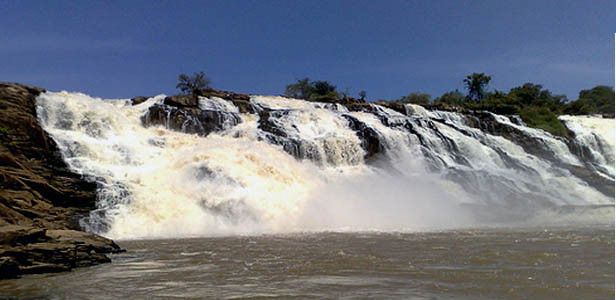
Gurara Falls is in Niger State, in central Nigeria, on the Gurara River, along the road that links Suleja with Minna. It lies just over 100 km from Abuja, the federal capital, which makes it the favourite weekend nature escape for people from the capital. It is a wide curtain of water about 30 metres high and up to 200 metres across, pouring over a rock ledge in the middle of savanna country.
📌Best time to go
Gurara changes completely with the seasons. In the dry season (December to March) the flow drops and the river splits into two or three channels between the rocks, with calm pools where you can go for a swim. At the height of the rainy season (April to November, peaking between August and September) the channels merge into a single roaring, spectacular curtain, but it is dangerous for swimming. The best photos come at the end of the rains (October-November), when there is still a huge volume of water and it has stopped raining overhead.
📌Suggested days
It is a half-day or full-day trip from Abuja. Most people go, spend a few hours by the water, have a picnic and return the same day. If you like, you can combine it with Zuma Rock, which is on the way out of Abuja towards Suleja.
📌Getting there
You can drive from Abuja in just over an hour (100-110 km) along the Abuja-Suleja expressway and then the Suleja-Minna road; the falls are signposted by the roadside, near the village of Bonu/Gurara. There is no convenient direct public transport, so the usual options are your own car, a car with a driver or an organised tour from the capital. In the rainy season a high-clearance vehicle is a good idea because of the state of the access road.
📌Getting around
Once there, everything is on foot: a path leads down to the base of the falls and there are viewpoints from above. In the dry season you can walk among the rocks and reach the pools; in the rains you should keep a safe distance because the rocks are slippery and the current is strong. Local guides are usually around and, for a tip, will show you the best spots.
📌Language and currency
Nigeria's official language is English, which is widely spoken; in the area you will also hear Hausa and Gwari. The currency is the Nigerian naira (NGN); in mid-2026 the exchange rate is around 1.400 naira to the US dollar. Bring cash in naira for the entrance fee, tips and some food, because there are no ATMs on site and cards are not accepted.
💱 NGN exchange rate
Loading rate…
🌤️ Weather in Gurara Falls
Loading weather…

Gurara Falls is the great nature escape right on Abuja's doorstep: a wide curtain of water on the Gurara River, in Niger State, just over an hour's drive from the Nigerian capital. It was 'discovered' for the modern world in 1745 by a Gwari hunter named Buba, although the local peoples had known and revered it long before. Its name comes from two local deities, Gura and Rara, who were worshipped beside the water.

The show depends on the season. In the rainy season the river pours over in a single white sheet almost 200 metres wide, crashing down the rock ledge and throwing up a cloud of spray; it is awe-inspiring but dangerous to approach. In the dry season, by contrast, the flow splits into several channels and crystal-clear pools appear between the rocks, ideal for dipping your feet or taking a plunge, with the stone warm in the sun and the murmur of water in the background.

This guide tells you how to get there from Abuja, when to go depending on what you want to see, what to expect on site and how to combine it with the famous Zuma Rock, which is on the way. Gurara is not a world wonder with big infrastructure, but a simple, authentic natural spot, perfect for escaping the pace of the capital and spending a few hours by the water.

📖 History of Gurara Falls

Although the Gwari peoples of the area already revered the river, tradition says the falls were made known in 1745 by a hunter named Buba, who came across them while tracking his prey. The name 'Gurara' comes from two local deities, Gura and Rara, to whom sacrifices were offered for good harvests and protection. During the 20th century the site grew in fame as a picnic destination and, when the new capital arrived in nearby Abuja in the 1980s, it became the region's favourite weekend outing. The full story is on our history page.

Read the full history ↓

🏛️ Gurara Falls is in Abuja and the centre

The country's planned capital and its central belt: Abuja, built from scratch in the geographic heart of Nigeria and guarded by the granite bulk of Zuma Rock.

Read the history of Abuja and the centre →

🗺️ What to see

1
The main curtain of water
The central drop of the Gurara River, about 30 metres high, which in the rains forms a single curtain almost 200 metres wide.
Leer más ↓
This is the star of the show: the Gurara River plunges over a rock ledge about 30 metres high. At the height of the rainy season (August-September) the whole wall is covered in water and becomes a roaring curtain up to 200 metres wide, throwing up a fine mist and, when the sun is out, a rainbow. This is when Gurara looks most impressive, but also when it is most dangerous. In the dry season the same wall splits into two or three thinner streams between dark rocks, revealing the geology of the falls. Tips: for photos, the best light is mid-morning; the upper viewpoint gives you the full panorama.
2
The dry-season pools
Natural pools among the rocks at the foot of the falls, where you can swim and cool off in the dry season.
Leer más ↓
When the flow drops, between December and March, pools of clear, calm water form among the flat rocks at the foot of the falls. This is when visitors go swimming, hop from stone to stone and sunbathe on the warm rock. It is a very relaxed outing, like a natural lido, very different from the fury of the water in the rains. Tips: wear shoes with good grip because wet rocks are slippery, and watch out for the current even in the dry season.
3
The path and viewpoints
A short path that runs down from the car park to the base of the falls, with panoramic spots along the way.
Leer más ↓
From the car park and picnic area, a path descends towards the base of the falls, passing several spots where you can look out over the drop. It is a short walk but with slopes and stones, and in the rains it can be muddy and slippery. The upper viewpoints are ideal for a wide shot of the full width of the falls, while down below you feel the force of the water up close. Tips: go down carefully and take your time; local guides will show you the best angles for a tip.
4
The picnic area and shelters
The shaded rest area above the river, where families from Abuja set up their weekend picnic.
Leer más ↓
Gurara is, above all, a picnic spot. Up top, above the river, there is an open area with trees, benches and a few simple shelters where families lay out their food, play music and spend the day. At weekends and on public holidays it fills up with people from Abuja. It is not a resort with lots of facilities, but a natural space with basic infrastructure, and that is part of its charm. Tips: bring your own food, water and bags for your rubbish; there are informal stalls but not much variety.
5
The Gurara River upstream and downstream
The stretches of river before and after the falls, with pools, gentle rapids and good traditional fishing.
Leer más ↓
Beyond the falls themselves, the Gurara River offers walks along its banks, with calm stretches, small rapids and riverside forest. It is a good place for walking, birdwatching and watching local fishermen work with their nets and rods. It gives you a sense of the natural setting that feeds the falls and of life in the Gwari riverside villages. Tips: ask a local guide to take you to the quieter stretches if you want to get away from the bustle of the picnic area.
6
Combining with Zuma Rock
The famous granite monolith at the gates of Abuja, which appears on the 100-naira note and lies on the way to Gurara.
Leer más ↓
Zuma Rock, a huge granite monolith over 700 metres high that appears on the 100-naira note, sits just outside Abuja on the road to Suleja, in the same direction as Gurara. Many visitors take the chance to stop and photograph it or walk around its base before or after the falls, making a full-day nature trip from the capital. Tips: the best view of Zuma is from the Abuja-Kaduna expressway; combine both in a single trip to make the most of the drive.
📶I have never landed without internet. I arrive and my phone connects to the strongest network in the country I am visiting: I can say I landed, sort out transport, book tours and keep posting, at a seriously good price. I always use the Maya eSIM — check their plans by clicking the banner.See plans →Maya Mobile eSIM — skip roaming fees, unlimited data
What nobody tells you

💵 Prices

Tickets

TypePrice
Entrada general (gate fee) por personaAround NGN 1.000 (approx. US$ 0,70), 2024-2025 rate; check when visiting
Estacionamiento de vehículoA token fee of about NGN 500-1.000 (approx. US$ 0,35-0,70) is usually charged separately, 2024; check when visiting
Guía local (opcional)Tip by agreement, around NGN 1.000-3.000 (approx. US$ 0,70-2), 2024; check when visiting
🔄 updated monthlyOfficial / reference values · double-check when buying

Activities and tours

Swimming in the natural pools (dry season)
Included in admission
DurationAs long as you like
OperatorOpen site; local guides optional
Guided walk to the foot of the falls
PriceTip of about NGN 1.000-3.000 (US$ 0,70-2), 2024
Duration1 to 2 hours
OperatorLocal village guides
Day picnic by the river
PriceAdmission only; bring your own food
DurationHalf day to full day
OperatorOn-site picnic area
Full-day trip from Abuja (with Zuma Rock)
DurationFull day
OperatorAbuja tour operators
Price
Depends on the operator, typically from NGN 25.000-60.000 (US$ 18-43) per person including transport, 2024; check
🔄 updated monthlyOfficial / reference values · double-check when buying

🚌 How to get there and distances

Getting around

ModePriceDurationNotes
Own car or hired car with driverBy arrangement; a driver costs around NGN 25.000-50.000 (US$ 18-36) per day, 20241 to 1,5 h from AbujaThe most comfortable and flexible option; lets you stop at Zuma Rock on the way
Taxi or app (Bolt) hired for the dayNegotiable for the return trip with waiting time; usually agreed separately1 to 1,5 h each wayAgree the price for the outward trip, waiting time and return before leaving Abuja
Organised tour from AbujaFrom NGN 25.000-60.000 (US$ 18-43) per person, 2024Full dayIncludes transport and sometimes a guide; the simplest option if you don't drive
🔄 updated monthlyOfficial / reference values · double-check when buying

How to get there

RouteAirlines / operatorsAvg. priceDuration
Abuja → Gurara Falls (via Suleja)Own car, taxi, Bolt or tourFuel/fare depending on mode; admission extra NGN 1.000, 20241 to 1,5 h (100-110 km)
Suleja → Gurara Falls (Minna road)Own car or local taxiShort trip; negotiable45 min to 1 h
Minna → Gurara FallsOwn car or local taxiNegotiableAbout 1 h from Minna
🔄 updated monthlyOfficial / reference values · double-check when buying

🏨 Where to stay

No exact prices: a scale from $ (budget) to $$$$$ (luxury), with 2-3 options per category.

In Abuja, upmarket (recommended base)
Price$$$$$
Recommended options
In the capital, from about NGN 120.000-350.000+ (US$ 85-250+) per night: Transcorp Hilton Abuja, Fraser Suites or Nordic Hotel; almost everyone stays in Abuja and goes on a day trip
In Abuja, mid-range
Price$$$$$
Recommended options
Approx. NGN 40.000-100.000 (US$ 28-70) per night; comfortable hotels in areas such as Wuse, Garki or Maitama, a good base for the trip to Gurara
In Suleja or Minna, budget
Price$$$$$
Recommended options
From about NGN 15.000-40.000 (US$ 11-28) per night; simple hotels for those who want to stay near the falls, especially coming from Minna

🍴 Where to eat

Picnic propio en las cataratas
Price$$$$$
Options / signature dish
Most common: bring your own food and drink (jollof rice, suya, snacks); there are few stalls on site and little variety
Puestos locales de comida (Suleja/camino)
Price$$$$$
Options / signature dish
From about NGN 1.500-4.000 (US$ 1-3) per dish; suya (skewers), jollof rice, grilled fish at roadside stops
Restaurantes en Abuya
Price$$$$$
Options / signature dish
In the capital, from about NGN 8.000-30.000 (US$ 6-21) per person; Nigerian, Lebanese and international cuisine in Wuse and Maitama before or after the trip

📖 History of Gurara Falls

Origins, formation and what the sources say.

A step of rock in the heart of Nigeria

Gurara Falls owe their existence to a simple but striking geological feature: the Gurara River, flowing down through the rolling country of Niger State in central Nigeria, suddenly meets a step of hard rock and plunges about thirty metres in a fall up to two hundred metres wide. The river gives its name to the falls, as well as to a local government area and to the nearby village itself. The whole region is part of Nigeria's central plateau, a land of wooded savannah where granite outcrops rise here and there among the farmland.

Unlike the great rainforest waterfalls in the south of the country, Gurara is a savannah waterfall, shaped by the rhythm of the seasons. During the long rainy season, from April to November, the river swells and covers the entire rock face with a single thundering curtain of water. In the dry season, from December to March, the flow drops so much that the fall splits into two or three thin streams, and pools of clear water appear among the rocks, where people go swimming. That double personality, fury in the rains and calm in the dry months, is part of what makes it what it is.

The surrounding area has historically belonged to the Gwari (or Gbagyi) people, farmers of central Nigeria who revered the river and its waters long before any written record existed. For them, as for so many cultures, a waterfall was not just scenery but a place charged with spiritual power, linked to the fertility of the land and to the water deities.

en.wikipedia.org · Gurara Fallscometonigeria.com · Gurara waterfalls

Gura, Rara and Buba the hunter

According to local tradition, the name 'Gurara' comes from the union of two deities worshipped by the peoples of the area: Gura and Rara. Sacrifices and prayers were offered to them beside the water, asking for good harvests, protection and prosperity. As at so many sacred sites in West Africa, the waterfall served as a natural shrine, a meeting point between the world of the living and the world of the spirits.

The most often repeated story about the falls' 'discovery' by the outside world places it in 1745, and its hero is a Gwari hunter named Buba. Tradition says that Buba, chasing his prey through the bush, reached the edge of the falls and was amazed by a cascade that until then had been known only to the people living closest to it. From him, the story goes, word of the place gradually spread through the region.

These dates and stories are best taken for what they are: oral tradition passed down from generation to generation, not documented history. What matters is that they reflect the deep bond between local communities and the river, and that the very name of the falls preserves the memory of a form of worship older than the arrival of Islam and Christianity in the region. Even today, many people in the surrounding villages see the place as much more than a tourist attraction.

cometonigeria.com · Gurara waterfallsnigeriagalleria.com · Gurara Falls Niger State

From shrine to weekend getaway

Through the centuries of the Hausa kingdoms and the Sokoto Caliphate, and later under British colonial rule, the Gurara area remained farmland of the Gwari and other peoples of Nigeria's Middle Belt. The waterfall stayed a local landmark, known to travellers on the routes between Suleja (formerly Old Abuja) and Minna, but with little reputation beyond the region.

Over the 20th century, as roads improved and nearby towns grew, Gurara began to draw visitors looking for a cool, green place to spend the day. Little by little the weekend picnic became a habit: families arrived with their food, settled in the shade above the river and enjoyed the water. The site became a classic outdoor spot for people from the centre of the country.

Niger State governments recognised the falls' tourism potential and made basic improvements to access, signage and rest areas, though the infrastructure always stayed modest. Gurara never became a big resort: it kept its character as a simple natural spot, closer to a popular bathing place than a theme park, and that authenticity is now part of its appeal.

nigeriagalleria.com · Gurara Falls Niger Stateen.wikipedia.org · Gurara Falls

The new capital changes everything

The big turning point in Gurara's recent history came from a political decision made far from the river: moving Nigeria's capital. In 1976 the military government decided to build a new federal capital in the geographic centre of the country, in a landscape of savannah and hills, to replace congested Lagos. That is how Abuja was born. It grew through the 1980s and officially became the capital in 1991.

With Abuja just over a hundred kilometres away, Gurara Falls gained a huge potential audience almost overnight: the hundreds of thousands of civil servants, diplomats and families who settled in the brand-new capital. For many of them, Gurara became the nearest and easiest nature escape, the ideal place for a Sunday away from the concrete and heat of the city.

Since then the falls have depended mainly on domestic weekend tourism: people from Abuja and the neighbouring towns of Suleja and Minna who drive out for the day. In high season and on public holidays, the picnic area fills with families, music and groups of friends. Being close to the capital has also put Gurara on the map for organised tours, often combined with nearby Zuma Rock, another of the great natural landmarks around Abuja.

en.wikipedia.org · Abujacometonigeria.com · Gurara waterfalls

Simple nature on the capital's doorstep

Today Gurara Falls are one of the most visited natural attractions in central Nigeria, precisely because they combine beauty with closeness to Abuja. They can't compete in size with the world's great waterfalls, but they offer something valuable: a piece of nature that is easy to reach, with its curtain of water, its pools and its savannah setting, just a short trip from the capital of a country of more than two hundred million people.

The site keeps a deliberately simple character. The infrastructure is basic (paths, viewpoints, picnic areas, the odd food stall) and much of the experience depends on the visitors themselves and on local guides from the nearby villages. That lack of polish is both its weakness (services are lacking) and its charm (it feels authentic, not staged for mass tourism).

Like so many natural sites in Nigeria, Gurara faces challenges with conservation, waste management and road safety, and its tourism development has been uneven over the years. But its story, from a Gwari shrine devoted to Gura and Rara, to a regional picnic spot, to the favourite getaway of the new capital, sums up how a quirk of a river can become, with time and geography, a small piece of identity for a whole region of the country.

cometonigeria.com · Gurara waterfallstripadvisor.com · Attraction Review g7258173 d12193729 Reviews…

📚 Bibliography

  • Wikipedia (EN) — «Gurara Falls»: https://en.wikipedia.org/wiki/Gurara_Falls
  • Wikipedia (EN) — «Abuja»: https://en.wikipedia.org/wiki/Abuja
  • Wikipedia (EN) — «Gbagyi people»: https://en.wikipedia.org/wiki/Gbagyi_people
  • Come to Nigeria — Gurara Waterfalls: https://www.cometonigeria.com/gurara-waterfalls/
  • Nigeria Galleria — Gurara Falls, Niger State: https://www.nigeriagalleria.com/Nigeria/States_Nigeria/Niger/Gurara-Falls-Niger-State.html
  • Tripadvisor — Gurara Waterfalls, Minna: https://www.tripadvisor.com/Attraction_Review-g7258173-d12193729-Reviews-Gurara_Waterfalls-Minna_Niger_State.html
  • The African Hobo — Tracking Waterfalls in Africa (1): Gurara: https://theafricanhobo.wordpress.com/2019/01/07/tracking-waterfalls-in-africa-1-visiting-gurara-water-falls-niger-state/
  • Ou Travel & Tour — Gurara Waterfall, Niger State: https://outravelandtour.com/gurara-waterfall-niger-state/
  • Real Journey Travels — Gurara Waterfalls: https://www.realjourneytravels.com/places/gurara-waterfalls/

❓ Frequently asked questions

When should I go, in the dry season or the rains?+
It depends on what you are after. In the rainy season (April-November, peaking August-September) you will see the falls in all their glory, as a single roaring curtain of water, but you won't be able to swim and the rocks are very slippery. In the dry season (December-March) the flow drops, calm pools form and you can go for a swim, although the falls look less impressive. The ideal middle ground is October-November: there is still plenty of water and it hardly rains any more.
How do I get there from Abuja?+
By car it is just over 100 km and a little over an hour along the Abuja-Suleja expressway and then the road towards Minna; the falls are signposted by the roadside. There is no convenient direct public transport, so the best option is your own car, a car with a driver, a taxi/Bolt hired for the day or an organised tour. You can stop at Zuma Rock on the way.
Can you swim at the falls?+
Yes, but only in the dry season (December-March), when the flow drops and calm pools form among the rocks. In the rainy season the current is strong and dangerous, and going in is not recommended. At any time of year, be careful on wet rocks, which are very slippery, and stay close to the areas where you see locals swimming.
How much is admission?+
General admission is around NGN 1.000 per person (less than a dollar), and there is usually a small separate parking charge. Local guides work for tips. Bring cash in naira because there are no ATMs on site and cards are not accepted. Check the amounts when you arrive, as they change with inflation.
What should I bring?+
Bring your own food and drink (it is mainly a picnic spot), plenty of water, sunscreen, a cap, shoes with good grip for the rocks, swimwear and a towel if you go in the dry season, and bags to take your rubbish away. Cash in naira for admission, parking and tips. In the rains, add a high-clearance vehicle because of the state of the access road.

More places in Nigeria

Cataratas de Erin-Ijesha (Olumirin)Colinas de Idanre (Oke Idanre)JosKanoLagosMontaña de Obudu (Obudu Mountain Resort)
See every place in Nigeria →The history of Nigeria →
Sources consulted (5)
Still planning?
Explore more destinations in Nigeria
See all destinations →
Image credits
Photos from Wikimedia Commons, each under its own licence (CC BY, CC BY-SA or public domain). Open each file to see its author and licence.
Gurara waterfalls