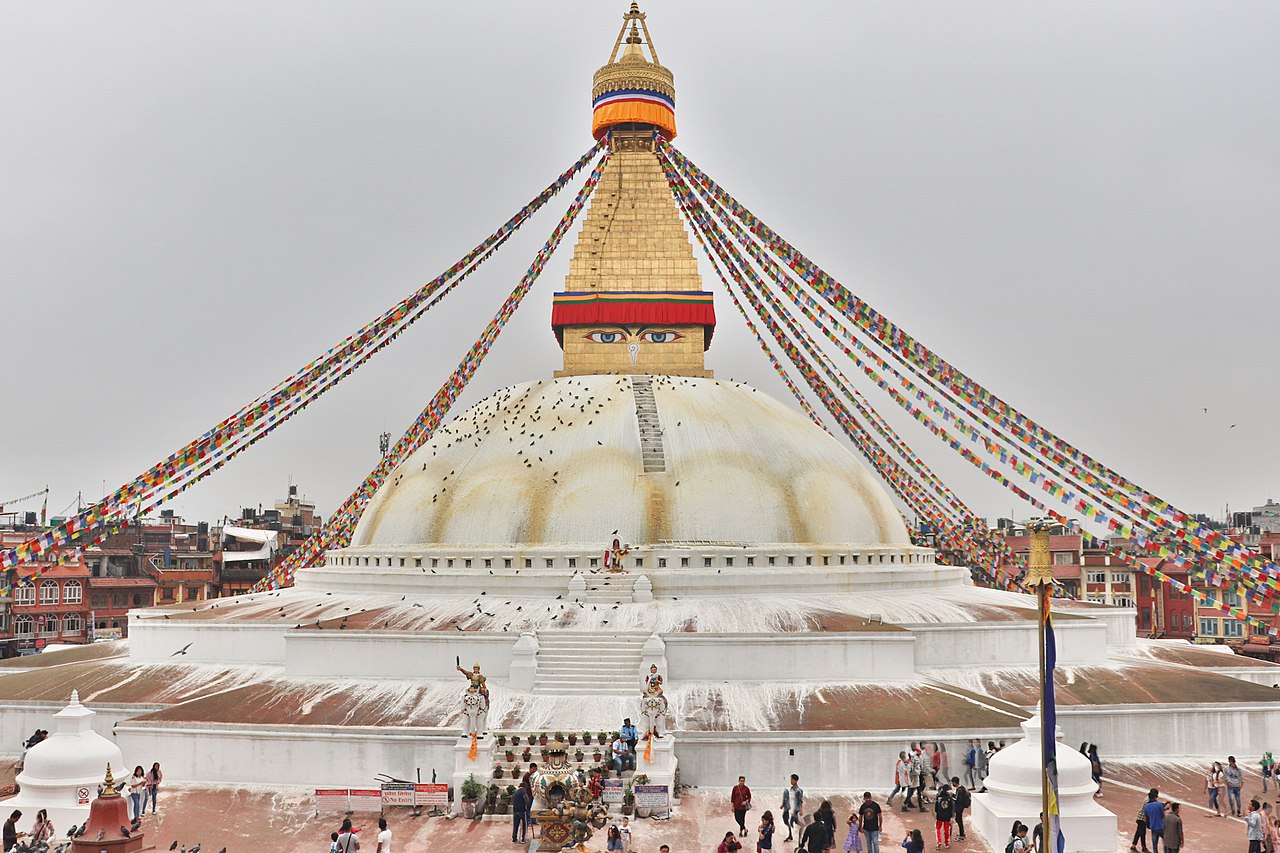
Kathmandu hits you straight away. There's the blare of horns, the dust, the swarm of motorbikes and the tangled cables. Incense and spices hang in the air and prayer flags flap in the wind. Then, suddenly, a medieval square full of carved-wood temples that looks like it belongs to another century. Nepal's capital is chaotic and exhausting, yes, but also one of the most fascinating places in Asia. Here, in just a few kilometres, Hinduism and Buddhism live side by side, along with pilgrims and backpackers, ash-smeared sadhus and rivers of people praying, shopping and praying again.
For centuries the Kathmandu Valley was a crossroads between India and Tibet, and an extraordinary cradle of art. Newar craftsmen built pagodas, palaces and stupas here that today form a World Heritage ensemble. The city brings together four great landmarks: the royal Durbar Square, the Swayambhunath stupa on its hill, the huge Buddhist stupa of Bodnath and the Hindu temple of Pashupatinath beside the sacred river. Add to that a hypnotic old town and the traveller chaos of Thamel, with its trekking shops, cafés and agencies.
This guide helps you find your way through that chaos with a practical approach. It covers what to see and in what order, and how much admission costs (it isn't cheap for foreigners). It also covers how to reach each site, how to dodge taxis that inflate the fare and the usual scams, and how to use Kathmandu as a base for Patan, Bhaktapur and Himalayan treks. In 2015 an earthquake devastated part of its heritage. Much of it has since been restored, but knowing that history helps you look at the city with respect. Kathmandu isn't 'pretty' in the easy sense: it's intense, vivid and hard to forget.
The Kathmandu Valley has been inhabited since ancient times. It flourished under the Licchavi kings (4th-9th centuries), who filled the valley with Hindu and Buddhist temples. But it reached its height under the Malla dynasty (13th-18th centuries). The valley was split into three rival kingdoms (Kathmandu, Patan and Bhaktapur), each with its own royal square (Durbar Square), and Newar craftsmen built the pagodas, palaces and statues that still amaze visitors today. In 1768-1769, King Prithvi Narayan Shah of the House of Gorkha conquered the valley and unified Nepal. He made Kathmandu the capital of a kingdom that would last until 2008, when Nepal became a republic. The April 2015 earthquake, of magnitude 7,8, badly damaged many of its monuments, most of which have now been restored. Our history page tells the city's long story, from the Newar to the Gorkha kings and from the Malla to the city of today.
Read the full history ↓The historic heart of Nepal: the three royal cities of the valley —Kathmandu, Patan and Bhaktapur— with their Durbar squares, their Newar pagodas and a religious life that blends Hinduism and Buddhism.
Read the history of Kathmandu Valley (culture and heritage) →A local guide tells you in half an hour what no sign at the site will ever explain. We look ours up on Civitatis: guided in Spanish and booked online with no fuss. They have over 20 activities in Katmandu. Three are below so you get the idea: tap any of them and they all open.
If you book from here we earn a commission and you pay no more. Prices and availability come from Civitatis.
No exact prices: a scale from $ (budget) to $$$$$ (luxury), with 2-3 options per category.
Origins, formation and what the sources say.
Buddhist legend says the Kathmandu Valley was once a huge lake, and that a luminous lotus flowered in the middle of its waters. A bodhisattva named Manjushri came from the north and cut through the wall of a hill with his sword to drain the lake. The water flowed away and left the fertile plain of the valley, and the hill of Swayambhunath rose where the lotus had been. Beautiful as it is, the myth has real geology behind it: the valley really was the bed of an ancient lake, and its very rich soil explains why people have lived on it and farmed it for thousands of years.
The first documented inhabitants were the Newar, the valley's original people. They were craftsmen and traders with a sophisticated culture that mixed Hinduism and Buddhism from very early on. The valley sat where routes between the plains of India and the plateaus of Tibet crossed, and trade made it rich: salt, wool, rice and the goods that crossed the Himalaya all passed through here.
Between the 4th and 9th centuries the Licchavi dynasty ruled. It is the first dynasty with solid historical records, and some of its stone inscriptions still survive. The Licchavi filled the valley with temples, founded many of the shrines that are still worshipped today and laid the foundations of the art and religion that would define Kathmandu. Sites as sacred as Pashupatinath, Swayambhunath and Changu Narayan have their roots in that period. Even then, the valley was a holy place for both Hindus and Buddhists, and it has never lost that.
If the Kathmandu Valley is one of Asia's great artistic treasures today, it owes that above all to the Malla dynasty, which ruled from the 13th to the 18th century. It was a golden age of art, architecture and religion. The Malla kings were devout and refined, and they competed with one another in patronage and splendour. With their support, Newar craftsmen reached a legendary level of skill. They carved wood as if it were lace and cast bronze so delicately that it was admired even at the court of the Mongol emperor of China. They also built the multi-tiered pagodas that have become the very image of Nepal.
From the 15th century on, the valley was split into three independent, rival kingdoms: Kathmandu, Patan (Lalitpur) and Bhaktapur. Each had its own court and its own royal square, the Durbar Square, which was the political and religious heart of the city. Far from impoverishing the valley, the rivalry enriched it. Every king wanted his square to be more beautiful than his neighbours', and the result was an astonishing concentration of palaces, temples, courtyards, fountains and statues within a handful of kilometres. Many of the monuments we admire today date from this period: the Taleju temples, the columns topped by kneeling kings, the Golden Gate of Bhaktapur and the Nyatapola pagoda.
This was also when many of the valley's living traditions took shape: the worship of the Kumari, the 'living goddess'; the great chariot festivals that still roll through the streets; and Newar culture at its height, with its own language, cuisine and festivals. Tradition says the name Kathmandu comes from the Kasthamandap, a wooden pavilion in Durbar Square supposedly built from the wood of a single tree. The monumental Kathmandu we know today is essentially the city the Malla left behind.
In the mid-18th century, while the valley's three Malla kingdoms wore themselves out in rivalry, an ambitious king was watching from the hills to the west. His name was Prithvi Narayan Shah, and he ruled the small principality of Gorkha, one of many mountain kingdoms scattered across central Nepal. He was convinced that only a united state could hold out against the British, who were advancing through India. So he began a long campaign of conquest and economic blockade to bring the neighbouring kingdoms under his control, one by one.
The Kathmandu Valley, rich and coveted, was the big prize. Prithvi Narayan besieged it for years and choked off its trade. Its fall was almost theatrical. On 25 September 1768, Kathmandu was celebrating the festival of Indra Jatra, with the townspeople and the defenders caught up in the processions and dances. The Gorkha troops marched in and took the royal palace with almost no resistance. Patan fell soon after, and in 1769 Bhaktapur, the last to hold out, fell too. That ended the Malla era and gave birth to the modern Kingdom of Nepal, with Kathmandu as its capital.
The Shah dynasty would rule Nepal until well into the 21st century. There was one long interruption: in the 19th century and much of the 20th, real power lay with prime ministers from the Rana family. Prithvi Narayan Shah is remembered today as the father of the Nepali nation, the man who turned a handful of mountain kingdoms into the country that exists today. But his unification also ended the independence of the valley's old Newar cities. Their culture survived all the same, and it is still alive in every square and every temple.
For much of the 19th century and up to 1951, real power in Nepal was held not by the Shah kings but by the Rana, a dynasty of hereditary prime ministers. They kept the monarchs as little more than figureheads and kept the country closed to the outside world. In Kathmandu the Rana built huge white European-style palaces, neoclassical buildings with columns and mirrored halls. They stood in sharp contrast to the Newar pagodas, and many still dot the city today. The Rana also left places like the Garden of Dreams. During those years Nepal stayed almost completely isolated, with hardly any roads and very few foreigners.
In 1951 a revolution ended Rana rule and gave power back to the crown. Nepal began to open up. The first tourists arrived, along with mountaineers dreaming of Everest, which was first climbed in 1953. In the 1960s and 1970s came waves of hippie travellers, who made Kathmandu a legendary stop on the 'road to the East'. The famous Freak Street, next to Durbar Square, was the centre of that era of musicians, spiritual seekers and backpackers, before Thamel took over.
The end of the 20th century and the start of the 21st were turbulent. From 1996 to 2006 Nepal went through a bloody Maoist civil war. In 2001 a tragedy shook the country: almost the entire royal family was killed in a massacre inside Narayanhiti Palace in Kathmandu, in circumstances that have never been fully explained. The monarchy, already weakened, never recovered. In 2008, after a peace process, Nepal abolished the monarchy and declared itself a republic. The last king left the palace, which is now a museum. That brought to an end almost 240 years of the Shah dynasty begun by the conqueror from Gorkha.
At midday on 25 April 2015, a magnitude 7.8 earthquake shook Nepal, with its epicentre northwest of Kathmandu. It was the country's worst natural disaster in more than eighty years. Nearly 9,000 people died, hundreds of thousands of homes were destroyed and the valley's heritage took a very hard blow. In the Durbar Squares of Kathmandu, Patan and Bhaktapur, centuries-old temples collapsed in seconds. The historic Kasthamandap pavilion, which gave the city its name, was reduced to rubble, and monuments such as the Dharahara tower came down with visitors inside. Pictures of the royal squares covered in broken brick went around the world.
Rebuilding was slow but steady. It had international support and, above all, depended on the work of Newar craftsmen, who had inherited the same techniques used to build the temples centuries earlier. Today, more than a decade later, most of the monuments have been restored or are well into restoration. The Kasthamandap stands again, many pagodas have their old outlines back and the squares have come back to life. Seeing them today also means seeing a heritage that refused to die.
21st-century Kathmandu is a city of more than a million people, and it is growing fast. It has all the problems of a modern Asian capital: chaotic traffic, air pollution, unplanned building and heavy pressure on its historic centre. And yet its essence is intact. In a single morning you can see a pilgrim turning a prayer wheel at Bodnath, a sadhu meditating at Pashupatinath, a craftsman carving wood as people did five hundred years ago and a backpacker haggling over a backpack in Thamel. Few capitals in the world pack so much history, so much spirituality and so much chaos into so few kilometres. Kathmandu is still what it has always been: the gateway to the Himalaya and the living heart of Nepal.