Viajá con Gus
Home › Mauritania › Oualata
Oualata
🇲🇷 Mauritania · The eastern Sahara (Tagant and Hodh)

Oualata

🪪 What do I need to enter Mauritania?Pick your citizenship and we tell you the visa, the days and the paperwork, with the official source.

By leaving your email and citizenship you agree to receive the documents you asked for and weekly travel news. You can unsubscribe whenever you want. How we handle your data.
Jump to what you need
📍Region
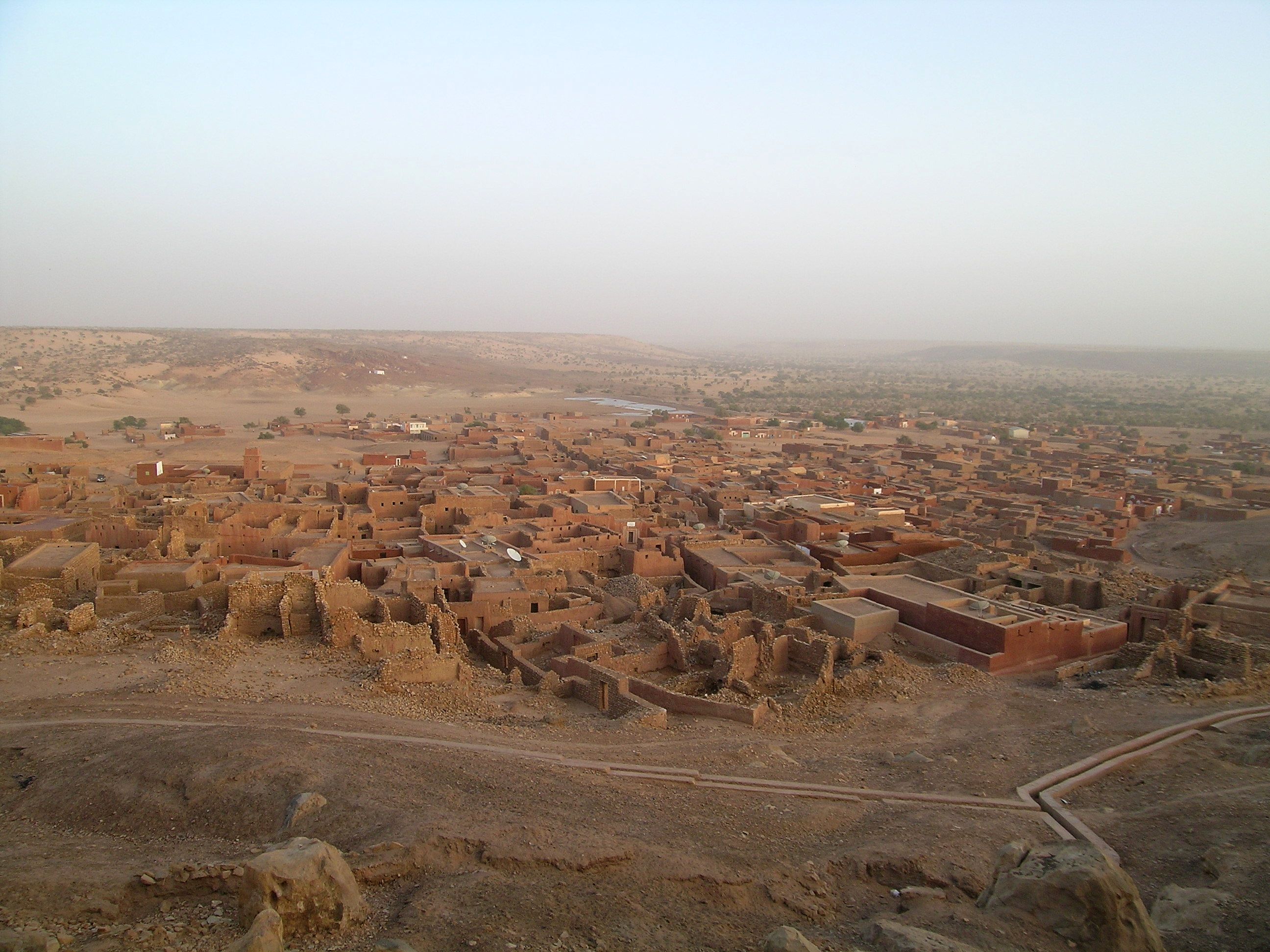
Oualata (Walâta) is the easternmost and most isolated of Mauritania's old caravan towns. It lies in the far south-east of the country, in the Hodh Ech Chargui region, on the eastern edge of the Aoukar depression and close to the border with Mali. It is famous across the Sahara for its houses decorated with beautiful bas-reliefs and red and ochre paintings, an art found nowhere else in the region. It is one of the four ksour that make up a UNESCO World Heritage Site, and one of the hardest to visit because it is so remote and because of the security situation in this border area.
📌Best time
The only reasonable season, weather-wise, is the northern-hemisphere winter, from November to February, with warm days and cold nights. The rest of the year the Saharan heat is extreme. But, as with Tichitt, the deciding factor is not the climate but security: this south-eastern region, close to the border with Mali, is one of the most sensitive in the country, and you need to be very well informed before you even consider the trip.
📌Suggested days
Because the place is so remote, those who manage to reach Oualata usually spend at least 1 full day there, on top of the long journey in. The visit itself — the decorated stone old town, the old mosque, the manuscript library, the workshop of the women who keep the decoration tradition alive — takes a few hours, but the logistics mean you have to plan with plenty of slack. It is a destination only for very well-prepared travellers with a trusted local operator.
📌Getting there
Access is very difficult: Oualata is in the far south-east, a long way from everything. You get there by road and track from Néma (the regional capital of Hodh Ech Chargui, on the 'Route de l'Espoir' that crosses the south of the country) and then on a track heading north. Only by 4x4 with an expert guide, and after a careful security assessment. There is no tourist transport and no infrastructure. Before organising any trip, check your country's latest official travel advice.
📌Language and currency
The official language is Arabic; Hassaniya and some French are spoken. The currency is the Mauritanian ouguiya (MRU); in mid-2026 the rate is around 40 MRU to the dollar (the ouguiya was redenominated in 2018: 1 new MRU = 10 old MRO). Everything is cash: bring ouguiyas from Nouakchott or Néma, because there are no banking services in Oualata. Carry plenty of extra water, fuel and supplies for the whole expedition.
📌Safety
Important warning: Oualata is in south-eastern Mauritania, close to the border with Mali, an area that many governments advise against travelling to or classify as very high risk because of the threat from armed groups and kidnappings in the Sahel. It is not a conventional tourist destination, nor safe by default; for long periods, travel there has been advised against outright. If you are considering it, go only with a Mauritanian operator you trust completely, who assesses the situation in real time, and always after checking your country's latest official travel advice. If you have the slightest doubt, it is best not to go.
💱 MRU exchange rate
Loading rate…
🌤️ Weather in Oualata
Loading weather…

Oualata is the most distant and secret gem of the Mauritanian Sahara: an old stone caravan town in the far south-east of the country, famous across the desert for its houses decorated with bas-reliefs and red and ochre paintings around doors and windows, a unique women's art that exists in none of the other ksour. For centuries it was a major centre of trans-Saharan trade and Islamic learning, the southern terminus of one of the most important caravan routes.

What makes Oualata unique is that mix of artistic beauty, deep history and extreme isolation: a stone town painted red, with its old mosque, its manuscripts and its walls decorated by hand by the women, on the edge of the desert and the Sahel savannah. Along with Tichitt, it is also the hardest and most sensitive to visit of the four World Heritage ksour, because of its remoteness and the security situation in this region bordering Mali.

This guide presents Oualata honestly: what it is and what you can see, why getting there is so difficult and sensitive, and what precautions you need to take before considering the trip — starting with checking your country's official travel advice. For the exceptionally well-prepared and well-advised traveller, and only when conditions allow, Oualata is one of the last great adventures of the Sahara; for most people, it is a place to admire above all through its history and its art.

📖 History of Oualata

Oualata was an important centre of trade and learning, the southern terminus of a major trans-Saharan route in the 13th and 14th centuries, when it came to outrank other towns and welcomed merchants and scholars linked to the Mali Empire (the traveller Ibn Battuta passed through in 1352). Home to Berber and Sudanese communities, it developed a unique art of decorating its houses with bas-reliefs and red paintings, the work of its women. With the decline of the caravans it faded and remained a remote ksar, a World Heritage Site since 1996. The full story is on our history page.

Read the full history ↓

🏛️ Oualata is in the eastern Sahara (Tagant and Hodh)

In Mauritania's remote east, Tichitt and Oualata hold out: the most isolated of the caravan towns, with their decorated stone architecture and their memory of the Mali Empire, on the edge of a sea of dunes.

Read the history of The eastern Sahara (Tagant and Hodh) →

🗺️ What to see

1
The decorated houses and their red bas-reliefs
Oualata's great treasure: façades and interiors decorated by hand with geometric motifs in red and ochre, a women's art unique in the Sahara.
Leer más ↓
Oualata's most famous and beautiful feature is its decorated houses. Around doors and windows and inside the rooms, the walls are covered with bas-reliefs and paintings of geometric and floral motifs in red, ochre and white, a delicate and highly elaborate art that the women of Oualata have passed down from generation to generation. There is nothing like it in the country's other caravan towns: it is the town's signature. These motifs — arabesques, diamonds, palms, interlacing lines — have aesthetic but also symbolic and cultural value, and they decorate both the façades and the rooms where important events are celebrated. Walking round the houses with a guide, seeing this decoration up close and meeting the craftswomen who keep it alive is the heart of a visit to Oualata, and one of the most remarkable forms of art in the whole Sahara. Getting there: in the town's old quarter, with a local guide. Best time: winter, during the day. Tips: ask permission before entering or photographing inhabited houses; a contribution or buying some handicrafts supports the women who preserve the tradition.
ℹ️ Distance: In Oualata's old quarter · Best time: Winter (Nov-Feb), daytime · Admission: Local guide recommended, about 500-1.500 MRU per group (~USD 12-35, 2026; check when visiting) · Duration: 1 to 2 hours
2
The old mosque
Oualata's old stone place of worship, the religious heart of the town and a reminder of its past as a centre of learning.
Leer más ↓
Oualata was a notable centre of Islamic learning, and its old stone mosque is the religious heart of the historic quarter. Plain and suited to its desert setting, it is one of the town's most significant buildings and recalls its role as a community of scholars and a stopover for pilgrims and students on the trans-Saharan routes heading east. The guide explains its history and Oualata's ties to the Islamic tradition of the western Sahara and to the world of the Mali Empire, in which it was an important town. The mosque, like the rest of the old quarter, is part of the ensemble UNESCO recognised as a World Heritage Site. Getting there: in the old quarter, as part of the guided tour. Best time: winter, during the day. Tips: it is a place of worship: dress modestly and follow the guide's instructions about access and photography.
ℹ️ Distance: In Oualata's old quarter · Best time: Winter (Nov-Feb), daytime · Admission: Included in the guided tour (check when visiting, 2026) · Duration: 20 to 30 minutes
3
The library and the manuscripts
Oualata's written legacy: medieval manuscripts that bear witness to its past as a great centre of learning.
Leer más ↓
Like its sister towns in the desert, Oualata was an important intellectual hub, and it still holds old manuscripts on religion, law, history and the sciences, kept by families or local institutions. These documents bear witness to its golden age, when the town, linked to the Mali Empire, drew merchants and scholars from a vast territory. Some manuscripts and objects are displayed in a small museum or centre that the town has tried to develop to preserve and show its heritage. Seeing these documents helps you understand that Oualata, for all its isolation today, was a cosmopolitan hub in a network connecting the Maghreb, the Sahara and sub-Saharan Africa. Getting there: in the town; the guide arranges the visit depending on availability. Best time: winter, during the day. Tips: the manuscripts are generally not to be touched or photographed with flash; it is customary to leave a contribution towards their conservation.
ℹ️ Distance: In the village of Oualata · Best time: Winter (Nov-Feb), daytime · Admission: Contribution of about 500-1.000 MRU per person (~USD 12-25, 2026; subject to availability; check when visiting) · Duration: 30 to 45 minutes
4
The women's craft workshop
The space where the women of Oualata keep the tradition of decoration and local craftwork alive.
Leer más ↓
The decoration of Oualata's houses is a women's art, passed from mothers to daughters for generations. In the town there are initiatives and workshops where women keep this tradition alive, both on walls and on handicrafts — leather, textiles, pottery — using the same red and ochre geometric motifs. Visiting one of these spaces, when possible, lets you see up close how the decoration is made and meet the women who create it. Supporting this craftwork — by buying pieces or leaving a contribution — is a direct way of helping the community and of making sure this unique art is not lost. In a town so isolated and with such scarce resources, the women's culture and know-how are both heritage and livelihood. Getting there: in the town, with a guide who arranges it with the craftswomen. Best time: winter, during the day. Tips: buy local handicrafts as support; ask permission before photographing the women and their work.
ℹ️ Distance: In the village of Oualata · Best time: Winter (Nov-Feb), daytime · Admission: Free; purchase of handicrafts or a contribution to the craftswomen (2026) · Duration: 30 to 60 minutes
📶I have never landed without internet. I arrive and my phone connects to the strongest network in the country I am visiting: I can say I landed, sort out transport, book tours and keep posting, at a seriously good price. I always use the Maya eSIM — check their plans by clicking the banner.See plans →Maya Mobile eSIM — turn travel mode on
What nobody tells you

💵 Prices

Tickets

TypePrice
Guía local para el casco antiguo (por grupo)About 500-1.500 MRU (~USD 12-35, 2026; check when visiting)
Visita a manuscritos/biblioteca (por persona)About 500-1.000 MRU (~USD 12-25, 2026; subject to availability; check when visiting)
Antigua mezquitaIncluded in the guided tour (2026)
Artesanía de las mujeresDepends on the item; direct support to the craftswomen (2026)
🔄 updated monthlyOfficial / reference values · double-check when buying

Activities and tours

ActivityPriceDurationOperator
Guided tour of the decorated houses and the ksarGuide from about 500-1.500 MRU per group + contributions (2026; check when visiting)2 to 3 hoursLocal guides in Oualata
Visit to the women's craft workshopsPurchase of handicrafts / contribution (2026; check when visiting)30 to 60 minLocal cooperatives and craftswomen
4x4 expedition to the Hodh and OualataDepends on the operator; multi-day expedition, tailor-made price (2026; check when booking)Several daysSpecialist operators (assess security)
🔄 updated monthlyOfficial / reference values · double-check when buying

🚌 How to get there and distances

Getting around

ModePriceDurationNotes
4x4 with expert guide (essential)Part of the expedition; tailor-made price (2026)Long drive from Néma on a trackThe only way to get there and get around; requires experience and a security assessment of the area
On foot around the ksarFree—The old quarter and the decorated houses are explored on foot, with a guide
🔄 updated monthlyOfficial / reference values · double-check when buying

How to get there

RouteAirlines / operatorsAvg. priceDuration
Nouakchott → Néma on the 'Route de l'Espoir'Road transport (south of the country)Variable; very long journey (about 1.100 km, 2026; check when visiting)One to two days' travel
Néma → Oualata by 4x4Specialist operators/guidesPart of the expedition; tailor-made price (2026)Several hours on a track (about 100-120 km north)
Safety warning——Very high-risk area bordering Mali; check your country's official travel advice before organising any trip
🔄 updated monthlyOfficial / reference values · double-check when buying

🏨 Where to stay

No exact prices: a scale from $ (budget) to $$$$$ (luxury), with 2-3 options per category.

Basic accommodation in Oualata (guesthouse/khaima tent)
Price$$$$$
Recommended options
Very basic and limited; lodging in a local home or a khaima tent, subject to availability (price to be agreed, 2026); there are no hotels as such
Expedition camp
Price$$$$$
Recommended options
Bivouac or khaima tent set up by the operator, with meals from the crew; the usual option on a trip to Oualata
Base beforehand in Néma
Price$$$$$
Recommended options
In Néma, the capital of Hodh Ech Chargui, there are simple places to stay the night before or after the track to Oualata (variable price, 2026)

🍴 Where to eat

Comida de la expedición
Price$$$$$
Options / signature dish
Included in the trip logistics; couscous, rice, dates and mint tea prepared by the crew; there are no restaurants in Oualata
Hospitalidad local
Price$$$$$
Options / signature dish
Almost symbolic; tea and simple food the community may offer, in keeping with the desert's tradition of hospitality
Provisiones desde Nuakchot/Néma
Price$$$$$
Options / signature dish
Essential to carry plenty of extra water, fuel and food before the track; there are no supplies in Oualata

📖 History of Oualata

Origins, formation and what the sources say.

A city on the edge of the desert and the savannah

Oualata (Walâta) stands in the far south-east of Mauritania, in the Hodh Ech Chargui region, on the eastern edge of the great Aoukar depression and very close to today's border with Mali. Its location shaped its history. It sat in the transition zone between the Sahara Desert to the north and the Sahel savannah to the south. That is the point where the desert caravans met the world of the Sudanese kingdoms of West Africa.

That location made it a prime stopover and marketplace. Caravans crossing the Sahara from the Maghreb with salt, cloth and other goods came here to trade them for the gold, ivory and products coming up from the kingdoms of the south. Oualata was a great meeting point for trade and the terminus of one of the most important trans-Saharan routes. It was also the desert's gateway into the heart of West Africa.

The city had a mixed population: Berber communities from the desert and groups of Sudanese origin from the south. This gave it a cosmopolitan character and a distinctive cultural richness. That mix still shows today in its art, its architecture and its traditions, which differ from those of the more 'Saharan' ksour to the north, such as Chinguetti and Ouadane.

en.wikipedia.org · Oualatawhc.unesco.org

Golden age: Oualata and the Mali Empire

The 13th and 14th centuries were Oualata's golden age. They coincided with the height of the Mali Empire, the great Sudanese state that ruled much of West Africa and controlled the gold trade. Oualata came into Mali's orbit and became one of its most important cities on the northern side. It was the southern end of the caravan route and a centre of trade, learning and religious life. During this period the city grew more important than others in the area.

A first-hand account of that golden age comes from the famous Maghrebi traveller Ibn Battuta, one of the great explorers in history. He crossed the Sahara and reached Oualata in 1352 on his way to the Mali Empire. In his account he described the city, its people, their customs and its role as the first stop in the land of the Blacks after leaving the desert. It is one of the most valuable descriptions of the region from that time.

Like the other ksour, Oualata was also a notable centre of Islamic learning, with schools, scholars and libraries of manuscripts. Its wealth came from trade and knowledge, and it made Oualata a cosmopolitan, cultured city at the crossroads of the Arab-Berber world to the north and the Sudanese world to the south.

en.wikipedia.org · Oualataen.wikipedia.org · Mali Empire

The art of the decorated houses

Oualata's trademark is the decoration of its houses. It is what makes the city unique among all the cities of the Mauritanian Sahara. Around doors and windows and inside the rooms, the walls are covered in bas-reliefs and paintings with geometric and floral motifs in red, ochre and white: arabesques, diamonds, palms and interlacing lines. It is a delicate, elaborate and highly recognisable art, and you won't find it in Chinguetti, Ouadane or Tichitt.

This art is also a women's tradition. The women of Oualata have created and kept up this decoration for generations, passing it from mother to daughter. They paint both the façades and the rooms used for celebrations and important occasions. The motifs have aesthetic value, but they also carry cultural and symbolic meaning, and they are part of the identity of each family and of the city.

Today the survival of this art is one of Oualata's greatest heritage assets and one of the reasons for its international recognition. In such an isolated and impoverished town, keeping the decoration and the related crafts alive does two things: it preserves the culture, and it gives the women who practise it a source of income.

en.wikipedia.org · Oualataecofinagency.com · 1105 55452 tichitt and oualata mauritania s…

Decline and isolation

Like every caravan city, Oualata declined when trans-Saharan trade lost its central role. Traffic shifted to the sea routes along the Atlantic coast. Political changes swept the Sahel kingdoms, and the roads became unsafe. Later, paved roads and lorries arrived. Each of these made the city less important. Once a great trading crossroads, Oualata was pushed further and further to the margins of the modern routes.

Isolation became its defining feature. It lies in a remote corner of the south-east, far from the country's main routes. Oualata steadily lost people and influence, and like the rest of the Sahel it suffered the great droughts of recent decades. Its heritage was left at the mercy of time, sand and lack of money: the decorated houses, the mosque and the manuscripts. An ever-smaller community held it together.

In recent times, a decisive problem has added to this geographic isolation: insecurity along the border with Mali, which is affected by instability across the Sahel. For long stretches this has kept Oualata out of travellers' reach. It has become one of the desert's 'forgotten cities', admired from afar more than visited.

ecofinagency.com · 1105 55452 tichitt and oualata mauritania s…en.wikipedia.org · Oualata

World Heritage and a fragile present

In 1996, UNESCO inscribed Oualata on the World Heritage List together with Chinguetti, Ouadane and Tichitt, as Mauritania's 'ancient ksour'. The listing recognised these cities as exceptional evidence of caravan culture, of Saharan town planning and of the desert's commercial, religious and intellectual life between the 11th and 19th centuries. The unique art of Oualata's decorated houses is one of the most original features of the group.

There have been efforts to preserve Oualata's heritage. A small museum or centre was set up to conserve and display manuscripts and objects, and there are projects supporting the women's crafts. Conservation is very hard, though. The town is remote, money is scarce, and the region's instability keeps tourism and investment away.

Today, for almost everyone, Oualata is a place people dream of more than one they visit. It is a symbol of the beauty, sophistication and fragility of the cities of the Sahara. For an exceptionally well-prepared and well-advised traveller, and only when security conditions allow, it is one of the most extraordinary adventures the desert can offer. For everyone else, Oualata lives on mainly through its history and its art. It is the red city at the far edge of the Sahara, where women paint the memory of a caravan civilisation onto stone walls.

whc.unesco.orgen.wikipedia.org · Oualata

📚 Bibliography

  • UNESCO — Ancient Ksour of Ouadane, Chinguetti, Tichitt and Oualata: https://whc.unesco.org/en/list/750/
  • Wikipedia (EN) — «Oualata»: https://en.wikipedia.org/wiki/Oualata
  • Wikipedia (EN) — «Mali Empire»: https://en.wikipedia.org/wiki/Mali_Empire
  • Wikipedia (EN) — «Ibn Battuta»: https://en.wikipedia.org/wiki/Ibn_Battuta
  • Ecofin Agency — Tichitt and Oualata, Mauritania's Forgotten Desert Cities: https://www.ecofinagency.com/news-tourism/1105-55452-tichitt-and-oualata-mauritania-s-forgotten-desert-cities
  • UNESCO Urban Heritage Atlas — Ancient ksour of Mauritania: https://whc.unesco.org/en/activities/1307/
  • Wikipedia (EN) — «Ancient Ksour of Ouadane, Chinguetti, Tichitt and Oualata»: https://en.wikipedia.org/wiki/Ancient_Ksour_of_Ouadane,_Chinguetti,_Tichitt_and_Oualata
  • Britannica — «Oualâta»: https://www.britannica.com/place/Oualata

❓ Frequently asked questions

Is it safe to travel to Oualata?+
To be very clear: Oualata is in south-eastern Mauritania, close to the border with Mali, an area that many governments advise against travelling to or classify as very high risk because of the threat from armed groups and kidnappings in the Sahel. It is not a conventional tourist destination, nor safe by default, and for long periods travel there has been advised against outright. If you are considering it, go only with a Mauritanian operator you trust completely, who assesses the situation in real time, and always after checking your country's latest official travel advice. If you have the slightest doubt, it is best not to go.
Why is Oualata famous?+
Above all for its decorated houses: the women of Oualata paint and sculpt in bas-relief geometric and floral motifs in red, ochre and white around doors, windows and interiors, a unique art that does not exist in the other caravan towns of the Mauritanian Sahara. Oualata was also a great centre of trade and learning, the southern terminus of a trans-Saharan route, linked to the Mali Empire (the traveller Ibn Battuta passed through in 1352). It is one of the four ksour that make up a UNESCO World Heritage Site.
How do you get to Oualata?+
With great difficulty: it is in the far south-east of the country. You take the long 'Route de l'Espoir' from Nouakchott to Néma (the regional capital, about 1.100 km away), and from there a track heading north, only by 4x4 with an expert guide. There is no tourist transport and no infrastructure, and the security of the area is the deciding factor. Before organising any trip, you must check your country's latest official travel advice and have a trusted local operator.
What can you see in Oualata?+
The stone old quarter with its famous houses decorated in red and ochre, the old mosque, the manuscript library (and a small museum/heritage centre) and the workshops where the women keep the tradition of decoration and craftwork alive. All of it in a setting of desert and savannah on the edge of the Aoukar. It is an exceptional artistic and historical heritage, recognised by UNESCO in 1996 together with Chinguetti, Ouadane and Tichitt.
When is the best time to go?+
The northern-hemisphere winter, from November to February, with warm days and cold nights; the rest of the year the heat is extreme. But, as with Tichitt, the main constraint is not the climate but security: before thinking about dates, you need to find out whether the trip is feasible and advisable, by checking your country's official travel advice and asking trusted local operators. If the situation is unclear, the responsible choice is not to go.

More places in Mauritania

Parque Nacional del Banc d'ArguinParque Nacional del DiawlingPort de Pêche de NuakchotTerjitTichittTren del hierro
See every place in Mauritania →The history of Mauritania →
Sources consulted (6)
Still planning?
Explore more destinations in Mauritania
See all destinations →
Image credits
Photos from Wikimedia Commons, each under its own licence (CC BY, CC BY-SA or public domain). Open each file to see its author and licence.
Oualata 03