Gunung Mulu is Borneo's great underground adventure: a remote corner of rainforest and limestone mountains in the interior of Sarawak, so isolated that you can only get there by small plane. Hidden inside it are some of the most colossal caves on the planet. Here you'll find the Sarawak Chamber, the largest known underground chamber in the world (so huge that several football stadiums would fit inside), and Deer Cave, which has one of the biggest cave mouths there is. Deer Cave is famous for the show it puts on every evening, when millions of bats stream out in rippling formations and head into the jungle to hunt. A World Heritage Site for its geology and biodiversity, Mulu is a place that defies the imagination.
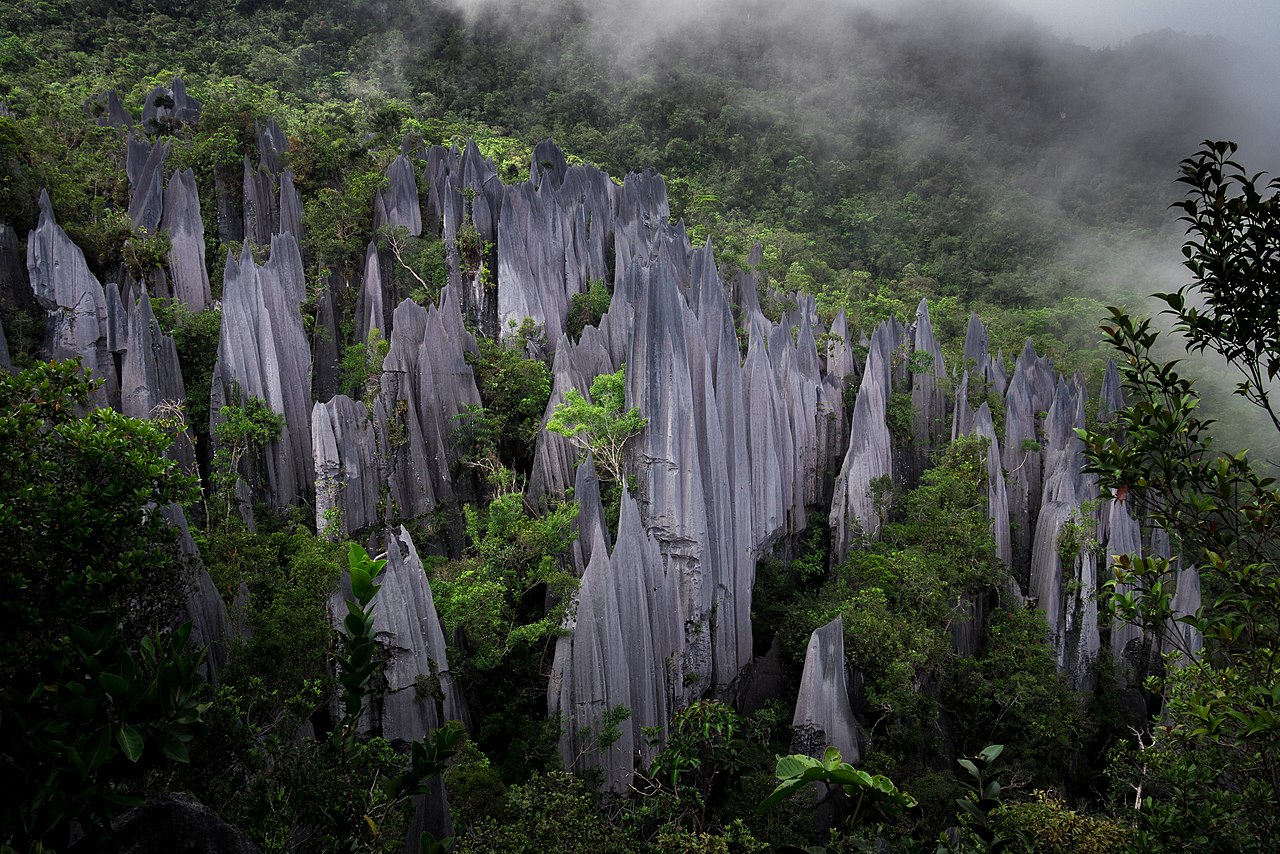
But Mulu isn't just caves. On the slopes of Mount Api stands one of Borneo's most surreal landscapes: the Pinnacles, a forest of knife-sharp limestone spikes up to 45 metres tall. They rise out of the jungle and can only be reached after a gruelling trek of several days. All around is World Heritage primary rainforest, with crystal-clear rivers, canopy walkways and the culture of local peoples such as the Penan, nomadic hunter-gatherers of the jungle. It's a destination for people who want nature in its wildest state and are willing to travel to the ends of the earth to see it.
This guide gets you ready for Mulu. It covers how to get there (spoiler: on a MASwings small plane, booked well ahead), which caves to see and what they cost, why the bat exodus depends on the weather, what the demanding Pinnacles trek involves, and how to arrange everything with the park (nothing is done on your own). It also covers the practical side of such an isolated destination: bring cash, because there are no reliable ATMs; book accommodation and activities in advance, because capacity is limited; and be ready for heat, humidity and rain. Getting to Mulu takes some effort, but what you see inside its caves and on top of its pinnacles stays with you forever.
Gunung Mulu National Park, in the jungle heart of Sarawak, was created in 1974 and listed as a UNESCO World Heritage Site in 2000 for its outstanding geological and biological value. It holds one of the world's most important limestone cave systems, spectacular karst formations such as the Pinnacles, and exceptional biodiversity across 17 distinct vegetation zones. Scientific exploration of its caves revealed giant cavities such as the Sarawak Chamber to the world, above all through the major British caving expeditions of the 1970s and 1980s. Long before the explorers arrived, though, these forests were (and still are) home to indigenous peoples such as the Berawan and, above all, the Penan. The Penan are one of the last nomadic hunter-gatherer peoples of Southeast Asia, and their fight to preserve their way of life and their forest from logging is one of Borneo's most moving stories. The full history of Mulu, the exploration of its caves and the peoples of the forest is on our history page.
Read the full history ↓Malaysia's largest state: the kingdom of the Brooke White Rajahs, land of the Dayak and their longhouses, with Kuching on the riverbank and the colossal caves of Mulu.
Read the history of Borneo — Sarawak →No exact prices: a scale from $ (budget) to $$$$$ (luxury), with 2-3 options per category.
Origins, formation and what the sources say.
To understand Mulu, you have to imagine a very deep stretch of time. Tens of millions of years ago, much of what is now this corner of Borneo lay under a warm, shallow tropical sea, where for ages the remains of corals, shells and marine organisms piled up, layer upon layer, forming thick deposits of limestone. Then the titanic movements of the Earth's crust folded and lifted those seabeds, turning them into mountains: that is how Mulu's limestone massifs were born, such as Mount Api, whose name means 'fire' because of the way its white walls blaze in the sun.
Once out of the water, the other great sculptor took the stage: rain. In one of the wettest regions on the planet, slightly acidic rainwater dissolved the limestone drop by drop, millennium after millennium. This process, called karstification, did two spectacular things. On the surface, it carved the rock into razor-sharp shapes, creating the Pinnacles: a forest of limestone spikes tens of metres tall that jut out of the rainforest like blades. And deep below, the water bored through the mountain from the inside, hollowing out, over millions of years, one of the most colossal and extensive cave systems in the world.
Those caves are Mulu's crown jewel. Beneath the rainforest lies a labyrinth of hundreds of kilometres of passages, underground rivers, gigantic chambers and corridors that have yet to be fully explored. The undisputed star is the Sarawak Chamber, discovered in the 1980s: the largest known underground chamber on the planet, so enormous — hundreds of metres long, wide and high — that several football stadiums or dozens of aeroplanes would fit inside. Mulu is, in essence, a monument to geological patience: proof of what water and time can do to stone when given millions of years.
Long before any explorer mapped these caves, Mulu's rainforests already had inhabitants: the Indigenous peoples of Borneo, among them the Berawan and, above all, the Penan. The Penan are one of the last nomadic hunter-gatherer peoples of Southeast Asia, a way of life that vanished millennia ago in almost every other part of the world. For generations they lived on the move through the deep rainforest in small groups, without building permanent villages: they hunted with the blowpipe and poison darts, fished, and above all relied on sago, a starch they extract from a certain palm, as well as the fruit, honey and materials the jungle provided.
The Penan have an extraordinary knowledge of the rainforest — its plants, its animals, its rhythms — and a culture built on principles of reciprocity and care for the forest, with a concept, 'molong', that means never taking more than you need and preserving resources for the future. Their relationship with the forest was not that of owners exploiting a resource, but of inhabitants who are part of a whole. That worldview, so different from modern extractive logic, unintentionally made them a symbol of a way of life in harmony with nature that the world was about to sweep away.
From the 1970s and 1980s onwards, the Penan's rainforest — like that of almost all of Borneo — was invaded by logging companies, which cut roads and felled trees at a devastating pace to export tropical timber. The Penan watched their home being destroyed, their rivers polluted and the animals they depended on disappear. Their response became famous around the world: peaceful resistance. In the 1980s and 1990s, groups of Penan set up human blockades to stop the logging roads, in an unequal and courageous struggle that drew international attention to the deforestation of Borneo. Many were arrested or suppressed, and logging largely continued, but their cause became a global emblem of forest protection and Indigenous rights.
Although local peoples had known many of Mulu's cave entrances since time immemorial, the true scale of its underground world stayed hidden from the rest of the planet until relatively recently. The first mountain to draw outsiders was Gunung Mulu itself, a sandstone peak of more than 2,300 metres whose jungle-clad slopes fascinated naturalists and mountaineers. But it was the exploration of the caves that revealed something truly exceptional.
The big leap came with a series of international scientific and caving expeditions, above all the ambitious expedition by Britain's Royal Geographical Society in 1977-1978, which studied the region's geology, flora and fauna in depth, followed by British caving expeditions in the decades that came after. It was these explorers — crawling through unknown passages, wading through underground rivers and surveying galleries — who gradually revealed the astonishing scale of the system: hundreds of kilometres of caves, and finds that left the world open-mouthed, such as the Sarawak Chamber in 1981, the largest known underground chamber, or the confirmation that Clearwater Cave was part of one of the longest cave systems on the planet.
Those expeditions not only put Mulu on the world caving map, they also provided the scientific case for protecting it. Gunung Mulu National Park was established in 1974, and the knowledge gathered by the explorers was key to UNESCO declaring it a World Heritage Site in 2000, recognising both its geological and speleological value and its extraordinary biodiversity, with 17 distinct vegetation zones stepping up from lowland rainforest to the mountain's summit. Exploration continues to this day: every so often, new cavers still discover passages in a system that may never be fully known.
Mulu is not just a geological marvel: it is an ecosystem overflowing with life, both above ground and below it. On the surface, its World Heritage rainforests are home to astonishing biodiversity thanks to their range of altitudes and their variety of soils and habitats: thousands of plant species (including many orchids and carnivorous Nepenthes pitcher plants), hundreds of birds, primates, deer, and an almost countless array of insects and other invertebrates. It is one of the most diverse and best-preserved rainforests in Borneo.
But what is truly unique is the life underground. Mulu's caves host one of the richest cave ecosystems in the world, a dark universe that revolves around two main players: bats and swiftlets. Millions of bats of several species live in caves such as Deer Cave, and every evening they put on the famous 'exodus', streaming out in columns that twist across the sky. Their guano, piled up in gigantic mounds on the cave floors, is the base of an entire underground food chain: cockroaches, beetles, crickets, centipedes, spiders and other invertebrates adapted to life in darkness live on it, many of them endemic, and they in turn feed snakes and other predators.
It is a delicate balance that the surrounding forest also depends on: the bats, heading out each night to hunt tonnes of insects, and the swiftlets help control pests and keep the whole region's ecosystem healthy. That is why conserving the caves and the rainforest go hand in hand: harming one affects the other. This web of life — from the limestone spike baking in the sun to the blind invertebrate living on guano in total darkness — is what makes Mulu so valuable, and what UNESCO set out to protect when it declared it a World Heritage Site. Visiting it means glimpsing not only a geological wonder, but a living, complex world that has been working for millions of years.
21st-century Gunung Mulu is one of Borneo's great nature and adventure destinations, a place that combines the prestige of World Heritage status with the magic of remoteness: lost in the rainforest of inland Sarawak, it can only be reached by small plane. Every year, travellers from all over the world come here to venture into its colossal caves, watch the bats stream out, suffer through and enjoy the Pinnacles trek, or simply soak up one of the most biodiverse rainforests on the planet. The park, which is well managed, offers a first-rate nature experience with local guides, many of them from the area's Berawan and Penan peoples.
When it is responsible, this tourism plays an important role: it gives economic value to the standing forest, offers local communities an alternative to logging, and funds and justifies the conservation of an irreplaceable ecosystem. But Mulu, like all of Borneo, is not a bubble: around it, pressure from deforestation, logging and plantations still threatens the rainforests of inland Sarawak, and with them the way of life of peoples such as the Penan, whose fight for their land is far from over. The existence of a protected park does not erase the tensions around it.
For travellers who make the effort to reach this remote corner, Mulu leaves something more than spectacular photos: the awareness of being somewhere exceptional, shaped by millions of years of water and stone, home to astonishing life above and below ground, and cared for — not without difficulty — as one of humanity's natural treasures. Walking through its giant caves, watching the river of bats against the evening sky or gazing at the Pinnacles rising out of the rainforest are experiences that put things in perspective: they remind us how small we are in the face of time and nature, and how much wonders like this are worth protecting. Mulu is one of those places that is hard to reach and impossible to forget.