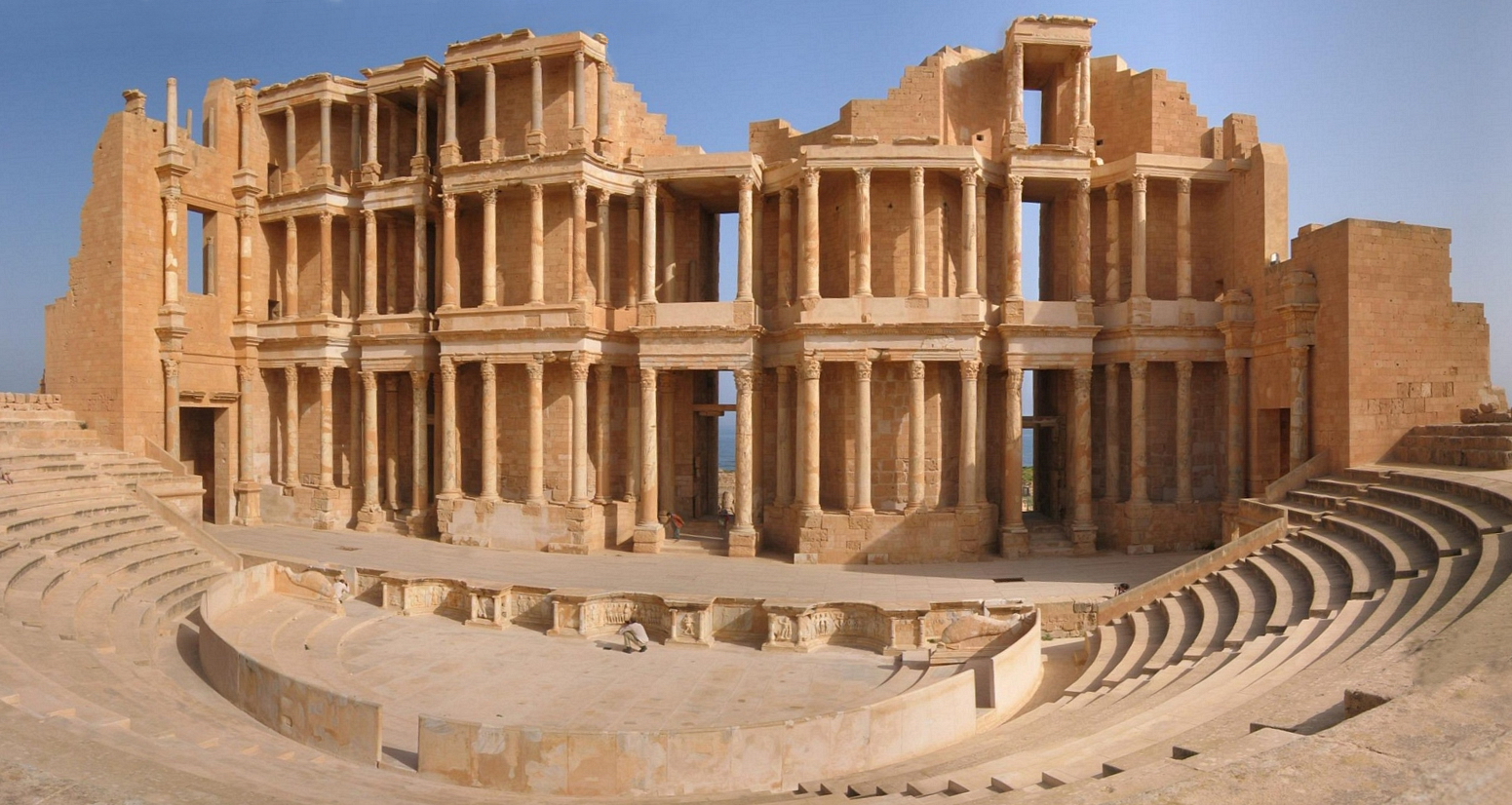
Seventy kilometres west of Tripoli, on a headland that looks straight out over the Mediterranean, Sabratha holds one of the best-preserved Roman theatres in all of Africa. Its three-storey stage front still has dozens of columns standing, and eighteen centuries later it remains one of the most complete performance buildings of the ancient world. Around it lies a whole city of forum, temples, baths and basilica, which traces the change from a modest Phoenician trading post into one of the urban gems of Roman Tripolitania.
Sabratha began as a Phoenician trading post around the 4th century BC, tied to trade with the African interior along the caravan routes. It then came under Carthage's sway before joining the Roman world after Carthage fell in 146 BC. Its golden age came with the Severan dynasty in the 2nd and 3rd centuries AD, when the city nearly doubled in size and filled with temples to Roman, North African and Eastern gods alike: Liber Pater, Serapis, Isis.
Like the rest of Libya's heritage, Sabratha is going through a delicate time. It has been on the List of World Heritage in Danger since 2016, and it suffered documented damage during the armed clashes of 2017-2018 in the neighbouring modern town, which were linked to human-trafficking networks. This guide describes its real heritage in the detail it deserves, while making clear that as of 2026 a visit can only be considered as part of a tour organised by a licensed Libyan operator.
Sabratha began as a Phoenician trading post around the 4th century BC, at the western end of Tripolitania. It was tied to the caravan trade with the African interior and to Carthage's maritime routes. After Carthage was defeated in the Third Punic War (146 BC) it passed into Rome's orbit. It had its heyday in the 2nd and 3rd centuries AD under the Severan dynasty, which came from nearby Leptis Magna, when the city was almost entirely rebuilt and its famous theatre went up. It became Christian in the Byzantine period, gaining several early Christian basilicas. The Arabs conquered it in the 7th century, and it was gradually abandoned as a town. Systematic excavation of its ruins began in the 20th century, first under Italian and later under Libyan administration. It has been a UNESCO World Heritage Site since 1982 and on the List of World Heritage in Danger since 2016.
Read the full history ↓The historical heart of Libya: the three Phoenician cities that gave Tripolitania its name, the capital of kings, pashas and rival governments, and the birthplace of the Roman emperor Septimius Severus.
Read the history of Tripoli and the Tripolitanian coast →No exact prices: a scale from $ (budget) to $$$$$ (luxury), with 2-3 options per category.
Origins, formation and what the sources say.
Sabratha began as a modest Phoenician trading post around the 4th century BC, at the western end of the Tripolitanian coast, where the caravan routes crossing the desert from inland Africa reached the Mediterranean. It started out as a trading terminal: goods from the interior, such as gold, ivory, slaves and exotic wares brought across the Sahara, were traded here for manufactured and farm goods from the Mediterranean world.
As Carthage rose to become the dominant power in the western Mediterranean, Sabratha came into its commercial and political orbit, along with Oea (later Tripoli) and Leptis Magna. That gave the region its Greek name, Tripolis, "the three cities". The Punic period left a deep mark on local religion that was still visible centuries later in cults such as that of Liber Pater, a deity with local roots who was later identified with the Roman Bacchus/Dionysus.
After Carthage's final defeat in the Third Punic War (146 BC), Sabratha passed into Rome's orbit, first as an allied city and later as a municipium and then a colony with full rights. Its first major phase of Roman-style building came in the 1st and 2nd centuries AD, with the first forum, several temples and a theatre smaller than the one that stands today.
The real leap forward came with the Severan dynasty in the 3rd century AD. Septimius Severus, born in nearby Leptis Magna, was generous to the whole of Tripolitania, and under his dynasty Sabratha went through a period of intensive rebuilding and expansion. The city roughly doubled in size, new temples went up to Liber Pater, Serapis and Isis, and the great three-storey theatre that defines the site today was built, with an estimated capacity of several thousand spectators. This was when the city reached its architectural and demographic peak, thanks to the wealth from the trade in olive oil, grain and goods from inland Africa.
The 5th century brought the crisis of the Western Roman Empire and the Vandal invasion of North Africa. In AD 455 a major earthquake, followed by Vandal occupation, badly damaged Sabratha's urban infrastructure and began a long decline from its Severan peak.
In the mid-6th century the Byzantine emperor Justinian I reconquered North Africa and restored several cities in the region, Sabratha among them. The great Basilica of Justinian, with its geometric mosaic floors, dates from this period. It shows that the city had become fully Christian and had rejoined the Byzantine world, if only briefly. By then Sabratha had a clearly Christian identity, with several early Christian basilicas scattered across the city.
The Arab-Muslim conquest of North Africa in the 7th century ended Sabratha's Byzantine period. Tripoli (Oea) remained an inhabited city under Arab and Ottoman rule and grew into a modern capital. Sabratha, by contrast, slowly declined and emptied, and lost its role as a leading urban centre to other towns in the region.
For centuries its ruins lay partly buried under sand and vegetation. The occasional European traveller came by and recorded the visible remains of the theatre and some of the temples, but no one had yet studied the site systematically.
Scientific archaeology reached Sabratha during the Italian colonial occupation of Libya (1911-1943). Italian archaeologists excavated the site systematically, and in the 1930s they partly rebuilt the great Roman theatre by anastylosis, reassembling its scattered original columns and restoring much of its three-storey stage front. That work made Sabratha one of the most visitable and photogenic archaeological sites in all of North Africa.
UNESCO added the Archaeological Site of Sabratha to the World Heritage List in 1982, recognising its urban layout and its value as a record of how a Punic-Roman city developed in North Africa. In July 2016, however, during the Libyan civil war that followed 2011, UNESCO placed Sabratha on the List of World Heritage in Danger, along with Leptis Magna, Cyrene, Tadrart Acacus and Ghadames. The reasons were the country's general instability and the risk posed by armed groups operating near the sites. Between 2017 and 2018 the neighbouring modern town also saw armed clashes directly linked to control of people-smuggling networks to Europe, which added a further, specific risk to the area. As of 2026, Sabratha remains on the List of World Heritage in Danger, according to the official update on whc.unesco.org. Ghadames is the only one of the five Libyan sites to have been removed from that list, in July 2025.