Viajá con Gus
Home › Jordan › Dana Reserve
Dana Reserve
🇯🇴 Jordan · The south: Petra, Wadi Rum and the King's Highway

Dana Reserve

🪪 What do I need to enter Jordan?Pick your citizenship and we tell you the visa, the days and the paperwork, with the official source.

By leaving your email and citizenship you agree to receive the documents you asked for and weekly travel news. You can unsubscribe whenever you want. How we handle your data.
Jump to what you need
📍Region
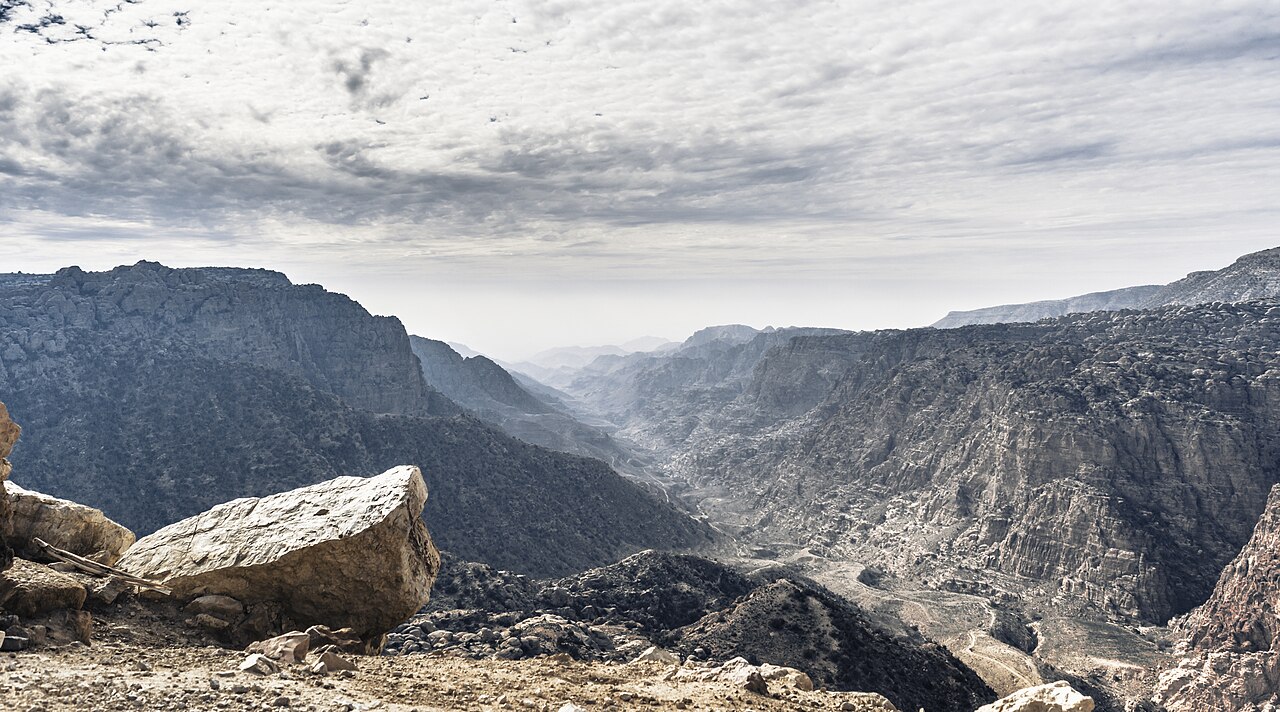
The Dana Biosphere Reserve is Jordan's largest nature reserve, in the south-central part of the country, on the King's Highway, halfway between the Dead Sea and Petra. It stretches from the highlands (over 1,500 m) down to the Wadi Araba desert (close to sea level), covering four distinct bioclimatic zones in a single place, which gives it a huge variety of landscapes, plants and wildlife. Perched on the edge of a spectacular canyon is the stone village of Dana, a restored Ottoman village. It is run by the RSCN (Royal Society for the Conservation of Nature), a pioneer of ecotourism in the country.
📌Best time to go
Spring (March to May) is the best time: ideal walking temperatures, the canyon in bloom and plenty of greenery. Autumn (September to November) is also excellent. Summer (June to August) is hot, especially in the lower parts towards the desert (Feynan), although the Dana highlands are cooler; it's best to start early and carry plenty of water. Winter (December to February) is cold at altitude, with a chance of snow, but pleasant in the lowlands. Because of the differences in altitude, temperatures vary enormously within the reserve depending on the area and the time of day.
📌Suggested days
With 1 night you can enjoy the essentials: arrive at Dana village, walk one of the short trails through the canyon, watch the sunset over the valley and sleep in the village or at a campsite. With 2 nights you can do the great Wadi Dana trail, which descends from the village to Feynan Ecolodge (14-16 km, 5-7 h) across the reserve, sleep at Feynan (no electricity, lit by candles) and enjoy its starry sky. Trekking lovers can spend more days here and do several routes. Dana combines very well with Petra (~1 h away) along the King's Highway.
📌Getting there
Dana village sits on the King's Highway, about 25 km north of the town of Tafila, halfway between Madaba/the Dead Sea and Petra. The most practical way to get there is with a private driver or a rental car; many people include it as a stop on the scenic drive between Amman/the Dead Sea and Petra along the King's Highway. There is also the occasional minibus through the area (infrequent). There is no train or nearby airport; the main one is Queen Alia in Amman. The RSCN and the places to stay help arrange transfers, especially to reach the remote Feynan Ecolodge (accessed by 4x4 from the desert side).
📌Getting around
Inside the reserve you get around on foot: the trails are the way to explore it, some self-guided and others requiring an RSCN guide (mandatory on long or connecting routes). Dana village is small and pedestrian. Feynan Ecolodge, at the desert end, is reached in the lodge's 4x4 from the village of Qurayqira/Greigra (private cars can't get in). Between Dana village and Feynan you can either walk the great trail (downhill) or arrange road transport, which means a long detour. Plan your transfers carefully, because the reserve is large and remote.
📌Language and currency
The language is Arabic; English is spoken at the RSCN lodges and by the guides. The currency is the Jordanian dinar (JOD, or JD): as of July 2026, 1 JOD is roughly 1.41 USD (about 1.30 EUR). In Dana you pay per trail, and the price already includes reserve admission and the guide: 10, 12 or 20 JOD per person for non-Jordanians depending on the length of the route (8/10/17 for residents and 6/7/14 for Jordanians, according to the RSCN 2026 price list); it is NOT included in the Jordan Pass (it is managed by the RSCN, not the Ministry). Accommodation and meals are paid separately to the RSCN or to the community-run lodgings. Bring cash, because this is a rural, remote area where you can't always pay by card; it's best to book accommodation and trails in advance.
💱 JOD exchange rate
Loading rate…
🌤️ Weather in Dana Reserve
Loading weather…

If Petra is Jordan's stone jewel and Wadi Rum its sand desert, Dana is its green heart: the country's largest nature reserve, a place where travellers change pace, put away the monument camera and lace up their boots to walk. From the stone village perched on the edge of an immense canyon, the reserve spills down the mountain, from cool summits covered in juniper to the scorching desert of Wadi Araba, crossing four bioclimatic zones and an astonishing biodiversity in just a few kilometres of descent.

Dana is the flagship of ecotourism in Jordan, a pioneering project of the RSCN (the Royal Society for the Conservation of Nature) that achieved something difficult: protecting nature while giving the local community a future. The old Ottoman village of Dana, half abandoned, was reborn thanks to responsible tourism, and today its restored stone houses welcome travellers who come to walk, watch birds and ibex, sleep under the stars and discover a side of Jordan that doesn't make the postcards but wins over anyone who seeks it out.

This guide helps you plan your visit to Dana: which trails to do (from a short stroll through the canyon to the great trek to Feynan), how much admission and accommodation cost, where to sleep (from the guesthouse with views to the legendary candlelit ecolodge), when to go and how to combine it with Petra along the King's Highway. Dana is a place to take your time: to walk slowly, listen to the silence of the mountains, watch the sunset colour the canyon and understand why many travellers remember it as the most peaceful and authentic moment of their whole trip to Jordan.

📖 History of Dana Reserve

Dana village is an old farming village of Ottoman origin, with stone houses perched on the edge of a great canyon, inhabited for centuries by communities that farmed terraced gardens and raised livestock using the mountain springs. The area also has a much older past: in the lowlands of the reserve, towards Feynan, lie some of the copper mines worked for thousands of years, as far back as the Bronze Age, among the oldest in the world. In the mid-20th century, with modernisation and rural exodus, Dana village was almost abandoned. Its revival came in 1989-1993, when the RSCN (Royal Society for the Conservation of Nature) created the Dana Biosphere Reserve and launched a pioneering ecotourism model that restored the village, protected nature and gave work and a future to the local community. Today Dana is Jordan's largest reserve and an international benchmark for conservation and responsible tourism. Its full history is on our history page.

Read the full history ↓

🏛️ Dana Reserve is in the south: Petra, Wadi Rum and the King's Highway

The monumental south: Nabataean Petra carved into the rock, the Wadi Rum desert, the country's only port at Aqaba and the castles of the old King's Highway.

Read the history of The south: Petra, Wadi Rum and the King's Highway →

🗺️ What to see

Tours nearby, in Petra

They depart from Petra, 42 km away. If you book from this link we earn a commission and you pay no more.

1
Dana village and the canyon viewpoint
The old Ottoman stone village, restored and perched on the edge of an immense canyon, with spectacular views over the valley.
Leer más ↓
Dana village is the heart of the reserve and its gateway: a village of Ottoman-style stone houses from the 19th century and earlier, perched on the edge of a spectacular canyon that opens to the west, towards the desert and Wadi Araba. Half abandoned by the mid-20th century, the village was restored as part of the RSCN ecotourism project, and today it combines renovated houses, charming guesthouses, craft workshops run by the local cooperative (silver jewellery, ceramics, jams) and pedestrian lanes with a calm, authentic feel. What takes your breath away is the view. From the village viewpoints and the terraces of the lodgings, the Dana canyon unfolds in all its scale, with its stepped slopes, its ochre, reddish and green tones depending on the season, and that sense of vastness and silence that only great mountain landscapes give. Sunset here is memorable: golden light bathes the canyon and the outlines of the mountains stand out against the distant desert. The village is the best place to start your visit, get information on the trails at the RSCN centre, enjoy the calm, buy local crafts and stay somewhere with a view. Most of the hiking routes start here, including the short walks through the canyon and the great trek to Feynan. It's a place to slow down, breathe the fresh mountain air and take in one of the most beautiful landscapes in Jordan.
ℹ️ Distance: On the King's Highway, ~25 km north of Tafila; main entrance to the reserve · Best time to go: Sunset for the views; spring and autumn for ideal weather · Admission: Paid per trail, with admission and guide included: 10 JOD for short trails, 12 JOD for half-day trails and 20 JOD for long trails for non-Jordanians (8/10/17 residents, 6/7/14 Jordanians); NOT included in the Jordan Pass (managed by the RSCN) (RSCN — «RSCN Tourism Trails Price List 2026», Dana Biosphere Reserve, rscn.org.jo, accessed 08/08/2026) · Duration: As long as you like; ideally stay one night
2
The Wadi Dana trail (to Feynan)
The reserve's great trek: down the canyon from the village to Feynan Ecolodge, crossing four bioclimatic zones.
Leer más ↓
The Wadi Dana trail is the reserve's star route and one of Jordan's great treks: a descent of some 14 to 16 km from Dana village, high on the mountain, to Feynan Ecolodge, in the desert lowlands, dropping more than a thousand metres. The walk, which takes 5 to 7 hours depending on your pace, crosses the reserve's different bioclimatic zones, so you start among junipers and Mediterranean mountain vegetation and finish in full desert landscape, an astonishing change of worlds in a single hike. The path follows the bottom of the wadi (the canyon bed), between rock walls, oases with springs, fig trees and oleanders, and colourful geological formations. It's downhill, so it's easier than a climb, but you need good footwear, plenty of water and sun protection, and it's best to set off early to avoid the heat in the lower sections. The route can be done without a guide (it is fairly well marked and is one of the few self-guided long routes), although many people prefer to hire an RSCN or village guide, who also enriches the experience and supports the community. On reaching Feynan, the reward is twofold: rest at the famous ecolodge (candlelit, no electricity) and the feeling of having crossed the reserve end to end on foot. You need to arrange your stay at Feynan and the return transport in advance (the lodge connects to the outside world by 4x4). It's an unforgettable experience for hiking lovers and one of the best ways to experience Dana's variety of landscapes. There are also variants and other connecting routes (some all the way to Petra) for advanced trekkers.
ℹ️ Distance: 14-16 km from Dana village to Feynan (descent of >1,000 m) · Best time to go: Spring and autumn; set off early; avoid the extreme summer heat · Admission: Self-guided route (within reserve admission); optional RSCN guide by arrangement (verified July 2026) · Duration: 5 to 7 hours
3
Feynan Ecolodge
An award-winning ecolodge in the middle of the desert, with no electricity, lit by candles, under one of the best starry skies in the country.
Leer más ↓
Feynan Ecolodge is one of the most unusual and celebrated places to stay in Jordan (and in the world): an ecolodge in the lowlands of the Dana reserve, right in the Wadi Araba desert, run on sustainable principles and in close collaboration with the local Bedouin communities. It runs on solar power and, at night, is lit entirely by candles —hundreds of candles handmade by the community—, creating a magical, silent atmosphere, completely disconnected from the modern world. The lodge offers simple, comfortable rooms, local vegetarian food and an experience centred on nature and culture: walks through the canyons and the ancient copper mines nearby, visits to local Bedouin families to learn about their life and hospitality, birdwatching and, above all, stargazing. The total absence of light pollution makes Feynan one of the best places in Jordan for astrotourism: from its rooftop, with a Bedouin guide, you take in a spectacular night sky, with the Milky Way visible to the naked eye. Getting to Feynan is part of the experience: you arrive from the desert side (from the village of Qurayqira/Greigra) in the lodge's 4x4, or by walking the great trail from Dana village. Its isolation and philosophy make it a refuge for truly disconnecting. It has won international ecotourism awards and regularly appears on lists of the best ecolodges on the planet. Booking ahead is recommended. It's one of those experiences that sum up the best of responsible tourism in Jordan.
ℹ️ Distance: In the reserve's lowlands (Wadi Araba); 4x4 access from Qurayqira/Greigra or on foot from Dana · Best time to go: Spring, autumn and winter (pleasant in the lowlands); clear nights for the stars · Admission: Full-board stay from ~60-90 JOD/person approx.; activities included or by arrangement (verified July 2026) · Duration: 1 or 2 nights
4
The short canyon trails
More accessible routes from the village (Rummana, the waterfall, the village trail) to enjoy the canyon without a big trek.
Leer más ↓
You don't need to be a serious hiker to enjoy Dana: the reserve offers several short, moderate routes that let you discover the canyon, its plants and wildlife without committing to the great trek to Feynan. From the village and the RSCN centre, trails set off such as the Dana Village Trail (a short walk around the village and its surroundings), the Dana Waterfall Trail (which descends part of the canyon to a spring), and others of one to three hours that you can do on your own or with a guide. Another hiking area is Rummana, with the Rummana Campsite and its routes, such as the Rummana Mountain Trail and the Caves Trail, which cross different landscapes of the reserve and are ideal for watching birds and wildlife. Rummana Campsite opens seasonally (roughly from mid-March to late October) and lets you sleep in tents in the heart of nature, with starry skies and beautiful sunrises. Dana is, in fact, a paradise for bird and nature watchers: it is home to hundreds of plant species (many of them endemic), and wildlife that includes Nubian ibex, foxes, hyenas and numerous birds of prey and migratory birds that use the reserve's corridor. The RSCN rangers and guides know the best spots and times for seeing wildlife. These short routes, combined with the sunset from the village and a night under the stars, are the perfect way to enjoy Dana at a relaxed pace.
ℹ️ Distance: Routes of 1 to 3 h from Dana village or Rummana Campsite · Best time to go: Spring (plants and birds) and autumn; Rummana opens ~mid-March to late October · Admission: Within reserve admission; some routes require an RSCN guide (verified July 2026) · Duration: 1 to 3 hours per route
5
The ancient copper mines of Feynan
One of the oldest mining complexes in the world, worked since the Bronze Age, in the reserve's lowlands.
Leer más ↓
The Feynan area, in the lowlands of the Dana reserve, hides a first-rate archaeological treasure: one of the oldest and most extensive copper mining and smelting complexes in the world. Copper was mined here for thousands of years, as early as the Neolithic and above all during the Bronze and Iron Ages, leaving a vast landscape of ancient mines, galleries, slag heaps (mountains of smelting waste) and remains of settlements that archaeologists are still studying. Some researchers link these mines to biblical accounts and to the kingdoms of the region, and their exploitation over millennia —up to Roman and Byzantine times, when prisoners and convicts also worked there— makes them a key site for understanding the history of metallurgy and of humankind. The landscape, with its hills blackened by slag and its galleries cut into the rock, has enormous historical value as well as natural value. Feynan Ecolodge organises walks and guided visits to these mines and the nearby canyons (such as Wadi Ghuwayr, one of the most beautiful gorges in Jordan, with water and vegetation), combining nature, archaeology and Bedouin culture. It's a lesser-known side of Dana that adds a surprising historical depth to the reserve experience. For anyone interested in archaeology and geology, or simply anyone who wants to walk through extraordinary landscapes with thousands of years of history, it's a fascinating visit.
ℹ️ Distance: In the Feynan area, the reserve's lowlands; visited from Feynan Ecolodge · Best time to go: Spring, autumn and winter (hot in the lowlands in summer) · Admission: Guided walks organised by Feynan Ecolodge (by arrangement) (verified July 2026) · Duration: Half day
6
Dana is a perfect stop on the scenic King's Highway on the way to Petra, and the starting point for treks to the Nabataean city.
Leer más ↓
Dana is strategically located on the historic King's Highway, the scenic route that crosses Jordan from north to south through the highlands, passing Madaba, Mount Nebo, Karak Castle and, further south, Petra. That's why Dana is a natural and highly recommended stop for anyone driving this road between the Dead Sea/Amman and Petra, instead of the faster (but dull) Desert Highway. The mix of landscapes, history and nature along the King's Highway is one of the great travel experiences in the country. In fact, Dana is only an hour from Petra by road, so the two destinations link up easily: many travellers spend a night in Dana to walk and rest in nature before or after the intensity of Petra. It's a perfect contrast: the green serenity of the reserve and the stone monumentality of the Nabataean city. For the more adventurous, Dana is even the starting point for multi-day treks that link the reserve with Petra through the mountains, crossing spectacular, remote landscapes (part of the Jordan Trail, the long-distance path that runs the length of the country from north to south). These treks, done with a guide and organised logistics, are one of the most epic ways to reach Petra: on foot, over the mountains, like the travellers of old. Whether by car or on foot, the Dana-Petra connection through Jordan's mountainous heart is one of the gems of the south of the country.
ℹ️ Distance: Petra ~1 h by road; Karak, the Dead Sea and Madaba to the north along the King's Highway · Best time to go: Spring and autumn for the trails and the scenic drive · Admission: Depends on the destination; the Dana-Petra trek with guide and logistics (by arrangement); Petra in the Jordan Pass (verified July 2026) · Duration: 1-night stop or multi-day trek
📶I have never landed without internet. I arrive and my phone connects to the strongest network in the country I am visiting: I can say I landed, sort out transport, book tours and keep posting, at a seriously good price. I always use the Maya eSIM — check their plans by clicking the banner.See plans →Maya Mobile eSIM — skip roaming fees, unlimited data
What nobody tells you

💵 Prices

Tickets

TypePrice
Entrada a la Reserva de la Biosfera de Dana (RSCN)Dana has no standalone admission ticket: you pay for the trail, and the price already includes reserve admission and the guide. For non-Jordanians, 10.00 JOD for the four short trails of up to 2 h (Dana Village, Rummana Mountain, Rummana Campsite and Caves), 12.00 JOD for the half-day ones (Shaq El Reesh, Nawatef, White Dome and Wadi Dana) and 20.00 JOD for the long 8-9 h ones (Wadi Ghweir and Wadi Al Dathneh). Residents of Jordan pay 8, 10 and 17 JOD, and Jordanians 6, 7 and 14 JOD. NOT included in the Jordan Pass (RSCN — «RSCN Tourism Trails Price List 2026», Dana Biosphere Reserve, rscn.org.jo, accessed 08/08/2026)
Senderos guiados con guía de la RSCNThe guide is already included in the trail price (10, 12 or 20 JOD per person for non-Jordanians). Groups range from a minimum of 6 people (10 on the long trails) to a maximum of 20. Transfer to the trailhead and the return from the end of the trail are not included (RSCN — «RSCN Tourism Trails Price List 2026», Dana Biosphere Reserve, rscn.org.jo, accessed 08/08/2026)
Sendero del Wadi Dana (autoguiado)Included in the reserve admission; optional guide extra, 2026
Campamento de Rummana (temporada)Tent with half board, from ~40-60 JOD/person approx., 2026
Feynan Ecolodge (pensión completa)From ~60-90 JOD per person approx., 2026
🔄 updated monthlyOfficial / reference values · double-check when buying

Activities and tours

Wadi Dana trek (village → Feynan)
Duration5 to 7 h
OperatorRSCN and local guides
Price
The Wadi Dana Trail costs 12.00 JOD per person for non-Jordanians, admission and guide included (10 JOD residents, 7 JOD Jordanians); minimum 6 and maximum 20 people (RSCN — «RSCN Tourism Trails Price List 2026», Dana Biosphere Reserve, rscn.org.jo, accessed 08/08/2026)
Short trails through the canyon (village, waterfall)
PriceIncluded in admission; some with a guide, 2026
Duration1 to 3 h
OperatorRSCN
Rummana trails (mountain, caves)
Duration2 to 4 h
OperatorRSCN (season Mar-Oct)
Price
With an RSCN guide included in the trail price: 10, 12 or 20 JOD per person for non-Jordanians depending on the route (RSCN — «RSCN Tourism Trails Price List 2026», Dana Biosphere Reserve, rscn.org.jo, accessed 08/08/2026)
Stargazing at Feynan (astrotourism)
PriceIncluded in the ecolodge stay, 2026
Duration1-2 h at night
OperatorFeynan Ecolodge (Bedouin guides)
Walks to the Feynan copper mines and canyons
PriceOrganised by the ecolodge, by arrangement, 2026
DurationHalf day
OperatorFeynan Ecolodge
Dana-Petra trek (multi-day, Jordan Trail)
Duration3 to 6 days
OperatorTrekking agencies (check)
Price
With guide and logistics, depending on operator (several hundred JOD), 2026
🔄 updated monthlyOfficial / reference values · double-check when buying

🚌 How to get there and distances

Getting around

On foot along the trails
Included in admission
Duration1 h to a full day
Notes
The trails are the way to explore the reserve. Some are self-guided, others require an RSCN guide (mandatory on long or connecting routes). Hiking boots, plenty of water and sun protection
Feynan ecolodge 4x4
PriceTransfer from Qurayqira/Greigra, arranged with the lodge, 2026
Duration~30-45 min
Notes
Feynan can only be reached by 4x4 from the desert side (private cars can't get there) or on foot via the big trail. Arrange it with the ecolodge when booking
Private driver / rental car
PriceDepends on the route; stop on the King's Highway, 2026
DurationVariable
Notes
The best way to reach Dana village and combine it with Petra and the King's Highway. The reserve is large and remote: plan your transfers ahead
Minibus along the King's Highway
Cheap but infrequent, 2026
DurationVariable
Notes
There are a few minibuses through the area (Tafila and surroundings), but timetables are limited and they don't always reach the village; impractical if you're short on time
🔄 updated monthlyOfficial / reference values · double-check when buying

How to get there

RouteAirlines / operatorsAvg. priceDuration
Amman / Dead Sea → Dana via the King's HighwayPrivate driver or rental carDepends on the route (scenic stop), 2026~3 h from Amman (more with stops)
Petra → DanaPrivate driver or rental carFrom ~30-50 JOD/car, 2026~1 h (via the King's Highway)
Dana village → Feynan EcolodgeOn foot (big trail) or lodge 4x4 from QurayqiraTrail included in admission; 4x4 arranged with the lodge, 20265-7 h on foot / ~45 min by 4x4 (roundabout route)
Minibus along the King's Highway (Tafila)Local minibuses (infrequent)Cheap, 2026Variable
🔄 updated monthlyOfficial / reference values · double-check when buying

🏨 Where to stay

No exact prices: a scale from $ (budget) to $$$$$ (luxury), with 2-3 options per category.

Feynan Ecolodge (iconic, sustainable)
Price$$$$$
Recommended options
Full board from ~60-90 JOD/person approx., 2026. Award-winning ecolodge in the middle of the desert, with no electricity, lit by candles and powered by solar energy, run together with Bedouin communities; one of the best in the world for disconnecting and watching the stars
Dana Guesthouse (RSCN) with canyon views
Price$$$$$
Recommended options
~40-80 JOD per night, 2026. The RSCN guesthouse on the edge of the canyon, with rooms and balconies overlooking the valley and unforgettable sunsets; book ahead as it's very popular
Guesthouses and hotels in Dana village
Price$$$$$
Recommended options
~25-60 JOD per night, 2026. Community and family-run places to stay (such as the historic Dana Hotel/Tower and other restored houses) in the village, with local charm, terraces with views and home cooking; they support the community
Rummana Campsite (seasonal) and budget options
Price$$$$$
Recommended options
Tent with half board from ~40-60 JOD/person; simple options in the village, 2026. The RSCN campsite in the heart of nature (open ~Mar-Oct) for sleeping under the stars; plus budget guesthouses for tight budgets

🍴 Where to eat

Comidas en los alojamientos de la RSCN y la aldea
Price$$$$$
Options / signature dish
Half board/full board depending on accommodation; dinners ~8-15 JOD, 2026. The accommodations serve local home cooking (mezze buffets, stews, vegetables, bread), often with produce from the area; the most practical choice, as options elsewhere are very limited
Cocina local y comunitaria
Price$$$$$
Options / signature dish
Dishes ~4-12 JOD, 2026. In the village and family-run accommodations you'll eat simple, authentic Jordanian food, sometimes prepared by women from the local cooperative; a cultural experience as well as a culinary one
Comida vegetariana en Feynan Ecolodge
Price$$$$$
Options / signature dish
Included in the stay, 2026. The ecolodge serves simple, tasty local vegetarian food in a candlelit setting with no electricity; part of the place's sustainable experience
Provisiones y té
Price$$$$$
Options / signature dish
Depends on the product, 2026. It's a good idea to bring water and some food for the trails; the village has small shops and the cooperative sells local products (jams, herbs). Outside the accommodations there are few restaurants

📖 History of Dana Reserve

Origins, formation and what the sources say.

The copper of Feynan: one of the oldest mines in the world

Dana's story begins long before its stone village: it begins underground, in the copper veins that run through the reserve's lowlands, around Feynan and the Wadi Araba. There, thousands of years ago, people discovered and exploited one of the resources that would change civilisation: copper. The Feynan mines are one of the oldest and largest copper mining and smelting complexes in the world, with documented activity from the Neolithic and, above all, during the Bronze and Iron Ages, between four and six thousand years ago.

For millennia, generation after generation dug tunnels here, extracted the ore and smelted it in furnaces, leaving a landscape marked by mountains of slag (the black waste from smelting) and by the remains of settlements, workshops and water systems. Some researchers have linked this region to ancient kingdoms and stories of the area, and even to biblical episodes, given its huge importance as a source of metal in a world that depended on bronze, and later iron, for its tools and weapons.

Mining continued in Roman and Byzantine times, when, according to the sources, the Feynan mines were also worked by prisoners and convicts in extremely harsh conditions. This thousands-of-years-old mining past gives Dana a historical depth that surprises visitors who come expecting only nature: beneath its spectacular landscapes lies one of the oldest chapters in the history of human technology. Today you can visit these mines on guided walks from the Feynan ecolodge, a journey back to the origins of metalworking.

The stone village: centuries of farming life

In the reserve's highlands, perched on the edge of a great canyon, the village of Dana is another chapter in the area's story: that of the farming communities who lived in these mountains for centuries. The village, with its distinctive stone houses, took its present shape mainly in the Ottoman period (18th and 19th centuries), although people settled here much earlier, drawn by the springs and the relatively fertile slopes.

Dana's people lived from a clever and sustainable form of mountain farming: they grew vegetable gardens and fruit trees on terraces stepped down the canyon slopes, making the most of every drop of spring water through channels, and they raised goats and sheep. It was a hard life but one adapted to its surroundings, in balance with a nature rich in biodiversity but demanding. For generations, Dana's families knew every path, every spring and every corner of these mountains, knowledge that partly survives today thanks to ecotourism.

That traditional way of life went into crisis in the 20th century. Modernisation, the lack of economic opportunities, the pull of the cities and changes in farming caused a rural exodus that gradually emptied the village. In the mid and late 20th century, many families moved to nearby towns and cities in search of work, and Dana became more and more deserted, its stone houses slowly falling into ruin. The beautiful canyon village seemed doomed to disappear, like so many rural villages in the country. But its story was about to take an unexpected turn.

The rebirth: the RSCN and the biosphere reserve

The turning point came in the late 1980s and early 1990s, thanks to the RSCN, the Royal Society for the Conservation of Nature of Jordan, a pioneering environmental organisation in the country. Aware of the area's extraordinary natural value (its geology, its biodiversity, its four bioclimatic zones in a single place) and of the risk of losing both the nature and the village, the RSCN pushed for the creation of the Dana Biosphere Reserve, established in 1989 and developed over the following years until it became Jordan's largest nature reserve.

What made the Dana project special was not just protecting nature, but doing it in a way that benefited the local community instead of pushing it out. The RSCN bet on a pioneering model of ecotourism and community development: it restored the village houses, created places to stay (the Dana Guesthouse), opened trails, trained local guides and rangers, and launched economic projects for the residents, such as craft workshops (silver jewellery, pottery), jam and herb production, and tourism jobs. The idea was that nature conservation would also be the engine of a new life for the people of Dana.

The model worked and became an international benchmark for how responsible tourism can fund conservation and give rural communities a future. Dana won ecotourism awards and inspired other RSCN reserves in Jordan. The dying village came back to life: its stone houses filled up again, now with travellers from all over the world who come to walk, watch wildlife and discover a different way of travelling around the country. It was a true rescue, of nature and community at the same time.

Four worlds in one reserve: Dana's biodiversity

The underlying reason Dana is such a treasure is its extraordinary biodiversity, the result of its unique geography. The reserve stretches from the highlands, more than 1,500 metres up, down to the floor of the Wadi Araba desert, close to sea level, dropping a huge distance over a relatively short stretch. That descent crosses four different bioclimatic zones (Mediterranean mountain, Irano-Turanian, Saharan and Sudanian), so a single reserve brings together environments that elsewhere would be thousands of kilometres apart.

That variety of habitats translates into exceptional biological richness. Dana is home to hundreds of plant species, many of them rare or endemic, from the juniper and cypress woodlands of the heights to the desert vegetation of the lowlands. Its wildlife includes iconic mammals such as the Nubian ibex, the wolf, the fox, the caracal and even, in theory, elusive species like the striped hyena; and a very rich birdlife, with many breeding and migratory species, making Dana one of the best places in Jordan for birdwatching, including birds of prey. There are also reptiles and plant life adapted to each altitude band.

This diversity is exactly what the RSCN works to protect, and what visitors come to discover on the trails, often guided by local rangers who know where and when to spot wildlife. Walking from the cool summits to the scorching desert on the great Wadi Dana trail literally means crossing several natural worlds in a few hours. That sense of diversity and untouched nature is the heart of the Dana experience and what sets it apart from anywhere else in Jordan.

Dana today: a model of tourism with roots

Today's Dana is Jordan's largest nature reserve and one of the symbols of responsible tourism in the Middle East. The restored village, with its guesthouses overlooking the canyon, welcomes travellers from all over the world who are looking for something different from the big monuments: nature, hiking, silence, starry skies and genuine contact with local life. The reserve's trails, from the short walk along the canyon to the great trek down to Feynan, let you experience its amazing variety of landscapes, and local cooperatives offer crafts and products that keep the community's economy alive.

In the lowlands, the Feynan Ecolodge has become an international emblem of ecotourism: a lodge without electricity in the rooms, lit by candles and powered by solar energy, run in close partnership with the area's Bedouin communities, who work as guides, cooks and drivers and benefit directly from tourism. Feynan combines nature, archaeology (the ancient copper mines) and Bedouin culture, and regularly appears on lists of the world's best ecolodges. It is living proof that you can offer a memorable travel experience while respecting the environment and the people.

Dana is also part of the Jordan Trail, the long-distance path that crosses the country from north to south, and is one of its most celebrated stages, as well as the starting point for multi-day routes through the mountains all the way to Petra itself. Beyond the figures and the awards, what makes Dana special is a combination that is hard to achieve: protected, splendid nature, a local community that has found a future in looking after it, and a slow, respectful way of travelling. In a country famous for its ancient stones, Dana is a reminder that Jordan is also nature, silence and mountains, and it offers travellers one of its most peaceful and authentic corners.

📚 Bibliography

  • Wikipedia (EN) — «Dana Biosphere Reserve»: https://en.wikipedia.org/wiki/Dana_Biosphere_Reserve
  • RSCN — Dana Biosphere Reserve: https://www.rscn.org.jo/content/dana-biosphere-reserve-1
  • Wikipedia (EN) — «Royal Society for the Conservation of Nature»: https://en.wikipedia.org/wiki/Royal_Society_for_the_Conservation_of_Nature
  • Wikipedia (EN) — «Wadi Faynan»: https://en.wikipedia.org/wiki/Wadi_Faynan
  • Feynan Ecolodge (official): https://www.feynan.com/
  • Visit Jordan — Dana: https://international.visitjordan.com/
  • Wikipedia (EN) — «Jordan Trail»: https://en.wikipedia.org/wiki/Jordan_Trail
  • Wikipedia (ES) — «Reserva de la biosfera de Dana»: https://es.wikipedia.org/wiki/Reserva_de_la_biosfera_de_Dana
  • RSCN — Wild Jordan: https://www.rscn.org.jo/
  • RSCN — Dana Biosphere Reserve Trails 2026: https://www.rscn.org.jo/uploaded_files/reservation/Dana%20Biosphere%20Reserve%20Trails%202026.pdf

❓ Frequently asked questions

Is Dana admission included in the Jordan Pass?+
No. Dana Biosphere Reserve is managed by the RSCN (Royal Society for the Conservation of Nature), not the Ministry of Tourism, so it is NOT included in the Jordan Pass (unlike Petra, Wadi Rum, Jerash, etc.). There's no separate admission ticket: you pay for the trail, and that price already covers reserve admission and the guide. For non-Jordanians it's 10 JOD for the four short trails of up to 2 h, 12 JOD for the half-day ones and 20 JOD for the 8-9 h ones; residents of Jordan pay 8, 10 and 17 JOD and Jordanians 6, 7 and 14 JOD (official RSCN 2026 rate sheet). Accommodation and meals are paid separately to the RSCN or to the community accommodations. Bring cash, as it's a rural and remote area.
Which trails can I do in Dana?+
There's something for every level. The most famous is the big Wadi Dana trek, which descends 14-16 km from the village to Feynan Ecolodge (5-7 h, crossing four bioclimatic zones); it's a demanding but spectacular descent and can be done without a guide. There are also short and moderate routes of 1 to 3 hours from the village (village trail, waterfall trail) and in the Rummana area (mountain, caves), the latter with an RSCN guide. For advanced trekkers there are even multi-day routes linking Dana with Petra through the mountains (part of the Jordan Trail). Bring hiking boots, plenty of water and sun protection.
Is it worth staying overnight in Dana or Feynan?+
Very much so. Dana is a place to take your time, so staying at least one night transforms the visit. In the village, the RSCN's Dana Guesthouse and the community guesthouses offer rooms with canyon views and unforgettable sunsets. In the lowlands, Feynan Ecolodge is a unique experience: no electricity, candlelit, solar-powered, vegetarian food and one of the best starry skies in the country, run together with Bedouin communities. Both are benchmarks of ecotourism and it's best to book them well in advance.
When is the best time to visit Dana?+
Spring (March-May) is the best: ideal walking temperatures, the canyon in bloom and lush vegetation. Autumn (September-November) is also excellent. Summer is hot, especially in the lowlands (Feynan), although Dana's highlands are cooler; start early and stay hydrated. Winter is cold up high (snow is possible) but pleasant in the lowlands. Because of the big differences in altitude, temperatures vary enormously within the reserve. Rummana Campsite opens roughly from mid-March to late October.
How do I combine Dana with Petra?+
Very easily: Dana is just 1 hour from Petra along the King's Highway, the country's scenic route. Many travellers stop for a night in Dana to walk and unwind in nature before or after Petra, a perfect contrast between the green serenity of the reserve and the monumental Nabataean city. Driving the King's Highway (with Dana, Karak, Madaba…) instead of the Desert Highway is one of the best travel experiences in Jordan. The more adventurous even get from Dana to Petra on foot on a multi-day trek.

More places in Jordan

JerashKarakMadabaMar MuertoMonte NeboPetra
See every place in Jordan →The history of Jordan →
Sources consulted (13)
Still planning?
Explore more destinations in Jordan
See all destinations →