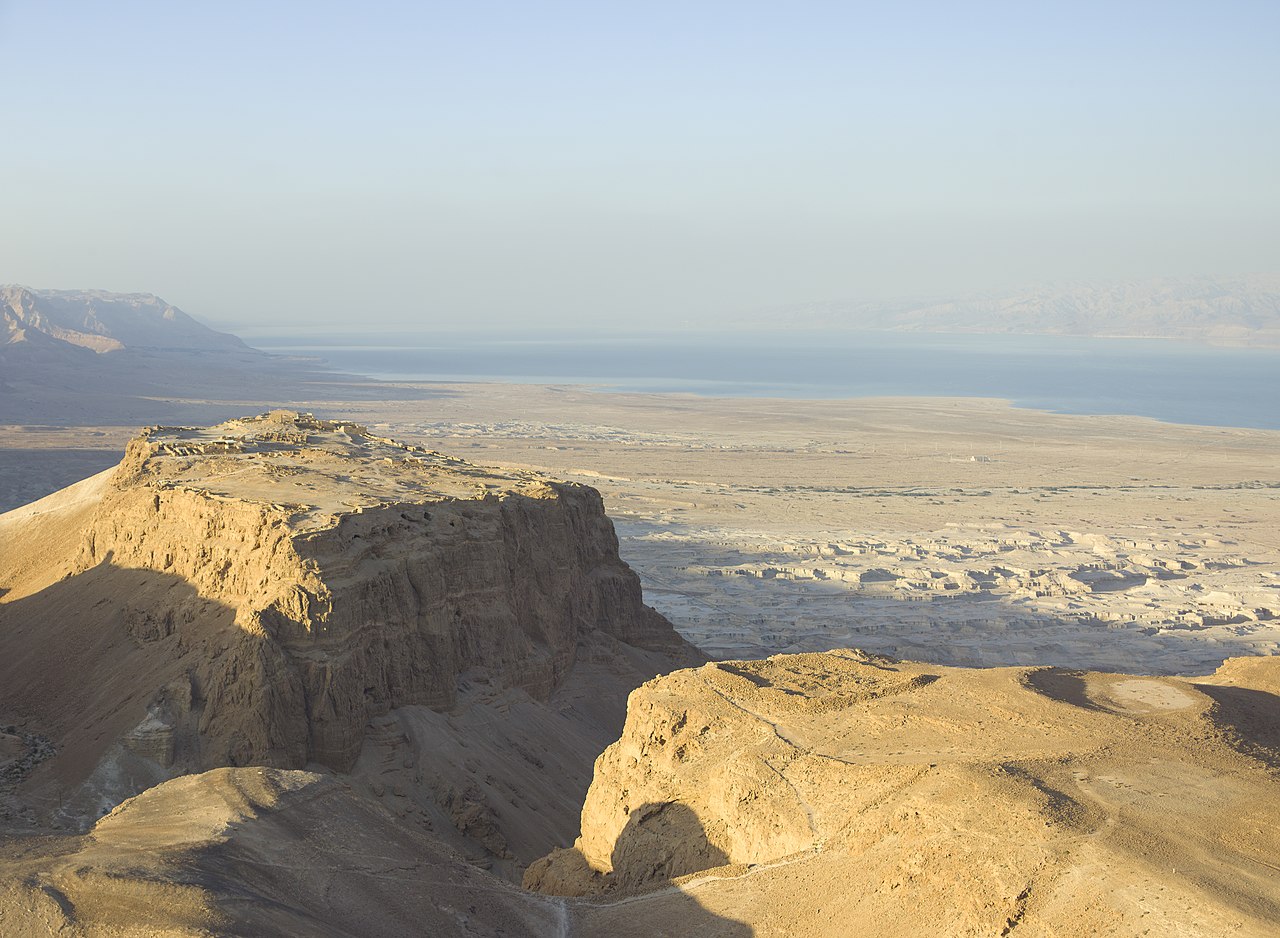
Few places pack in as much history and drama as Masada. On an isolated rocky plateau, more than 400 metres above the Dead Sea, stand the ruins of the fortress King Herod had built in the 1st century BC: palaces clinging to the cliff, storehouses, gigantic cisterns and walls, all surrounded by the Judaean Desert and with breathtaking views.
But Masada is famous above all for what happened there in 73-74 AD, when a group of Jewish rebels held out against the siege of a Roman legion in the final episode of the Great Revolt. According to the historian Flavius Josephus —the only ancient source for the episode—, the besieged chose death over slavery. That story, part history and part symbol, turned Masada into a national emblem in modern Israel, although scholars today debate how much of it is true.
This guide helps you visit Masada with practical sense and context: how to get up (cable car, Snake Path or Roman ramp), why sunrise is so special, what to see at the top, how much it costs and how to combine it with the Dead Sea and Ein Gedi. And we tell you, with nuance and respect for the historiographical debate, what we know and what we don't know about what happened at the summit.
Masada was first fortified in Hasmonean times, but it was King Herod the Great who, between 37 and 31 BC, turned it into an impressive complex of palaces and defences, taking advantage of the plateau's impregnable position and equipping it with cisterns and storehouses to withstand long sieges. Its decisive moment came almost a century later: during the Great Jewish Revolt against Rome (66-73 AD), a group of rebels —the Sicarii— seized the fortress, and after the fall of Jerusalem in 70 they took refuge there with their families. In 73-74 AD, the Roman Tenth Legion besieged Masada, built a gigantic earth ramp against the wall and finally took it. According to the Jewish historian Flavius Josephus —the only ancient source for the episode—, when the Romans entered they found the nearly one thousand defenders dead: they had supposedly preferred to take their own lives rather than be enslaved. The 20th-century excavations led by Yigael Yadin brought the site to light, but the story of the mass suicide is now hotly debated by scholars. All of this, with its nuances, is on our history page.
Read the full history ↓The great desert of the south and the lowest point on Earth: the fortress of Masada, the oases of the Dead Sea, the Bedouin heritage of the Negev and the Red Sea at Eilat.
Read the history of South: Negev and the Dead Sea →They depart from Jerusalen, 52 km away. If you book from this link we earn a commission and you pay no more.
No exact prices: a scale from $ (budget) to $$$$$ (luxury), with 2-3 options per category.
Origins, formation and what the sources say.
Masada is, above all, an extraordinary natural feature: a flat-topped rocky plateau, cut off by cliffs more than 400 metres high that drop sheer to the Judaean Desert and the Dead Sea. Its name comes from the Hebrew 'metzuda', meaning fortress. Anyone who looks at it understands right away why, since ancient times, people saw it as a refuge: it is almost impossible to reach, and from the top you can see the whole horizon.
The first known fortification was built by the Hasmonean rulers, the Jewish dynasty that ruled the region in the 2nd and 1st centuries BC. But the man who made Masada monumental was King Herod the Great, the great builder of Roman Judaea. Between 37 and 31 BC, Herod, who always feared enemies at home and a possible invasion, turned the summit into a fortified palace complex of astonishing ambition.
He built two palaces, one of them hanging off the northern cliff on three terraces, with frescoes and Roman-style baths. He added storerooms for food and weapons and a wall around the entire plateau. Above all, he built a remarkably clever water system that caught the desert's occasional flash floods and stored the water in huge cisterns cut into the rock. With all this, Masada could hold a large number of people and withstand a long siege in the middle of the desert. Herod died without ever needing his refuge, but the fortress was left ready for an episode he could never have imagined.
In 66 AD, the anger of Judaea's Jewish population at Roman rule broke out into open war: the Great Revolt. For four years the rebels held out against the power of Rome. Then in 70 AD the legions of the future emperor Titus took Jerusalem, sacked the city and destroyed the Second Temple. It was a devastating blow to Judaism, and it is still remembered today.
Even after Jerusalem fell, pockets of resistance remained. One of them was Masada, which had been seized at the start of the revolt by a group of radical rebels known as the Sicarii (after the 'sica', the dagger they carried). After Jerusalem was destroyed, more rebels and their families took refuge in the fortress, relying on its defences and its stores of water and food. For a while, Masada was the last major stronghold of the revolt.
The Sicarii were a hard-line faction. The ancient sources, above all the historian Josephus, do not present them as idealised heroes. They describe a violent group that also attacked other Jewish communities. It is hard to reconstruct exactly who they were and what they did, because we depend almost entirely on a single account written years later. What is certain is that around 73 AD Rome decided this last pocket of resistance could not be left standing, and sent the Tenth Legion to finish it off.
The siege of Masada, in 73–74 AD, is one of the best-preserved examples of Roman military engineering anywhere, and you can still see its traces in the desert. The Tenth Legion, led by Flavius Silva, surrounded the mountain with a circumvallation wall, a continuous wall that cut the fortress off completely. Around it they set up eight camps, whose outlines can still be seen from the summit.
The plateau could not be taken by direct assault, so the Romans turned to engineering. Against the western slope they built a huge ramp of earth, stone and timber, raising it metre by metre until it reached the height of the wall. They moved a siege tower and a battering ram up the ramp and finally broke through the defences. According to the accounts, much of the work was done with forced labour, and it took months.
According to Josephus, as the Romans prepared for the final assault, the defenders set part of the fortress on fire and made an extreme decision. When the legionaries entered the next day, nobody fought back. They found the besieged already dead. This is where verifiable history and the inherited story part ways, and where one of the great debates in the region's archaeology and historiography begins.
Everything we know about the end of Masada comes from a single ancient source: Flavius Josephus, a Jewish general who went over to the Roman side during the war and later wrote 'The Jewish War' in Rome. Josephus did not witness the siege. He wrote about it decades later, probably drawing on Roman reports and his own literary craft. In his account, almost a thousand defenders of Masada (men, women and children) saw that resistance was hopeless and chose to die rather than be enslaved. The men killed their families, then drew lots to decide who would kill the rest, and the last man took his own life. Josephus has their leader, Eleazar ben Yair, give two eloquent speeches in favour of this choice.
It is a powerful story, but it needs to be read with caution. Josephus wrote with political and moral aims, and he was a master of classical rhetoric. The speeches are clearly a literary composition: nobody could have passed on to him, word for word, what was said by men who, by his own account, all died. What's more, the 20th-century excavations found no remains of a large mass suicide. Only a handful of skeletons turned up, and what they are and what they mean are still debated.
The excavations led by the Israeli archaeologist and soldier Yigael Yadin in the 1960s confirmed Herod's fortress, the siege, the ramp, the synagogue and many objects, and made Masada world-famous. But several scholars have pointed out that Yadin and his generation read the finds in the light of the heroic story. Today historians and archaeologists such as Jodi Magness argue that archaeology can neither confirm nor rule out the mass suicide. In short, the siege happened and the fortress fell, but the exact ending Josephus describes belongs more to storytelling than to proven fact. Seeing that distinction doesn't make the site any less interesting. If anything, it makes the story more honest.
In the 20th century, both before and after the State of Israel was founded in 1948, Masada became a major national symbol. The story of a handful of rebels who held out to the end rather than surrender matched the idea of a people ready to defend its freedom, and the fortress became a place of civic pilgrimage. For years, Israeli army units held swearing-in ceremonies there under the motto 'Masada shall not fall again'.
Over time, this symbolic use came under critical scrutiny. Historians and educators pointed to the risks of building a national myth on an episode known from a single source. They also questioned holding up as a model such a tragic and ambiguous ending, especially one brought about by a radical faction. The so-called 'Masada myth' became a subject of study in its own right. The term refers to the gap between the popular heroic story and what the sources and archaeology can actually support. Today, Israel reads the site in a more nuanced and less triumphant way than it did in the early decades.
Whatever the debates, the site's value is beyond question. In 2001, UNESCO declared Masada a World Heritage Site, both for the remains of Herod's palace-fortress and for the exceptional set of Roman siege works around it, which are unmatched in how well they have survived. For today's traveller, Masada offers three things at once: a breathtaking landscape, a lesson in ancient archaeology and engineering, and an invitation to think carefully about how peoples build the stories they tell about themselves. You can admire the place and still look at its history with a critical eye.