Tana Toraja is one of the most extraordinary and moving destinations in Indonesia, a place where death isn't hidden but celebrated as the most important moment of life. In these mountains of inland Sulawesi live the Toraja people, famous around the world for their funeral rites: ceremonies lasting several days, with hundreds of guests, music, dances and sacrifices of buffalo and pigs, to bid farewell to the dead and accompany them to the afterlife. Here, a funeral can cost a fortune and take years to prepare, and the deceased may stay for months in the family home, treated as someone who is ill, before their grand farewell.
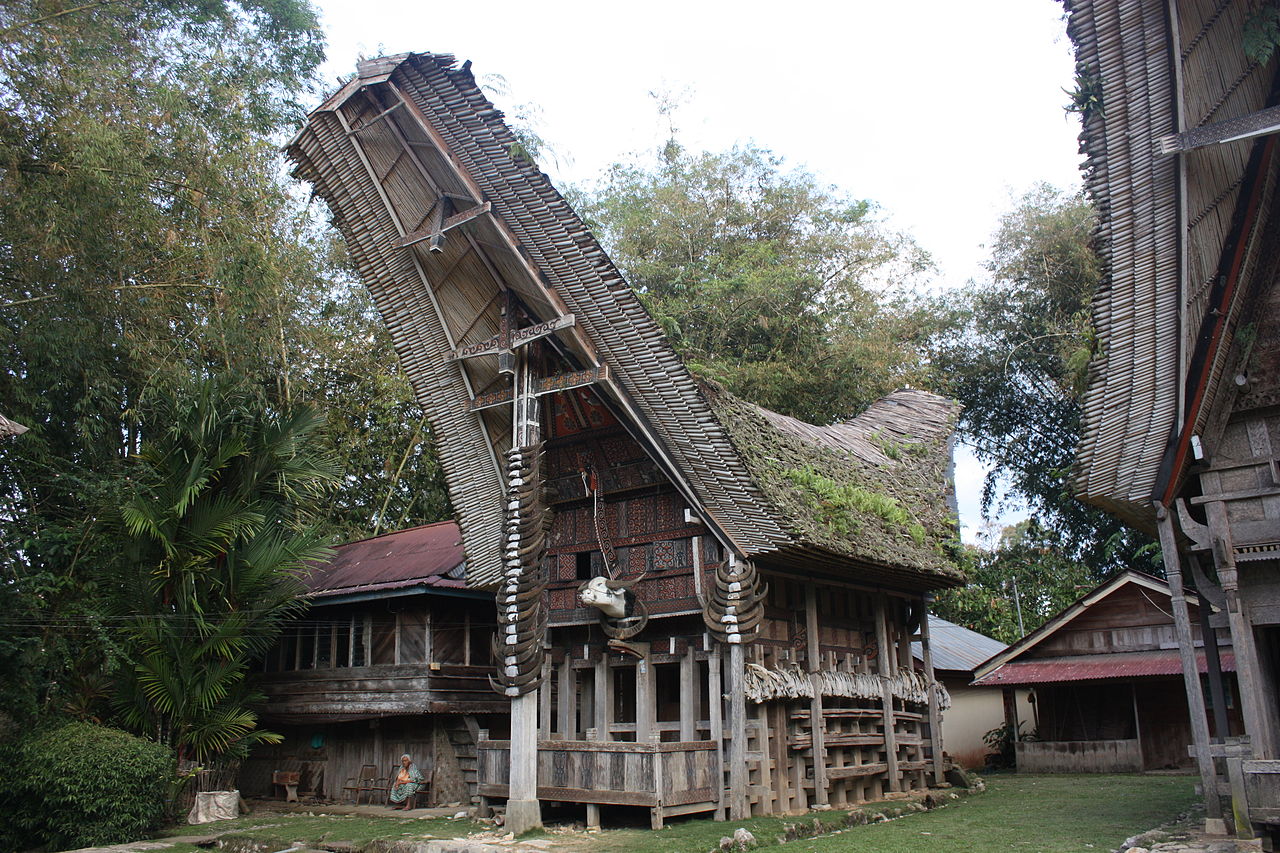
But Tana Toraja isn't only about funerals. It's also a landscape of serene beauty: terraced rice fields climbing the hillsides, mist-wrapped valleys and, above all, the tongkonan, the astonishing traditional houses with curved roofs that rise at the ends like the bow and stern of a ship, decorated with red, black and yellow carvings and crowned with rows of buffalo horns. The dead rest in tombs carved into cliffs or in caves, watched over by the 'tau tau', eerie wooden effigies in the likeness of the deceased that gaze out over the valley from the rocks.
This guide helps you approach a unique culture with respect: how to get there from Makassar, when to go for the best chance of seeing a ceremony (the dry-season funeral season), which villages and tombs to visit (Kete Kesu, Londa, Lemo, Palawa), how to get around and, above all, how to behave when attending a funeral rite. Tana Toraja isn't an easy postcard destination but an intense cultural experience that leaves its mark and invites you to think about life and death in a different way.
The Toraja are a people of Austronesian origin who settled centuries ago in the highlands of south-central Sulawesi, where the isolation of the mountains allowed them to preserve a very distinctive culture. Their name comes from a term the coastal peoples used for 'those from above', the highlanders. For centuries they lived in autonomous villages ruled by the nobility, with an ancestral religion, Aluk To Dolo ('the way of the ancestors'), centred on the cult of the dead and a complex system of rites. In the early 20th century, the Dutch subdued the region and introduced Christianity through Protestant missionaries, and most Toraja converted, though they kept many of their funeral rites, which today are reinterpreted and preserved. Incorporated into independent Indonesia, Tana Toraja opened up to tourism in the 1970s and 1980s, when the world discovered its spectacular funerals, its tongkonan and its cliff tombs. The full story is on our history page.
Read the full history ↓Eastern Indonesia: Sulawesi of the seafaring Bugis and the Toraja, the historic spice islands of Maluku and remote Papua with Raja Ampat.
Read the history of Sulawesi and the east →No exact prices: a scale from $ (budget) to $$$$$ (luxury), with 2-3 options per category.
Origins, formation and what the sources say.
In the mountains of south-central Sulawesi, far from the sea and the trade routes, one of Indonesia's most remarkable cultures took shape: that of the Toraja. The name isn't their own. It came from outside: coastal peoples such as the Bugis and the Makassar called the highlanders 'to riaja', 'the people from above', and 'Toraja' grew out of that. For a long time the Toraja themselves didn't see themselves as a single people. They were a collection of valley communities, each with its own territory and its own chiefs.
Like most of Indonesia's peoples, the Toraja are of Austronesian origin, and their own myths say their ancestors came from the north by sea, in boats, in the distant past. Oddly enough, that memory of the sea survived far inland, high up in the mountains, in the shape of their houses. The huge curved roofs of the tongkonan are often read as an echo of the bows and sterns of those ancestral boats, or as the horns of the buffalo, the sacred animal.
Cut off by geography, the Toraja built a hierarchical society of nobles, commoners and slaves, organised around lineages and ancestral houses. Above all, they developed a religion of their own, Aluk To Dolo ('the way of the ancestors'). This complex system of rites governed every part of life and rested on two pillars: the rites of life and fertility (Rambu Tuka') and, most importantly, the rites of death (Rambu Solo'). In this view of the world, death wasn't an end. It was the most important and most elaborate step of all.
To understand Tana Toraja, you have to understand its relationship with death, which is very different from the Western one. In the traditional religion, Aluk To Dolo, death isn't a moment but a long process. When someone dies, they aren't considered fully dead but 'sick' ('to makula'). The body is treated with preservatives and wrapped in cloth, and it stays in the family home for weeks, months or even years. The family keeps bringing it food and talking to it as if the person were still alive. Only after the great funeral ceremony does the deceased fully become an ancestor, and only then does their soul set off for 'Puya', the land of the dead.
That great ceremony, Rambu Solo', is the most important event in Toraja life, above everything else. It can last several days and bring together hundreds or thousands of people, and it costs a huge amount of money. Buffaloes and pigs are sacrificed. The buffalo is the sacred animal, and the most prized ones, such as those with spotted hides, are worth a fortune. The animals are believed to go with the deceased, and the more are sacrificed, the better the journey and the greater the family's prestige. That's why funerals are often put off for years, until the family has raised enough money.
After the funeral, the body isn't buried in the ground. It's placed in tombs carved into cliffs, in caves or in hanging graves, to bring it closer to the sky and keep it safe. For nobles, a 'tau tau' is carved: a wooden effigy in the person's likeness, set on a rock balcony facing the valley and watching over the living. This whole system made death the central axis of Toraja culture and the reason for its worldwide fame.
If death shapes Toraja time, the tongkonan shapes Toraja space and society. These traditional wooden houses stand on stilts, and their spectacular curved roofs sweep upwards at both ends. They aren't just homes. Each one is the ancestral house of a lineage, the point of reference for a whole extended family whose members may be scattered around the world. The word 'tongkonan' comes from a verb meaning 'to sit', because it's where the family gathers. Owning, maintaining or restoring a tongkonan is both a responsibility and an honour that binds relatives together across generations.
Every tongkonan is carefully decorated with geometric carvings in four colours, each with its own meaning: black for death, red for life and blood, white for purity and yellow for divine blessing. The motifs show buffaloes, roosters, plants and the sun. Rows of buffalo horns pile up on the front of the house, taken from animals sacrificed at the family's funerals. The more horns, the greater the lineage's prestige and wealth. Facing the house stand the rice barns, the 'alang', smaller but just as richly decorated.
The traditional villages, with their tongkonan facing their rice barns and laid out along compass points full of meaning, are real lessons in a worldview where architecture, family, religion and social status are woven together. So visiting villages such as Kete Kesu or Palawa isn't just about admiring pretty houses. It's a glimpse into a whole way of understanding the world.
For centuries the Toraja lived largely apart from the major powers of Sulawesi. They were in contact, through both trade and conflict, with the coastal kingdoms of the Bugis and the Makassar, some of which had converted to Islam. That relative isolation ended in the early 20th century, when the Netherlands, which already controlled much of the East Indies, set out to bring the Sulawesi highlands under its rule. Around 1905-1906, Dutch colonial troops occupied the Toraja region after defeating local resistance and absorbed the territory into their empire.
Missionaries came with the Dutch. The Dutch Reformed Church set about converting the Toraja, and over the 20th century a large part of the population became Christian, mostly Protestant, though there are Catholics too. Part of the reason the Toraja embraced Christianity was to set themselves apart from their Muslim Bugis neighbours and to assert their own identity. Today Tana Toraja is a Christian-majority region within Muslim-majority Indonesia.
What stands out is that conversion didn't wipe out the old rites. Many Aluk To Dolo practices survived in reinterpreted, adapted forms, above all the funerals. Today the Christian faith held by most people sits alongside funeral ceremonies with ancestral roots, and those ceremonies are still held with enormous energy. The Indonesian state also ended up officially recognising Aluk To Dolo as a branch of Hinduism, which helped it survive. This blend of Christianity and tradition is one of the keys to Toraja today.
After Indonesian independence (proclaimed in 1945 and recognised in 1949), Tana Toraja became part of the new nation, within the province of South Sulawesi. For decades it remained a remote farming region, until the world 'discovered' it from the 1970s and 1980s onwards. Anthropologists, photographers and, above all, tourists were captivated by its funeral ceremonies, its tongkonan and its cliffside tombs. Tana Toraja became one of Indonesia's great icons of cultural tourism, alongside Bali, and its images travelled around the world.
Tourism brought income and pride, but it also raised dilemmas. How do you open up to visitors ceremonies that are, first and foremost, intimate and sacred family mourning? On the whole, Toraja culture has managed to strike a balance. Families usually welcome visitors to funerals, as long as they come respectfully and bring a gift, and tourism has fitted in without entirely distorting the rites, which are still held out of conviction and not as a show. Even so, there are tensions that the community has to manage: commercialisation, the impact on the sites, and the debate over tau tau stolen from tombs by art traffickers in the past.
Today Tana Toraja is even seeking UNESCO recognition for its unique cultural landscape. For travellers it remains an exceptional destination: a living culture that has kept, well into the 21st century, a relationship with death and with the ancestors that almost everywhere else has been lost. Approaching it with respect, from its funerals to its houses, its tombs and its welcoming people, is one of the most profound experiences Indonesia has to offer. It's a reminder that there are many ways of understanding life, death and memory.