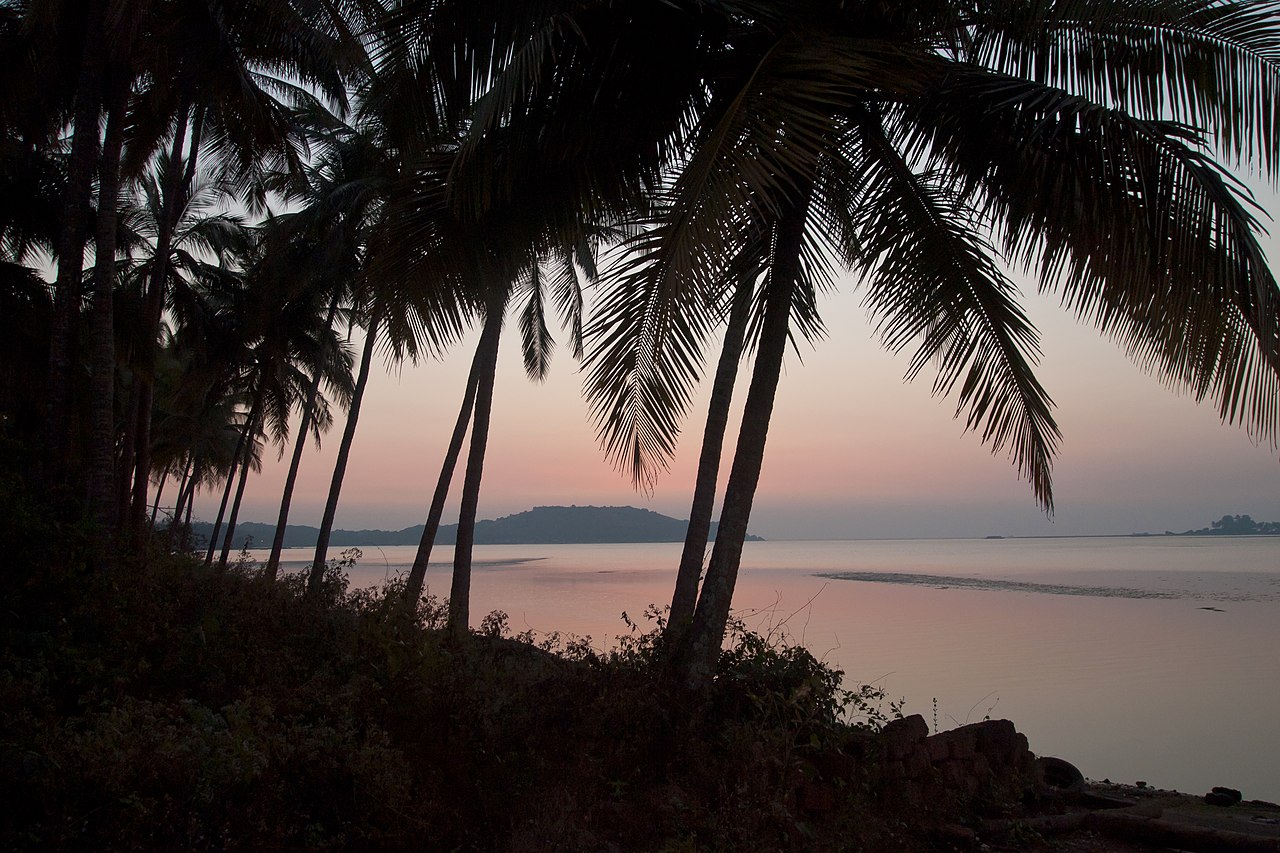
Goa is the India that doesn't feel like India, and yet it is deeply Indian. For 450 years it was a Portuguese colony, and that heritage left a mark that can't be erased: white baroque churches peeking out between the coconut palms, colourful mansions with balconies and tiles, crosses at the crossroads, surnames like Fernandes or D'Souza, feijoada and cashew wine. But above all, Goa is beach: more than a hundred kilometres of golden-sand coast lined with palm trees, with beach bars (shacks) where you eat fresh fish with your feet in the sand and watch the sun go down over the Arabian Sea.
There are two Goas, and it's worth knowing before choosing where to stay. The north —Baga, Calangute, Anjuna, Vagator, Arambol— is the lively party Goa, birthplace of the hippie and trance culture, with markets, nightlife, music and crowds. The south —Palolem, Agonda, Colva, Benaulim— is the quiet, idyllic Goa, with cleaner and emptier beaches, beachfront huts and a slow pace. In between lies Panjim, the small capital, with its charming Latin quarter of Fontainhas, and Velha Goa, the old stone capital with its World Heritage churches.
This guide helps you build your Goa to measure: which beach to choose depending on what you're after, how to get around by motorbike, which churches and markets not to miss, how to reach the Dudhsagar Falls and how much everything costs. Goa rewards those who want parties and backpacking just as much as those who only want a hammock, a good fish curry and to do absolutely nothing. For many travellers, it's the well-earned beach break after the intensity of the rest of India.
Inhabited since ancient times and ruled by Hindu dynasties and by the Bijapur Sultanate, Goa changed forever in 1510, when the Portuguese Afonso de Albuquerque conquered the city and made it the capital and jewel of the Portuguese empire in Asia, the 'Estado da Índia'. For centuries, Velha Goa ('Golden Goa') was a rich, monumental city, a base for the spice trade and for Catholic proselytising: this is where the Jesuit Saint Francis Xavier preached and died, and his body is still venerated in the Basilica of Bom Jesus. The Inquisition and forced conversions also marked that era. While the rest of India fell under British rule, Goa remained Portuguese, a Portuguese-speaking Catholic enclave for 450 years, until 1961, fourteen years after India's independence, when the Indian army took the territory and incorporated it into the country (Operation Vijay). In 1987 Goa became a state. That long Portuguese heritage, unique in India, lives on in its religion, architecture, food and character. The full history of Portuguese Goa is on our history page.
Read the full history ↓The India of the coasts and the Dravidian south: the megacity of Mumbai, Portuguese Goa, spice-scented Kerala and its backwaters, the plantations of Munnar and the ruins of the Vijayanagara empire at Hampi.
Read the history of The west and the south →A local guide tells you in half an hour what no sign at the site will ever explain. We look ours up on Civitatis: guided in Spanish and booked online with no fuss. They have 5 activities in Goa. And there are free tours here: you book without paying and tip the guide whatever you think at the end, so trying one costs you nothing. Have a look below: tap any of them to see them all.
If you book from here we earn a commission and you pay no more. Prices and availability come from Civitatis.
No exact prices: a scale from $ (budget) to $$$$$ (luxury), with 2-3 options per category.
Origins, formation and what the sources say.
Long before the Portuguese caravels and the white churches arrived, Goa was already a prosperous and coveted land. Its magnificent natural harbour, navigable rivers and position on the Indian Ocean spice route made it an important trading post from ancient times. The region appears in ancient texts under various names, and it was inhabited and ruled by successive Hindu dynasties of the Deccan, which left behind temples and a deeply rooted Hindu culture that is still alive today in Goa's interior.
Among the peoples and kingdoms that ruled the area were the Kadambas, who turned Goa into a thriving trading centre between the 11th and 14th centuries, with busy exchanges with Arabia and the Mediterranean world. The port city of Goa exported horses, spices and textiles, and it was a crossroads of cultures and religions, with Muslim merchants also present.
In the 14th century the region fell under the rule of Muslim sultanates: first, briefly, the Delhi Sultanate, then the kingdom of Vijayanagara (the great Hindu empire of the south, whose capital was Hampi) and finally the Bijapur Sultanate, which Goa belonged to when the Portuguese arrived. Under the sultans of Bijapur, the city of Goa (what would later become Velha Goa) was already an important, well-fortified port. That was the scene at the start of the 16th century: a rich, contested and strategic land, ripe to fall into the hands of a European power newly arrived in the Indian Ocean.
The year that changed Goa forever was 1510. Just twelve years after Vasco da Gama opened the sea route from Europe to India, the great Portuguese conqueror Afonso de Albuquerque set his sights on Goa as the ideal base for the maritime empire Portugal was building in Asia. After a first failed attempt, Albuquerque took the city of Goa for good from the Sultan of Bijapur in November 1510, with the help of a local ally. It was a bloody conquest, followed by massacres of the Muslim garrison.
Goa thus became the capital and the jewel of the 'Estado da Índia', the group of Portuguese possessions in Asia that stretched from East Africa to the spice islands of Indonesia, Malacca and Macau. From Goa, the Portuguese controlled the spice trade — pepper, cloves and cinnamon, worth their weight in gold in Europe — and dominated the Indian Ocean sea routes with their fleets. The city filled with wealth, merchants, officials, soldiers and clergy who came from all over the world.
Unlike other powers, Portugal did not stop at trade: it settled in to stay, with a policy of settlement, intermarriage and, above all, evangelisation. Goa became the head of the Catholic Church throughout Asia, the seat of an archbishopric and the starting point for missionaries. Marriages between Portuguese men and local women were encouraged, and a unique mixed-race Catholic society was born, with Portuguese surnames, language and customs, which endures to this day. Goa's long history as a piece of Portugal in India was beginning.
During the 16th and 17th centuries, Velha Goa enjoyed its golden age, so splendid that it was called 'Goa Dourada' (Golden Goa) and 'the Rome of the East'. It was one of the richest and most populous cities in the world, comparable to the great European capitals, with magnificent churches, convents, palaces, hospitals and bustling trade. European travellers who visited were dazzled by its luxury. The heart of the city was religious: dozens of orders — Jesuits, Franciscans, Dominicans, Augustinians — built monumental churches that still stand today.
The central religious figure of Portuguese Goa was Saint Francis Xavier, the Jesuit from Navarre who arrived in Goa in 1542 and from there evangelised India, the Moluccas and Japan, in one of the greatest missionary undertakings in history. He died in 1552 off the coast of China, and his body was taken to Goa, where — according to Catholic tradition — it remained miraculously incorrupt. His relics, venerated in the Basilica of Bom Jesus, became Goa's greatest spiritual treasure and still draw pilgrims today; every ten years they are put on public display before crowds of the faithful.
But the splendour had a dark side. Along with the churches came the Inquisition, established in Goa in 1560, which for more than two centuries harshly persecuted converts suspected of keeping their old Hindu or Muslim practices, as well as Jews and 'heretics', with trials, torture and executions. Hindu temples and mosques were destroyed and conversions were imposed. The Goa Inquisition was one of the most severe and is a painful chapter of that history. Over time, epidemics, stagnating trade and unhealthy conditions also emptied Velha Goa, and the capital was eventually moved to Panjim in the 19th century, leaving the great churches behind amid the jungle.
While the rest of the subcontinent gradually fell under the rule of the British Empire, Goa remained Portuguese. That was what made it truly unique: for 450 years, a small Catholic, Portuguese-speaking territory held out on India's west coast, untouched by the British Raj. Goans spoke Konkani and Portuguese, had Portuguese surnames, were mostly Catholic in the coastal areas (and Hindu inland) and lived under the administration of Lisbon. Many emigrated around the world — to Mumbai, to East Africa, to Portugal — taking that mixed identity with them.
When India gained independence from the United Kingdom in 1947, it also claimed the enclaves still in European hands, Goa among them. But the regime of Portuguese dictator Salazar flatly refused to give up what it considered an overseas province, an integral part of Portugal. For years there were failed negotiations, protests by Goan and Indian nationalists, and growing tension. The international community applied pressure, but Salazar would not budge.
Finally, in December 1961, after diplomacy had failed, Nehru's India launched Operation Vijay: in just a few days, the Indian army occupied Goa (along with the small enclaves of Damão and Diu) against minimal Portuguese resistance. For India it was the 'liberation' of Goa and the end of the last European colonial stronghold on the subcontinent; for Salazar's Portugal it was an 'invasion', which it did not recognise until after the 1974 Carnation Revolution. Goa was integrated into India as a territory, and in 1987 it became the Union's 25th state, with Konkani as its official language.
Modern Goa went through a second transformation in the 1960s and 1970s, when it became a legendary stop on the hippie trail that took young Western travellers from Europe to Asia. Drawn by its idyllic beaches, its climate, its laid-back vibe and its tolerance, the hippies settled on beaches such as Anjuna and Calangute, started the flea markets (where they sold their belongings) and laid the foundations of Goa's fame as a mecca of freedom, music and parties. Years later this would give rise to 'Goa trance', a style of electronic music tied to the region's all-night parties.
From that seed grew today's major tourist destination. Goa is by far India's leading beach destination and one of its most international, welcoming millions of visitors every year: Indians from all over the country who come to enjoy the sea and the nightlife, and foreigners from Europe, Russia, Israel and the rest of the world. Tourism is the main engine of its economy, along with mining and fishing. That success also brings problems: overdevelopment, pressure on the beaches and the environment, tensions between development and conservation, and the debate over how to preserve Goa's unique character in the face of mass tourism.
Because, beyond the beaches and the parties, what makes Goa special is its mixed identity, found nowhere else in India: the Portuguese heritage that lives on in its baroque churches, its colourful houses, its surnames, its food (that delicious fusion of Indian and Portuguese flavours), its strong Catholic community living alongside the Hindu one, and a slower, cheerful way of life, the famous Goan 'susegad' (from the Portuguese 'sossegado', calm). For travellers, Goa is both India's beach getaway and a window onto a unique story of encounter between Europe and Asia, written on the shores of the Arabian Sea.