Viajá con Gus
HomeGuatemalaZunil
Zunil
🇬🇹 Guatemala · Highlands and the west

Zunil

Jump to what you need
📌Location
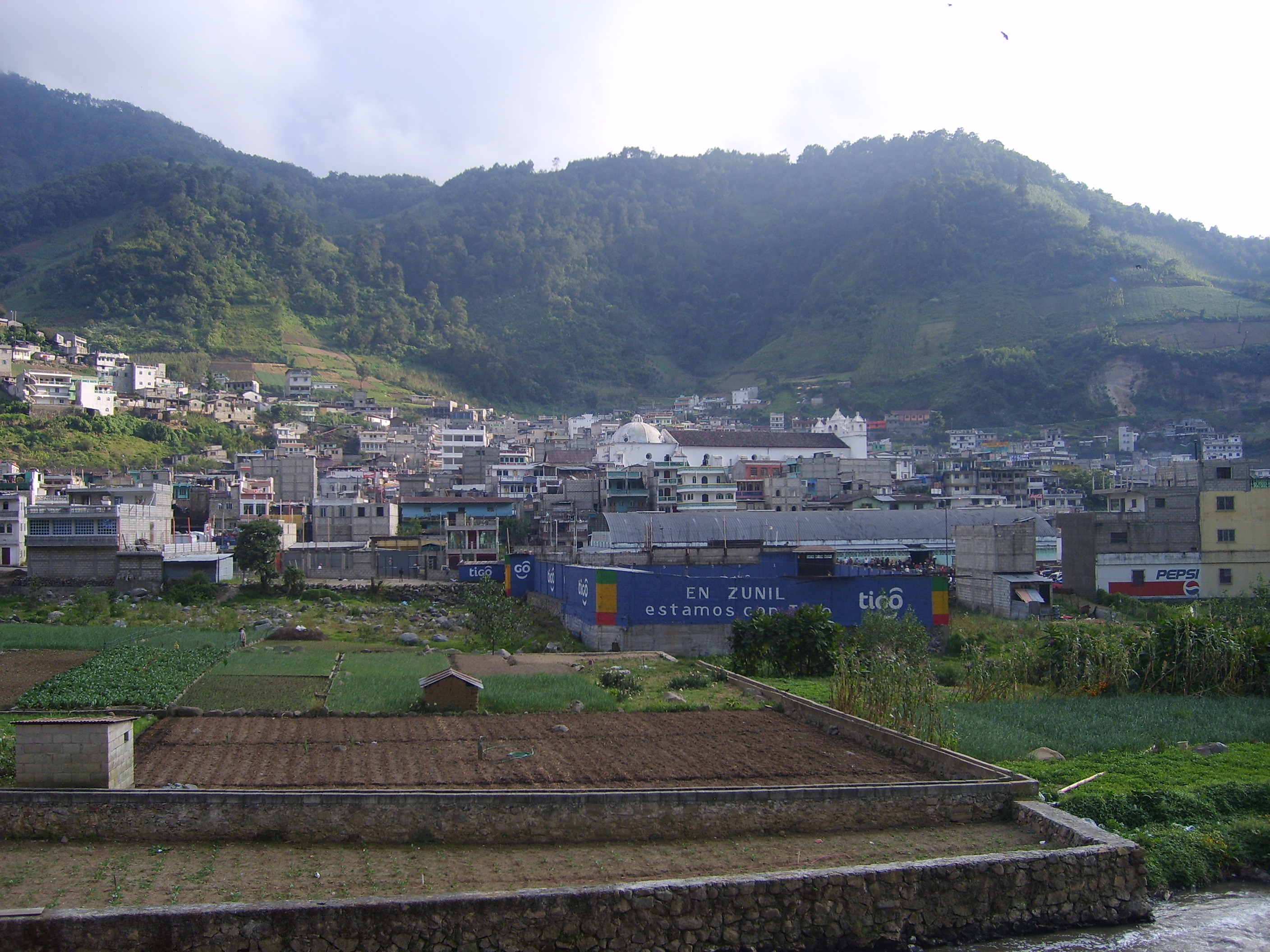
Zunil is a town and municipality in the department of Quetzaltenango, in Guatemala's western highlands, some 10 kilometers southeast of the city of Quetzaltenango (Xela). It sits at about 2,000-2,100 meters above sea level, in a deep, fertile valley at the foot of the mountains, crossed by the Samalá river. Its population is largely K'iche' Maya. It's famous for its white colonial church, for its slopes carpeted with terraced vegetable plots, and very especially for the cult of San Simón (Maximón), one of the best-known syncretic religious figures in Guatemala. It's also the gateway to the Fuentes Georginas.
📌Service city
The service base is Quetzaltenango (Xela), some 20-30 minutes away, with hotels, restaurants, tour agencies, ATMs, hospitals and transport. Zunil itself is a small town with basic services (comedores, shops, a market), better suited to a day visit than an overnight stay. It's easily reached by minibus from Xela, by taxi or as part of a tour that usually combines Zunil with the Fuentes Georginas. The mountain road up to the hot springs starts at Zunil, so many travelers string both places together on the same outing.
📌Best time to go
Zunil can be visited year-round. The dry season (November to April) brings clearer, more comfortable days for walking the town and combining it with the Fuentes Georginas or walks in the area. The rainy season (May to October) brings more cloud and afternoon rain. To catch the town at its liveliest, go on a market day, when the plaza in front of the church fills with color, farm produce and women in traditional dress. To see San Simón you can go any day, asking in town which house holds the image that year. The highland climate is cool almost all the time.
📌Suggested days
Zunil is a half-day visit, usually combined with the Fuentes Georginas on the same excursion from Xela: a while to walk the town, see the colonial church and visit San Simón, and then up to the hot springs. Those with more cultural interest can give it a few extra hours to see the market, the cultivated slopes and daily K'iche' highland life. It doesn't usually require an overnight stay: the logical approach is to use Quetzaltenango as a base and add Zunil to the region's circuit of excursions (Georginas, Laguna Chicabal, Santa María Volcano).
💱 GTQ exchange rate
Loading rate…
🌤️ Weather in Zunil
Loading weather…

Zunil is one of those Guatemalan highland towns that concentrate, in a few streets, much of the region's cultural richness. Set in a deep green valley at the foot of the mountains, with slopes sculpted into terraced vegetable plots, Zunil surprises you first with its look: the white-fronted colonial church cut out against the hills, the plaza enlivened by the market and K'iche' women in their colorful dress and headwraps.

But what has made Zunil famous beyond the region is the cult of San Simón, also known as Maximón: a syncretic figure, half saint, half folk character, to whom the faithful bring offerings of liquor, tobacco, candles and money in exchange for favors and protection. Visiting San Simón —in the house that holds him that year— is a glimpse into one of the most singular and living expressions of Guatemalan folk religion, where Maya and Catholic elements are inseparably intertwined.

This guide gathers the essentials for getting to know Zunil with respect: how to get there from Quetzaltenango, what to see in town, how and where to visit San Simón, and how to combine the stop with the nearby Fuentes Georginas. Small but intense, Zunil is a perfect window onto the life and beliefs of the K'iche' highlands.

📖 History of Zunil

Zunil is an ancient K'iche' Maya settlement in the western highlands that, after the Spanish conquest, became a colonial town with its church and its layout around the plaza, always keeping a strong indigenous identity. Its economy has historically revolved around agriculture: the Samalá river valley and the terraced slopes are one of the country's great vegetable-producing areas. But Zunil's fame comes above all from the cult of San Simón or Maximón, a syncretic figure whose origin can be traced to the mixing of pre-Hispanic Maya traditions with Catholic elements brought by the Spanish, and who is venerated in several highland towns (notably Santiago Atitlán as well) with distinctive features in each place. In Zunil, the image of San Simón is looked after by a cofradía and moves each year to a different house, where it receives the faithful and visitors who bring offerings. The town, like much of the west, has also suffered nature's blows —landslides and floods linked to the rains, hurricanes and the behavior of the Samalá river. The full history, with the K'iche' origins, the colonial era and the cult of Maximón, is on our history page.

Read the full history ↓

🏛️ Zunil is in Quetzaltenango

The 'capital' of the west and the country's second city, Xela: the setting of Tecún Umán's K'iche' resistance, capital of the short-lived State of Los Altos, a liberal coffee city at the foot of the Santa María volcano, among hot springs and cloud forest.

Read the history of Quetzaltenango →

🗺️ What to see

1
San Simón (Maximón) of Zunil
The celebrated syncretic figure venerated in the town, to whom the faithful bring offerings in exchange for favors.
Zunil's great attraction is the cult of San Simón, also called Maximón, one of the most singular figures in Guatemalan folk religion. It's a life-size effigy, dressed in clothes, a hat, scarves and often dark glasses and a lit cigarette or cigar, to whom the faithful come to ask for health, work, love, luck on journeys or protection, in exchange for offerings. Typical offerings include aguardiente and other liquors, tobacco, colored candles, flowers and money; those who attend him usually give the image a 'drink' and a 'smoke' as part of the ritual. San Simón is a deeply syncretic figure: he mixes roots in pre-Hispanic Maya spirituality with Catholic and folk elements, and embodies an ambivalent religiosity, capable of granting both 'good' and 'dark' favors, which makes him at once venerated and feared. He's a fascinating character for understanding how Maya and Catholic elements coexist in the highlands. A key particularity of Zunil: the image isn't kept in a fixed temple but moves each year to a different house, in the care of a cofradía. So to visit him you have to ask in town which house holds him that year. He's usually attended by a family that receives the faithful and visitors. Getting there: once in Zunil, ask in the plaza or of locals for that year's 'casa de San Simón'. Best time: any day; busier on special dates. Tips: bring small cash for the contribution (and, if you like, an offering), ask permission before taking photos (sometimes there's a charge or it isn't allowed) and behave respectfully: this is a serious place of worship for many people.
ℹ️ Distance: In a house in the town of Zunil (it changes each year; ask locally) · Best time: Any day; busier on special dates · Admission: Q10–20 (US$ 1.50–2.50) voluntary contribution, 2025; Q5–10 if you want to take photos · Duration: 30 minutes to 1 hour
2
The colonial church of Santa Catarina Alejandría
The town's white church, with its ornamented facade, heart of the plaza and of Zunil's religious life.
The church of Zunil, dedicated to Saint Catherine of Alexandria, the town's patron, is the most emblematic building in the place. Its white facade, richly decorated with colonial reliefs and ornaments, stands out against the green of the hills and dominates the central plaza, where the town's life is concentrated. It's one of the most photographed churches in the Quetzaltenango highlands for its elegance and its setting. Inside, as in many Guatemalan highland churches, you find a religiosity that blends Catholicism with elements of Maya spirituality: it's common to see colored candles lit on the floor, offerings and prayers in K'iche', in an atmosphere reflecting the region's deep syncretism. The church is the center of the town's great festivities, especially the patron-saint feast (25 November). Visiting the church and the plaza is the best way to take Zunil's pulse: this is where the market, daily life, women in traditional dress and religious activity all converge. It's a natural starting point for walking the town. Getting there: it's on Zunil's central plaza, easy to find. Best time: market days and the patron-saint feast for more atmosphere. Tips: enter respectfully (there may be prayers or ceremonies underway), don't photograph people without permission, especially in moments of devotion, and take the chance to walk the plaza and the market around it.
ℹ️ Distance: Central plaza of the town of Zunil · Best time: Market days and the patron-saint feast (25 November) for more atmosphere · Admission: Free (working church; respect ceremonies) · Duration: 30 minutes to 1 hour (with the plaza)
3
The market and traditional K'iche' dress
The town market, full of farm produce and women in the colorful traditional dress of Zunil.
Zunil is a deeply agricultural and K'iche' town, and its market is a good window onto that life. On market days, the area around the church fills with stalls selling the vegetables grown on the valley's terraced slopes —Zunil is one of Guatemala's great vegetable larders— along with fruit, grains, everyday goods and items for ceremonies (candles, incense). The bustle, the colors and the smells make the market a very highland sensory experience. One of the great visual draws is the traditional dress of Zunil's women, particularly striking: huipiles embroidered with intense colored motifs and distinctive headwraps that set them apart. Every highland town has its own dress, and Zunil's is among the most recognizable and beautiful. Seeing women in the market and the plaza in their outfits is one of the images that stay with you from the visit. The market is also the place to buy local produce at good prices, try typical food at the stalls and chat with people, always with respect and warmth. Getting there: around the church and the central plaza of Zunil. Best time: market days (generally Tuesdays and Fridays) for maximum atmosphere. Tips: always ask permission before photographing people (many prefer not to be photographed), bring small cash and, if you buy textiles or produce, do so with respect for local work. Mind your belongings in the bustle.
ℹ️ Distance: Around the church and plaza of Zunil · Best time: Market days (roughly Tuesdays and Fridays) · Admission: Free (public market) · Duration: 1 to 2 hours
4
The Fuentes Georginas (combinable)
The celebrated volcanic hot springs on the mountain above Zunil, the classic pairing for the excursion.
The mountain road up to the Fuentes Georginas, the region's most famous volcanic hot springs, starts at Zunil, some 8 kilometers from the town. That's why the vast majority of visitors combine both places on the same excursion from Xela: a while in Zunil (the church, San Simón, the market) and then the climb up to relax in the thermal pools surrounded by cloud forest. The Georginas are stepped pools of naturally hot water, heated by the region's geothermal activity, set deep in the mountains at more than 2,500 meters. The contrast between the hot water and the cool cloud-forest air, with mist sliding through the vegetation, makes them an unforgettable experience. There's a mountain restaurant and bungalows for overnight stays. The Zunil + Georginas combination is one of the most complete and best-loved outings in the Quetzaltenango region, mixing culture (the town and San Simón) with relaxation (the hot springs) in a single day. (We have a dedicated page on the Fuentes Georginas with all the details.) Getting there: on the mountain road climbing from Zunil; by car, taxi, pickup or tour. Best time: year-round (the water is always hot); go early for fewer people. Tips: if you combine both, plan your timing carefully; bring swimwear, a towel, non-slip sandals and warm clothes for after the soak. See the Fuentes Georginas page for more information.
ℹ️ Distance: Some 8 km from Zunil, up the mountain (steep road) · Best time: Year-round; go early for fewer people · Admission: Q60 (US$ 8) foreigners, Q40 (US$ 5) nationals, 2025; plus Q25 for parking · Duration: Half a day (combined with Zunil)
5
The terraced slopes and the farming landscape
The landscape of stepped plots that wraps around the town, the heart of Zunil's vegetable economy.
One of Zunil's most characteristic features is its landscape: the slopes around the valley are covered with terraced crops, mainly vegetables (cabbage, carrot, onion, potato) that supply much of the national market. Walking the paths that skirt the town, or simply looking out over the valley from a high point, lets you appreciate this green mosaic of stepped plots climbing the mountains. This farming landscape isn't only scenic: it reflects the way of life of Zunil's K'iche' community, tied to the land since pre-Hispanic times, and largely explains the town's economy and rhythm. Sunrises and sunsets, with mist rising from the valley through the crops, are especially photogenic. Some local operators offer short walks around the town to see this farming landscape up close and talk with the growers, a simple but revealing experience of everyday highland life. Getting there: appreciated by walking around the town or from the road climbing to the Fuentes Georginas. Best time: early morning, with mist in the valley. Tips: bring comfortable shoes, respect private plots and ask locals for directions to the paths.
ℹ️ Distance: Around the town, in the Samalá river valley · Best time: Early morning, with mist in the valley · Admission: Free (public landscape, walks on rural roads) · Duration: 30 minutes to 1 hour
6
Feast of Saint Catherine of Alexandria (25 November)
The town's great festival, with processions, traditional dances, a fair and the cofradías, the best day to see Zunil at its cultural fullest.
Every 25 November Zunil celebrates its patron, Saint Catherine of Alexandria, with the town's titular fair. It's by far the liveliest moment of the year: the plaza and the streets around the white church fill with processions, traditional dances (the 'convites' and folk dances), marimba, fairground rides, fair food and an enormous influx of people from the town and neighboring villages, many in traditional K'iche' dress. During the festival, the cofradías take on a special prominence, the traditional religious brotherhoods that organize Zunil's ceremonial life and that also look after San Simón. Watching the interplay between the Catholic liturgy in the church and folk religiosity in the houses —including San Simón's, which usually sees more visitors these days— is a living lesson in highland syncretism. If your trip coincides with late November, it's very much worth timing your visit for the fair; the town, normally quiet, is transformed. That said, there are more people, the minibuses run full and it's best to go early. Getting there: the same access as always, minibus or taxi from Xela; during the fair there's more demand for transport. Best time: around 25 November (the fair runs several days). Tips: bring cash, mind your belongings in the crowd, ask permission to photograph people and join in respectfully — this is above all a religious and community event.
ℹ️ Distance: Plaza and church of Zunil · Best time: 25 November and the days around it (titular fair) · Admission: Free (to attend the fair; food/rides separate) · Duration: Half a day or more
Advertisements
What nobody tells you

💵 Prices

Tickets

TypePrice
Visit to San Simón (Maximón) at his houseQ10–20 (US$ 1.50–2.50) voluntary contribution; Q5–10 extra for photos (source: traveler accounts/Xela agencies, verified July 2026)
Church of Santa Catalina and the plazaFree (working church)
Town marketFree (public market)
Admission to the Fuentes Georginas (if combined)Q60 (US$ 8) foreigners, Q40 (US$ 5) nationals, Q25 children; plus Q25 for parking (source: Guatemala.com / Soy502, verified July 2026)
🔄 updated monthlyOfficial / reference values · double-check when buying

Activities and tours

ActivityPriceDurationOperator
Cultural tour of Zunil + San Simón (from Xela)Q150–250 (US$ 20–33) per person, 2025Half dayQuetzaltenango tour agencies
Combined Zunil + Fuentes Georginas excursionQ150 promotional / Q250 standard rate (US$ 20–33) per person, 2025Half a day to a dayXela agencies and guides, e.g. Nómadas.gt
Tour of the market and the cultivated slopesQ100–200 (US$ 13–26) per person with a guide, 20251 to 2 hoursLocal guides
Visit during the feast of Santa Catarina (25 November)Free (to attend); expenses separateVariableThe community of Zunil
🔄 updated monthlyOfficial / reference values · double-check when buying
Advertisements

🚌 How to get there and distances

Getting around

ModePriceDurationNotes
Minibus Xela → ZunilAbout Q5 (US$ 0.65), paid in cash to the conductor on board, 2025 (source: XelaPages/Quetzaltrekkers, verified July 2026)20 to 30 minThe minibuses leave from the Minerva terminal area / Xela roundabout toward Zunil and Almolonga very frequently. There's no travel card or QR in the region: you pay in cash (bring small notes and coins). The option most used by budget travelers
Taxi from XelaQ80–150 (US$ 10–20) each way, cash, 2025 (source: Xela agencies, verified July 2026)20 to 30 minComfortable; you can arrange for the driver to wait and combine it with the Fuentes Georginas. There's no established Uber/InDrive service from Xela to Zunil, so you negotiate with local taxi drivers
Organized tourQ150 promotional / Q250 standard rate (US$ 20–33) per person, 2025 (source: Nómadas.gt / Feliz Viaje, verified July 2026)Half dayUsually combines Zunil and the Georginas with return transport; the simplest option
App for planning transportFree (source: Moovit / Google Maps, verified July 2026)To see minibus routes and stops in Xela and the area, use Moovit (which covers Guatemala) and Google Maps; real-time minibus location is limited, so confirm departures by asking at the terminal. Departures are coordinated by word of mouth, not by a published fixed timetable
On foot (within the town)FreeVariableZunil is small and covered on foot: the church, the plaza, the market and San Simón's house are all close together
🔄 updated monthlyOfficial / reference values · double-check when buying

How to get there

RouteAirlines / operatorsAvg. priceDuration
Guatemala City → Quetzaltenango (Xela)Line buses (Álamo, Marquensita) and pullmanQ60–100 (US$ 8–13), 2025About 4 to 5 hours
Antigua / Panajachel → Quetzaltenango (Xela)Tourist shuttles and local busesUS$ 15–20, 2025About 2.5 to 4 hours
Xela → ZunilMinibus, taxi or tourQ5–150 depending on the mode, 202520 to 30 min
Zunil → Fuentes Georginas (if combined)Car, taxi, pickup or tourQ30–60 (US$ 4–8) shared pickup, 2025About 30 min (mountain road)
🔄 updated monthlyOfficial / reference values · double-check when buying

🏨 Where to stay

No exact prices: a scale from $ (budget) to $$$$$ (luxury), with 2-3 options per category.

CategoryPriceRecommended options
Higher-end hotels in Xela (recommended base)$$$$$US$ 56–95 a night; since Zunil is a day visit, the usual approach is to stay in Quetzaltenango (Xela), with charming hotels in its historic center. E.g. Lar Antiqua Hotel
Mid-range hotels and guesthouses in Xela$$$$$US$ 21–40 a night; a wide choice of hotels and family guesthouses in Quetzaltenango, a comfortable, good-value base for visiting Zunil and the region
Hostels and budget lodging in Xela$$$$$US$ 8–20 a night; hostels and cheap lodging in Xela, very popular with backpackers and Spanish students
Bungalows at the Fuentes Georginas (nearby)$$$$$About Q190 (US$ 25) per person per night; for anyone who wants to sleep in the mountains near Zunil, the rustic bungalows at the Fuentes Georginas let you combine hot springs and an overnight stay; cold nights

🍴 Where to eat

TypePriceOptions / signature dish
Comedores and the Zunil market$$$$$Q25–50 (US$ 3–6.50) per dish; simple comedores and market stalls with typical highland food (broths, tamales, fresh vegetables) at cheap prices
Fuentes Georginas restaurant$$$$$Q60–120 (US$ 8–15) per dish; if you combine with the hot springs, the Georginas mountain restaurant serves typical food and hot dishes with forest views
Restaurants and cafés in Xela$$$$$US$ 6–15 per dish; for a wider choice, Quetzaltenango has K'iche' highland cooking, specialty coffee shops and international options
Advertisements

📖 History of Zunil

Origins, formation and what the sources say.

K'iche' origins in the Samalá river valley

Zunil is an ancient settlement of K'iche' Maya origin, set in a deep, fertile valley in Guatemala's western highlands, crossed by the Samalá river and ringed by mountains. Long before the Spanish arrived, the region formed part of the territory of the powerful K'iche' lordship, one of the great Maya peoples of the Late Postclassic, whose capital, Q'umarkaj (Utatlán), lay near present-day Santa Cruz del Quiché. The Quetzaltenango highlands were a densely populated and cultivated area for these peoples.

Zunil's life has always revolved around agriculture. The Samalá valley and the slopes around it offer fertile land which, with the terraced cultivation system inherited and developed over the centuries, became one of the country's great vegetable-producing areas. That farming vocation, bound to the land and the water, lies at the base of the town's identity and continues to this day.

Zunil's K'iche' population also preserves a strong cultural identity, expressed in the language, in the traditions, in the community's organization and in the striking traditional dress, especially that of the women, among the most recognizable in the highlands. Understanding this K'iche' substrate is essential to understanding Zunil: however much the conquest and the colonial era left their mark, the town never stopped being, at heart, a Maya community.

Zunil within the territory of the K'iche' lordship
The sources place Zunil's origin as a K'iche' Maya settlement in the Quetzaltenango highlands, a region that formed part of the K'iche' lordship before the Spanish conquest. Details about the exact age of the pre-Hispanic settlement are limited, so they are taken as general historical context.
Source: https://es.wikipedia.org/wiki/Zunil

The Spanish conquest and the making of the colonial town

The conquest of the K'iche' highlands by the forces of Pedro de Alvarado, in 1524, marked the beginning of a new era for the whole Quetzaltenango region. After the defeat of the K'iche' —an episode in which tradition places the death of the legendary leader Tecún Umán near the plains of Xelajú— the Spanish organized the territory under their rule, founding or reorganizing indigenous towns around churches and plazas, following the colonial model.

Zunil was thus constituted as a colonial town, with its church dedicated to Saint Catherine of Alexandria as its religious center and its layout around the plaza. Evangelization, carried out by the religious orders, sought to implant Catholicism, but in practice it fused with pre-existing Maya beliefs, giving rise to the religious syncretism that still characterizes the highlands. Zunil's white church, with its ornamented facade, is testimony to that colonial era.

Despite the changes, the population remained largely indigenous and the community preserved much of its organization, its language and its traditions. Agriculture continued to be the livelihood, and the system of cofradías —religious brotherhoods of colonial origin that combine Catholic and community functions— came to structure much of the town's religious life, including, in time, the care of the image of San Simón. Colonial Zunil was, in short, one more point in that long negotiation between the imposed and the indigenous that defines the history of Guatemala's Maya peoples.

The syncretism born of evangelization
The historiography agrees that colonial evangelization in the Guatemalan highlands did not erase Maya beliefs but merged with them, giving rise to a religious syncretism visible in towns such as Zunil (a Catholic church with Maya practices, the cult of San Simón). The cofradía system, of colonial origin, was key to that articulation.
Source: https://es.wikipedia.org/wiki/Sincretismo_religioso

San Simón / Maximón: the origin and meaning of a syncretic cult

The feature that has made Zunil famous beyond the region is the cult of San Simón, also known as Maximón. He is a deeply syncretic and enigmatic figure, venerated in several towns of the Guatemalan highlands —notably Santiago Atitlán too, where he takes on distinctive features— blending roots in pre-Hispanic Maya spirituality with elements of the Catholic calendar of saints and of folk culture. His exact origin is disputed and lost in the fusion of traditions of the colonial era.

San Simón is represented as a human-looking effigy, dressed in clothes, a hat and often dark glasses, to whom people offer liquor, tobacco, candles and money in exchange for favors: health, work, love, luck, protection on journeys. He is an ambivalent figure, capable of granting both benign favors and darker ones, which makes him at once venerated and feared. That moral ambiguity sets him apart from conventional Catholic saints and connects him with figures of power in the Maya worldview.

There are various interpretations of who or what Maximón represents: for some he embodies an ancient Maya figure or deity; for others he is associated, through syncretism, with figures from the saints' calendar (such as Saint Simon or, in certain traditions, Judas or Pedro de Alvarado). What is certain is that the cult is a living creation of the highlands, and each town lives it in its own way. In Zunil, his veneration is in the care of a cofradía, which places him within the town's traditional religious structure.

The multiple origins attributed to Maximón
The sources record several interpretations of the origin and identity of San Simón/Maximón: roots in a pre-Hispanic Maya deity or figure, syncretic associations with figures from the Catholic calendar (Saint Simon) and even with historical characters. There is no single consensus; this is a syncretic figure whose meaning varies by town and tradition.
Source: https://es.wikipedia.org/wiki/Maxim%C3%B3n
A cult shared by several highland towns
The cult of Maximón/San Simón is not exclusive to Zunil: it is also practiced in Santiago Atitlán, San Andrés Itzapa and other places, with local variations in the image, the rituals and the calendar. This reinforces the idea of a regional syncretic phenomenon rather than a figure of single, localized origin.
Source: https://en.wikipedia.org/wiki/Maxim%C3%B3n

The travelling image and the role of the cofradías

One particularity of the cult of San Simón in Zunil is that the image doesn't reside in a fixed temple but moves each year to a different house in the town. That travelling character is tied to the cofradía system, the traditional religious brotherhoods that, in the Guatemalan highlands, take charge of caring for sacred images and organizing the celebrations. The relevant cofradía guards San Simón, and the family or cofrade who hosts him that year receives the faithful and visitors.

This system, inherited from the colonial era but steeped in Maya meaning, distributes the honor and the responsibility of caring for the image among different members of the community over time. For devotees, attending San Simón —giving him a 'drink' and a 'smoke', keeping the candles lit, receiving the offerings— is a religious service of great prestige and obligation. That's why anyone who wants to visit him must ask in town which house holds him that year.

This mobility of the image reinforces the communal, living character of the cult: San Simón isn't a relic locked away in a museum but an active presence circulating through the town, woven into daily life and into networks of devotion and reciprocity. For the visitor, understanding how this works helps you approach the cult with the respect it deserves and to grasp that you are entering the intimate sphere of a community's religious life.

The cofradía system and the travelling image
The sources describe how in Zunil the image of San Simón is cared for by a cofradía and moves annually to a different house, a practice consistent with the traditional cofradía system of the Guatemalan highlands. The specific details (calendar, cofradías involved) can vary and are best verified locally.
Source: https://es.wikipedia.org/wiki/Maxim%C3%B3n

Nature, agriculture and the force of disaster

Zunil's life has always been shaped by its natural setting, as generous as it is demanding. The Samalá river valley and the terraced slopes make Zunil one of Guatemala's great vegetable-producing areas, which sustains the local economy and gives it its characteristic landscape of cultivated fields climbing the mountains. Intensive agriculture is the heart of daily life, and the valley's produce fills the region's markets.

But that same geography of steep mountains, fast rivers and volcanic soils leaves the town vulnerable to natural disasters. Western Guatemala periodically suffers the consequences of heavy rain, hurricanes and tropical storms, which cause landslides, flooding of the Samalá river and inundations. Events such as Hurricane Mitch (1998), Tropical Storm Stan (2005) and other extreme rainfall have hit the region's communities, damaging crops, roads and homes.

On top of that climate exposure comes the seismic and volcanic context of the highlands, crossed by the Pacific volcanic chain. The nearby geothermal activity that feeds the Fuentes Georginas is proof of the fire living beneath this land. Zunil has learned to live alongside that powerful nature, which brings fertility but also threat, and its history —like that of so many highland towns— is also the story of a community that rebuilds and endures in the face of the blows of the earth and the climate.

The region's vulnerability to natural disasters
Sources on western Guatemala document the recurring impact of hurricanes and storms (Mitch in 1998, Stan in 2005, among others), with landslides and floods affecting highland communities and the Samalá basin. The specific damage in Zunil in each event can vary and is best taken as part of the regional context.
Source: https://es.wikipedia.org/wiki/Tormenta_tropical_Stan

📚 Bibliography

  • Wikipedia (ES) — «Zunil»: https://es.wikipedia.org/wiki/Zunil
  • Wikipedia (ES) — «Maximón»: https://es.wikipedia.org/wiki/Maxim%C3%B3n
  • Wikipedia (EN) — «Maximón»: https://en.wikipedia.org/wiki/Maxim%C3%B3n
  • Wikipedia (ES) — «Quetzaltenango»: https://es.wikipedia.org/wiki/Quetzaltenango
  • Wikipedia (ES) — «Reino k'iche' de Q'umarkaj»: https://es.wikipedia.org/wiki/Reino_k%27iche%27_de_Q%27umarkaj
  • Wikipedia (ES) — «Pedro de Alvarado»: https://es.wikipedia.org/wiki/Pedro_de_Alvarado
  • Wikipedia (ES) — «Sincretismo religioso»: https://es.wikipedia.org/wiki/Sincretismo_religioso
  • Wikipedia (ES) — «Río Samalá»: https://es.wikipedia.org/wiki/R%C3%ADo_Samal%C3%A1
  • Wikipedia (ES) — «Tormenta tropical Stan»: https://es.wikipedia.org/wiki/Tormenta_tropical_Stan

❓ Frequently asked questions

Who is San Simón or Maximón?+
He's a syncretic figure of Guatemalan folk religion, venerated in Zunil and other highland towns (such as Santiago Atitlán). He blends Maya roots with Catholic elements, and people ask him for health, work, love or protection in exchange for offerings of liquor, tobacco, candles and money. He is at once venerated and feared for his ambivalent character.
Where do you visit San Simón in Zunil?+
In Zunil the image isn't kept in a fixed temple: it moves each year to a different house, in the care of a cofradía. So you have to ask in town (in the plaza or of locals) which house holds it that year. It's usually attended by a family that receives the faithful and visitors. Bring small cash (Q10-20) for the contribution.
Can I take photos of San Simón?+
Sometimes yes, sometimes no, and in many cases a small amount (Q5-10) is charged for photographing the image. The right thing to do is to ask and get permission before taking photos, both of the effigy and —above all— of the people performing their rituals. It's a serious place of worship, so behave respectfully.
How do I get to Zunil from Quetzaltenango (Xela)?+
It's very easy: it's about 20-30 minutes by minibus (Q5-10, frequent and cheap), taxi (Q80-150) or tour (Q150-250). Many travelers go on an excursion combining Zunil with the Fuentes Georginas, since the road to the hot springs starts right in Zunil. The town is small and covered on foot.
Is it worth combining Zunil with the Fuentes Georginas?+
Yes, it's the classic pairing and highly recommended. The road up to the Georginas, the region's most famous volcanic hot springs, climbs from Zunil, with admission of Q60 for foreigners. The usual plan is to see the town (church, San Simón, market) and then head up to relax in the thermal pools. It mixes culture and relaxation in a single day. We have a dedicated page on the Fuentes Georginas.
When is Zunil at its liveliest?+
On market days (roughly Tuesdays and Fridays), when the plaza in front of the church fills with vegetable stalls and women in their colorful traditional K'iche' dress, and during the feast of Saint Catherine of Alexandria, on 25 November. At those moments the town shows its greatest cultural vitality. Check the market days before you go.
How do you pay for the bus to Zunil and which app should you use?+
The minibus from Xela to Zunil is paid in cash directly to the conductor on board (about Q5); there's no travel card, QR or payment app in the western highlands, so bring small notes and coins. To plan routes and locate stops you can use Moovit (which covers Guatemala) or Google Maps, but real-time minibus location is limited: the safest bet is to ask at the terminal, since departures are coordinated by word of mouth and don't follow a published fixed timetable (verified July 2026).
Sources consulted (15)
Still planning?
Explore more destinations in Guatemala
See all destinations →
Advertisements
Image credits
Photos from Wikimedia Commons, each under its own licence (CC BY, CC BY-SA or public domain). Open each file to see its author and licence.
Zunil panorama