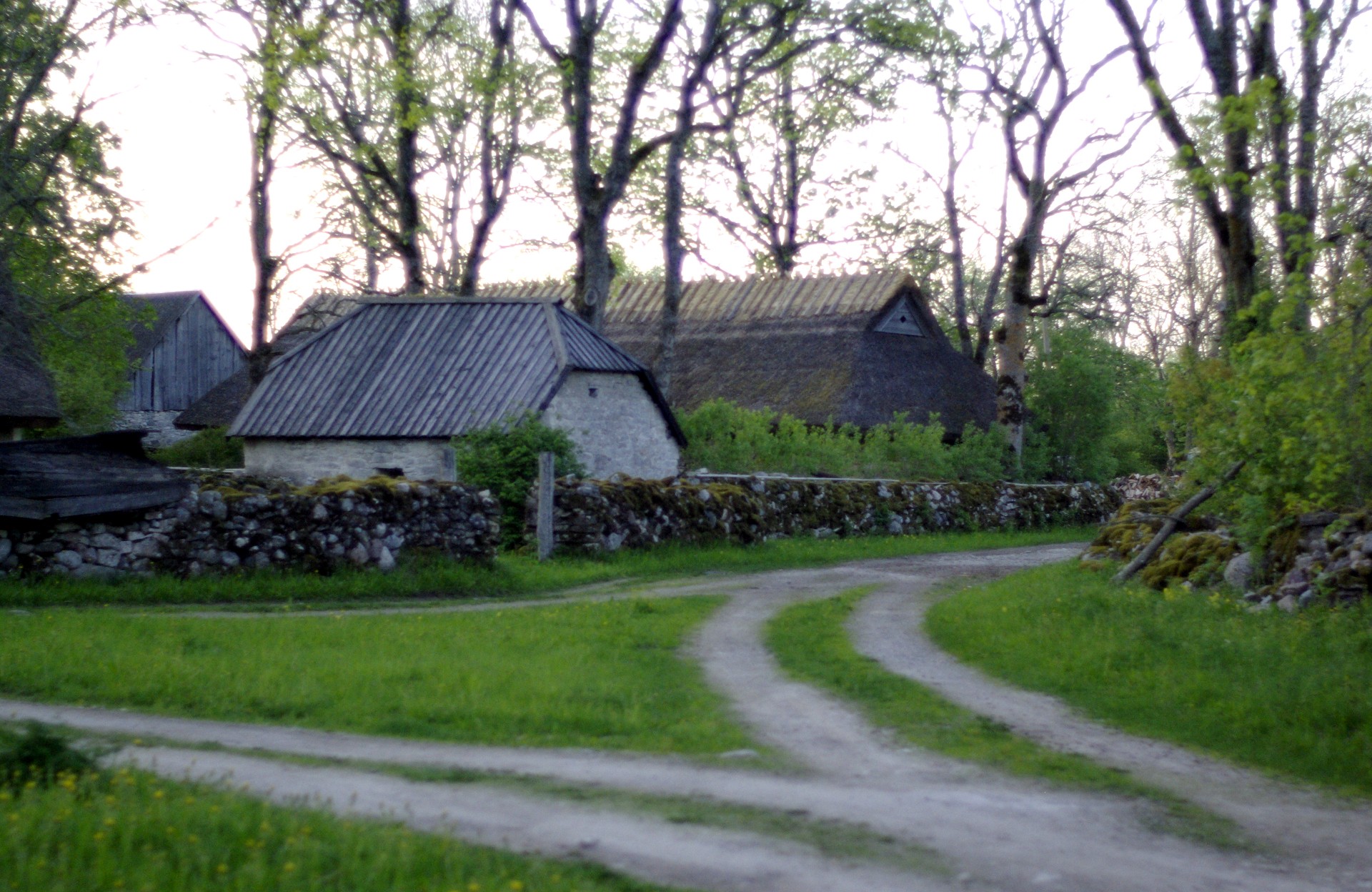
Muhu is one of Estonia's most charming islands: small, rural and frozen in time, a haven of peace between the mainland and the big island of Saaremaa. Although many people just pass through on the way to Saaremaa, Muhu is worth stopping and staying for: here you'll find the museum village of Koguva, with its intact stone and thatch houses; the old medieval St Catherine's Church; the windmills, the doors painted with symbols, and a tradition of crafts and good food that is surprising for such a small island.
Muhu's landscape is one of silent villages, stone walls, meadows, juniper woods and an indented coastline with a few lovely beaches, such as Tuhkana. It's a land of thatched roofs, colourful embroidery, homemade black bread and a quiet way of life that has managed to keep its identity. At the same time, it is home to one of the country's most celebrated hotel-restaurants, Pädaste, which has put Muhu on the map of fine dining in northern Europe.
This guide covers Muhu from a practical angle: how to get there on the Virtsu–Kuivastu ferry, what to see on the island (Koguva, the church, the windmills, the coast), where to stay and eat, and how to combine it with Saaremaa, to which it is linked by a causeway. An ideal destination for anyone looking for quiet islands, rural heritage, nature and an authentic getaway far from the crowds.
Muhu has been inhabited since prehistoric times and was, like the whole region, the land of the ancient Oeselians, feared seafarers and warriors of the Baltic. After the crusader conquest of the 13th century, the island was divided between the Livonian Order and the Bishopric of Ösel-Wiek, which built a castle here (Muhu/Mõisaküla), now in ruins, and St Catherine's Church, one of the oldest medieval churches in Estonia. The island passed into Danish, Swedish and, from 1710, Russian hands, always with a very traditional peasant way of life. The village of Koguva preserves that rural architecture intact. In the 20th century it lived through the wars and the Soviet era as a closed border zone, which helped preserve its heritage. The full story is on our history page.
Read the full history ↓The western archipelago, frozen in time: the large island of Saaremaa with its crater and castle, forested Hiiumaa with its lighthouses, and little Muhu.
Read the history of The western islands →Some places make no sense on your own; with someone explaining them, they change completely. We look ours up on Civitatis: guided in Spanish and booked online with no fuss. They have 14 activities in Tallin. And there are free tours here: you book without paying and tip the guide whatever you think at the end, so trying one costs you nothing. Three are below so you get the idea: tap any of them and they all open.
They depart from Tallin, 125 km away. If you book from this link we earn a commission and you pay no more.
No exact prices: a scale from $ (budget) to $$$$$ (luxury), with 2-3 options per category.
Origins, formation and what the sources say.
Muhu has been inhabited since prehistoric times, and its early history can't be separated from the sea or from its neighbours, the Oeselians of Saaremaa. Before the crusaders arrived, the islands of western Estonia were home to farmers, fishermen and, above all, seafarers and warriors feared across the Baltic. Medieval chronicles describe the Oeselians as bold pirates who set out in their ships to raid the coasts of Sweden, Denmark and the neighbouring lands.
Muhu sits between the mainland and Saaremaa, so it was a natural crossing point and part of that island world. Its people lived off the land and the sea, with their own culture, pagan beliefs and a strong identity. Because the island controlled the strait leading to Saaremaa, it had strategic weight within the archipelago.
That free, warlike world ran head-on into the great wave of Christian conquest that swept over the lands of the Estonians and Livonians from the early 13th century. Muhu, like Saaremaa, would become one of the last and toughest strongholds of ancient Estonian resistance against the crusaders.
The islands were conquered late, and with a lot of bloodshed. While mainland Estonia fell in the first decades of the 13th century, the Oeselians and their neighbours held out longer. In the winter of 1227, a large crusader army made up of the Livonian Brothers of the Sword, the Bishop of Riga and their allies crossed the frozen sea and attacked the western islands. One of the key moments of that campaign was the assault on the Muhu stronghold (Muhu linnus), an earth-and-timber fortress built by the islanders.
The chronicles of Henry of Livonia describe the siege and fall of the Muhu stronghold as a fierce battle in which many of the defenders died. Taking Muhu opened the way to the conquest of Saaremaa, and with that, almost all of present-day Estonia came under the rule of the Church and the military orders. The islanders were forcibly converted to Christianity and made subjects of their new lords.
After the conquest, Muhu became part of medieval Livonia and, like Saaremaa, was split between two powers: the Livonian Order and the Bishopric of Ösel-Wiek. Both built fortresses and churches to secure their rule, and the sturdy St Catherine's Church, one of the oldest medieval churches in Estonia, dates from that period.
St Catherine's Church in Muhu, in the village of Liiva, is the island's great medieval monument. It was built in stone in the second half of the 13th century, shortly after the conquest. It's a sturdy, plain Gothic church in the typical island style, with remains of medieval frescoes and a strong sense of age. It was the island's religious centre for centuries and still stands as a witness to that time.
Among the church's most fascinating features are its old gravestones and burial slabs, some carved with symbols that have been read as echoes of paganism. They are a reminder that Christianity was forced on these islands by the crusades, and that for a long time the old beliefs lived on beneath the new official faith. Like all of rural Estonia, Muhu kept a layer of pre-Christian traditions that still shows through in its folk culture, its symbols and its painted gates.
Through the Middle Ages and the early modern period, Muhu was an island of farmers, with villages of stone farmhouses and thatched roofs, dry-stone walls and a hard life tied to the land and the sea. The village of Koguva, which has survived almost intact to this day, is the best example of that traditional rural Estonia, with houses dating from the 17th to the 19th centuries.
Like the rest of the western islands, Muhu shared the fate of Saaremaa and the Bishopric of Ösel-Wiek through the great upheavals of Baltic history. When the bishopric collapsed during the Livonian War (1558-1583), the island passed, along with Saaremaa, to Denmark, which bought these island territories in 1559. It was the start of centuries of rule by one foreign power after another.
After the Peace of Brömsebro (1645), which ended a war between Sweden and Denmark, Muhu and Saaremaa passed to the Swedish Crown. The Swedish period strengthened the Lutheran Church and the administration, but the islanders were still peasants under the lords of the manor houses. Then came the Great Northern War (1700-1721): Sweden was defeated by Russia and, under the Treaty of Nystad (1721), the islands were absorbed into the Russian Empire, where they would stay for two centuries.
Under all these rulers (Danish, Swedish, Russian) and under the local power of the Baltic German nobility in their manor houses (such as Pädaste), the farmers of Muhu held on remarkably well to their language, their island dialect, their traditional dress, their embroidery and their customs. That relative isolation and unbroken farming life explain why the island has kept such a rich and genuine cultural heritage.
For Muhu, as for the rest of Estonia, the 20th century brought independence and then the tragedy of war and occupation. After the War of Independence (1918-1920), the island became part of the new Republic of Estonia, and in the years between the wars it carried on its farming life in a free country. But the Molotov-Ribbentrop Pact of 1939 and the Second World War changed everything: Soviet occupation in 1940, German invasion in 1941 and Soviet reconquest in 1944, with heavy fighting on the western islands.
During the Soviet occupation, which lasted almost half a century, Muhu, like all of Saaremaa, became a closed military border zone: the western frontier of the USSR. For decades you needed a special permit to visit the islands. That held back daily life and tourism a great deal, but it also, ironically, helped protect the island's heritage and rural landscape, which were left untouched by development and construction.
Soviet collectivisation transformed farming and hit the traditional way of life hard, and many islanders were deported or fled into exile during the war. Even so, Muhu's culture survived: its dialect, its crafts, its food, and its villages of stone houses with thatched roofs. It was protected partly by the island's own isolation as a forbidden border territory.
When Estonia regained its independence in 1991, Muhu opened up to the world again and found that its heritage and nature were its greatest assets. Today it's a quiet island of only about 1,500 people that has chosen slow, sustainable, high-quality tourism closely tied to its identity: the Koguva village museum, the medieval church, the windmills, the painted gates, the crafts, the black bread, and a food scene that has won international fame thanks to places like Pädaste Manor and its restaurant Alexander.
The island blends old and new. On one side, it has the best-preserved pre-industrial rural Estonia, with stone farmhouses, thatched roofs and living traditions. On the other, it offers high-quality tourism that draws travellers from all over the world looking for authenticity, nature and good food. Being so close to Saaremaa, and linked to it by a causeway, makes Muhu the natural gateway to the western archipelago.
For travellers, Muhu is a small treasure: an island where time seems to stand still. You can wander through quiet villages, swim at wild beaches like Tuhkana, eat freshly baked homemade black bread or have a fine island dinner, and feel the long history of these lands up close. Oeselian, crusader, Danish, Swedish, Russian and Estonian, it's all packed into a handful of kilometres of stone, thatch and sea.