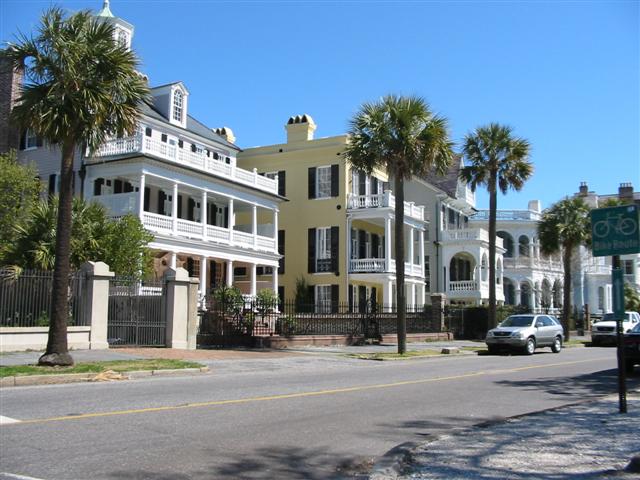
Charleston is one of the most beautiful and historic cities in the United States, a colonial gem on the Atlantic coast of South Carolina. Founded in 1670, it has kept an old town of cobbled streets, pastel houses, stately mansions, white-steepled churches and palm trees, in a setting of southern elegance that has earned it recognition as one of the best destinations in the country and the world.
Its Historic District, at the tip of the peninsula, gathers centuries of history: from the famous stretch of Rainbow Row, with its colored houses, to the mansions of The Battery facing the sea, the churches that gave it the nickname 'Holy City', the lively City Market and the old sites tied to colonial trade and to slavery. Across the bay stands Fort Sumter, where the Civil War broke out, and all around lie historic plantations with spectacular gardens.
This guide covers the essentials of Charleston with a practical eye: the historic district and its icons, the plantations and gardens nearby, Fort Sumter, the exquisite lowcountry cooking, the nearby beaches and how to get around. Whether for its architecture, its history, its gardens or its food, Charleston is a southern getaway as beautiful as it is heavy with memory.
Charleston (originally Charles Town, in honor of King Charles II of England) was founded in 1670 and became one of the wealthiest ports in the British colonies, thanks to rice and indigo grown on plantations worked by enslaved people; it was, in fact, one of the main points of entry for the slave trade in North America. A cradle of the independence movement, it was also where the Civil War broke out in 1861, with the attack on Fort Sumter. It survived wars, earthquakes and hurricanes, preserving an exceptional heritage. The full story is on our history page.
Read the full history ↓The state where the Civil War began: land of rice and indigo plantations, cradle of Gullah culture, of the elegant colonial port of Charleston, of the first shot at Fort Sumter and of its Atlantic beaches.
Read the history of South Carolina →If you book from here we earn a commission and you pay no more. Prices and availability come from Civitatis.
No exact prices: a scale from $ (budget) to $$$$$ (luxury), with 2-3 options per category.
Origins, formation and what the sources say.
Walk along Rainbow Row today, with its caramel-colored houses looking out over the river, and it is hard to imagine that this same waterfront was, for almost two centuries, one of the richest and at the same time most tragic ports in North America: the point of entry for a huge share of the enslaved Africans who reached the colonies. Charleston is beautiful, and its beauty is woven through with that memory. It was founded in 1670 by English colonists as Charles Town, in honor of King Charles II of England, who had granted the territory of Carolina to a group of nobles, the Lords Proprietors. The original settlement stood on the banks of the Ashley River and, a decade later, moved to its present site at the tip of the peninsula between the Ashley and Cooper rivers, a better-protected spot with an excellent natural harbor.
The city grew quickly to become one of the most important and prosperous ports in the British colonies in America. Its wealth was built on plantation agriculture: first rice —which made fortunes for the local elites— and then indigo, both highly profitable export crops. That economy depended entirely on the labor of enslaved Africans, and Charleston became one of the main points of entry for the transatlantic slave trade in North America: an enormous proportion of the enslaved Africans who arrived in the colonies passed through its port.
That history left a deep and painful mark, but it also gave rise to the rich Gullah/Geechee culture of the Carolina coast —descendants of enslaved people who preserved African languages, traditions and crafts, such as the famous sweetgrass baskets still sold at the City Market. Colonial Charleston was also a remarkably cosmopolitan and religiously tolerant city for its time, which earned it the nickname 'Holy City' for its abundance of churches and steeples.
Charleston played a prominent part in the American Revolution. In 1776, the patriots successfully defended the harbor against a British attack on Sullivan's Island, at the fort that would later be called Fort Moultrie. In 1780, however, the city fell to the British after a long siege, in one of the biggest American defeats of the war, and remained occupied until the end of the conflict. After independence, Charles Town was officially renamed Charleston.
Through the first half of the 19th century, Charleston remained a prosperous city and the center of the aristocratic culture of the South, but also a focal point for the defense of slavery and for the ideas that would tear the country apart. South Carolina was the first state to secede from the Union, in December 1860, lighting the fuse of the crisis.
The final explosion happened in Charleston harbor itself. On 12 April 1861, Confederate batteries opened fire on Fort Sumter, the federal fortification guarding the harbor entrance: these were the first shots of the Civil War, the bloodiest war in United States history. During the conflict, Charleston was subjected to a long siege and bombardment by Union forces, and suffered severe damage before falling in 1865. The war ended with the abolition of slavery, transforming forever the society on which the city had been built.
After the Civil War, Charleston went through decades of economic hardship and a string of natural disasters. In 1886, a powerful earthquake shook the city and damaged numerous buildings (the characteristic 'earthquake bolts', the iron tie rods you see on many facades and which were used to reinforce the structures, date from that time). Throughout its history, Charleston has also been hit repeatedly by hurricanes, such as the devastating Hugo in 1989.
Paradoxically, the long post-war economic stagnation helped preserve its heritage: with no resources and no pressure to demolish and rebuild, much of the colonial and antebellum architecture stayed standing. Charleston was also a pioneer of historic conservation in the United States: in 1931 it established the country's first protected historic district by municipal ordinance, setting a precedent for urban preservation across the nation.
Thanks to that effort, Charleston has reached the present day with an exceptional historic center that has made it one of the most admired tourist destinations in the country, repeatedly honored by travel publications. The city combines its heritage —the cobbled streets, Rainbow Row, The Battery, the churches, Fort Sumter— with a renowned food and cultural scene. In recent decades it has also moved toward recognizing and telling its history tied to slavery more fully, with institutions such as the International African American Museum, on the site of the old wharf where thousands of enslaved Africans arrived.
For much of Charleston's history, the African American population was the majority in the city and on the surrounding Sea Islands. Out of that world came Gullah-Geechee culture, one of the most distinctive in the United States: descendants of enslaved people who, thanks to the relative isolation of the rice plantations and the islands, preserved linguistic, culinary, religious and craft traditions of African origin. Their creole language, their music, their storytelling and their famous woven sweetgrass baskets are still alive today and are officially recognized through the Gullah Geechee Cultural Heritage Corridor, created by Congress in 2006.
After the Civil War, during Reconstruction, Charleston's freedpeople took an active part in political life: there were African American legislators in South Carolina and a flowering of schools, churches and organizations. But the end of Reconstruction in 1877 and the imposition of Jim Crow segregation laws rolled back much of that progress for almost a century. Curiously, Charleston is credited with the origin of the 'Charleston', the dance that became a craze in the 1920s, which emerged in the city's African American communities.
During the civil rights movement, Charleston lived through significant episodes, such as the long 1969 strike by hospital workers (mostly Black women), backed by figures from the movement. Decades later, in 2015, the city returned to world attention because of the racist attack at Emanuel AME Church, where a white supremacist murdered nine African American parishioners; the community's response of forgiveness and unity and the subsequent removal of the Confederate flag from the state capitol marked a turning point. Today, institutions such as the International African American Museum (2023) aim to tell this history fully and honestly.