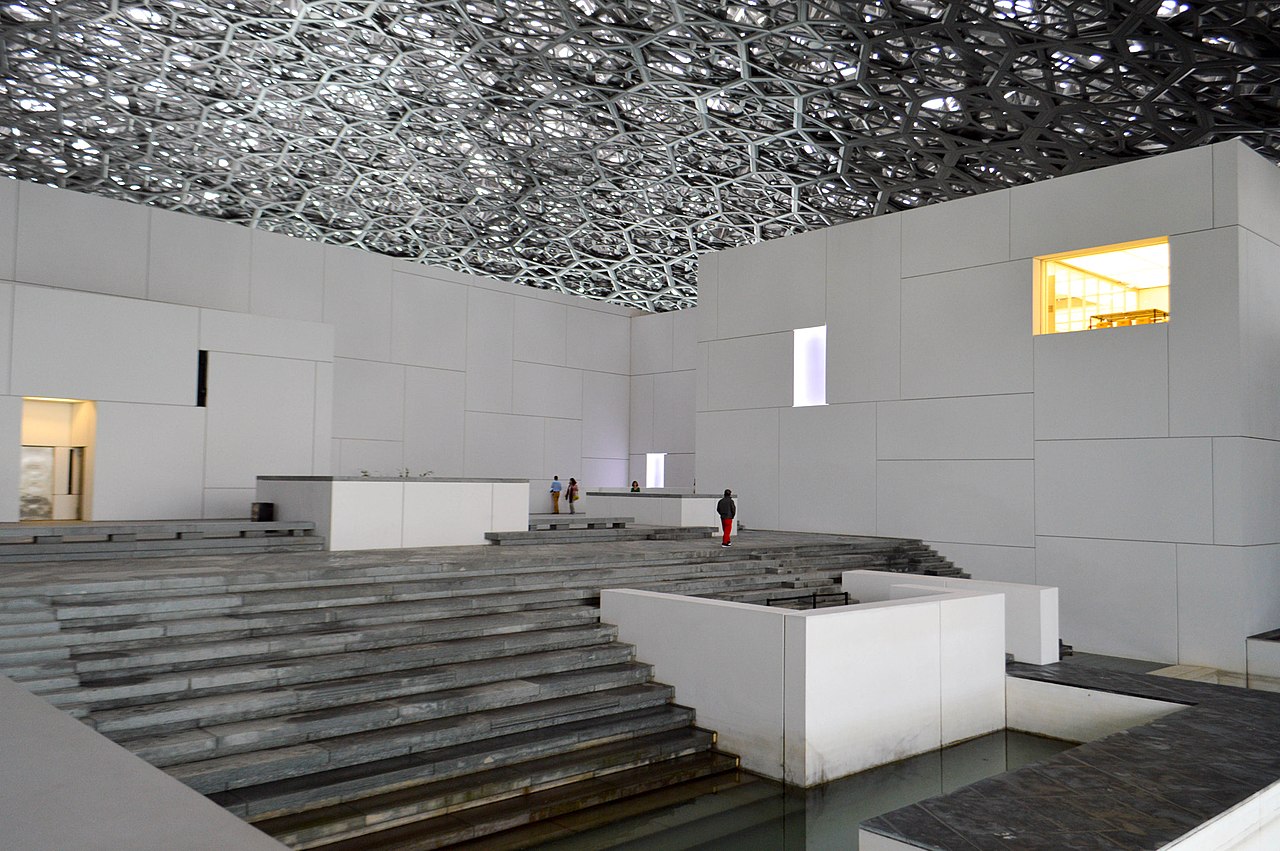
If Yas Island is Abu Dhabi's fun and adrenaline, Saadiyat Island is its cultural soul. 'The island of happiness', as it's called in Arabic, is a colossal bet: to create, in the middle of the Persian Gulf, the largest concentration of museums and cultural institutions in the world. The result already dazzles: the Louvre Abu Dhabi beneath its famous perforated dome that rains light, teamLab's immersive digital experience, the Zayed National Museum, the future Guggenheim and an Abrahamic Family House that brings together a mosque, a church and a synagogue.
But Saadiyat isn't just museums. The island also holds some of the most beautiful and least developed beaches in all the Emirates: white sand, turquoise water and a stretch of coast where, every spring, hawksbill turtles come to nest under the protection of conservation programmes. That mix of cutting-edge art and well-cared-for nature, of museums and sea, makes Saadiyat a unique place in the Gulf, very different from the bustle of Dubai or the parks of Yas.
This guide helps you plan your visit: which museums to see and which are already open, how much tickets cost (the Louvre is surprisingly affordable), when you can see the turtles, how to visit the Abrahamic Family House, how to get around the district and how to combine Saadiyat with the rest of Abu Dhabi and with Yas Island. For lovers of art, architecture and quiet beaches, Saadiyat is a gem that keeps on growing.
Until the early 21st century, Saadiyat Island was a mostly untouched, sandy island off the coast of Abu Dhabi, with beaches, dunes and wildlife, but almost no development. Everything changed when the emirate, as part of its strategy to diversify the economy beyond oil and become a global cultural reference, decided to dedicate the island to an ambitious project: the Saadiyat Cultural District. The plan, launched in the mid-2000s, aimed to attract the world's great cultural institutions and to commission their buildings from some of the most celebrated architects in the world (Jean Nouvel, Frank Gehry, Norman Foster, Tadao Ando). The first big milestone was the opening of the Louvre Abu Dhabi in 2017, the first 'Louvre' museum outside France. In the 2020s it was followed by the Abrahamic Family House (2023), the digital experience teamLab Phenomena, the Zayed National Museum —dedicated to the father of the nation— and the Guggenheim Abu Dhabi, set to be the largest in the world. At the same time, Saadiyat protected its beaches and wildlife, including the turtles that nest on its shores. And so, in barely two decades, an almost untouched island was transformed into one of the planet's biggest cultural hubs. We tell the story of that transformation, and of Abu Dhabi's cultural ambitions, on our history page.
Read the full history ↓The capital and the country's richest emirate: from the Liwa oasis and the founding on the island to oil, the Grand Mosque, the Louvre on Saadiyat and Formula 1 on Yas.
Read the history of Abu Dhabi and its islands →If you only have one day, take a guided tour on the first one: it sets up the rest of your trip and saves you a lot of walking. We look ours up on Civitatis: guided in Spanish and booked online with no fuss. They have over 50 activities in Dubai. Three are below so you get the idea: tap any of them and they all open.
They depart from Dubai, 112 km away. If you book from this link we earn a commission and you pay no more.
No exact prices: a scale from $ (budget) to $$$$$ (luxury), with 2-3 options per category.
Origins, formation and what the sources say.
In Arabic, Saadiyat means 'happiness' or 'bliss', and until little more than a decade ago the island lived up to its name in the most natural way possible: it was a stretch of almost untouched coastline off Abu Dhabi, with long white-sand beaches, dunes, low vegetation and rich wildlife, including the hawksbill turtles that came every spring to lay their eggs in the sand. A quiet, wild place with hardly any buildings, just a few minutes from the capital.
Unlike Al Ain or Old Dubai, Saadiyat has no long urban history: there are no centuries-old forts or ancient oases here. Its story as a destination is recent, almost as recent as that of its neighbour Yas. But while Yas was set aside for leisure and speed, Saadiyat was meant for a very different and far more ambitious role: to become the great cultural beacon of Abu Dhabi and, in time, of the whole region.
That decision was part of the emirate's strategic vision. Aware that oil would not last forever, Abu Dhabi set out to build an economy and an image rooted in culture, knowledge and quality tourism as well. And that called for something spectacular: not a museum, but an entire island of museums. Saadiyat, with its natural beauty and its closeness to the city, was the perfect setting for that dream.
In the mid-2000s, Abu Dhabi announced one of the most ambitious cultural projects ever conceived: the Saadiyat Cultural District, designed to bring together on a single island the world's greatest concentration of top-tier cultural institutions. The idea was not to timidly imitate the great art capitals, but to compete with them head-on, attracting legendary museum brands and commissioning the buildings from the most celebrated architects on the planet.
The plan gathered a constellation of star names. For universal art, a historic agreement with France would allow the use of the 'Louvre' name and loans from its collections, in a building by Jean Nouvel. For contemporary art, a Guggenheim designed by Frank Gehry, set to be the largest in the world. For national identity, a museum dedicated to Sheikh Zayed designed by Norman Foster. Other institutions would join them over the years. Rarely in history had so much architectural talent been brought together in such a small space.
The project was not free of controversy. The working conditions of the thousands of migrant workers who built the island drew criticism and international campaigns, which denounced abuses and pushed for improvements. And there were debates about the meaning of 'buying' culture and importing museum brands. Despite it all, and with years of delays, the vision gradually took shape, brick by brick, on the sand of the 'island of happiness'.
The big milestone came in November 2017, with the opening of the Louvre Abu Dhabi, the first museum bearing the 'Louvre' name outside France. It was the result of an extraordinary intergovernmental agreement between the Emirates and France, signed a decade earlier, covering the use of the name, advice from French museums and the loan of works. Jean Nouvel's building — an immense silver dome, pierced with thousands of openings that create a famous 'rain of light' inside — instantly became a global architectural icon.
But beyond the building, the Louvre Abu Dhabi put forward a powerful idea: a 'universal museum' that, instead of separating art by civilisation, arranges works by period and theme, showing the dialogues and similarities between very different cultures. An ancient sculpture next to a European painting, an Islamic object beside an Asian one: a story of art as the shared heritage of humanity, especially meaningful in a region where civilisations have always crossed paths.
The Louvre's opening proved that the Saadiyat dream was possible and put the island on the world's cultural map. Millions of visitors began to arrive, and the museum became the district's flagship and one of the great attractions of the whole country. With it, Abu Dhabi showed that its bet on culture was not just rhetoric: it was concrete, steel, light and masterpieces.
After the Louvre, Saadiyat kept adding pieces to its great cultural mosaic, at an ever faster pace. In 2023 the Abrahamic Family House opened, a unique interfaith complex by British-Ghanaian architect David Adjaye that brings together a mosque, a church and a synagogue of identical size within a single site. It grew out of the Document on Human Fraternity, signed in Abu Dhabi in 2019, and embodies a message of tolerance and coexistence between the three great Abrahamic religions, especially powerful in a region marked by tensions.
The island also opened up to the most contemporary and technological art. The Japanese collective teamLab, world-famous for its immersive digital art museums, opened teamLab Phenomena Abu Dhabi in 2025, an organic building with dozens of installations that blur the boundaries between art, science and nature, and in which visitors are literally immersed in the works.
And the great museums still missing arrived. At the end of 2025 the Zayed National Museum opened, dedicated to the country's history and its founder, beneath Norman Foster's towers shaped like falcon feathers. And in 2026 the long-awaited Guggenheim Abu Dhabi opened its doors, Frank Gehry's colossal contemporary art museum, set to be the largest Guggenheim in the world. A large Natural History Museum is also in development. Piece by piece, the island was completing its constellation.
Today's Saadiyat is the visible result of one of the boldest cultural bets of the 21st century: in barely two decades, an almost untouched island has become one of the world's biggest hubs of museums and culture, with top-tier institutions designed by legendary architects, a few minutes from one another and facing the sea. For visitors, exploring the Cultural District means witnessing live the birth of a major new chapter in the world's cultural geography.
It is also an island that has tried not to turn its back on its nature. Alongside the museums, Saadiyat preserves and protects its beaches — ranked among the best in the world — and the nests of the hawksbill turtles that still come to nest in its sand every spring, in an effort to combine development with conservation. That double face, cutting-edge art on one side and the coastal ecosystem on the other, is part of its unique charm.
Like Abu Dhabi's whole model, Saadiyat stirs both admiration and debate: for its ambition and beauty, but also for the questions it raises about how it was built, about migrant labour and about the meaning of creating culture at this scale and speed. Either way, for travellers the island offers something rare: the chance to see, in one place, universal art, contemporary art, a country's identity, dialogue between religions and a turtle beach. The 'island of happiness' has become the island of culture, and its story is still being written.