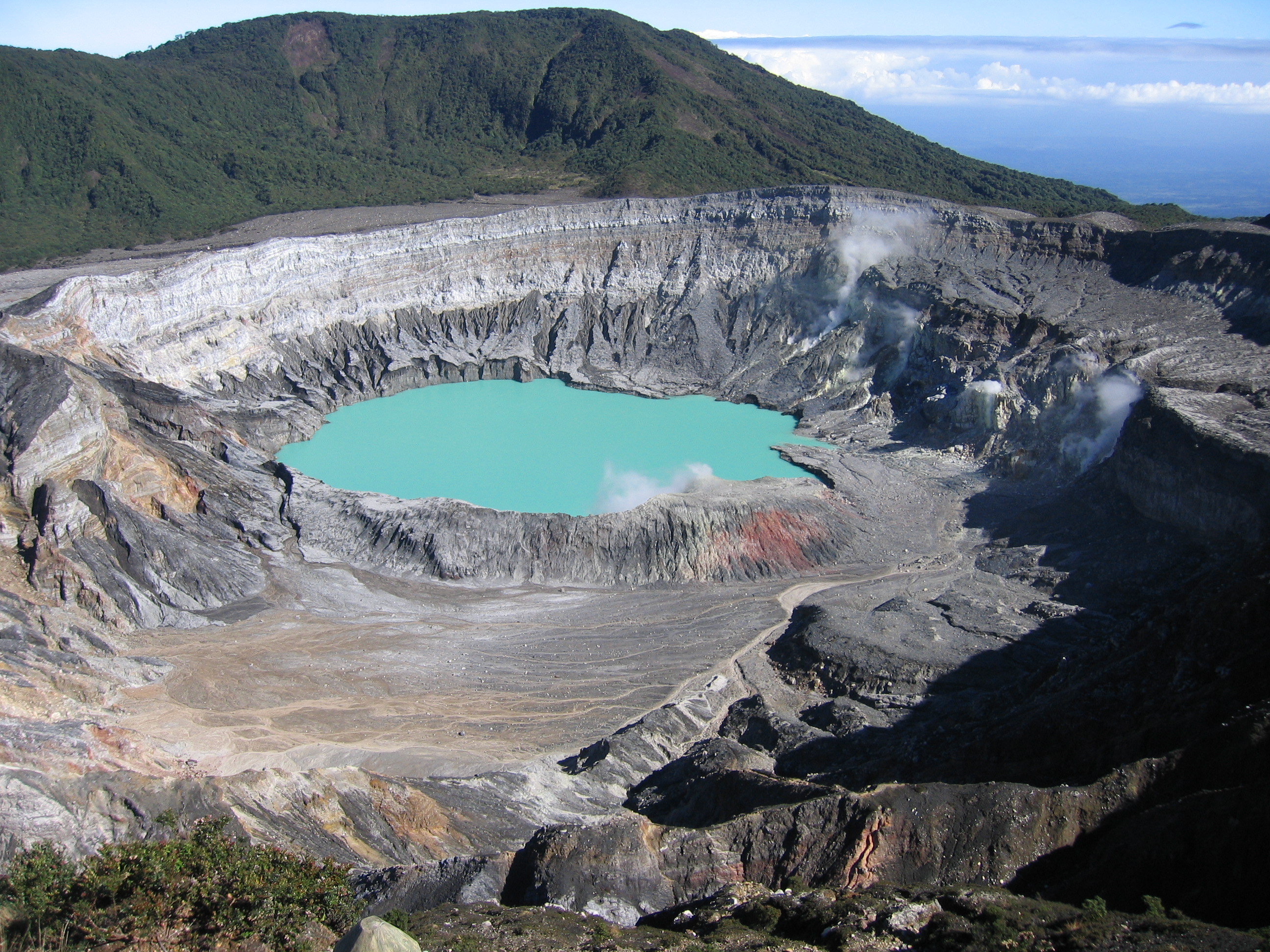
Poás Volcano is one of the most accessible and spectacular active volcanoes in Costa Rica, and for good reason it's one of the country's most visited national parks. From the main viewpoint, at more than 2,700 meters, you look out over a giant crater -more than a kilometer across and some 300 meters deep- with the Laguna Caliente steaming at the bottom, a lake of acid turquoise water, one of the most acidic in the world. It's a postcard like almost nothing else: it looks like another planet, with fumaroles, sulfur vapors and water in unreal colors.
The good part is that nature makes it easy here: a short paved trail takes you from the visitor center to the crater rim in about 10-15 minutes, so you enjoy it without effort and it works for almost everyone. Add a second, more wooded trail that climbs to Laguna Botos, a dormant crater filled by a cold lake ringed by cloud forest. Walking among giant ferns, mosses and mist is the other side of Poás, green and silent.
One important note: Poás is a genuinely active volcano, closely monitored by OVSICORI and the CNE. It had a long closure after the 2017 eruptions and another in 2025, and it reopened with a strict capacity system. That's why booking your ticket online on the SINAC site before you go is MANDATORY today: tickets aren't sold at the gate and there are limited slots per time block. Book days ahead, especially in high season and on weekends, and go early to beat the cloud.
Poás is a complex stratovolcano of 2,708 meters with a long record of historical eruptions (1834, 1910, 1953-1955, 1989-1990 and 2017, among others). Poás Volcano National Park was created on 25 January 1971. The big eruption of April 2017 destroyed the dome in the crater and forced the park to close for more than a year; in 2025 a new eruptive cycle closed it again for several months, until it reopened on 30 July 2025 with controlled capacity. The full geological history and the origin of the name 'Poás' are on the history page.
Read the full history ↓The country's largest province, stretching from the Central Valley to the Northern Plains: birthplace of the hero Juan Santamaría, land of the Poás and Arenal volcanoes, home of the Sarchí oxcarts and gateway to the wetlands, waterfalls and turquoise rivers of the north.
Read the history of Alajuela →They depart from Alajuela, 20 km away. If you book from this link we earn a commission and you pay no more.
No exact prices: a scale from $ (budget) to $$$$$ (luxury), with 2-3 options per category.
Origins, formation and what the sources say.
Before the Spanish arrived, the massif had names in the languages of the region's original peoples. One tradition records the name 'Chibuzú', linked to the Cabécar language and said to mean 'mountain of Sibú', a reference to Sibú, the main creator deity in the Bribri and Cabécar worldview. That Indigenous root is a reminder that these mountains were places charged with spiritual meaning long before anyone mapped them under the current name.
The exact origin of the word 'Poás' has no settled consensus, and several hypotheses coexist. One derives it from a Huetar word (the Huetar were the people who dominated the Central Valley when the Spanish arrived), 'poasi' or 'puasi', of uncertain meaning. Another widespread explanation links it to the Latin word 'púa' (spike), for the thorny plants in the area, or to a village and a river called 'Púas' near the massif, whose name would already have been recorded in the 17th century. There's no way to settle definitively which is correct, and that's why the different versions are usually presented together.
Poás is a complex stratovolcano rising to 2,708 meters above sea level, at the northwestern end of Costa Rica's Central Volcanic Range. Its summit, shaped by millennia of activity, has faults, depressions, volcanic cones and as many as three craters: the main crater (active), the Von Frantzius crater (older and forested, to the north) and the crater now filled by Laguna Botos. It was built over hundreds of thousands of years, layering lava, ash and pyroclastic material.
The most spectacular feature is the main crater, around 1.3 km across and some 300 meters deep, holding the Laguna Caliente, one of the most acidic crater lakes in the world, with a pH that can approach zero and temperatures that vary sharply with activity. This lake works like a 'lid' on the volcanic system: when heat and gases increase, its level drops, its temperature rises and phreatic (steam) eruptions can occur, throwing out water, mud and gases. Laguna Botos, by contrast, fills a crater inactive for thousands of years and holds cold rainwater, with no connection to the activity of the main crater. The whole complex is covered by high-altitude cloud forest, with vegetation adapted to cold, wind and mist.
Poás began to be studied scientifically in the mid-19th century, as part of the naturalist expeditions that crossed Central America. The Danish botanist Anders Sandøe Ørsted is credited with one of the first scientific explorations of the volcano, around 1847, in which he documented accounts of the 1834 eruption.
A few years later, in 1860, the German physician and naturalist Alexander von Frantzius climbed the volcano and published his observations in European scientific journals, helping make Poás known internationally. One of the massif's three craters, the Von Frantzius crater, is named after him. These first descriptions laid the groundwork for knowledge of the volcano, which today is one of the most closely watched in the country: the Volcanological and Seismological Observatory of Costa Rica (OVSICORI) and the National Seismological Network (RSN) continuously monitor its seismicity, its gases and the changes in the Laguna Caliente, which makes it possible to anticipate episodes of activity and to decide whether to open or close the park.
Poás has one of the best documented eruptive records in Costa Rica. Among the historical events, two stand out: the 1834 eruption, with strong explosions and ashfall, and above all that of 1910, considered the volcano's most important historical eruption: on 25 January of that year a violent explosion raised a column said to have reached 8,000 meters, expelling an enormous volume of ash (on the order of tens of thousands of tons) that affected wide areas all around.
Between 1953 and 1955 the volcano went through another cycle of major activity, with violent explosions that partly dried out the lake and formed a lava dome in the crater, plus damage to coffee crops in the area. Around 1989 and 1990 a new period of unrest was recorded, with a drop in the level and a rise in the temperature of the Laguna Caliente and gas emissions. These episodes show a pattern typical of Poás: long periods of relative calm with a steaming acid lake, interrupted by phases of phreatic and, at times, juvenile eruptions (with fresh magma), which force the park to be managed with caution.
Poás Volcano National Park was created on 25 January 1971, through Law No. 4714, as one of Costa Rica's first national parks, part of the country's pioneering push to protect its nature. It protects around 65 km² taking in the volcano, its craters and a valuable high-altitude cloud forest, with its characteristic flora and fauna.
Its closeness to San José and Alajuela and the ease of reaching the crater rim by a short paved trail quickly made it one of the most visited parks in the country, a showcase of the Costa Rican model of nature tourism. Today it's managed by SINAC (the National System of Conservation Areas), within the Central Conservation Area, which regulates its capacity, its hours and, since the recent closures, a mandatory online ticket booking system to control visitor numbers and guarantee safety given the volcano's activity.
In April 2017, after decades of mostly quiet activity, Poás produced its most important eruption since the 1950s. A series of high-energy explosions raised columns several kilometers high, destroyed the dome that had formed in the crater and threw out ash, gases and blocks of rock. The intensity of the event forced SINAC to close the park for safety, and the closure ran for about 16 months, until it reopened in 2018 with new measures to protect visitors.
In 2025 the volcano reminded everyone again that it's alive. In early March the CNE issued an alert over increased activity and, toward the end of that month, MINAE and SINAC ordered the park closed, first for a day and then indefinitely. Through March and April there were episodes of near-continuous eruptions, with pulses of explosions and larger events -especially in late April- that threw incandescent material and ballistic projectiles beyond the crater. After several months of monitoring by OVSICORI and the RSN and a drop in activity, the authorities lowered the alert and reopened Poás Volcano National Park on 30 July 2025, with controlled capacity, entry by time block and limited time at the main viewpoint. This back-and-forth of openings and closures is the new normal at Poás and the underlying reason you have to book admission in advance today.