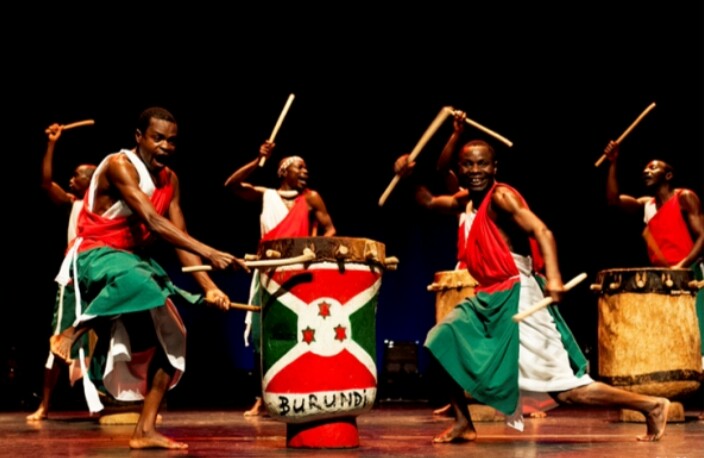
If one experience sums up the soul of Burundi, it's the drum. On the sacred hill of Gishora, near Gitega, the royal drummers keep a centuries-old tradition alive: a hypnotic show of percussion, singing and dancing that UNESCO recognised in 2014 as Intangible Cultural Heritage of Humanity.
The Burundian drum (ingoma) isn't just music: it was a symbol of royal power, a sacred instrument linked to fertility and renewal, and the voice of the nation. At Gishora, the drummers carry the huge drums on their heads, set them out in a semicircle and, taking turns on the central drum, unleash a thunderous choreography of beats, leaps and chants that gives you goosebumps.
This guide explains how to visit the sanctuary: how to get there from Gitega, how to arrange the show, what the drums mean and why this tradition is Burundi's greatest cultural treasure. A must for anyone who makes it to the heart of the country.
The Gishora Sanctuary was founded in 1903 by the mwami (king) Mwezi IV Gisabo, after his victory over a rebel chief, as a sacred place dedicated to the royal drums. In the culture of the old kingdom of Burundi, the drum (ingoma) was the emblem of the mwami's power and a sacred ritual instrument, played on solemn occasions by brotherhoods of drummers who passed the art down from generation to generation. That tradition, kept alive at Gishora, was inscribed by UNESCO as Intangible Cultural Heritage of Humanity in 2014. Its story is told on our history page.
Read the full history ↓The former royal capital and today the country's political capital: land of the mwami, of the sacred drums of Gishora and of the museum that keeps the memory of the kingdom.
Read the history of Gitega and the cultural heartland →No exact prices: a scale from $ (budget) to $$$$$ (luxury), with 2-3 options per category.
Origins, formation and what the sources say.
In the old kingdom of Burundi, the drum (called 'ingoma' in Kirundi) was much more than a musical instrument. It was the very emblem of the mwami's (king's) power and a sacred object full of ritual meaning. The drum stood for royalty, fertility and renewal, and its sound marked the great moments in the life of the kingdom: the enthronement of a new king, sowing and harvest, and the most solemn ceremonies.
The drums weren't played on just any occasion or by just anyone. They were kept in sanctuaries and entrusted to families of drummers, guilds that passed the art down from father to son over generations. Each drum had its own name, place and role. The most important ones were revered objects, tied directly to the person of the mwami and to the continuity of the dynasty.
The drum and life were so closely linked that the word 'ingoma' meant both 'drum' and 'kingdom' or 'reign'. Playing the drum was, in a way, sounding the voice of the kingdom. This deep symbolism is what makes Burundi's drumming tradition unique, and very different from a simple folk performance.
The Gishora sanctuary is linked to one of the great kings in Burundi's history, the mwami Mwezi IV Gisabo. He ruled during the second half of the 19th century and the first decades of colonisation, and he firmly resisted European expansion. According to tradition, Gisabo founded the Gishora sanctuary in 1903 as a sacred place dedicated to the royal drums, after defeating a rebel chief named Ntibirangwa.
Traditional huts were built at the top of Gishora hill to keep the sacred drums. They were guarded by a guild of drummers connected to the royal court. The site became one of the kingdom's most important drum sanctuaries, a place where ritual music, royal power and the sacred came together. Gishora is close to Gitega, the capital of the kingdom, and that location strengthened its link with the political and spiritual heart of Burundi.
Mwezi Gisabo is remembered as a symbol of Burundian resistance to colonialism. He eventually had to accept German rule, but his name remained tied to the defence of the kingdom's sovereignty and traditions, including the drums. More than a century later, the sanctuary he founded at Gishora is still the living guardian of that heritage.
A performance by Burundian drummers is a complete show. The musicians wear traditional colours (often red, white and green) and arrive singing, carrying the huge drums on their heads. The drums are carved from hollowed-out tree trunks and covered with tightly stretched hides. The drummers set them in a semicircle around a central drum, the 'inkiranya', which sets the rhythm. Then a powerful performance begins: they take turns playing the central drum while the others play together in time.
Singing, leaping and dancing join the drumming. The drummers dance, spin and jump over the drums in an energetic, precise routine that combines physical strength with a strong sense of rhythm. Together it makes a thunderous, hypnotic sound that impresses everyone who hears it. It wasn't originally a show for tourists. It is a ritual expression that has stayed alive over time.
Passing this art from one generation to the next, within families and drummers' guilds, is an essential part of the tradition. Learning to play, to make the drums and to perform the dances takes a long time and is part of these communities' identity. That living continuity is one of the reasons the tradition earned international recognition.
The monarchy was abolished in 1966, and the political upheaval that followed took away the drumming tradition's original setting, the mwami's court. But the tradition didn't disappear. The drums kept sounding at official celebrations, national events and cultural performances, and they became a powerful symbol of Burundian identity that rises above the country's divisions. Drumming groups even took the art to stages around the world, making the 'drums of Burundi' famous internationally.
In 2014, UNESCO inscribed Burundi's 'ritual dance of the royal drum' on the Representative List of the Intangible Cultural Heritage of Humanity, recognising its value and the need to preserve it. The listing was also meant to protect the tradition from purely commercial or out-of-context use, and to make sure its ritual meaning is passed on to new generations. In later years, the Burundian authorities set rules on who may play the drums and on which occasions.
Today, the Gishora sanctuary is the best place for travellers to get close to this living tradition. Watching the drummers perform on the sacred hill and learning about their history and meaning is a way to experience the cultural heart of Burundi. In a country marked by poverty and conflict, the drum is still a source of pride and a symbol of unity: the deep voice of a nation.