Viajá con Gus
HomeBrazilBonito
Bonito
🇧🇷 Brazil · Central-West

Bonito

Jump to what you need
📌State
Mato Grosso do Sul (Brazil). Bonito is in the southwest of the state, in the heart of the Serra da Bodoquena, a range of limestone rock (limestones and dolomites of the Corumbá Group, more than 500 million years old). That karst geology is the key to everything: rainwater, slightly acidic, dissolves the limestone over millennia and carves out caves, sinkholes and springs. As it passes through the limestone, the water takes on calcium carbonate, which precipitates and drags the impurities down to the riverbed, leaving rivers of an almost unreal transparency. That's why Bonito is famous for its 'crystal-clear waters': it's known as Brazil's ecotourism capital and has been voted the country's best ecotourism destination dozens of times.
📌Service city
The town of Bonito itself has the hotels, guesthouses, restaurants and, above all, the accredited travel agencies that issue the voucher and book each outing. It has a regional airport (Aeroporto de Bonito, code BYO) with non-daily flights from a few capitals (Azul from Campinas/Corumbá, Gol from São Paulo-Congonhas, subject to season and changes). The most used gateway, though, is Campo Grande, the state capital, some 300 km away (BR-060), with good air connections and shared transfers and buses running from there to Bonito (about 4 hours). The attractions are also spread between Bonito and the neighboring municipalities of Jardim and Bodoquena (70-80 km away).
📌Best time to go
The dry season (roughly April/May to September/October) gives the best visibility and the sharpest floating: with less rain, the rivers run clear and you see the fish and the riverbed with aquarium clarity. After heavy rain (above all in summer, December to March) some rivers can turn cloudy for a while and visibility drops. In exchange, the rainy summer is ideal for the cachoeiras (waterfalls), which come down with more volume and force. September and October usually combine good weather, warmth and still little rain; April and October are good for avoiding the crowds of the Brazilian holidays.
📌Suggested days
Count on 3 to 5 full days. The reason is the system: in Bonito nearly every attraction is on private property (fazendas) with a limited daily quota and an assigned time slot, and they're booked in advance through the Voucher Único via an accredited agency. You can't just turn up at an outing on a whim: each float, cave or waterfall has vagas (slots) that sell out, especially in high season, and rarely do more than one or two big outings fit into a day (many take half a day or the whole day). With 3-4 days you'll cover the essentials (one float, one cave, one waterfall and a river beach); with 5 or more you can add diving, abseiling or the more distant attractions in Jardim and Bodoquena.
💱 BRL exchange rate
Loading rate…
🌤️ Weather in Bonito
Loading weather…

Bonito is, beyond argument, Brazil's ecotourism capital: a quiet town in the Serra da Bodoquena, in southwestern Mato Grosso do Sul, that became world-famous for rivers so transparent that floating down them is like swimming inside a giant aquarium. The secret is underground: the whole region sits on limestone, and as the water filters through that rock it drops its impurities to the bottom and comes out with an almost impossible clarity. The result is emerald rivers full of fish, caves with blue lakes, waterfalls deep in the forest and sinkholes inhabited by macaws.

Unlike a beach destination where you do as you please, Bonito runs on a very particular, pioneering system: the Voucher Único. Nearly all the attractions sit inside private fazendas, with a limited daily quota and an assigned time slot, and the only way in is by booking in advance through an accredited local agency. It sounds bureaucratic, but it's exactly what keeps the place intact: the flow of visitors is controlled so the rivers don't get saturated or dirty. So plan ahead, book the star outings weeks (or months, in high season) in advance, and understand that here nature sets the pace.

The range of activities is enormous and there's something for everyone: floating (flutuação) with a snorkel in the Rio da Prata or the Rio Sucuri, taking in the Gruta do Lago Azul, abseiling and diving in the Abismo Anhumas, trekking between waterfalls at Estância Mimosa or Boca da Onça, running the rapids by boat or on a boia-cross down the Rio Formoso, or simply a relaxed day at the Balneário Municipal. It isn't a cheap destination: many attractions have high, fixed prices. But few places in the world offer water this clear and a nature experience this carefully looked after.

📖 History of Bonito

Long before the name 'Bonito' arrived, these lands of the Serra da Bodoquena were inhabited by Indigenous peoples such as the Terena, the Kadiwéu and the Guarani, who knew the rivers and the natural routes and lived in close relationship with their surroundings. Non-Indigenous settlement began in 1869, when captain Luiz da Costa Leite Falcão founded the Fazenda Rincão Bonito in the area; the future town's name came from the adjective used to describe the natural beauty of the place. Bonito was constituted as a district in 1915 and was raised to municipality on 2 October 1948, after years tied to Miranda. For decades it was a rural, cattle-raising town, but from the 1980s and, above all, from 1991, an alliance between local people, the government and NGOs began developing a model of sustainable ecotourism, with rigorous control of visitor numbers. In 1995 the Voucher Único system was born, a first in Brazil, which orders and limits access to each attraction. That 'Bonito model' of quota management is internationally recognized today and is the reason the water is still this clear despite the fame. The full story is on our history page.

Read the full history ↓

🏛️ Bonito is in Mato Grosso do Sul

The young state of the Pantanal and the crystal-clear waters: split off from Mato Grosso in 1977, it brings together the largest wetland on the planet and the ecotourism paradise of Bonito, with rivers of astonishing transparency and the third largest Indigenous population in Brazil.

Read the history of Mato Grosso do Sul →

🗺️ What to see

1
Floating in the Rio da Prata (Recanto Ecológico)
Bonito's most celebrated float: more than 2 km of crystal-clear river full of fish, considered one of the most transparent in the world.
Floating (flutuação) in the Rio da Prata is, for many, the number one experience in Bonito and one of the most sought-after in the whole destination. It takes place at the Recanto Ecológico Rio da Prata, a private property in the municipality of Jardim, some 53 km from the center of Bonito. The adventure starts with a walk along a trail through Atlantic forest, out to the Olho d'Água spring, from where you let yourself go downstream, face down, drifting slowly with the current. What sets the Rio da Prata apart is the combination of clarity and life: its water is so clean that it feels like floating over a giant aquarium, surrounded by shoals of piraputangas, dorados, curimbas and other fish swimming centimeters from you, indifferent to your presence. The float is long, around 2.2 km, longer than on other rivers, which makes it an immersive, unhurried communion with the water. The outing is very complete and designed so anyone can do it. The agency and the operator provide all the gear: a wetsuit, a life jacket, snorkel and mask, floating booties, and a briefing beforehand. You don't need to be a strong swimmer: you float in a jacket and the guide is alongside you the whole time. It's suitable for families, though it's worth checking the recommended minimum age for the youngest. Like every attraction in Bonito, the Rio da Prata is booked in advance through the Voucher Único, via an accredited agency, with an assigned day and time slot and a limited daily quota. In high season the vagas go fast, so book well ahead. Best time to go: the dry season (April to September/October) gives the best visibility; after heavy rain the water can turn cloudy and lose its sharpness. Tips: follow the guide's instructions (don't touch the bottom or the fish, so as not to stir up sediment or damage the ecosystem), bring biodegradable sunscreen (at many attractions only that kind is allowed), and set aside cash or a payment method for extras. Being private property, there's usually a restaurant and changing rooms on site.
ℹ️ Distance: Recanto Ecológico Rio da Prata, in Jardim, ~53 km from the center of Bonito · Best time to go: Dry season (Apr-Oct) for the best visibility; after rain it can turn cloudy · Admission: R$ 470 (low) to R$ 570 (high) per person (source: riodaprata.eco.br, verified July 2026); includes guide, gear, lunch and insurance · Duration: Half a day to a full day (includes transfer, walk and a float of ~2 km, about 4 h in total)
2
Floating in the Rio Sucuri
The other classic crystal-clear float, closer to town; emerald water among aquatic plants.
Floating in the Rio Sucuri is the other great flutuação in Bonito, historically considered one of the cleanest rivers on the planet. It takes place at the Fazenda São Geraldo, some 19 km from the center of Bonito, which makes it a good deal closer and easier to reach than the Rio da Prata. It's one of the most photographed experiences in the destination: the water has an emerald green tone so transparent it looks unreal, threaded with long aquatic plants swaying in the current. The float runs about 1,800 meters (a little shorter than the Rio da Prata) and is done on the gentleness of the current, letting yourself drift while you watch the fish and the underwater scenery. The starting point usually involves a short ride in a boat (rowed or electric, depending on the operator) to the beginning of the float section, which adds a slow moment on the river before you get in the water. Just as at the Rio da Prata, the operator provides all the gear you need: wetsuit, jacket, snorkel, mask, booties and a safety briefing. You don't need to know how to swim; the jacket keeps you afloat and the guides stay with the group. It's ideal if you're short on time or want a float closer to town, and the debate is often exactly between Sucuri and Prata: both are excellent, the difference being that Prata usually has more fish and a longer route, while Sucuri is closer and tends to be a bit cheaper. As always in Bonito, you book in advance with the Voucher Único through an accredited agency, with an assigned time slot and quota. Best time to go: dry season (April to October) for maximum clarity. Tips: follow the guide's rules so you don't stir up the riverbed, use biodegradable sunscreen, bring an underwater or waterproof camera if you want to record the underwater scenery, and ask whether the outing includes lunch or whether it's worth pairing it with another nearby attraction the same day.
ℹ️ Distance: Fazenda São Geraldo, ~19 km from the center of Bonito · Best time to go: Dry season (Apr-Oct) for the best visibility · Admission: R$ 349 (low) to R$ 438 (high) per adult, without lunch (source: riosucuri.com.br, verified July 2026; the price went up compared with previous seasons); lunch extra R$ 52 adults / R$ 25 children · Duration: Half a day (transfer + float of ~1,800 m)
3
Gruta do Lago Azul
The Bonito postcard: a cave with an underground lake of a deep, hypnotic blue. Viewing only.
The Gruta do Lago Azul is the symbol of Bonito, its most recognizable cartão-postal and one of the destination's most important attractions for the beauty and the state of conservation of its geological formations. It's a protected natural monument (Monumento Natural da Gruta do Lago Azul), and its great draw is the intense, deep blue underground lake that forms at the bottom of the cave, considered one of the largest known flooded cavities on the planet. The visit starts with a short path to the cave mouth and then a descent down a stone staircase (a fair number of steps, with a steep drop) heading into the interior. As you go down, the cave opens up with stalactites, stalagmites and other limestone formations, until you reach the viewing platform where you look out over a lake of a blue that seems painted on. The color changes with the sunlight: in certain months and morning hours, the rays come in through the mouth of the cave and light up the water, deepening the blue. That's why a morning visit is usually recommended. It's important to know that this is a purely contemplative attraction: you can't go down to the water or swim; the lake is viewed from the platform. Even so, it's one of those images you don't forget. Going down and back up the staircase takes a certain level of fitness (you have to climb every step on the way back), so wear comfortable, non-slip shoes. The Gruta do Lago Azul is booked with the Voucher Único through an accredited agency, with limited time slots and daily quotas. It's usually combined on the same day with another half-day attraction (a float or a waterfall in the morning or afternoon, for instance). Best time to go: all year; to see the lake at its most intense blue, the mornings of the months when the sun comes right in (ask your agency about the best time slot). Tips: wear closed, non-slip shoes for the staircase, avoid perfumes and respect the ban on touching the formations, and bear in mind the effort of the climb back up if you have knee or breathing problems.
ℹ️ Distance: ~20 km from the center of Bonito · Best time to go: Mornings for the most intense blue; open all year · Admission: R$ 120 (low) to R$ 180 (high) per person plus an environmental conservation fee of R$ 15 (source: bonitoecotour.com / grutadolagoazulbonito.com.br, verified July 2026; some agencies list R$ 110–160); book 3 months ahead in high season · Duration: About 1 hour (including going down and back up the staircase); visits from 7:00 to 14:00, you can stay until 15:00
4
Gruta de São Miguel
A cave with a suspended walkway through the treetops and an interior packed with varied speleothems.
The Gruta de São Miguel is one of the most accessible and most instructive caves in Bonito, perfect for anyone who wants to see the underground world of the Serra da Bodoquena without the physical demands of the more extreme attractions. The outing starts in an unusual way: with a walk along a passarela suspensa (suspended walkway) that passes through the treetops, offering a different view of the forest before you go into the cave. Once inside, the cave reveals itself as a genuine natural museum of limestone formations: stalactites hanging from the ceiling, stalagmites growing from the floor, columns where the two have met, travertines and coralloid formations. A guide accompanies the route along the internal walkways and explains how each structure formed over millennia through the slow action of water on rock, which makes it a very educational visit, ideal for understanding the geology that makes the whole region unique. The Gruta de São Miguel is simpler and less demanding than, say, the Abismo Anhumas: the route is short and comfortable, suitable for almost all ages, and it pairs well with another attraction the same day. It's an excellent option for a morning or an afternoon, or to combine with a float or a river beach. Like the rest of the attractions, it's booked with the Voucher Único through an accredited agency, with an assigned time slot and quota. Best time to go: all year, since it's an indoor attraction and doesn't depend on the weather or on river visibility. Tips: wear comfortable closed shoes, follow the guide's instructions and don't touch the formations (the grease from your skin damages speleothems), and take the chance to ask about karst geology: understanding why the water in Bonito is crystal-clear makes the rest of the trip far more enjoyable.
ℹ️ Distance: A few kilometers from the center of Bonito · Best time to go: All year (indoor attraction, doesn't depend on the weather) · Admission: R$ 92–120 per person (range according to traveler blogs and accredited agencies, verified July 2026) · Duration: About 1 to 1.5 hours
5
Abismo Anhumas (abseiling and diving/floating)
Bonito's most extreme adventure: a 72 m abseil down into a cave with an underground lake where you float or dive.
The Abismo Anhumas is the most spectacular and most demanding attraction in Bonito, and one of the most iconic adventure experiences in Brazil. It's some 23 km from the center of town, on private property. The adventure consists of abseiling down a vertical shaft of about 72 meters into a huge cave that holds an underground lake of crystal-clear water, ringed by imposing cone formations and stalagmites, some of them gigantic. Once down at the lake, the experience splits into two options. In the floating version, you cross the lake on a raft and then float with a snorkel to take in the submerged formations and the clarity of the water. In the diving version (mergulho), certified divers go down with tank gear to explore the underwater cone of the lake, one of the most impressive cave dives in the country (this option requires diving certification). At the end, you come back up on the rope system, with safety crew assistance. Because of its technical complexity and its infrastructure, the Abismo Anhumas is one of the most expensive attractions in Bonito, with a high fixed price that holds all year. The daily quota is very limited, so booking in advance is essential. When you book, you get a voucher with a check-in time the day before the adventure, since there's usually a talk and a gear test beforehand. It's an experience for anyone after adrenaline who isn't afraid of heights or enclosed spaces; it isn't for everyone, and it's worth checking the physical, age and health requirements. Best time to go: all year (it's an underground attraction). Tips: book well ahead because of the small quota, be ready for the physical effort of the descent and the climb, decide whether you're floating or diving (diving requires a brevet/certification), and confirm all the health, weight and age requirements with the agency before you buy.
ℹ️ Distance: ~23 km from the center of Bonito · Best time to go: All year (underground attraction) · Admission: Viewing only (abseil + boat, without getting in the water) R$ 997 adults and R$ 541 children in high season, R$ 498.50 for children in low season; floating R$ 1,598 adults / R$ 799 children; intro dive R$ 1,898 and Open Water R$ 2,037 (official store abismoanhumas.com.br, verified August 2026) · Duration: Half a day (includes briefing, abseil, activity on the lake and the climb back up)
6
Aquário Natural / Nascente Azul
Two gentler, closer floats, ideal for families and for a first taste of Bonito's crystal-clear water.
The Aquário Natural and the Nascente Azul are two floating attractions gentler than the Rio da Prata or the Sucuri, very popular with families with children and with anyone who wants a first taste of Bonito's crystal-clear water. The Aquário Natural is the closest float to town: it's barely 7 km from the center of Bonito. The flutuação runs about 900 meters and crosses three different rivers —the Rio Baía Bonita, the Formoso and the Formosinho—, in a spring packed with fish that swim right alongside you. Because it's close, short and in a controlled setting, it's perfect for the youngest and for anyone after a calm experience. It usually also has rest areas and natural pools on the property. The Nascente Azul, on the other hand, is some 30 km from the center and offers a float of around 2,000 meters, with water in a distinctive turquoise blue and plenty of fish. It's recommended for children from 4 years old and combines the float with infrastructure designed for a full day: paths, a lookout, a zipline over the water in some versions and a restaurant. It's a very complete and photogenic option. Choosing between the two (or between these and the classic floats) comes down to time, budget and the age of your group: the Aquário Natural wins on closeness and gentleness; the Nascente Azul on color and on facilities for making a full day of it. Both are booked, as with everything in Bonito, with the Voucher Único through an accredited agency. Best time to go: dry season (April to October) for the best visibility, though being springs they keep good clarity most of the year. Tips: ideal for families with children (check the minimum age for each), use biodegradable sunscreen, and check what each package includes (lunch, other activities) so you can make the most of a full day.
ℹ️ Distance: Aquário Natural ~7 km; Nascente Azul ~30 km from the center of Bonito · Best time to go: Good visibility most of the year; best in the dry season (Apr-Oct) · Admission: Aquário Natural from R$ 337; Nascente Azul approx. R$ 462 adults, R$ 418 children 7-11 (range according to accredited agencies and traveler blogs, verified July 2026). Booked through the Voucher Único · Duration: Half a day to a full day depending on the attraction
7
Boca da Onça (waterfalls and abseiling)
The region's biggest waterfall circuit, with the highest cachoeira in Mato Grosso do Sul and the tallest abseil in Brazil.
Boca da Onça is the great cachoeira (waterfall) destination in Bonito, an enormous property crossed by paths that link a succession of falls deep in nature. Its jewel is the Cachoeira Boca da Onça, some 156 meters high, the tallest waterfall in all of Mato Grosso do Sul. The attraction offers different options. The Trilha Adventure is a walking route of around 4 km that passes several points and swimming stops, taking in, besides the imposing Boca da Onça, other falls such as the Cachoeira da Anta, the Garganta da Arara, the Piscina da Cotia and the Cascata do Jabuti, among natural pools and forest. There are fuller versions (the Discovery type) that add routes and experiences, and lunch is usually included in the price of the outing. The most adrenaline-heavy experience at Boca da Onça is the 90-meter platform abseil, considered the tallest abseil in Brazil: a vertical assisted free-fall descent facing the waterfall landscape, an unforgettable experience for anyone who loves heights (with its corresponding fitness and health requirements, and a separate price). The walking circuit involves hiking and some descents down stairs and paths, so a reasonable level of fitness and proper footwear help. It's one of the outings where the rainy summer pays off most, when the falls come down with more volume, though you can visit all year. Like the rest, Boca da Onça is booked with the Voucher Único through an accredited agency; the quota is limited and prices vary between high and low season (and by option: Adventure, Discovery or Rapel). Best time to go: summer (December to March) gives you the waterfalls at their strongest, though it can rain; the dry season works too, with less volume but more comfortable paths. Tips: bring hiking shoes that can get wet, swimwear and a dry change of clothes, be ready to walk for several hours, and if you're doing the 90 m abseil, check the weight, age and health requirements ahead of time.
ℹ️ Distance: On the road to Bodoquena, several dozen km from the center of Bonito · Best time to go: Summer (Dec-Mar) for waterfalls with more volume; open all year · Admission: Trilha Adventure approx. R$ 280–400 per person; 90 m abseil at an additional charge (range according to bocadaonca.com.br and accredited agencies, verified July 2026) · Duration: Full day (the Trilha Adventure is about 4 km, with lunch included)
8
Estância Mimosa (waterfalls)
The biggest circuit of accessible waterfalls in the Bonito area: 10 cachoeiras on a path with swimming stops.
Estância Mimosa is one of the best-loved and most complete waterfall outings in Bonito, ideal for families and for anyone who wants a full day among falls and forest without the extreme demands of an abseil. It's some 26 km from the center of Bonito (about half an hour by car), on a property surrounded by forest and rich biodiversity. The outing is a waterfall circuit along a path of about 2,800 meters, taking in around 10 cachoeiras on the Rio Mimoso, with several stops to swim in natural pools of transparent water. The route takes roughly 4 hours and includes a stretch of about 500 meters on an electric boat (solar-powered), a detail that reflects the place's commitment to low-impact tourism. Each fall has its own personality: some for diving in, others for a natural shower, others simply to look at. Since it's a long outing that takes energy, lunch is usually included in the price and is prepared traditionally (in many cases over a wood fire and served buffet-style), which makes it a rounded full-day experience. It's a moderately difficult outing: there's walking and some slope, but it's accessible for most people, children included from a certain age. Like the rest of the attractions, Estância Mimosa is booked with the Voucher Único through an accredited agency, with limited time slots and daily quotas. Best time to go: the rainy summer gives the falls more volume; the dry season offers more comfortable paths and water that's just as clear. Tips: bring hiking shoes that can get wet, swimwear and a dry change of clothes, insect repellent and biodegradable sunscreen, and enjoy the home-cooked lunch included. It's an excellent complement for the opposite half of the day (morning or afternoon) with the Gruta do Lago Azul.
ℹ️ Distance: ~26 km from the center of Bonito (~30 min by car) · Best time to go: Summer for more volume; dry season for comfortable paths; open all year · Admission: R$ 286 (low) to R$ 376 (high) for adults; children R$ 246 (low) to R$ 292 (high) (source: estanciamimosa.eco.br, verified July 2026; lunch included). Horseback riding or birdwatching, R$ 120 each, extra · Duration: About 4 hours (path of ~2,800 m, lunch included)
9
Buraco das Araras
A giant sinkhole with reddish walls inhabited by red macaws: pure viewing and birdwatching.
The Buraco das Araras is one of the most singular attractions in the region: a giant doline, that is, an enormous natural sinkhole formed by the collapse of the limestone ground of the Serra da Bodoquena over millennia. It has imposing reddish walls and considerable depth, and vegetation grows inside it, with even a small lagoon forming at the bottom. What makes the place magical is its inhabitants: flocks of araras-vermelhas (red macaws) that nest in the walls of the sinkhole and fly over it with their characteristic flight and calls. Watching them glide against the red backdrop of the earth is a spectacle, above all first thing in the morning or at sunset, when they're most active. Other birds can be spotted too and, with luck, other animals, which makes the Buraco das Araras an ideal outing for anyone who loves birds and nature photography. The visit is contemplative and takes little physical effort: you walk a short path and take in the sinkhole from lookouts perched on the rim, always with a guide. You don't go down inside. It's a perfect outing to combine with the float in the Rio da Prata, since both are in the Jardim area, on the same road axis south of Bonito. Like the rest of the attractions, it's booked with the Voucher Único through an accredited agency. Best time to go: all year; the first hours of the morning and sunset are the best moments to see the macaws in action. Tips: bring binoculars and a camera with zoom to appreciate the birds better, plus a hat and sunscreen (the lookouts are in full sun), and combine the visit with the Rio da Prata or with the trip to or from Jardim to make the most of the drive.
ℹ️ Distance: Jardim area, on the southern axis from Bonito (can be combined with the Rio da Prata) · Best time to go: All year; early morning and sunset to see the macaws active · Admission: R$ 185–210 for adults, R$ 135–160 for children 8-12 (range according to accredited agencies and traveler blogs, verified July 2026); booked through the Voucher Único · Duration: About 1 to 1.5 hours (short path and lookouts)
10
Rio Formoso (boat, boia-cross and duck)
Running rapids and falls down the Rio Formoso: water adventure by boat, boia-cross or inflatable kayak (duck).
The Rio Formoso is the setting for the liveliest water activities in Bonito, an alternative with more adrenaline and more fun than contemplative floating. Several properties (such as the eco parks on the river) offer different ways to run it and enjoy it. The most classic option is the boat trip: a descent of several kilometers down the Rio Formoso —typically around 5 km— running rapids and dropping down a few small cachoeiras and corredeiras, with stops to swim along the way. It's suitable for families, with just the right thrill from the rapids but no great risk, guided by an instructor. For anyone after more action, there's boia-cross and duck. Boia-cross means running the river's rapids riding a boia (an inflatable tube or float), letting the current carry you and picking your way through the corredeiras: it's fun, wet and full of laughter. The duck is a single or double inflatable kayak you paddle to navigate and run stretches of the river more actively. Some properties also add stand-up paddle (SUP) for covering the calm stretches of the Formoso standing on a board. All these activities come with the appropriate gear and life jacket, and an instructor who goes along and explains. They're ideal for breaking up the routine of floats and caves with a more sporty, refreshing day, especially appealing in the hotter months. Like the rest, they're booked with the Voucher Único through an accredited agency, with an assigned quota and time slot. Best time to go: all year; with good water volume the rapids are more entertaining, while in very low water some options may vary. Tips: bring clothes that can get wet, footwear that stays on your feet (sandals with a heel strap, or booties), keep electronics in a waterproof bag, and check the minimum age for each option (boia-cross and duck usually have one).
ℹ️ Distance: Eco parks on the Rio Formoso, a few kilometers from the center of Bonito · Best time to go: All year; good water volume makes the rapids more entertaining · Admission: Boat, boia-cross or duck on the Rio Formoso approx. R$ 150–280 per person depending on the option (range according to accredited agencies and traveler blogs, verified July 2026); booked through the Voucher Único · Duration: Half a day (a descent of ~5 km in the case of the boat)
11
Balneário Municipal
The public river beach on the Rio Formoso: natural pools, fish and a relaxed day by the river, very affordable.
The Balneário Municipal of Bonito is one of the most accessible and best-loved outings in the destination: a river beach on the Rio Formoso designed for a quiet day by the water, swimming in natural pools of transparent water and enjoying the surroundings without the demands or the cost of the big private attractions. It's among visitors' favorite natural pools. Unlike the guided floats or the caves, the idea here is to relax: there are stretches of river set up for swimming, with clear water where plenty of fish swim right up to people, rest areas, shade from the trees, and usually service infrastructure such as changing rooms, kiosks or a restaurant, plus room to lay down your towel and spend the day. It's an ideal plan for a rest day between more intense outings, or for anyone traveling with children who wants a day without long walks. Because it's more recreational and relatively cheaper, the Balneário Municipal is an excellent option for balancing your budget in Bonito, where most attractions come at high prices. That said: since it tends to be very busy, especially in high season and at weekends, arrive early to get a good spot. Even though it's municipal, check the access conditions, opening hours and whether booking is required with your agency or accommodation, since in Bonito the quota and voucher system can also apply to manage the flow of visitors. Best time to go: all year; the hot days of the dry season are ideal for enjoying the water, though after rain the river can run less clear. Tips: bring what you need for a day by the river (towel, insect repellent, biodegradable sunscreen, food or cash for the kiosks), arrive early to win shade and a spot, and slot this relaxed day between two more demanding outings.
ℹ️ Distance: A few kilometers from the center of Bonito, on the Rio Formoso · Best time to go: All year; best on hot days in the dry season; after rain the clarity can drop · Admission: Approx. R$ 40–80 per person (range according to traveler blogs, verified July 2026), one of the cheapest attractions; confirm access and booking with your agency · Duration: Half a day to a full day (a relaxed day by the river)
12
Lagoa Misteriosa (diving and viewing)
A flooded sinkhole of turquoise blue water with more than 200 m of confirmed depth and a bottom still unmeasured.
The Lagoa Misteriosa is one of the most enigmatic attractions in the Bonito region: a flooded doline (a limestone sinkhole filled with water) whose name comes from its depth, which has been confirmed at more than 200 meters without anyone yet knowing the exact point where it ends. It's a destination that combines geological mystery, intense turquoise blue water and the chance to dive in one of the deepest and most singular freshwater dive sites in Brazil. The main activity is diving (mergulho), both introductory (batismo) for people who have never dived, in the first few meters under instructor supervision, and technical/deep diving for certified divers who want to explore the spectacular vertical drop into the blue abyss. The visibility and the color of the water make every dive an overwhelming experience, with the sensation of floating over a bottomless void. For non-divers, the Lagoa Misteriosa can also be visited contemplatively, looking out over the turquoise mirror of water ringed by vegetation and rock walls, in a setting of great beauty and stillness. It's more of a niche outing than the big floats, but fascinating for anyone who loves diving and geology. Like the rest of the attractions, it's booked with the Voucher Único through an accredited agency; diving also requires meeting specific requirements (and certification, for the deep dives). Best time to go: the dry season (April to October) usually gives the best visibility for diving. Tips: if you want to dive, check the requirements well in advance (certification, health, age) and whether you're doing a batismo or a technical dive; if you're only there to look, bring a camera and enjoy the silence of the place; combine it with other attractions on the southern axis (Jardim) to make the most of the drive.
ℹ️ Distance: Jardim area, on the southern axis of the Bonito region · Best time to go: Dry season (Apr-Oct) for the best diving visibility; viewable all year · Admission: Viewing/intro dive from R$ 250; technical diving (certified) from R$ 500 per person (range according to accredited agencies and traveler blogs, verified July 2026); booked through the Voucher Único · Duration: Half a day (depending on whether it's viewing or diving)
Advertisements
What nobody tells you

💵 Prices

Tickets

TypePrice
Gruta do Lago Azul (viewing)R$ 120 (low) to R$ 180 (high) per person, plus an environmental conservation fee of R$ 15 per day of outings (source: bonitoecotour.com / grutadolagoazulbonito.com.br, verified July 2026); booked through the Voucher Único
Gruta de São MiguelR$ 92–120 per person (range according to accredited agencies, verified July 2026)
Estância Mimosa (waterfalls, adults, lunch included)R$ 286 (low) to R$ 376 (high) for adults; children R$ 246–292 (source: estanciamimosa.eco.br, verified July 2026)
Rio da Prata floatR$ 470 (low) to R$ 570 (high) per person (source: riodaprata.eco.br, verified July 2026)
Rio Sucuri floatR$ 349 (low) to R$ 438 (high) per adult, without lunch (source: riosucuri.com.br, verified July 2026)
Abismo Anhumas (abseil + lake)Floating R$ 1,598 adults / R$ 799 children; viewing from R$ 541; tank diving from R$ 1,799 (source: abismoanhumas.com.br, verified July 2026 — prices well above previous seasons)
Buraco das Araras (viewing)R$ 185–210 for adults, R$ 135–160 for children 8-12 (range according to accredited agencies, verified July 2026)
Nascente Azul / Aquário Natural (family float)Nascente Azul approx. R$ 462 for adults; Aquário Natural from R$ 337 (range according to accredited agencies, verified July 2026)
Balneário MunicipalR$ 40–80 per person (range according to traveler blogs, verified July 2026), one of the cheapest options
🔄 updated monthlyOfficial / reference values · double-check when buying

Activities and tours

ActivityPriceDurationOperator
Snorkel float in the Rio da PrataR$ 470 (low) to R$ 570 (high) per person (source: riodaprata.eco.br, verified July 2026)Half a day to a full dayRecanto Ecológico Rio da Prata (Jardim) via an accredited agency
Snorkel float in the Rio SucuriR$ 349–438 per adult, without lunch (source: riosucuri.com.br, verified July 2026)Half a dayRio Sucuri Ecoturismo / Fazenda São Geraldo via an accredited agency
Abseil + floating or diving at the Abismo AnhumasFloating R$ 1,598 adults / R$ 799 children; diving from R$ 1,799 (source: abismoanhumas.com.br, verified July 2026)Half a dayAbismo Anhumas, booked with the Voucher Único via an agency
Waterfalls and a 90 m abseil at Boca da OnçaTrilha Adventure approx. R$ 280–400; 90 m abseil at an additional charge (range according to bocadaonca.com.br, verified July 2026)Full dayBoca da Onça (on the road to Bodoquena) via an accredited agency
Waterfall circuit at Estância MimosaAdults R$ 286–376 depending on the season (source: estanciamimosa.eco.br, verified July 2026); lunch included~4 hoursEstância Mimosa Ecoturismo via an accredited agency
Boat, boia-cross, duck or SUP on the Rio FormosoR$ 150–280 per person depending on the option (range according to accredited agencies, verified July 2026)Half a dayEco parks on the Rio Formoso via an accredited agency
Diving in the Lagoa Misteriosa (batismo or technical)Intro dive/viewing from R$ 250; technical diving from R$ 500 (range according to accredited agencies, verified July 2026)Half a dayDive operators in Jardim via an accredited agency
🔄 updated monthlyOfficial / reference values · double-check when buying
Advertisements

🚌 How to get there and distances

Getting around

ModePriceDurationNotes
Transfer to the attractions (included in the outing or not)Approx. R$ 50–150 per person round trip depending on distance (range according to accredited agencies, verified July 2026); sometimes included in the packageVariable (attractions 7-80 km from the center)Many attractions are far from the center (Jardim ~50 km, Bodoquena further still); some agencies include the transfer in the package and others don't. Confirm whether your outing includes transport
Rental carApprox. R$ 150–300 per day plus fuel (range according to rental aggregators, verified July 2026)FlexibleGives you independence to move between attractions, especially the far ones (Jardim, Bodoquena). Watch out: many of the roads to the fazendas are dirt. You still need the Voucher Único booked through an agency to get into each attraction
Taxi / apps / private transferApprox. R$ 15–50 within town; transfers to the attractions R$ 80–250 (range according to traveler blogs, verified July 2026)VariableUseful within town and for one-off transfers; the supply of app drivers can be limited. Ask at your guesthouse
On foot / by bike in the centerFree on foot; bike rental R$ 30–60 per day (range according to traveler blogs, verified July 2026)-The center of Bonito is small and walkable; many restaurants and agencies are on the main streets. The attractions, on the other hand, are all outside town
🔄 updated monthlyOfficial / reference values · double-check when buying

How to get there

RouteAirlines / operatorsAvg. priceDuration
Flight to Campo Grande (CGR) + transfer/bus to Bonito (~300 km, BR-060)Airlines to Campo Grande + shared agency transfers / Cruzeiro do Sul bus (rodoviária)Shared transfer approx. R$ 120–200 per person; bus R$ 80–130 (range according to viajenaviagem.com and traveler blogs, verified July 2026)Flight + ~4 hours by van/bus (the bus can take 4 to 6.5 h with stops)
Direct flight to Aeroporto de Bonito (BYO)Azul (from Campinas/Corumbá) and Gol (from São Paulo-Congonhas), non-daily flights subject to seasonApprox. R$ 500–1,200 one way depending on origin and how far ahead you book (range according to flight search engines, verified July 2026)Depending on origin; the airport is very close to town
By car from Campo Grande on the BR-060Own or rental vehicleFuel and tolls depending on the route (verified July 2026)About 3.5 to 4 hours (~300 km)
Shared transfer, Campo Grande airport to your hotel in BonitoInbound agencies (advance booking), door-to-door vansApprox. R$ 120–200 per person (range according to destinosnotaveis.com.br, verified July 2026)~4 hours with a stop of ~30 min
🔄 updated monthlyOfficial / reference values · double-check when buying

🏨 Where to stay

No exact prices: a scale from $ (budget) to $$$$$ (luxury), with 2-3 options per category.

CategoryPriceRecommended options
Hostels and budget guesthouses$$$$$Guesthouses and hostels in the center of Bonito (a hostel bed R$ 70–130; a simple pousada R$ 150–250 a night; range according to Booking.com and backpacker blogs, verified July 2026); a good base for walking to the agencies and restaurants
Mid-range guesthouses$$$$$A wide choice of pousadas with a pool and breakfast included: R$ 250–450 a night (range according to Booking.com, verified July 2026). E.g. Pousada Muito Bonito, Pousada Olho d'Água, Pousada Girassol
Comfortable / upper-tier hotels$$$$$Higher-category hotels and boutique pousadas in the center and in quiet areas: R$ 450–800 a night (range according to Booking.com, verified July 2026). E.g. Wetiga Hotel, Zagaia Eco Resort (mid-to-high range)
Luxury resorts and fazendas / ecolodges$$$$$High-end hotel-fazendas and ecolodges in the natural setting of the Serra da Bodoquena: R$ 800–1,800 a night (range according to Booking.com and Tripadvisor, verified July 2026), with immersive experiences

🍴 Where to eat

TypePriceOptions / signature dish
Regional sul-mato-grossense and Pantanal cooking$$$$$Regional cooking: river fish (pacu, pintado), meats, sopa paraguaya, chipa and flavors from the border: R$ 50–120 per person, sharing plates for two R$ 90–180 (range according to Tripadvisor and traveler blogs, verified July 2026)
Tourist restaurants and Brazilian food$$$$$Restaurants, pizzerias and burger places are concentrated along Rua Coronel Pilad Rebuá: R$ 40–90 per person (range according to Tripadvisor, verified July 2026). Many attractions include lunch in the outing
Home cooking / pay-by-weight and budget options$$$$$Restaurantes por quilo (you pay by the weight of your plate, approx. R$ 60–80 a kilo) and lanchonetes: R$ 20–45 per person (range according to traveler blogs, verified July 2026), ideal for eating well and cheaply between outings
Bars, cafés and ice cream shops$$$$$Bars with music, cafés and ice cream shops in the center: drinks R$ 20–40, coffee/desserts R$ 10–30 per person (range according to traveler blogs, verified July 2026)
Advertisements

📖 History of Bonito

Origins, formation and what the sources say.

The Serra da Bodoquena: why the water in Bonito is crystal clear

To understand Bonito you have to look underground. The whole region sits on the Serra da Bodoquena, a range formed of carbonate rock — limestone and dolomite — from the Corumbá Group, laid down more than 500 million years ago, in the Neoproterozoic, when this part of the planet was covered by ancient seas. Those limestone rocks are the key to everything that makes Bonito famous.

The process is called karst (carste, in Portuguese). Rainwater, slightly acidic, seeps into the ground and over millions of years chemically dissolves the limestone, carving out an underground complex of caves, grottoes, dolines (large sinkholes formed when the ground collapses) and springs. That's the reason for the Gruta do Lago Azul, the Gruta de São Miguel, the Abismo Anhumas, the Buraco das Araras and the Lagoa Misteriosa: all are children of the same karst geology.

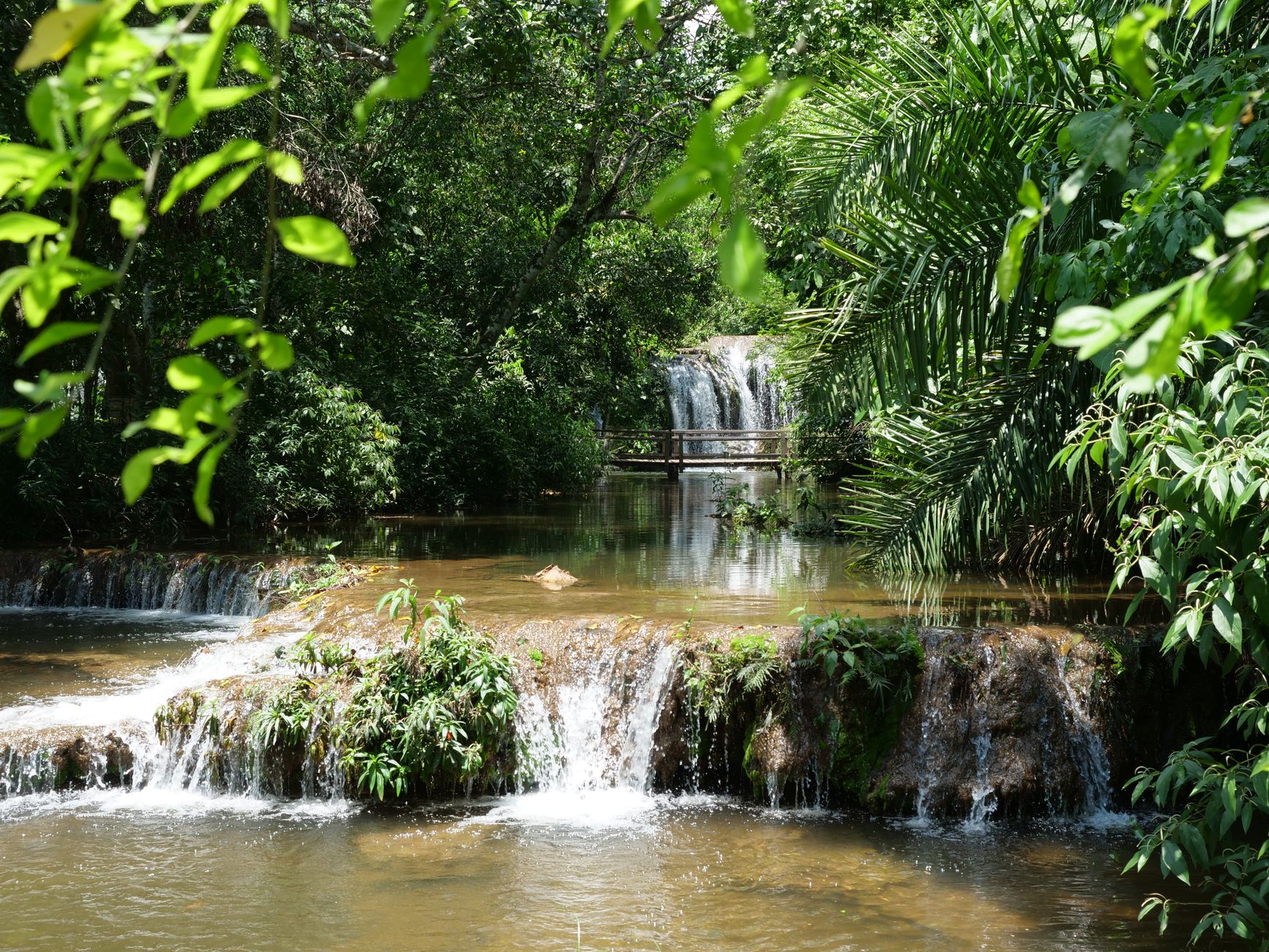
But the most celebrated part is the transparency of the water. When water passes through limestone it takes on calcium carbonate and becomes more alkaline. In that process, the suspended particles and sediment 'calcify', become heavier than water and drop to the bottom of the riverbed, where they settle in a colour close to sand. The result is water with almost no turbidity, clear as glass, letting you see the bottom and the fish with aquarium sharpness. What's more, that precipitated carbonate builds up over time into natural barriers called tufa or travertine, which dam the water and create turquoise pools. Every crystal-clear river in Bonito is, literally, a product of limestone chemistry.

Filtering through the limestone
The most widely repeated geological explanation: the springs of Bonito's rivers rise in areas of very pure limestone in the Serra da Bodoquena. Passing through the rock, the water takes on calcium carbonate, which calcifies the impurities and makes them drop to the bottom. Since that sediment stays on the riverbed (in a colour close to sand), the water stays transparent. The limestone tufa, moreover, forms natural barriers that create turquoise pools.
Source: https://vivabonito.com.br/rios-de-bonito-ms/
turismo.bonito.ms.gov.br · Parque nacional da serra da bodoquenavivabonito.com.br · Rios de bonito msbonitour.com.br · Tudo sobre as aguas cristalinas de bonito msacdmin.com.br · Serra da bodoquena ms

The original peoples: Terena, Kadiwéu and Guarani

Long before the name 'Bonito' or any fazenda existed, the territory of the Serra da Bodoquena and its surroundings was inhabited by Indigenous peoples. Among them were the Terena, the Kadiwéu and the Guarani, who occupied this region of what is now Mato Grosso do Sul, in the heart of South America, near today's border with Paraguay and Bolivia.

These peoples knew the rivers, the springs and the natural paths of the range, and kept a close, sustainable relationship with their surroundings: they used the waters and the forests, knew the routes between the dolines and the river headwaters, and formed deep ties with the land. The Kadiwéu, in particular, are historically known as a people with a strong warrior identity and a distinctive graphic art (their body and ceramic designs are famous), while the Terena have a long farming tradition and a presence in the region that continues to this day.

The arrival of non-Indigenous occupation, from the 19th century on, profoundly changed this territory, as happened across the Brazilian interior. Even so, the mark of these peoples is still present in Mato Grosso do Sul, where several Indigenous communities keep their culture alive, and it's part of the deep history of the land we now know as Bonito.

bonitoepantanal.com.br · Cidade de bonitoporaieporaqui.com.br · Uma breve historia da cidade de bonito

Colonization and the origin of the name: the Fazenda Rincão Bonito

Non-Indigenous occupation of the region began in 1869, when captain Luiz da Costa Leite Falcão settled on these lands and founded the Fazenda Rincão Bonito. From that name came, in time, the name of the future city. The most widely repeated explanation is direct and poetic: the adjective 'bonito' (beautiful) arose from how people saw the natural beauty around the place — the rivers, the forests, the waterfalls — so striking that the word ended up naming first the fazenda and then the whole town.

Over the following decades, the area grew as a rural, cattle-raising region of the interior of Mato Grosso (the state of Mato Grosso do Sul would only split from Mato Grosso in 1977). In 1915, Bonito was constituted as a district, consolidating an administrative centre that marked its regional importance. Finally, on 2 October 1948, after years attached to the municipality of Miranda, Bonito was raised to the status of an independent municipality.

For much of the 20th century, Bonito remained a quiet place, with an economy tied to farming and extraction, far from the main circuits. Few imagined then that those same crystal-clear rivers that had inspired the name 'bonito' would end up turning the town into the ecotourism capital of Brazil.

The name comes from the beauty of the landscape
The most widely accepted version holds that the name 'Bonito' came from the adjective used to describe the natural beauty of the place, first applied to the Fazenda Rincão Bonito (founded in 1869 by captain Luiz da Costa Leite Falcão) and later inherited by the city.
Source: https://bonitoepantanal.com.br/cidade-de-bonito/
bonitoepantanal.com.br · Cidade de bonitoporaieporaqui.com.br · Uma breve historia da cidade de bonitoguiaviagensbrasil.com · Bonito

The birth of ecotourism and the 'Bonito model' of the Voucher Único

The great turn in Bonito's history came at the end of the 20th century. From the 1980s, the transparent rivers, the caves and the waterfalls began to draw visitors, and it became clear that nature could drive a new economy. But tourism also brought risk: if too many people entered a crystal-clear river at once, trampling the bottom and human pressure could cloud the water and degrade precisely what people had come to see.

The answer was a pioneering one. From 1991, local people, government and NGOs worked together to develop a model of sustainable ecotourism, with rigorous control over visitor numbers. And in 1995 the tool that made it possible was born: the Voucher Único, the first system of its kind in Brazil. The idea is as simple as it is effective: each attraction has a daily cap on visitors (the vagas) and a centralized booking system. To do any outing — a float trip, a cave, a waterfall — you have to buy the voucher through an accredited local agency, with an assigned date, time and guide. You can't improvise.

This mechanism, which to a distracted visitor may look like bureaucratic hassle, is in fact the secret of Bonito's conservation. By limiting the flow, the rivers don't get saturated, the environment isn't degraded and the experience stays high quality. Today the voucher is mostly digital and covers more than 40 accredited attractions, almost all on private properties that work as genuine ecological parks. That 'Bonito model' of managing caps is internationally recognized as an exemplary case of well-run nature tourism, and it's why Bonito has been voted the best ecotourism destination in Brazil dozens of times.

The Voucher Único as flow control (since 1995)
The compulsory Voucher Único system, created in 1995, was a first in Brazil. It works as a control on tourist flow: it sets in advance the date, the time and the maximum number of visitors for each attraction, and is issued only by accredited agencies. Its aim is to protect the environment, avoid overcrowding and guarantee an organized, safe experience.
Source: https://bonitoecotour.com/blog/voucher-unico-em-bonito-como-funciona-o-sistema-obrigatorio-para-os-passeios-de-turismo/
bonitoecotour.com · Voucher unico em bonito como funciona o…acquaviagens.com · O que e o voucher unicobonito.ms.gov.br · Esta em funcionamento a nova versao do…cnnbrasil.com.br · Bonito ms como a cidade se transformou na…

Conservation: the Parque Nacional da Serra da Bodoquena and the future

Bonito's tourist success came with a serious conservation effort. The most important institutional piece is the Parque Nacional da Serra da Bodoquena, a federal protected area created by decree on 21 September 2000, covering some 76.400 hectares across the municipalities of Bonito, Bodoquena, Jardim and Porto Murtinho, to protect the range's ecosystems: the remaining forest, the springs of the crystal-clear rivers, the wildlife and the complex system of caves and dolines that karst geology carved over millions of years. The park safeguards precisely the headwaters on which the transparent waters that sustain the whole tourism economy depend.

Conservation in Bonito, though, isn't just a park. It's a system in which official protected areas, private properties managing each attraction to environmental standards, the Voucher Único cap system and a set of good practices all work together, and the visitor notices them on every outing: biodegradable sunscreen required at many attractions, a ban on touching the riverbed or the cave formations, limits on times and numbers, and guides accompanying you throughout.

This balance between tourist use and preservation is fragile and demands constant care: the pressure of growth, changes in rainfall patterns and the health of the springs are ever-present issues. But the case of Bonito shows that a destination can become world famous without destroying what made it famous. For the traveller, understanding this story — the geology that produces the crystal water, the peoples who lived on this land, the name born of beauty, the cap system that protects the rivers — turns every float trip and every cave into something far deeper than a photograph.

turismo.bonito.ms.gov.br · Parque nacional da serra da bodoquenaterra.com.br · Bonito ms se destaca no ecoturismo com rios…terrabrasilnoticias.com · O destino brasileiro de ecoturismo com aguas…

📚 Bibliography

  • Secretaria de Turismo de Bonito-MS — Parque Nacional da Serra da Bodoquena: https://www.turismo.bonito.ms.gov.br/parque-nacional-da-serra-da-bodoquena
  • Viva Bonito — Rios de Bonito MS: por que são tão cristalinos: https://vivabonito.com.br/rios-de-bonito-ms/
  • Bonitour — Tudo sobre as águas cristalinas de Bonito/MS: https://bonitour.com.br/tudo-sobre-as-aguas-cristalinas-de-bonito-ms/
  • Academia da Mineração — Serra da Bodoquena MS (geologia cárstica): https://acdmin.com.br/2025/12/serra-da-bodoquena-ms/
  • Bonito e Pantanal — Origem da cidade de Bonito MS, história e evolução: https://bonitoepantanal.com.br/cidade-de-bonito/
  • Por aí e Por aqui — Uma breve história da cidade de Bonito: https://poraieporaqui.com.br/uma-breve-historia-da-cidade-de-bonito/
  • Guia Viagens Brasil — Bonito MS: https://www.guiaviagensbrasil.com/ms/bonito/
  • Bonito Eco Tour — Voucher Único: como funciona o sistema obrigatório: https://bonitoecotour.com/blog/voucher-unico-em-bonito-como-funciona-o-sistema-obrigatorio-para-os-passeios-de-turismo/
  • Prefeitura Municipal de Bonito-MS — Nova versão do voucher único: https://www.bonito.ms.gov.br/2021/08/11/esta-em-funcionamento-a-nova-versao-do-voucher-unico/
  • CNN Brasil V&G — Como Bonito se transformou na capital brasileira do ecoturismo: https://www.cnnbrasil.com.br/viagemegastronomia/viagem/bonito-ms-como-a-cidade-se-transformou-na-capital-brasileira-do-ecoturismo/
  • Terra Brasil Notícias — Destino de ecoturismo com águas entre as 10 mais cristalinas do mundo (2026): https://terrabrasilnoticias.com/2026/04/o-destino-brasileiro-de-ecoturismo-com-aguas-entre-as-10-mais-cristalinas-do-mundo-ja-foi-eleito-19-vezes-o-melhor-do-pais

❓ Frequently asked questions

Is it true you have to book everything through an agency? How does the Voucher Único work?+
Yes. In Bonito nearly all the attractions are on private property and you get in through the Voucher Único, an official, compulsory document issued only by accredited local agencies. When you buy the outing, the system generates the voucher with your name, the attraction, the date, the time slot, the quota and the assigned guide/transport. You can't turn up at an outing without a booking. The voucher is usually digital these days (you show it on your phone at check-in). The system, created in 1995, exists to control the flow of visitors and protect the environment.
What's the best time to see the water at its clearest?+
The dry season, roughly April/May to September/October, gives the best visibility for floating and diving: with little rain, the rivers run clear. After heavy rain (above all in summer, December to March) some rivers can turn cloudy for a while. The rainy summer, on the other hand, is ideal for the cachoeiras, which come down with more volume. September and October usually combine good weather with still little rain; April and October are good for avoiding crowds.
Do I need to know how to swim to do the floats?+
It isn't essential. The floats (Rio da Prata, Rio Sucuri, Aquário Natural, Nascente Azul) are done in a wetsuit and a life jacket that keep you afloat, and always with a guide alongside the group. The idea is to let yourself drift face down with the current watching the fish, not to swim actively. Even so, it helps to feel comfortable in the water. For diving (the deep Abismo Anhumas, technical Lagoa Misteriosa) you do need certification; there are introductory diving options with an instructor.
Why are there quotas and why do they sell out? How far ahead should I book?+
Each attraction has a maximum number of visitors per day (vagas) so as not to overload the environment and to keep the water crystal-clear. That's why, in high season (the July holidays, the end of the year, long weekends) the most sought-after outings —Rio da Prata, Abismo Anhumas— can sell out weeks or months in advance. Booking well ahead is recommended, ideally up to two months before in high season, to secure the vagas and the time slots you want.
How do I get to Bonito?+
The most used gateway is Campo Grande (CGR airport), some 300 km away on the BR-060: from there you get in by shared transfer (a door-to-door van, ~4 hours, booked in advance), by bus (Cruzeiro do Sul, 4 to 6.5 h with stops) or by car. There are also direct flights to the Aeroporto de Bonito (BYO), but they aren't daily and depend on the season and the airline (Azul, Gol).
Is Bonito an expensive destination? How do I look after my budget?+
Yes, compared with other destinations: many attractions have high fixed prices (the Abismo Anhumas is among the most expensive in the country). To look after your budget, mix the star attractions with cheaper options like the Balneário Municipal, choose the closer floats (Aquário Natural, Rio Sucuri) if time is tight, eat at restaurantes por quilo, and book ahead to find better prices. April and October tend to be cheaper and less crowded. All prices should be checked, since they change with the season.
How many days do I need and what should I bring?+
With 3 to 5 full days you'll cover the essentials, bearing in mind that many outings take half a day or the whole day and you have to coordinate time slots and quotas. Bring biodegradable sunscreen (at several attractions only that kind is allowed), insect repellent, footwear that can get wet, swimwear and a dry change of clothes, a hat, and cash for extras. Book the key outings before you travel.
Sources consulted (34)
Still planning?
Explore more destinations in Brazil
See all destinations →
Advertisements