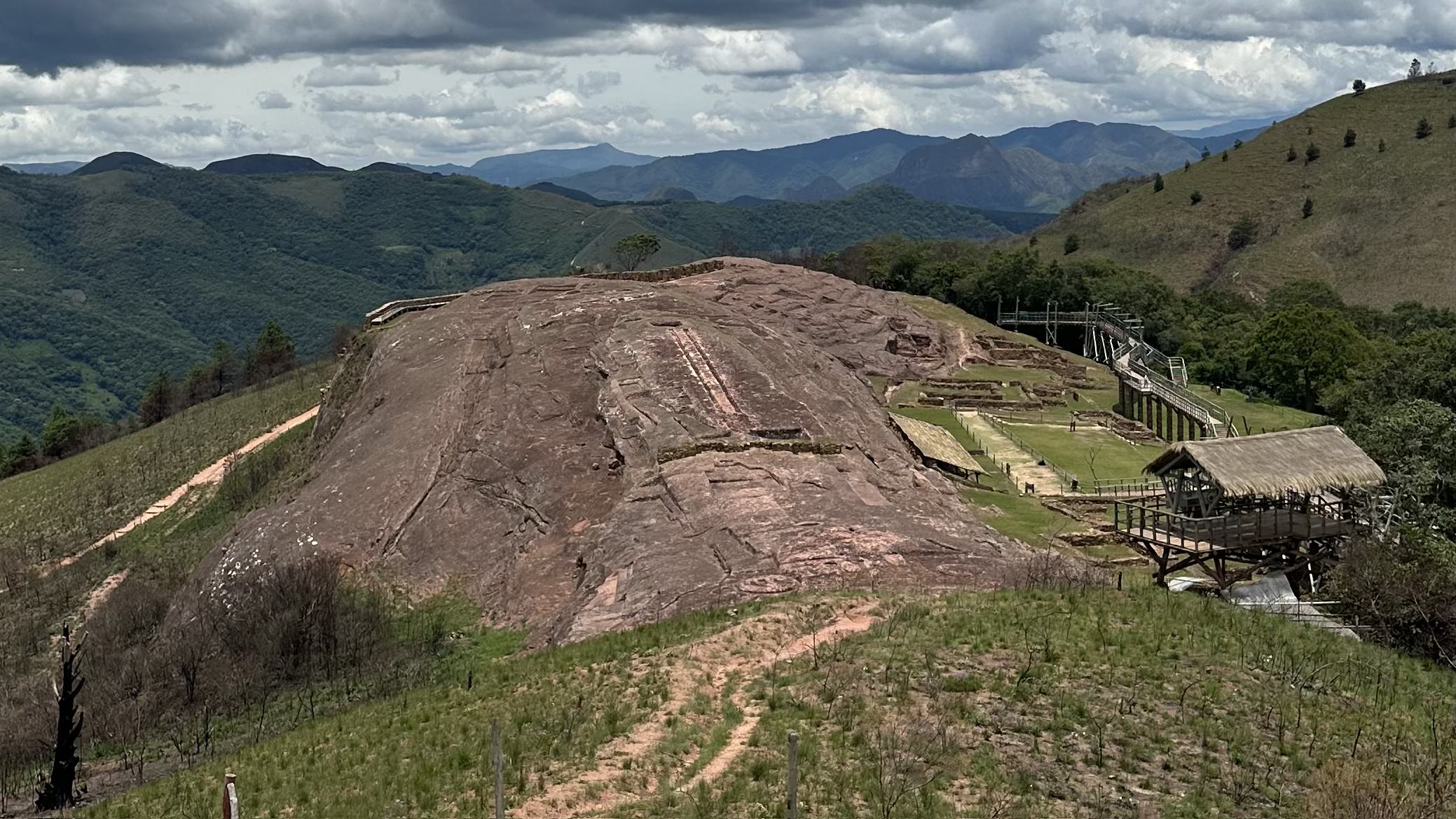
El Fuerte de Samaipata is one of the most singular archaeological sites in the Americas and a UNESCO World Heritage site. Its centerpiece is a colossal sandstone rock about 220 meters long by 60 wide, worked from end to end by human hands, with channels, niches, seats, platforms and carved figures of felines and serpents. It's reckoned the largest carved rock of its kind in the world.
Set on a hill beside the town of Samaipata, in the Santa Cruz valleys where the Andes meet the lowlands, the site was a great ceremonial center used by pre-Inca cultures, later occupied by the Incas as a point on their eastern frontier, and finally christened 'El Fuerte' (the fort) in colonial times. Its enigmatic side —the meaning of the channels and figures— is what makes it fascinating.
This guide gathers the essentials of El Fuerte de Samaipata: what there is to see at the site, how to get there from Santa Cruz or from the town of Samaipata, opening hours, prices, conservation rules and practical advice for visiting this monumental testimony to the pre-Hispanic cultures of eastern Bolivia.
El Fuerte de Samaipata was, in origin, a great ceremonial center carved by pre-Inca cultures of the Andean-Amazonian foothills. In the 15th century the Incas folded it into their eastern frontier, and in colonial times it took the name 'Fuerte' (fort) for its role in controlling the area. In 1998 it was declared a World Heritage site by UNESCO. The full history is on our history page.
Read the full history ↓The great department of the tropical east: Bolivia's economic engine, land of the cambas, home of the celebrated Jesuit Missions of Chiquitos and their baroque music, with the sacred rock of Samaipata, the forests of Amboró and Noel Kempff and the Bolivian Pantanal.
Read the history of Santa Cruz →They depart from Santa Cruz De La Sierra, 80 km away. If you book from this link we earn a commission and you pay no more.
No exact prices: a scale from $ (budget) to $$$$$ (luxury), with 2-3 options per category.
Origins, formation and what the sources say.
Picture a stone as big as two football pitches, on top of a hill, covered from end to end with channels, seats, niches and figures of felines and serpents chiselled by hands that left not a single written document explaining why. That's El Fuerte de Samaipata: the biggest archaeological puzzle in eastern Bolivia and, according to the experts, the largest sculpted rock of its kind in the world. Nobody knows for certain exactly what rituals were held on it, and that uncertainty, far from making it less interesting, is part of what makes it so compelling.
El Fuerte de Samaipata is, above all, that colossal sandstone rock about 220 meters long by 60 wide, worked over its whole surface by human hands: channels, conduits, niches, seats, platforms and an endless run of carved figures, among them representations of felines and serpents. Its sheer presence, high on a hill above the valleys, is overwhelming.
For a long time, because of its name, people believed the site had been a military fortress. Archaeological research, however, has shown that the great rock was above all a sacred and ceremonial space. Its channels, basins and figures are associated with cults linked to water, fertility, the sky and the heavenly bodies. It would have worked as a great open-air altar, a place of worship set on a spot commanding the landscape.
What intrigues visitors most is precisely that enigmatic side: the meaning of the figures, the function of the channels, the orientation of the whole. El Fuerte condenses centuries of occupation by different cultures, each of which left its mark on the stone, which makes it a unique palimpsest of the pre-Hispanic history of eastern Bolivia.
Before the Incas arrived, the Samaipata region —in the transition between the Andes and the Amazon and Chaco lowlands— was inhabited and frequented by pre-Inca peoples of the foothills. Archaeological studies put the start of occupation on the hill at around 300 AD, when Chané communities of the so-called Mojocoyas period (roughly 200-800 AD), of Arawak affiliation, began shaping the great rock as a ritual and residential area. They, then, were the first to carve the stone and turn it into the ceremonial center that over the centuries would become so famous.
Towards the end of the reign of the Inca Túpac Yupanqui (who ruled between 1471 and 1493) —according to the 17th-century Spanish chronicler Diego Felipe de Alcaya— the armies and administrators of the Tahuantinsuyo began pushing into the Samaipata region, in the middle of their expansion eastward. The Incas made the site an important point on their eastern frontier, a zone of contact and tension with the lowland peoples, in particular the Chiriguano (Guaraní). Far from destroying what they found, they folded the Chané sacred rock into their own worldview and raised new administrative, ceremonial and control buildings on and beside the earlier structures, in the style characteristic of the empire's provincial centers.
The name of the place is itself testimony to that presence: 'Samaipata' is of Quechua origin and is usually translated as 'rest in the heights' or 'place of repose'. The great rock, then, was not an Inca creation: the Incas found it already a sacred place with more than a thousand years of tradition and brought it into their world, adding one more layer to the site's history. Archaeologists therefore distinguish at least three superimposed cultures in the structures you visit today: Chané, Inca and, later, Spanish.
With the Spanish conquest and the collapse of the Inca world, the Samaipata region was folded into the colonial order while keeping its frontier character, between the Andean world under Spanish rule and the lowlands inhabited by peoples such as the Chiriguano. In that context the old sacred site took on, in Spanish eyes, a role of control and surveillance, and the name by which it is known today took hold: 'El Fuerte'. The label reflected the reading of the time, which saw a fortress rather than the ceremonial center it had originally been.
The site's exceptional value received international recognition on 2 December 1998, when UNESCO inscribed El Fuerte de Samaipata on the World Heritage list. The body recognized it as a unique testimony to the pre-Hispanic traditions and beliefs of the region, highlighting both the monumental scale of the carved rock and the overlay of the different cultures that occupied it and gave it meaning across the centuries.
The listing brought with it the challenge of conservation. The great sandstone rock is vulnerable to erosion, to the weather and to the wear caused by visitors, so protective measures were put in place, such as the walkways that now let you go round the site without stepping on the carved stone. Looking after El Fuerte for future generations is an essential part of its World Heritage status.
Systematic study of El Fuerte de Samaipata intensified through the 20th century and the start of the 21st, with excavations and research that gradually pinned down the site's different phases of occupation: the pre-Inca roots of the foothills, the significant Inca presence as a provincial center on the eastern frontier and the traces of the colonial stage. This work revealed, alongside the great rock, an extensive set of structures —among them the 'Kallanka', an enormous public hall, plus plazas, dwellings and storehouses— showing that El Fuerte was, as well as a sanctuary, a settlement of some size.
The World Heritage listing in 1998 brought with it the great challenge of conservation. The rock's sandstone is a relatively soft, vulnerable material: erosion by water and wind, lichens, frost and the wear of footsteps all threaten the thousand-year-old reliefs. Hence the perimeter walkways that let you admire the rock without stepping on it, and the monitoring and protection plans applied to the monument, which ranks among the priorities of Bolivian cultural heritage.
Today El Fuerte de Samaipata is one of the great archaeological draws of eastern Bolivia. The visit combines the awe of the carved rock's scale, a spectacular valley landscape and the chance to round out the experience with the nearby town of Samaipata and the biodiverse Amboró National Park. It's a destination that brings together, in one place, archaeological mystery, the deep history of the eastern Andes and exuberant nature.