Viajá con Gus
Home › Australia › Sunshine Coast
Sunshine Coast
🇦🇺 Australia · Queensland

Sunshine Coast

🪪 What do I need to enter Australia?Pick your citizenship and we tell you the visa, the days and the paperwork, with the official source.

By leaving your email and citizenship you agree to receive the documents you asked for and weekly travel news. You can unsubscribe whenever you want. How we handle your data.
Jump to what you need
📌State
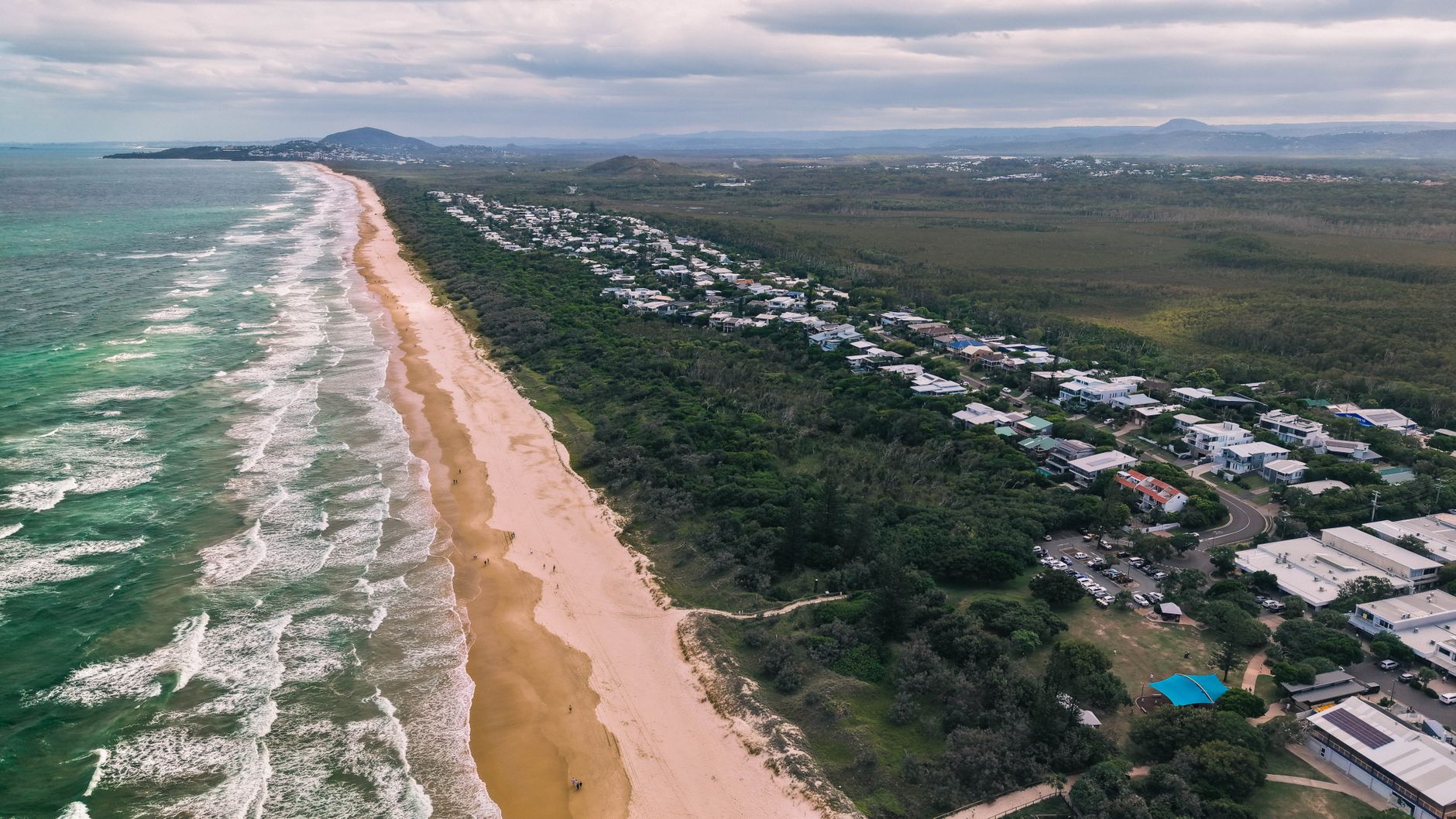
The Sunshine Coast is a coastal region of Queensland stretching about 60 km north of Brisbane, from Caloundra to Noosa, with a mountainous hinterland inland. Its main centres are Maroochydore (the administrative capital), Mooloolaba, Caloundra, Maroochy and the mountain villages of Montville and Maleny. It's famous for its relaxed golden beaches, its family-friendly, high-rise-free feel (unlike the Gold Coast), the Irwin family's Australia Zoo, the volcanic peaks of the Glass House Mountains and a green hinterland of waterfalls, forest and lookouts.
📌Best time to visit
You can enjoy the Sunshine Coast all year round thanks to its sunny subtropical climate. Winter (Jun-Aug) is dry and mild, with bright days (20-22 °C), ideal for walking in the hinterland, and it coincides with humpback whale season (Jun-Nov). Spring (Sep-Nov) brings good weather and less humidity. Summer (Dec-Feb) is hot and humid (28-30 °C), perfect for the beach, but it's peak season with the highest prices and biggest crowds; avoid the end-of-year school holidays and Easter.
📌Suggested days
With 3 days you can cover the highlights: the beach at Mooloolaba and Caloundra, Australia Zoo, SEA LIFE, a day in the hinterland (Montville, Maleny, waterfalls) and the Glass House Mountains. With 5 to 7 days you can add Noosa and its national park, the Noosa Everglades, more beaches and walks, and boat trips (whales, dolphins). It's a large region: it's best to have a coastal base (Mooloolaba or Maroochydore) and spend a couple of days in the hinterland.
📌Getting there
Sunshine Coast Airport (MCY), in Marcoola, has direct flights from Sydney, Melbourne, Adelaide and, seasonally, other cities; it sits in the middle of the region. Brisbane Airport (BNE) is the biggest and has the most cheap flights, ~1 h from Caloundra and ~1,5 h from Maroochydore by car. From Brisbane there are Queensland Rail trains to Nambour/Landsborough/Gympie North plus connecting buses, direct shuttles and hire cars. The region is linked by the Bruce Highway and the Sunshine Motorway.
📌Getting around
The Translink bus network (run by Kinetic/Sunbus and Glasshouse Country Coaches) connects Caloundra, Mooloolaba, Maroochydore, Nambour, Noosa and the airport (route 622). You can pay with a go card, with the go explore pass (unlimited daily travel for A$1,50) or with a contactless card on the coastal urban routes (not in the hinterland). For the hinterland, the Glass House Mountains and exploring freely, a hire car or a tour is the way to go. Apps: Translink and Google Maps.
📌Language and currency
English; Australian dollar (AUD, A$). Cards and contactless are accepted almost everywhere, including on Translink buses along the coast; it's worth carrying some cash for markets and beach stalls.
💱 AUD exchange rate
Loading rate…
🌤️ Weather in Sunshine Coast
Loading weather…

The Sunshine Coast is the most relaxed, family-friendly side of the Queensland sun: 60 kilometres of golden beaches north of Brisbane, without the Gold Coast's skyscrapers, with an unhurried pace, seafront cafés and a green hinterland of volcanic mountains, waterfalls and charming villages. It's the ideal destination if you're after sun, beach and nature without the bustle of the big coastal cities.

On the coast, towns such as Mooloolaba, Maroochydore and Caloundra offer patrolled beaches, seafront promenades, the SEA LIFE aquarium and an ever-improving food scene. Inland, the hinterland surprises with Montville and Maleny, their lookouts over the valley, their waterfalls and gardens, and above all with the Glass House Mountains, a group of rugged volcanic peaks more than 25 million years old, sacred to the Kabi Kabi people. And in Beerwah you'll find the world-famous Australia Zoo, created by Steve Irwin, 'the Crocodile Hunter'. All of this, with Noosa as the jewel at its northern end.

This guide covers the Sunshine Coast with a practical eye: how to get there from Brisbane and the region's airport, what to see without missing the best beaches, Australia Zoo or the hinterland, how much admission and activities cost (in Australian dollars, verified in July 2026) and where to eat and sleep to suit your budget. We also tell its story: that of the Kabi Kabi (Gubbi Gubbi) people, custodians of this land for tens of thousands of years and hosts of the great Bunya Festival, and that of the white settlers who came for timber and sugar cane.

📖 History of Sunshine Coast

The Sunshine Coast is Country of the Kabi Kabi (Gubbi Gubbi) people, who have lived on this coast, its rivers and its mountains for tens of thousands of years (there is evidence going back as far as 30.000 years). They were one of the host peoples of the great Bunya Festival, which brought many nations together in the mountains inland. The Glass House Mountains were named by Captain Cook in 1770; European settlers arrived in the mid-19th century looking for cedar and other timbers, and later grew sugar cane and fruit, founding towns such as Nambour and Maroochydore. In the 20th century the region became the beach-and-nature destination it is today. In 2024, the Federal Court recognised Kabi Kabi native title over much of the Sunshine Coast. Its full story is told on the history page.

Read the full history ↓

🏛️ Sunshine Coast is in Queensland

The state of sunshine and the tropics: land of dozens of Aboriginal nations, born as the Moreton Bay penal settlement in 1824, separated from New South Wales in 1859 and shaped by sugar cane, wool and mining. It is home to the Great Barrier Reef and the Daintree Rainforest, two World Heritage Sites.

Read the history of Queensland →

🗺️ What to see

Tours you can book

If you book from here we earn a commission and you pay no more. Prices and availability come from Civitatis.

1
Australia Zoo (Beerwah)
Steve Irwin's zoo, 'the Crocodile Hunter': crocodiles, Australian animals and live shows.
Leer más ↓
Australia Zoo, in Beerwah, is one of Queensland's most famous attractions and a must for families. Founded and made famous by Steve Irwin, 'the Crocodile Hunter', and now run by his family (Terri, Bindi and Robert Irwin), it's a huge wildlife park devoted to conservation. It's home to hundreds of Australian and exotic animals —kangaroos and koalas you can pat and feed, wombats, dingoes, cassowaries, tigers, elephants and snakes— and its star attraction is the crocodiles. The heart of the zoo is the Crocoseum, a stadium hosting daily live shows with crocodiles, snakes and birds of prey, in the educational, spectacular style that made Steve Irwin famous. The park also has an internationally recognised wildlife hospital. You'll need practically a full day to see it at a relaxed pace. Getting there: it's in Beerwah, near the Glass House Mountains; by car via the Bruce Highway, or by Queensland Rail train to Beerwah plus a transfer. Best time: any day; check the Crocoseum show times when you arrive. Tips: arrive early and bring a hat and sunscreen; there's a free bus from Beerwah train station at certain times.
ℹ️ Admission: adult ~A$71,95, child (2-14) ~A$46,95, family (2+2) ~A$217,95; open 9 am-5 pm (source: australiazoo.com.au, verified July 2026).
2
Glass House Mountains
Rugged 25-million-year-old volcanic peaks, sacred to the Kabi Kabi people, with lookouts and trails.
Leer más ↓
The Glass House Mountains are the postcard image of the Sunshine Coast hinterland: a group of volcanic peaks and domes that rise abruptly from the plain, the hardened remains of volcanoes from more than 25 million years ago. Captain Cook named them in 1770 because their silhouettes reminded him of the glass furnaces of his native Yorkshire. For the Kabi Kabi people they are sacred: their tradition tells that they are a family —the father Tibrogargan, the mother Beerwah (the tallest, pregnant), and their children, including Coonowrin (Crookneck), the one with the crooked neck—, each with its own story. You explore them via trails and lookouts. The Glass House Mountains Lookout offers the classic panoramic view of the group; Wild Horse Mountain Lookout is a short climb with a 360° view; and the Mount Tibrogargan base circuit (~4 km) loops around the peak without climbing it. Climbing Tibrogargan or Ngungun is for fit walkers; Beerwah and Coonowrin have restrictions and hazards. Getting there: by car via Steve Irwin Way; there's also a train station at Glass House Mountains. Best time: clear days, early in the morning or at sunset. Tips: respect closures and the cultural restrictions on some peaks; bring water and hiking shoes.
ℹ️ Glass House Mountains National Park lookouts and trails: free (source: parks.qld.gov.au, verified July 2026).
3
The hinterland: Montville, Maleny and the waterfalls
Mountain villages with views, cheese makers, gardens and waterfalls in the subtropical forest.
Leer más ↓
The Sunshine Coast hinterland is a world of its own, green and cool, less than an hour from the beach. Montville is an alpine-style village perched above the valley, with streets of craft shops, chocolate shops, galleries and cafés with spectacular views. Nearby Maleny is a land of cheese makers, craft breweries and gardens: Maleny Botanic Gardens & Bird World, with its huge aviary you can walk into and be among the birds, and Gardners Falls, a popular spot for a dip. Both villages share lookouts towards the Glass House Mountains, such as the famous Mary Cairncross Scenic Reserve, with subtropical forest and wallabies. The area has several waterfalls to walk to and cool off at, such as Kondalilla Falls (in its own national park, with a swimming hole) and Baxter Falls. It's the perfect complement to the coast: food, nature and mountain air. Getting there: a car is the most practical option (buses don't cover the hinterland well); there are full-day tours from the coast and Noosa. Best time: any clear day; after rain the waterfalls are at their most powerful. Tips: combine Montville, Maleny, a lookout and a waterfall in one loop; bring walking shoes.
ℹ️ Villages, lookouts and waterfalls: free access (no national park fees). Maleny Botanic Gardens & Bird World: ~A$45 adult (source: local operators, verified July 2026).
4
Mooloolaba, SEA LIFE and the coastal walk
Family beach, lively seafront promenade and the SEA LIFE aquarium with its underwater tunnel.
Leer más ↓
Mooloolaba is one of the Sunshine Coast's best-loved beach towns: a wide, patrolled main beach, ideal for families, with a seafront promenade (The Esplanade) full of cafés, restaurants, ice-cream shops and stores facing the sea. The coastal path links Mooloolaba with Alexandra Headland and Maroochydore, with lookouts and stretches of sand; it's perfect for walking or cycling with ocean views. Its star attraction is SEA LIFE Sunshine Coast (formerly UnderWater World), at Mooloolaba harbour: a large aquarium with more than 5.500 marine animals and an underwater tunnel of about 80 metres —one of the longest in the southern hemisphere— that you walk through surrounded by sharks, rays and fish. It's ideal for rainy days or for going with kids. Whale-watching cruises also leave from the harbour in season. Getting there: by car or Translink bus to Mooloolaba; the aquarium is at the Wharf. Best time: beach all year round; whales from June to November. Tips: swim between the flags; book SEA LIFE online to save; the sunset from the breakwater is beautiful.
ℹ️ Beach and coastal walk: free. SEA LIFE Sunshine Coast: adult from ~A$35-45 when booked online (discounted); check opening hours (source: visitsealife.com, verified July 2026).
5
Caloundra and Kings Beach
The southern end of the coast, with varied beaches, an ocean pool and a relaxed vibe.
Leer más ↓
Caloundra, at the southern end of the Sunshine Coast, is a classic family beach town, with a great variety of beaches to suit every taste within a short distance. Kings Beach is the most popular: patrolled all year round, with gentle waves that are good for learning to surf (sheltered by Moreton Island) and a 25-metre saltwater ocean pool with a kids' area. Nearby are Bulcock Beach and Golden Beach, calm and sheltered alongside the channel, ideal for family swimming, and more exposed surf beaches such as Dicky Beach and Moffat Beach. The Caloundra Coastal Walk links several of these beaches, with lookouts over the sea and Bribie Island. It's a relaxed area, with markets, cafés and a less touristy feel than the north of the coast, and a good budget base for exploring the region and the Glass House Mountains. Getting there: by car or Translink bus to Caloundra, ~1 h from Brisbane. Best time: beach all year round; the water is warmer in summer and autumn. Tips: Kings Beach for learning to surf and for kids (ocean pool); always swim between the flags.
ℹ️ Beaches, Kings Beach ocean pool and Coastal Walk: free (source: sunshinecoast.qld.gov.au, verified July 2026).
6
Whale watching and boat trips (Jun-Nov)
Cruises to see humpback whales and dolphins from Mooloolaba and along the coast.
Leer más ↓
Between June and November, the Sunshine Coast becomes one of Australia's best front-row seats for humpback whales: thousands of them pass the coast on their annual migration between Antarctica and the warm waters of the north, and many come close to play and breach near the boats. Whale-watching cruises leave mainly from Mooloolaba harbour and, in season, offer a sighting guarantee (a free trip if no whales appear). The rest of the year there are dolphin-spotting trips, sunset cruises, fishing and coastal outings. Some operators even let you swim with humpback whales in season, a regulated and very special experience. It's an unforgettable way to get to know the region's marine life. Getting there: cruises leave from The Wharf, in Mooloolaba; book ahead in season. Best time: July to October is peak whale season. Tips: bring a warm layer, a hat and something for seasickness; the best sightings are usually mid-morning.
ℹ️ Whale-watching cruise (Jun-Nov): adult from ~A$75-120, with a sighting guarantee in season; swimming with whales from ~A$180-250 (source: Mooloolaba operators, verified July 2026).
📶I have never landed without internet. I arrive and my phone connects to the strongest network in the country I am visiting: I can say I landed, sort out transport, book tours and keep posting, at a seriously good price. I always use the Maya eSIM — check their plans by clicking the banner.See plans →Maya Mobile eSIM — turn travel mode on
What nobody tells you

💵 Prices

Tickets

TypePrice
Australia Zoo — adulto~A$71,95 (source: australiazoo.com.au, verified July 2026)
Australia Zoo — niño (2-14) / familia (2+2)Child ~A$46,95; family ~A$217,95 (verified July 2026)
SEA LIFE Sunshine Coast (Mooloolaba)Adult from ~A$35-45 online (discounted) (verified July 2026)
Glass House Mountains (miradores y senderos)Free (source: parks.qld.gov.au, verified July 2026)
Maleny Botanic Gardens & Bird World~A$45 adult (verified July 2026)
Playas, cascadas y Coastal WalksFree (verified July 2026)
🔄 updated monthlyOfficial / reference values · double-check when buying

Activities and tours

ActivityPriceDurationOperator
Australia Zoo (full-day admission)Adult ~A$71,95, child ~A$46,95, family ~A$217,95 (verified July 2026)Full dayAustralia Zoo (Beerwah)
SEA LIFE Sunshine Coast (aquarium)Adult from ~A$35-45 online (verified July 2026)2 to 3 hoursSEA LIFE Sunshine Coast (Mooloolaba)
Full-day hinterland tour (Montville, Maleny, Glass House)From ~A$120-160 per person (verified July 2026)Full dayVarious Sunshine Coast and Noosa operators
Whale-watching cruise (Jun-Nov)Adult from ~A$75-120 (verified July 2026)~3 hoursSunreef, Whale One (Mooloolaba)
Surf lesson (Mooloolaba / Kings Beach)From ~A$60-80 per person (verified July 2026)~2 hoursLocal surf schools
🔄 updated monthlyOfficial / reference values · double-check when buying

🚌 How to get there and distances

Getting around

ModePriceDurationNotes
Translink buses (Kinetic/Sunbus) + go card / go explore / contactlessgo explore A$1,50/day unlimited; discounted fares on the Translink network
Queensland Rail train (Sunshine Coast/North Coast line)With go card / contactless, Translink fares
Hire car (recommended for the hinterland)Hire from ~A$55-80/day (verified July 2026)
Bike and on footFree / bike hire from ~A$25/day (verified July 2026)
🔄 updated monthlyOfficial / reference values · double-check when buying

How to get there

RouteAirlines / operatorsAvg. priceDuration
Sunshine Coast Airport (MCY) → coast (Mooloolaba/Maroochydore)Shuttle (Con-X-ion), Translink bus route 622, taxi, hire carShuttle ~A$25-40; bus with go explore A$1,50/day (verified July 2026)~20-30 min
Brisbane Airport (BNE) → Sunshine CoastShuttle (Con-X-ion), hire car, train + busShuttle ~A$45-65 per person; car depending on hire (verified July 2026)~1-1,5 h by car
Brisbane (city) → Sunshine CoastQueensland Rail train to Landsborough/Nambour + bus; car; shuttleTrain + bus from ~A$10-25 with go card; car depending on fuel (verified July 2026)~1,5 h by car; ~2,5-3 h by train+bus
Noosa → rest of the Sunshine CoastTranslink bus, carBus with go explore A$1,50/day; car depending on fuel (verified July 2026)~45-60 min to Mooloolaba/Maroochydore
🔄 updated monthlyOfficial / reference values · double-check when buying

🏨 Where to stay

No exact prices: a scale from $ (budget) to $$$$$ (luxury), with 2-3 options per category.

Luxury / resort
Price$$$$$
Recommended options
A$300-800+ per night. Beachfront resorts in Mooloolaba and Maroochydore (The Sebel, Mantra, Novotel Twin Waters), luxury retreats in the hinterland and design homes with views (verified July 2026)
Mid-range
Price$$$$$
Recommended options
A$150-320 per night. Self-catering apartments in Mooloolaba, Maroochydore and Caloundra, renovated motels, family resorts and B&Bs in Montville and Maleny (verified July 2026)
Budget
Price$$$$$
Recommended options
A$40-140 per night. Hostels (Mooloolaba, Maroochydore), holiday parks with cabins and beachfront camping, and simple rooms (verified July 2026)

🍴 Where to eat

Alta cocina y con vista
Price$$$$$
Options / signature dish
A$80-150 per person. Seafront restaurants in Mooloolaba and Maroochydore and mountain cuisine in Montville and Maleny, with local produce, seafood and wines (verified July 2026)
Café, brunch y cocina relajada
Price$$$$$
Options / signature dish
A$20-45 per dish. Specialty cafés, brunch, pizzerias, Asian eateries and bistros along the coastal promenades and in the hinterland villages (verified July 2026)
Económico y de playa
Price$$$$$
Options / signature dish
A$10-25 per meal. Seafront fish & chips, food trucks, bakeries, breweries serving food and market stalls; ideal for eating cheaply with a view (verified July 2026)

📖 History of Sunshine Coast

Origins, formation and what the sources say.

The Country of the Kabi Kabi people

Long before the fashionable beaches and resorts, the Sunshine Coast was —and still is— Country of the Kabi Kabi people, also spelled Gubbi Gubbi, one of the Aboriginal nations of south-east Queensland. Their territory took in this coast, its rivers, its lakes and the mountains of the hinterland, and their presence goes back tens of thousands of years: archaeological evidence suggests Aboriginal occupation of the region from around 30,000 years ago, which makes this landscape one of the oldest continuously inhabited in Australia.

Kabi Kabi life was closely tied to the abundance of the land around them. On the coast and in the estuaries they gathered shellfish and fished; in the forest they hunted and collected fruit, roots and honey; and they moved with the seasons, following the resources. Many place names in the region still carry roots from their language: Maroochydore, for example, comes from a word linked to the red-beaked black swans ('the place of the red beaks'), and Mooloolaba and Caloundra also have Aboriginal origins.

For the Kabi Kabi people, the landscape was not just a pantry but a network of places with spiritual meaning, Dreaming stories and responsibilities of care. The Glass House Mountains in particular hold a central place in their worldview, as we will see: they are not simply hills, but a family of ancestors turned to stone.

en.wikipedia.org · Kabi Kabi peopleheritage.sunshinecoast.qld.gov.au · First nationsbotanic-garden.sunshinecoast.qld.gov.au · Kabi kabi and gubbi gubbi people

The Glass House Mountains and the Bunya Gathering

The Glass House Mountains, the volcanic peaks that dominate the hinterland, are sacred to the Kabi Kabi people. Their tradition tells that they are a family: the father Tibrogargan, the mother Beerwah (the tallest, and pregnant), and their children, among them Coonowrin (Crookneck), the one with the crooked neck. The story tells how Tibrogargan, seeing the waters rise, asked his son Coonowrin to help his mother, and how the father's anger at his son's response left Coonowrin with his neck bent forever. It is a Dreaming story that explains the landscape and passes on values. Captain James Cook, sailing past the coast in 1770, named them 'Glass House' because their outlines reminded him of the glass furnaces of his native Yorkshire.

The region was also the setting for one of the great events of Aboriginal Australia: the Bunya Gathering. The bunya tree (Araucaria bidwillii), plentiful in the inland mountains, produces an extraordinary crop of giant cones packed with edible nuts every few years. When that harvest came, the Kabi Kabi —one of the host peoples— invited nations from far-off regions to a great gathering that brought together hundreds and even thousands of people.

For weeks, around the bunya nuts, people held ceremonies, arranged marriages, settled disputes, traded goods and renewed alliances. The Bunya Gathering was at once a celebration of abundance and a political and social summit linking the peoples of south-east Queensland and beyond. It shows the complexity and richness of Aboriginal life on this land long before Europeans arrived.

barunglandcare.org.au · Bunya dreamingen.wikipedia.org · Glass House Mountainsbotanic-garden.sunshinecoast.qld.gov.au · Kabi kabi and gubbi gubbi people

Cedar, cane and the colonial frontier

Sustained European contact with the Sunshine Coast began in the mid-19th century. The first to arrive were the 'cedar getters' and 'timber getters', drawn by the highly prized Australian red cedar and other fine timbers of the subtropical rainforest. The explorer Andrew Petrie travelled along the coast in 1842, and over the following decades the timber getters pushed up the Maroochy, Mooloolah and Noosa rivers, using the water to float the logs out to sea. In 1856, William Pettigrew's sawmill set up a timber depot at Cotton Tree, at the mouth of the Mooloolah.

Settlers and farming followed the timber. Sugar cane became the region's big crop: towns such as Nambour grew up around the sugar mills, and later came fruit plantations (pineapple, banana) and cattle grazing in the hinterland. The Sunshine Coast of the 19th and early 20th centuries was a rural region of sawmills, cane fields and farms, very different from the beach destination we know today.

As across the whole Australian frontier, the taking of the land came at a devastating cost to the Kabi Kabi people. The clearing of the rainforest, the seizure of land and water sources, diseases brought from Europe and frontier violence decimated the Aboriginal population and broke their access to traditional places of food and ceremony. Many Kabi Kabi were displaced or confined to missions and reserves, though they never lost their connection to Country.

heritage.sunshinecoast.qld.gov.au · Maroochydoreheritage.sunshinecoast.qld.gov.au · Place name originsen.wikipedia.org · Sunshine Coast, Queensland

From farmland to the coast of sunshine

The 20th century turned the Sunshine Coast from a rural region into a holiday destination. As roads improved and cars became common, people from Brisbane began heading down to the coast for their summer holidays: holiday homes, campgrounds and seaside resorts sprang up in Caloundra, Mooloolaba, Maroochydore and Noosa. The name 'Sunshine Coast' caught on in the middle of the century as a tourism brand for the whole coastal strip north of Brisbane, a nod to the sunny climate that is its main draw.

The growth of tourism, the building of better roads (the Bruce Highway, the Sunshine Motorway) and, later, the regional airport established the Sunshine Coast as one of Australia's favourite destinations. Unlike the neighbouring Gold Coast, the region generally kept a lower-key, family-friendly profile, with building height limits in many areas and a strong focus on nature: the national parks of the coast and hinterland, the waterfalls, the Glass House Mountains and, in Noosa, one of the most visited national parks in the country.

A cultural milestone of the 20th and 21st centuries was Australia Zoo, in Beerwah. Founded by the Irwin family and made world-famous by Steve Irwin, 'the Crocodile Hunter', the zoo put the Sunshine Coast on the global map and made the conservation of Australian wildlife an emblem of the region. After Steve's tragic death in 2006, his family carried on his legacy, and the zoo remains one of the country's great attractions.

en.wikipedia.org · Sunshine Coast, Queenslandvisitsunshinecoast.comen.wikipedia.org · Australia Zoo

Kabi Kabi recognition and the coast today

While the Sunshine Coast was growing into a holiday destination, its original people were travelling the long road towards legal recognition of their rights to the land. After the landmark 1992 'Mabo' decision of the High Court of Australia —which recognised native title for the first time and dismantled the legal fiction of 'terra nullius'—, the Kabi Kabi people pursued their claim over a large part of south-east Queensland.

That effort bore historic fruit in June 2024, when the Federal Court of Australia, under Justice Berna Collier, formally recognised Kabi Kabi native title over some 365,000 hectares of land and waters on the Sunshine Coast, including Caloundra, Maroochydore, Noosa, Gympie, Bribie Island and Mudjimba Island. It was the recognition of a long-denied truth: that the Kabi Kabi never stopped being the traditional owners of this coast and these mountains.

Today the Sunshine Coast lives with that dual identity. On one hand, it is one of Australia's best-loved beach and nature destinations: sun, sand, a green hinterland, the Glass House Mountains, Australia Zoo and a relaxed, family-friendly lifestyle. On the other, it is Kabi Kabi Country, increasingly visible through native title recognition, cultural tours led by descendants, the use of traditional place names and the shared care of the land. Exploring the Sunshine Coast means moving through those layers: the sacred Glass House Mountains and the ancient Bunya Gathering, the sawmills and cane fields of the colonial past, and today's coast of sunshine, all under the same bright sky that gave it its name.

woollydays.wordpress.com · Kabi kabi win sunshine coast native titleen.wikipedia.org · Kabi Kabi peopleheritage.sunshinecoast.qld.gov.au · First nations

📚 Bibliography

  • Wikipedia (EN) — «Sunshine Coast, Queensland»: https://en.wikipedia.org/wiki/Sunshine_Coast,_Queensland
  • Wikipedia (EN) — «Kabi Kabi people»: https://en.wikipedia.org/wiki/Kabi_Kabi_people
  • Wikipedia (EN) — «Glass House Mountains»: https://en.wikipedia.org/wiki/Glass_House_Mountains
  • Sunshine Coast Heritage — First Nations: https://heritage.sunshinecoast.qld.gov.au/first-nations
  • Sunshine Coast Botanic Garden — Kabi Kabi & Gubbi Gubbi people: https://botanic-garden.sunshinecoast.qld.gov.au/about-us/kabi-kabi-and-gubbi-gubbi-people
  • Barung Landcare — Bunya Dreaming: https://barunglandcare.org.au/bunya-dreaming/
  • Sunshine Coast Heritage — Place name origins: https://heritage.sunshinecoast.qld.gov.au/museums-and-places/place-name-origins
  • Sunshine Coast Heritage — Maroochydore town history: https://heritage.sunshinecoast.qld.gov.au/museums-and-places/town-histories/maroochydore
  • Woolly Days — «Kabi Kabi win Sunshine Coast native title» (Jul 2024): https://woollydays.wordpress.com/2024/07/14/kabi-kabi-win-sunshine-coast-native-title/
  • Wikipedia (EN) — «Australia Zoo»: https://en.wikipedia.org/wiki/Australia_Zoo

❓ Frequently asked questions

How many days should I spend on the Sunshine Coast?+
With 3 days you can combine the beach at Mooloolaba and Caloundra, Australia Zoo, SEA LIFE, a day in the hinterland (Montville, Maleny, waterfalls) and the Glass House Mountains. With 5 to 7 days you can add Noosa and its national park, the Noosa Everglades, more walks and boat trips (whales, dolphins). It's best to have a coastal base (Mooloolaba or Maroochydore) plus a couple of days in the mountains.
How do I get to the Sunshine Coast?+
Sunshine Coast Airport (MCY), in the middle of the region, has direct flights from Sydney, Melbourne and Adelaide. Brisbane Airport (BNE) is the biggest and has the most cheap flights, ~1-1,5 h away by car. From Brisbane there are also Queensland Rail trains (to Landsborough, Beerwah, Nambour, Gympie North) with connecting buses, direct shuttles and hire cars. The region is linked by the Bruce Highway and the Sunshine Motorway.
How much does Australia Zoo cost and how do I get there?+
Admission to Australia Zoo, in Beerwah, costs ~A$71,95 per adult, ~A$46,95 per child (2-14) and ~A$217,95 per family (2 adults + 2 children); it's open 9 am to 5 pm (source: australiazoo.com.au, verified July 2026). You can get there by car via the Bruce Highway/Steve Irwin Way or by Queensland Rail train to Beerwah plus a transfer. You'll need practically a full day to see it and catch the Crocoseum shows.
When is the best time to visit the Sunshine Coast?+
You can enjoy it all year round thanks to its sunny subtropical climate. Winter (Jun-Aug) is dry and mild, perfect for the hinterland, and coincides with whale season (Jun-Nov). Spring brings good weather and less humidity. Summer (Dec-Feb) is hot and humid, ideal for the beach, but it's peak season with the highest prices and biggest crowds (avoid the holidays and Easter).
What's the difference between the Sunshine Coast and the Gold Coast?+
Both are sunny Queensland coastlines, but the Sunshine Coast (north of Brisbane) is more relaxed, family-friendly and low-rise, without the skyscrapers or intense nightlife of the Gold Coast (to the south). The Sunshine Coast stands out for its quiet beaches, its green hinterland (Montville, Maleny, Glass House Mountains), Australia Zoo and Noosa. The Gold Coast is more urban, with theme parks and Surfers Paradise. Many people choose the Sunshine Coast for its unhurried pace.
Can I get around the Sunshine Coast easily without a car?+
On the coast, yes: Translink buses (Kinetic/Sunbus) connect Caloundra, Mooloolaba, Maroochydore, Nambour and Noosa, and you can pay with a go card, go explore (A$1,50/day unlimited) or contactless; Queensland Rail trains reach Beerwah (Australia Zoo) and Nambour. But for the hinterland (Montville, Maleny, waterfalls) and the Glass House Mountains, where public transport is scarce, a hire car or a tour is the way to go.

More places in Australia

UluruValle de BarossaWave RockWilsons PromontoryYarra ValleyAdelaida
See every place in Australia →The history of Australia →
Sources consulted (8)
Still planning?
Explore more destinations in Australia
See all destinations →