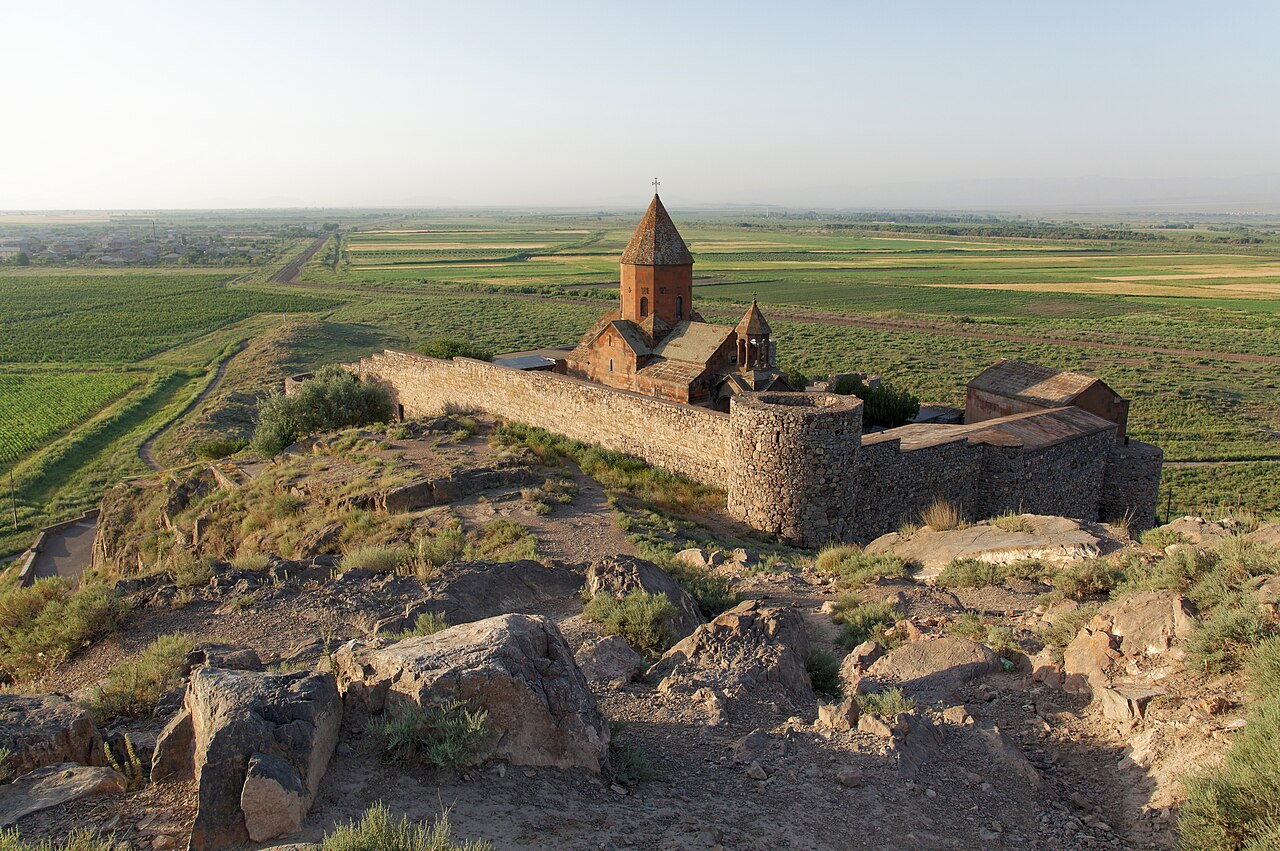
Few images sum up Armenia as well as Khor Virap Monastery with Mount Ararat behind it. On a solitary hill in the middle of the plain, the walls and dome of the monastery stand out against the snowy bulk of the biblical mountain, the mountain of Noah's Ark, the eternal symbol of the Armenian nation. And yet the mountain lies on the other side of a closed border: Khor Virap is only 100 metres from the boundary with Turkey, and Ararat, so close it feels as if you could touch it, is today out of reach for Armenians.
But Khor Virap is not just a viewpoint. Its name means 'deep pit', and refers to the most sacred place in its history: here, according to tradition, the pagan king Tiridates III had Gregory the Illuminator locked in a pit full of snakes, where the future saint survived thirteen years until he was freed, cured the king of madness and converted him, sealing Armenia's conversion to Christianity in the year 301. You can go down into that pit by a narrow ladder, a descent that for pilgrims is deeply moving.
This guide helps you visit Khor Virap in a practical way: how to get there from Yerevan, when Ararat is most visible, how to go down into Saint Gregory's pit, what to look at in the monastery and its walled enclosure, and how to combine it with other places in the south such as Noravank and Areni. It is an essential half-day trip that brings together the country's most symbolic landscape and the founding episode of its faith.
Khor Virap ('deep pit') stands on a hill on the Ararat plain, on the site where Artashat, one of the capitals of the Kingdom of Armenia, stood in antiquity. Its fame comes from Christian tradition: here, according to the story, the pagan king Tiridates III had Gregory the Illuminator thrown into a deep pit full of vermin for refusing to renounce his faith, and there Gregory survived thirteen years thanks to a widow who secretly threw bread down to him. When the king went mad, only Gregory could cure him; the monarch converted and, around the year 301, proclaimed Christianity the official religion of Armenia, the first nation in the world to do so. Over time a chapel was built over the pit, and next to it the monastery, with the church of Surp Astvatsatsin inside a walled enclosure. 100 metres from the Turkish border, Khor Virap also offers the closest view of Mount Ararat, today in Turkish territory. The story of the pit and the country's conversion is told on our history page.
Read the full history ↓The historical and spiritual heart of Armenia: the pink capital born from the Urartian fortress of Erebuni, the mother cathedral of Etchmiadzin, the pagan temple of Garni, the rock-cut monastery of Geghard and Khor Virap, where the conversion of the world's first Christian country began.
Read the history of Yerevan and its surroundings →They depart from Erevan, 34 km away. If you book from this link we earn a commission and you pay no more.
No exact prices: a scale from $ (budget) to $$$$$ (luxury), with 2-3 options per category.
Origins, formation and what the sources say.
Before the monastery existed, even before the saint's pit, the hill of Jor Virap and its surroundings were the setting for one of the great capitals of ancient Armenia. Here, on the fertile Ararat plain watered by the Araks River, stood Artashat, founded around 176 BC by King Artashes I, who started a new dynasty and a golden age for the kingdom of Armenia.
A tradition handed down by ancient historians adds an unexpected figure to the city's founding: Hannibal, the famous Carthaginian general and Rome's sworn enemy. Defeated and on the run, Hannibal is said to have taken refuge at the Armenian king's court, and it was supposedly he who advised on the site and layout of the new city, spread over several hills beside the river. Its size, wealth and commercial importance earned Artashat the nickname 'Armenian Carthage', and for centuries it was the kingdom's political capital, a cosmopolitan hub at the crossroads between Rome and Persia.
The city knew both glory and tragedy. In AD 58, during the wars between Romans and Parthians for control of Armenia, the legions of the Roman general Corbulo took it and burned it. Rebuilt, it remained important until, over the centuries, it declined in favour of other capitals. Today, beneath the monastery hill and in the surrounding fields, archaeologists are still uncovering the remains of that ancient city, where, much later, the founding chapter of Christian Armenia would be written.
The name Jor Virap means 'deep pit', and that pit is the heart of the site's story. At the end of the 3rd century, Armenia was a pagan kingdom ruled by Tiridates III (Trdat), of the Arsacid dynasty. To his court came Gregory, a young nobleman of Parthian origin who had been raised as a Christian in Cappadocia. When the king found out that Gregory was not only a Christian but also the son of the man who had murdered his own father, he had him horribly tortured and finally ordered him thrown into a deep pit in the dungeon of Artashat, a hole full of snakes, scorpions and vermin where the condemned went to die.
According to tradition, Gregory did not die. He survived in that pit for thirteen long years, secretly fed by a devout widow from the city who, guided by a dream, threw a loaf of bread down to him every day. Meanwhile, King Tiridates ordered the martyrdom of a group of Christian virgins who had fled Rome, among them Hripsime and Gayane, and shortly afterwards, the story goes, he was struck by a terrible illness that drove him mad and reduced him, in the language of legend, to the state of a beast.
The king's sister then had the same dream again and again: only Gregory, the forgotten prisoner in the pit, could heal the monarch. Against all hope, they pulled him out, alive after thirteen years underground. Gregory cured the king, and that meeting between the repentant persecutor and the surviving martyr would change Armenia's destiny forever.
Cured by Gregory, King Tiridates III converted to Christianity, and the whole royal household with him. Around the year 301 (some sources place it in 314), the monarch proclaimed Christianity the official religion of the kingdom of Armenia. It was a hugely significant act: Armenia thus became the first state in the world to officially adopt the Christian faith, more than a decade before Emperor Constantine legalised it in the Roman Empire with the Edict of Milan in 313, and many decades before it became the imperial religion.
Gregory, the man from the pit, was consecrated as the first Catholicos, head of the new Armenian Church, and for his role he went down in history as Gregory the Illuminator, the one who brought the light of faith to Armenia. He launched an intense campaign of Christianisation: pagan temples and idols were destroyed, churches were built, and the foundations were laid for a national Church that, over time, would become inseparable from Armenian identity.
The decision of 301 has consequences that reach all the way to today. For a small nation, surrounded by powerful empires and often without a state of its own, Christianity became the glue of its identity, the thing that set it apart from its Persian, Arab or Turkish neighbours and held it together through diasporas and catastrophes. For seventeen centuries, being Armenian and being Christian came to mean almost the same thing. And it all began, according to tradition, at the bottom of a pit on the Ararat plain.
Over the pit where Gregory had been held prisoner, a place of worship eventually rose. The first chapel dates from the 7th century and is attributed to Catholicos Nerses III the Builder, the same man behind the dazzling Zvartnots. Over the centuries, the sanctuary was enlarged and rebuilt until it became the monastery we know today, with its walled enclosure, its chapel over the pit and the main church of Surp Astvatsatsin (Holy Mother of God), built in its current form in the 17th century, around 1662.
Its location, so loaded with symbolism, was also exposed and dangerous. Jor Virap stands on the open plain, in a border area that throughout history was fought over by Persians, Ottomans, Russians and others, and the monastery, with the look of a small fortress, bore the brunt of those wars. In the 20th century, after the 1915 genocide and the drawing of the Soviet-Turkish border, the dividing line ended up barely 100 metres from the monastery: on the other side, in Turkey, lay Mount Ararat, the sacred mountain of the Armenians, visible but out of reach.
That closeness gives Jor Virap a symbolic intensity like nowhere else. Here the pit where Christian Armenia was born meets the nearest view of the lost Ararat; the founding chapter of the faith meets the open wound of the border and of exile. Few places pack so much of Armenian history and feeling into a single hill.
Mount Ararat, with its two snow-capped peaks rising above the plain, is the ultimate symbol of Armenia. According to Genesis, Noah's Ark came to rest on it after the Flood, and for Armenians it is the mother mountain, the centre of their emotional geography. It appears on the national coat of arms, on the labels of the famous Ararat brandy, in countless works of art and in the heart of every Armenian. And yet, since the 1915 genocide and the closure of the border with Turkey, Ararat has been on the other side of the line, in Turkish territory: Armenians see it every day and cannot set foot on it.
Jor Virap, just 100 metres from that border, therefore became the great national viewpoint, the place where you can see the lost mountain from closest up. The image of the monastery on its hill with Ararat in the background is perhaps the most reproduced photograph of Armenia, and it sums up in a single view the mix of faith, beauty and melancholy that defines the country. Turks and Armenians sometimes argue, even with bitter humour, about who the mountain 'belongs' to; Armenians reply that its presence on the coat of arms is not a territorial claim but the recognition of a symbol of the soul.
Today, Jor Virap is both a living sanctuary and one of the country's best-loved day trips. Pilgrims climb down into the pit of Saint Gregory, hold baptisms and weddings, light candles and release white doves towards Ararat; travellers climb the hill in search of the perfect photo at sunrise, when the mountain shows itself clearly before the haze sets in. Within a few kilometres you find ancient Artashat, the saint's pit, the medieval monastery and the eternal symbol of the mountain: Jor Virap is, in the fullest sense, the place where the heart of Armenian history beats.