Viajá con Gus
HomeArgentinaGoya (National Surubí Festival)
Goya (National Surubí Festival)
🇦🇷 Argentina · The Northeast

Goya (National Surubí Festival)

Jump to what you need
📌Province/State
Corrientes, Argentina. Goya is the second most important city in the province, in the southwest, on the Paraná River (through the Goya creek). It's a major farming, commercial and port center, historically tied to tobacco. It is known across the country for its National Surubí Festival, one of the most prestigious river fishing contests in Argentina.
📌Best time to go
Autumn and spring (March to May and September to November) bring the most pleasant weather. Summer is very hot and humid. The big date is the National Surubí Festival (a boat fishing contest with catch and release), usually held in late April or early May, which draws anglers from all over the country and huge crowds; it's the event that puts Goya on the tourist map.
📌Suggested days
The city and the riverside take 1 to 2 days. For fishing and river life, add a few more. During the National Surubí Festival the whole city turns to the event and it's worth booking a room far in advance. Many people stop here on the Paraná route or use it as a base for sport fishing.
📌Currency
Argentine peso (ARS). Bring cash for fishing services, boat trips and the riverside.
💱 ARS exchange rate
Loading rate…
🌤️ Weather in Goya (National Surubí Festival)
Loading weather…

Goya is the second city of Corrientes and one of the great river fishing capitals of Argentina. Set on the Paraná River, in the southwest of the province, it has a strong riverside, farming and commercial tradition, historically tied to tobacco growing. But its name rings across the country for one very specific reason: the National Surubí Festival, the big boat fishing contest that turns Goya, once a year, into a mecca for anglers.

The surubí, that huge river fish with tasty flesh and a fierce fight, is the star of an event that gathers hundreds of boats and thousands of people on the banks of the Paraná, a catch-and-release competition that mixes sport, tradition, food and street party. Beyond the contest, Goya is a destination for sport fishing lovers for much of the year, and for anyone who wants to see river life in the Corrientes Northeast.

This guide walks through the essentials of Goya, practical and warm: what to see in the city and along its waterfront, what the National Surubí Festival is like, how to organize a fishing trip, when to go, where to eat and sleep, and how to combine it with other Paraná destinations. Goya is the city of the surubí, an invitation to live the river, the fishing and the culture of Corrientes.

📖 History of Goya (National Surubí Festival)

Goya was founded in the 18th century in the southwest of Corrientes, on the Paraná River. Tradition says its name comes from 'Goya', the nickname of a woman (Gregoria Morales) who kept a country store at the spot and whose place travelers referred to when they said 'let's go to Goya's'. The town grew as a port and trading center on the river, and became an important farming hub, famous for growing Corrientes tobacco. In time, fishing for surubí and other Paraná species gave rise to the National Surubí Festival, today one of the country's great sport fishing events. The full story is on our history page.

Read the full history ↓

🏛️ Goya (National Surubí Festival) is in Corrientes

Founded in 1588 as San Juan de Vera de las Siete Corrientes, it is the most Guaraní and most federalist province in Argentina: cradle of chamamé, declared Intangible Cultural Heritage of Humanity, setting of the outbreak of the War of the Triple Alliance and home of the Esteros del Iberá, where the jaguar roars again after seventy years.

Read the history of Corrientes →

🗺️ What to see

1
National Surubí Festival
The big catch-and-release boat fishing contest on the Paraná, drawing anglers from all over the country.
The National Surubí Festival is the event that made Goya famous nationwide and one of the most important river fishing contests in Argentina. Every year, hundreds of boats carrying teams of anglers from all over the country head out onto the Paraná River after the surubí, the great river fish of the region. It is a boat fishing competition run on catch and release (the fish is weighed and returned alive to the river), which pairs the sport with a conservation-minded approach. Beyond the competition on the water, the festival is a huge popular event: for several days Goya throws itself into it with live music, peñas, food, a produce fair, the crowning of the queen and a party atmosphere that pulls in thousands of visitors. Sport, riverside tradition, Northeast music and celebration together make these the most awaited days on the Goya calendar. The 49th edition ran from 27 April to 3 May 2026 (source: El Litoral and COMUPE, verified July 2026); team registration was paid in two installments of AR$ 70,000 (August 2025) and AR$ 75,000 (September 2025), and the 5-day combo ticket to the grounds cost AR$ 30,000. The next edition (the 50th) is expected in late April/early May 2027; team registration usually opens in August through COMUPE (the Municipal Fishing Commission), based on the floating dock moored near Plaza Italia. Book your accommodation a very long way ahead, because the city fills up.
ℹ️ Distance: Goya's riverside and waterfront, on the Paraná River · Best time to go: Late April or early May (49th edition: 27 Apr–3 May 2026, already held; next edition 2027 to be confirmed) · Admission: 5-day combo ticket to the grounds AR$ 30,000; contest registration per team AR$ 70,000 + AR$ 75,000 in two installments (source: El Litoral and COMUPE, 2026 edition, verified July 2026) · Duration: Several days (the whole festival)
2
The waterfront and river life
Goya's riverside promenade on the Paraná, for the river, the sunsets and the fishing.
Goya's waterfront, on the Paraná River (through the Goya creek), is one of the city's great walks and the stage for its bond with the river. It's a pleasant place to stroll, ride a bike, drink mate or tereré, watch the boats go by and enjoy the sunsets over the water that are so typical of the Northeast. Riverside life beats hard in this fishing town. Fishing trips and boat rides along the river and its surroundings leave from the port area and the waterfront. The Paraná, with its volume and its biodiversity, offers highly prized sport fishing (surubí, dorado, pacú, boga, among other species) that draws enthusiasts for much of the year. It's also a good spot for birdwatching and riverside wildlife. Getting there: the waterfront is in the city itself, a short distance from the center. Best time to go: autumn and spring for the weather; sunsets all year round. Tips: perfect for a walk at the end of the day; if you want to fish, hire licensed guides or operators, check the season and the fishing rules (catch and release in many cases), and bring sunscreen and insect repellent.
ℹ️ Distance: Goya's waterfront, in the city itself, on the Paraná · Best time to go: Autumn and spring; sunsets all year round · Admission: Free access; boat trips from roughly AR$ 12,000 per person (range based on local boat operators, verified July 2026) · Duration: 1 to 3 hours
3
The city center and its heritage
Goya's old town, with its square, its church and the feel of a Corrientes city on the Paraná.
Downtown Goya keeps the air of a Corrientes city on the Paraná, with its main square, its church, its buildings and its shops. As the second city of Corrientes and the hub of a rich farming area, Goya has a life of its own and an identity tied to the river, to the countryside (with its tobacco tradition) and to Northeast culture. Walking the center is the way into its heritage and its everyday life. This is chamamé country, land of mate and tereré, chipá and river fish, and it keeps the Corrientes traditions that come out in its festivals, its music and its food. The hospitality and the easy pace of the interior mix with the bustle of a sizeable city. Wandering, chatting with people and trying the local cooking are part of the charm. Getting there: the center is walkable. Best time to go: any time; the weather is nicer in autumn and spring. Tips: ask at the tourist office about a heritage route, try the river fish and the chipá, and if traditions interest you, ask about chamamé peñas and cultural events.
ℹ️ Distance: Downtown Goya; walkable · Best time to go: Autumn and spring for the weather · Admission: Free (walking the city) · Duration: Half a day
4
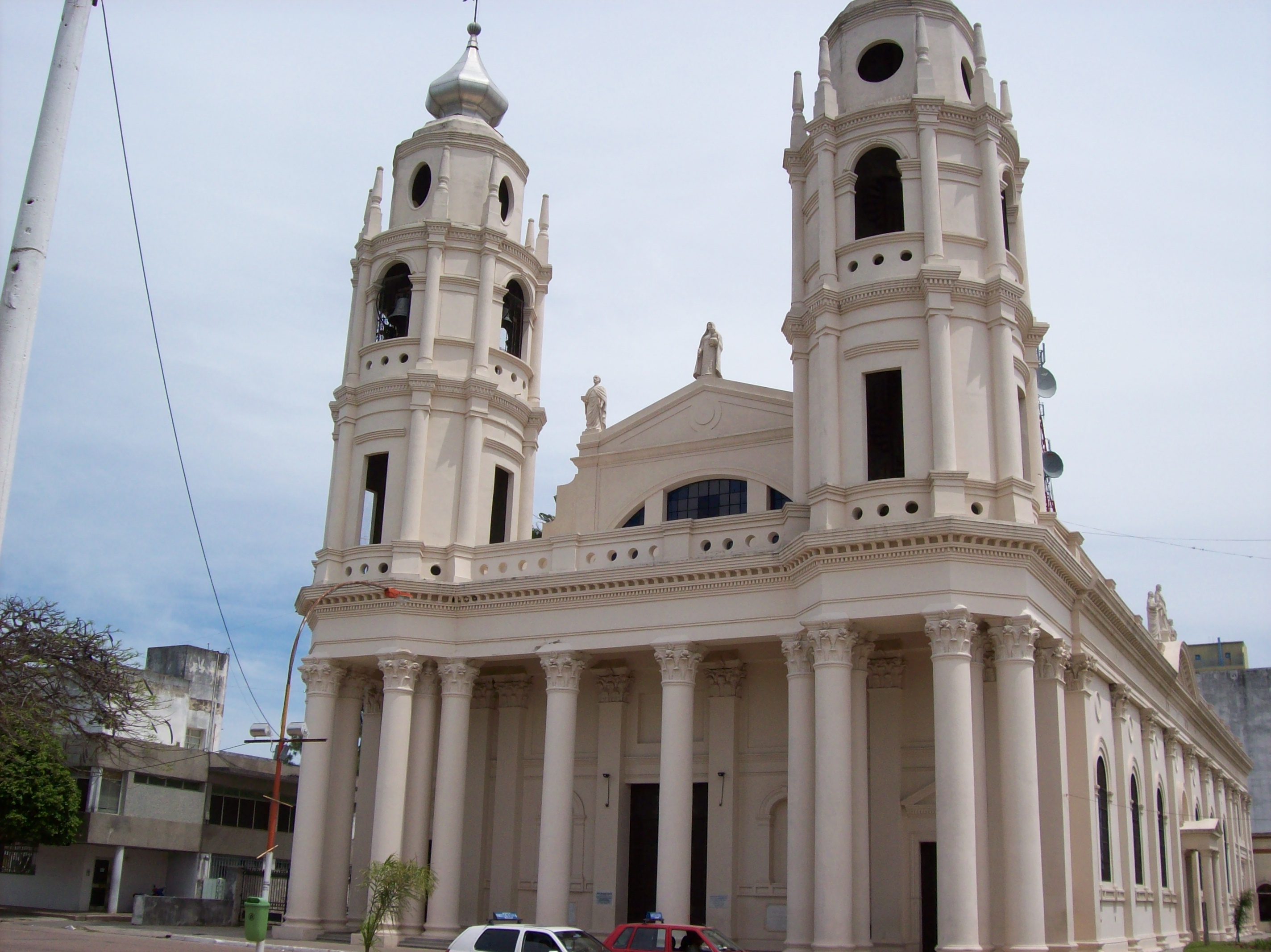
Nuestra Señora del Rosario Cathedral
Goya's main church, facing the central square, a symbol of the city.
Nuestra Señora del Rosario Cathedral is Goya's main church and one of the architectural landmarks of the center, facing the main square. Its style blends neoclassical and eclectic elements, and its towers cut against the Northeast sky make it both a reference point and a place of devotion for the people of Goya; it is the seat of the Goya diocese. A visit takes in the interior, the altar and the quiet atmosphere, and it's a good starting point for a walk through the historic center. The religious life of the city, with its patron saint festivities and processions, is part of Goya's identity, where popular faith and Northeast traditions are woven together.
ℹ️ Distance: Facing Goya's central square · Best time to go: All year round; patron saint festivities in October · Admission: Free (open access; respect service times) · Duration: 30 minutes to 1 hour
5
Sport fishing for surubí and dorado
Boat fishing trips on the Paraná for much of the year.
Beyond the festival, Goya is one of the great sport fishing destinations on the Paraná. Licensed guides and operators run boat trips after surubí, dorado (the 'river tiger'), pacú, boga and patí, on half-day or full-day outings. Fishing is increasingly done catch and release, to protect the stock. Trips include the boat, a guide, tackle and, depending on the package, food on board. Hire operators with insurance and a license, get the provincial fishing permit (compulsory) and respect the closed seasons and the rules. Dorado has a spawning closure (usually November to January, check each year), so it's worth asking which dates are open.
ℹ️ Distance: Trips leave from Goya's port and waterfront, on the Paraná · Best time to go: Autumn and spring; check the closed seasons (dorado has a summer spawning closure) · Admission: Guided boat trip AR$ 60,000–150,000 a day depending on the boat and the services (range based on local operators, verified July 2026); plus the fishing permit · Duration: Half a day to a full day
6
Isla Las Damas Nature Reserve
The island reserve opposite Goya's waterfront, with howler monkeys, capybaras, caimans and more than 100 bird species.
Just 250 meters off the Goya shore, separated by an arm of the Paraná, Isla Las Damas Nature Reserve is the city's big nature outing and one of the easiest ways to get into the island landscape of the middle Paraná. You get there on a short boat ride and, once on the island, you follow guided interpretive trails through gallery forest and wetlands, with lookouts over the city and inner lagoons such as Laguna de las Mujeres. The wildlife is the main draw: howler monkeys, capybaras, caimans, boas and more than a hundred recorded bird species make the island a paradise for wildlife watching and photography, minutes from downtown. It's ideal for families and nature lovers, and the perfect complement to the fishing and the waterfront. Getting there: by boat from the El Ingá beach area; departures are usually in the morning (8:30) and in the afternoon (from 16:00). Best time to go: autumn and spring; mornings for birdwatching. Tips: book ahead with the Goya Tourism Office, especially in high season; bring insect repellent, water, a hat and comfortable shoes.
ℹ️ Distance: 250 m off the Goya shore; short boat crossing from El Ingá beach · Hours: Usual departures at 8:30 and from 16:00 (book with the Goya Tourism Office) · Admission: Guided visit with the boat crossing roughly AR$ 15,000–40,000 per person (range based on local boat operators and the Tourism Office, verified July 2026) · Duration: Half a day
Advertisements
What nobody tells you

💵 Prices

Tickets

TypePrice
National Surubí Festival — contest registration (per team)AR$ 70,000 + AR$ 75,000 in two installments (source: El Litoral and COMUPE, 49th edition held in April-May 2026, verified July 2026)
National Surubí Festival — combo ticket to the grounds (5 days)AR$ 30,000 (source: COMUPE, 2026 edition, verified July 2026)
Provincial sport fishing permit (Corrientes)Variable price, pegged to the price of premium gasoline and updated every 90 days; issued online at licenciasrecursosnaturales.gob.ar (source: Government of Corrientes, verified July 2026)
Walking the city, the waterfront and the cathedralFree (open access)
🔄 updated monthlyOfficial / reference values · double-check when buying

Activities and tours

ActivityPriceDurationOperator
Take part in or attend the National Surubí Festival (next edition 2027)Registration per team from AR$ 70,000 in two installments; combo ticket to the grounds AR$ 30,000 for the 5 days (source: COMUPE, 2026 edition, verified July 2026; reference figures for the next edition)Several daysCOMUPE — Goya Municipal Fishing Commission
Boat sport fishing on the Paraná (surubí, dorado and others)AR$ 60,000–150,000 a day depending on the boat and the services (range based on local fishing operators, verified July 2026) + fishing permitHalf a day to a full dayLicensed fishing guides and operators in Goya
Boat trip along the river and the islandsRoughly AR$ 12,000–40,000 per person (range based on local boat operators, verified July 2026)1 to 3 hLocal boat operators
City tour and cultural experience (chamamé and food)Roughly AR$ 10,000–25,000 per person (range based on local guides, verified July 2026)Half a dayLocal guides / Goya Tourism
🔄 updated monthlyOfficial / reference values · double-check when buying
Advertisements

🚌 How to get there and distances

Getting around

ModePriceDurationNotes
On footFreeVariableDowntown Goya and the waterfront are walkable
Own or rental carFuel; rental from roughly AR$ 45,000–70,000 a day (range based on online rental agencies, verified July 2026)VariableHandy for getting here and for trips along the Paraná route
Remís and taxiCity rides from roughly AR$ 2,500–6,000 (range based on local rate sheets, verified July 2026)VariableFor transfers from the bus terminal and between points in the city
Boat (fishing and river trips)From AR$ 12,000 per person (a river trip) to AR$ 150,000 for a day's fishing (range based on local operators, verified July 2026)VariableFor fishing trips and boat rides, with licensed operators
🔄 updated monthlyOfficial / reference values · double-check when buying

How to get there

RouteAirlines / operatorsAvg. priceDuration
Corrientes city → Goya (National Route 12)Regional buses (Ciudad de Goya, Sotuca), carBus roughly AR$ 10,000–22,000 (range based on ticket agencies, verified July 2026)About 3 to 3.5 h (some 220 km)
Buenos Aires → GoyaLong-distance bus companies (Crucero del Norte, Río Uruguay), carBus roughly AR$ 60,000–120,000 (range based on ticket agencies, verified July 2026)About 9 to 11 h
Reconquista (Santa Fe) → Goya (crossing the Paraná)Car, ferry/river connectionsVaries with the connection and the crossing (check the ferry); fuelVaries with the connection
Resistencia (Chaco) → Goya (National Route 12)Buses, carBus roughly AR$ 15,000–30,000 (range based on ticket agencies, verified July 2026)About 3 to 3.5 h
🔄 updated monthlyOfficial / reference values · double-check when buying

🏨 Where to stay

No exact prices: a scale from $ (budget) to $$$$$ (luxury), with 2-3 options per category.

CategoryPriceRecommended options
Budget / guesthouses$$$$$US$ 25–45 a night / AR$ 25,000–55,000 (range based on Booking.com, verified July 2026); simple guesthouses and hotels in the center. During the surubí festival prices go up and it's worth booking far in advance
Mid-range hotels$$$$$US$ 50–85 a night (range based on Booking.com, verified July 2026); mid-range hotels in the city, with breakfast and air conditioning, handy for the fishing and for the surubí festival
Anglers' lodgings and cabins facing the river$$$$$US$ 55–110 a night (range based on booking aggregators, verified July 2026); places geared to anglers and cabins near the river, often with boat storage
Upmarket hotels and estancias$$$$$US$ 90–160 a night (range based on Booking.com and Despegar, verified July 2026); higher-category hotels in the city and fishing lodges/estancias in the area, with packages that include a guide and a boat
Specific establishments (verified names)$$$$$The register of the Corrientes Institute of Culture and Tourism lists in Goya: Condado Hotel Casino, at España 635 (its website is compromised and we don't link to it: don't open it, verified on 08/08/2026), the biggest in the city; Apart Hotel Costanera, at 12 de Octubre 837; and Hostería San Andrés, at Ángel Soto 1221. It's a short list: Goya is a town you pass through and fish from, not a mass hotel destination. NO RATE IN THE REGISTER.

🍴 Where to eat

TypePriceOptions / signature dish
River fish (surubí, dorado, pacú)$$$$$AR$ 12,000–28,000 a dish (range based on Tripadvisor reviews, verified July 2026); the star dish: surubí and other Paraná fish grilled, baked or breaded as milanesas
Corrientes and Northeast cooking$$$$$AR$ 5,000–15,000 (range based on traveler reviews, verified July 2026); chipá, mbeyú, cassava and dishes with Guaraní roots, alongside riverside cooking
Grills and Argentine cooking$$$$$AR$ 12,000–25,000 per person (range based on traveler reviews, verified July 2026); asado, milanesas and criollo cooking in grills and diners
Cafés and cheap eats$$$$$AR$ 3,000–9,000 (range based on traveler reviews, verified July 2026); cafés, bakeries with chipá and budget options in the center
Specific places (verified names)$$$$$The same register lists 13 eating places in Goya, with addresses: El Quincho de Sky, at Mitre and Sarmiento; La Estación, at Rolón and Neustad; Le Place, at Mariano I. Loza 512; La Petit Bar, at Tucumán 780; Punto de Encuentro, at Mariano I. Loza 990 and on the beach; Metro Pizza, at Mariano I. Loza 427; Karai Papas, on El Inga beach; Barcelona; El Entrerriano; La Impronta; Los Años Locos; Morocco Bar; and Sativa Bar. no menu published on the establishment'S WEBSITE: the register has a price field but it comes back empty on the Goya entries.
Advertisements

📖 History of Goya (National Surubí Festival)

Origins, formation and what the sources say.

Where the name came from, and the founding on the banks of the Paraná

Some cities are named after a saint, a founding father or a landform. Goya carries the nickname of a woman who ran a country store. No other important city in Argentina owes its name to a phrase as ordinary as 'let's go to Goya's' —the one that 18th-century drovers and travelers repeated as they passed the store of Gregoria Morales, on the banks of the Paraná— and yet that is how the name was born, mouth to mouth, the name that today identifies the second city of Corrientes and the national capital of surubí fishing. It's an origin story that says a lot about this land: here the river, trade and the everyday life of ordinary people wrote the place names, not decrees.

Goya has one of the most colorful naming stories in the Argentine Northeast. The most widespread tradition holds that the place name comes from the nickname of that woman, Gregoria Morales, known as 'Goya', who kept a country store at the spot on the banks of the Paraná River where the town would later grow. Travelers and drovers passing through would say 'let's go to Goya's', meaning her place, and from that popular usage the name is said to have stuck to the site and, in the end, to the city.

The settlement took shape through the 18th century in the southwest of Corrientes, in a region of long-standing Guaraní presence and later of criollo settlement. The location on the banks of the Paraná —the great river that ties the Northeast together— was decisive: the river was the communication, trade and transport route par excellence, and the ports along its banks became hubs of activity. Goya was born and grew tied to that river logic.

Over time the town established itself as a port and trading center, and kept gaining weight until it became one of the main settlements in Corrientes. Its bond with the river, there from the very origin of its name and its site, would mark its identity forever: a Paraná riverside city, open to the water and to the life that depends on it.

Where the name 'Goya' came from
Tradition puts the name down to 'Goya', the nickname of Gregoria Morales, owner of a country store at the spot. It's the most widespread popular explanation of where the place name comes from, passed on above all by word of mouth.
Source: https://es.wikipedia.org/wiki/Goya_(Corrientes)

Tobacco, the port and the making of the city

Goya's economy grew around two axes: port and trading activity on the Paraná, and the farm output of its rich hinterland. Among the crops, tobacco stood out: the Goya region became famous for producing Corrientes tobacco, which was for a long time a pillar of the local economy and gave work to many smallholding families. Growing tobacco shaped the rural landscape and the economic life of the area.

As a port on the Paraná, Goya channeled the produce of its region towards the big centers and took part in the heavy river traffic that defined the Northeast before the railway and the highways came along. That commercial and port activity, on top of farming, gradually turned Goya into an urban center of real weight, until it became the second city of the province of Corrientes, after the capital.

The city forged an identity of its own, tied to the river, to the countryside and to the Corrientes culture of the Northeast: chamamé, mate and tereré, cooking with Guaraní roots and river fish, rural traditions. Goya grew as a provincial city with a strong personality, busy thanks to its economy and rooted in its bond with the Paraná. On that riverside foundation would grow, in time, the event that made it famous across the country: the festival devoted to the great fish of the river.

The National Surubí Festival and the fishing capital

Goya's deep bond with the Paraná River found its fullest expression in fishing for surubí, that huge river fish with prized flesh and a fierce fight that lives in the waters of the great river. Sport fishing kept winning converts, and the abundance and the appeal of the surubí gave rise to an event that would end up defining the city's tourist profile: the National Surubí Festival.

Over the years the boat fishing contest became one of the most important and prestigious in Argentina. Every year hundreds of boats carrying teams of anglers from all over the country head out onto the Paraná after the surubí, in a competition that brings together sport, tradition and an enormous popular turnout. Catch and release —weighing the fish and returning it alive to the river— added a conservation dimension that matters for the sustainability of the fishery.

But the festival is much more than the competition on the water. For several days Goya turns into one big stage, with live music, chamamé peñas, riverside food, fairs and the crowning of the queen, drawing thousands of visitors. The event cemented Goya as 'the surubí capital' and as one of the great sport fishing destinations of the Northeast. And so a city born of the river, with a country store for a name and a history of tobacco and port trade, found in the great fish of the Paraná its calling card and its best-loved festival, which every year puts it on the map of the whole country.

The modern city and the festival's rise

Through the 20th century Goya established itself as the second city of Corrientes and the seat of a large department. Formal recognition of its urban standing, the growth of institutions, schools, hospitals and services, and a more diverse economy —tobacco, rice, cattle, trade and, later, sport fishing— steadily built its profile as a busy regional center in southwestern Corrientes.

The National Surubí Festival, born of Goya's passion for river fishing, grew from its first editions into a badge of the city's identity and one of the great fishing contests in Argentina. Its organization fell to COMUPE (the Municipal Fishing Commission), which each year handles team registration, the rules of the catch-and-release competition and the formidable logistics of getting hundreds of boats onto the Paraná.

In the 21st century the festival became more professional and gained national reach, with big prizes, media coverage and crowds arriving every late April or early May. The 49th edition ran from 27 April to 3 May 2026, and the city is already preparing the 50th, due in 2027. Beyond the contest, Goya has bet on fishing and nature tourism tied to the river and the islands, adding that to its traditional farming and riverside life. So the city entered the new century true to its essence: a Paraná town that made the great fish of the river its calling card.

From colonial way station to city: smugglers, cheese and the long road to 1852

Unlike most Spanish American colonial cities, Goya never had a formal founding, with a deed, a ceremony and a founder with a first and last name. Its origin was far more organic: the site of Gregoria Morales's country store —remembered for the quality of her cheeses as much as for her general trade— grew of its own accord as a resting point for those sailing the Paraná or taking the dirt road towards Buenos Aires. Only in 1772 did the Crown formally acknowledge that the settlement existed, and in 1774 it was made official as a way station on the royal road, one link in the chain of stations connecting Corrientes with the south.

The site's location, halfway between the big customs control centers, also made it a regular haunt for smugglers looking to dodge the duties on tobacco and cowhide, two of the most heavily taxed and most sought-after goods of the late colonial economy. That double status —official way station and nest of informal trade— shaped the character of a town used to people passing through, to outsiders, and to the river as both an escape route and an opportunity.

Full recognition as a city came only in 1852, more than three quarters of a century after that first colonial acknowledgment: a slow process, typical of settlements that grow from the ground up, by force of trade and habit rather than by a founder's will. That origin 'from below', with no founding epic but plenty of commercial nous, partly explains the pragmatic and hospitable character still attributed to the people of Goya today.

Goya as a way station and a smugglers' haven
Various local sources describe colonial Goya as a regular stop both for boatmen and travelers using the official way station and for smugglers evading the duties on tobacco and hides, making the most of its strategic position on the Paraná.
Source: https://www.regionlitoral.net/2017/06/goya-corrientes.html

📚 Bibliography

  • Wikipedia (ES) — «Goya (Corrientes)»: https://es.wikipedia.org/wiki/Goya_(Corrientes)
  • Wikipedia (ES) — «Fiesta Nacional del Surubí»: https://es.wikipedia.org/wiki/Fiesta_Nacional_del_Surub%C3%AD
  • Wikipedia (ES) — «Departamento Goya»: https://es.wikipedia.org/wiki/Departamento_Goya
  • Wikipedia (ES) — «Río Paraná»: https://es.wikipedia.org/wiki/R%C3%ADo_Paran%C3%A1
  • Wikipedia (ES) — «Surubí»: https://es.wikipedia.org/wiki/Pseudoplatystoma
  • Turismo Corrientes (oficial): https://www.corrientes.tur.ar/
  • Fiesta Nacional del Surubí — COMUPE: https://www.goyasurubi.com/
  • El Litoral — Fiesta Nacional del Surubí 2026: https://www.ellitoral.com.ar/sociedad/2025-8-4-18-15-0-la-fiesta-nacional-del-surubi-2026-ya-tiene-fecha-y-precios-de-inscripcion
  • Municipalidad de Goya: https://www.goya.gob.ar/
  • Región Litoral — «Goya, Corrientes»: https://www.regionlitoral.net/2017/06/goya-corrientes.html
  • Radio Infinita Goya — «Perfil de Goya»: https://radioinfinitagoya.com.ar/v1/2020/04/04/perfil-de-goya/

❓ Frequently asked questions

Why is Goya famous?+
For the National Surubí Festival, one of the most important river boat fishing contests in Argentina, which brings anglers from all over the country and big crowds to the banks of the Paraná. Goya is also the second city of Corrientes, an important farming center tied to tobacco and one of the country's great sport fishing capitals.
When is the National Surubí Festival and what does it cost to enter?+
It's held in late April or early May; the 49th edition ran from 27 April to 3 May 2026 (already over). Team registration was paid in two installments of AR$ 70,000 and AR$ 75,000, and the 5-day combo ticket to the grounds cost AR$ 30,000 (source: El Litoral and COMUPE, verified July 2026). The next edition (the 50th) is expected in 2027, with registration usually opening in August through COMUPE. Book your accommodation far in advance.
What is the surubí?+
It's a big river fish typical of the Paraná and the great rivers of the Northeast, prized for its size, its tasty flesh and the fight it gives anglers. It's the star species of the festival and one of the great draws of sport fishing in the region, increasingly done catch and release.
Can you fish outside the festival, and what does it cost?+
Yes, Goya is a sport fishing destination for much of the year. A guided boat trip runs around AR$ 60,000–150,000 a day depending on the boat and the services (range based on local operators, verified July 2026), plus the provincial fishing permit (compulsory, issued online, with a price updated every 90 days in line with the price of gasoline). Check the closed seasons and hire licensed operators.
Where does the name 'Goya' come from?+
Tradition says it comes from the nickname of a woman, Gregoria Morales ('Goya'), who kept a country store at the spot where the town later grew; travelers would say 'let's go to Goya's', and the name is said to have stuck. It's the most widespread popular account of where the place name comes from.
How do I get to Goya?+
It's in the southwest of Corrientes, on National Route 12. From Corrientes city it's about 220 km (3 to 3.5 hours); from Buenos Aires, between 9 and 11 hours. You can come by car or long-distance bus. The city and the waterfront are walkable.
What is Isla Las Damas and how do you visit it?+
It's a nature reserve just 250 meters off the Goya shore, separated by an arm of the Paraná. You cross by boat from the El Ingá beach area (usual departures at 8:30 and from 16:00) and follow guided trails through gallery forest and wetlands, with howler monkeys, capybaras, caimans and more than 100 bird species. Book ahead with the Goya Tourism Office.
Sources consulted (14)
Still planning?
Explore more destinations in Argentina
See all destinations →
Advertisements
Image credits
Photos from Wikimedia Commons, each under its own licence (CC BY, CC BY-SA or public domain). Open each file to see its author and licence.
Iglesia Catedral Nuestra Señora del Rosario, Goya