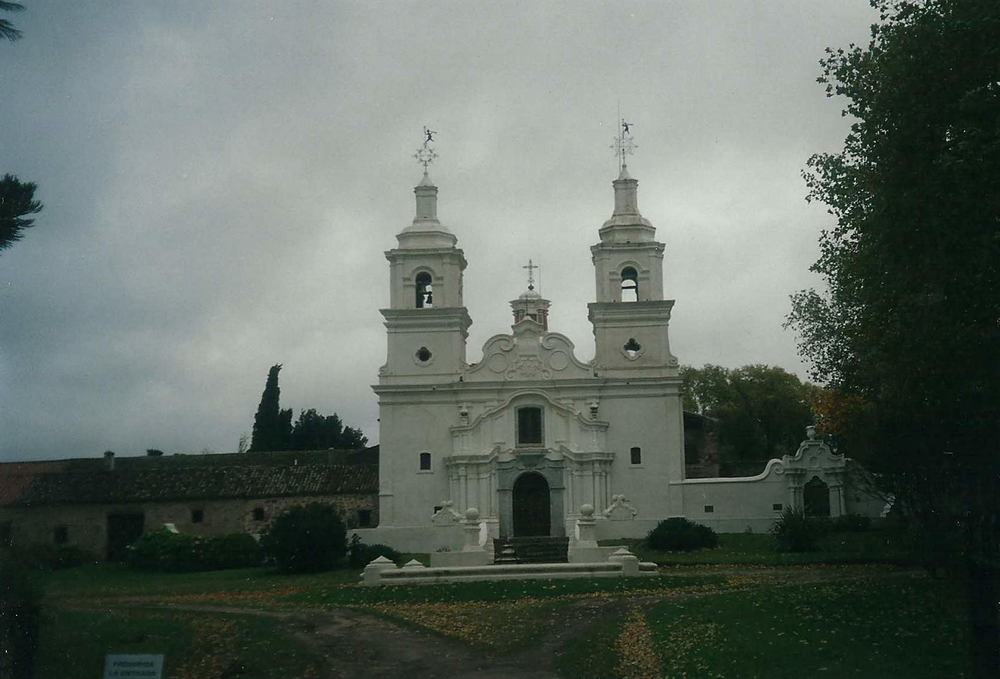
The Santa Catalina Jesuit Estancia is the largest and one of the most imposing of the estancias the Society of Jesus set up in the province of Córdoba during the 17th and 18th centuries. It is part of the Jesuit Block and Estancias of Córdoba, declared a UNESCO World Heritage Site in 2000, and an extraordinary record of the Jesuit economic and evangelizing system in the heart of South America.
Set in a quiet rural spot in northern Córdoba, near Ascochinga and Jesús María, Santa Catalina takes you by surprise with its magnificent church and its curved baroque facade, Central European in inspiration and unique of its kind in the region. The complex also takes in the residence, the workshops, the rancherías (workers' quarters), the waterworks and the whole productive apparatus of an estancia that became a great center of cattle raising and mule breeding, sustained by slave labor.
This guide covers Santa Catalina with a practical eye: the visit to the church and the historic core, its standing as a World Heritage Site, its place among the Jesuit estancias, its location in northern Córdoba near Jesús María, and the useful details for getting there, visiting and combining the trip with other attractions in the area.
Santa Catalina was the largest Jesuit estancia in Córdoba: the Society of Jesus bought this land on 1 August 1622 and turned it into a formidable productive unit to fund its schools and missions. A center for raising cattle and mules with slave labor, its magnificent baroque church was finished around 1754. After the expulsion of the Jesuits in 1767, the Junta de Temporalidades sold it in 1774 to Francisco Antonio Díaz, mayor of Córdoba, and today it is a UNESCO World Heritage Site, still in part the private property of that buyer's descendants. The full story is on our history page.
Read the full history ↓The landlocked province of sierras and rivers: Comechingón land founded by Cabrera in 1573, seat of the oldest university in the country and of the great Jesuit legacy, cradle of the University Reform and of the Cordobazo, capital of sierra tourism and of cuarteto.
Read the history of Córdoba →They depart from Cordoba Capital, 61 km away. If you book from this link we earn a commission and you pay no more.
No exact prices: a scale from $ (budget) to $$$$$ (luxury), with 2-3 options per category.
Origins, formation and what the sources say.
In the middle of the dry countryside of northern Córdoba, without warning, a curved baroque facade with two towers appears, looking as if it had been transplanted straight from Bavaria or Bohemia. There is no town around it, only dirt roads and neighboring ranches: the church of Santa Catalina rises alone on the plain, and that solitude is, paradoxically, the key to understanding what this place was. It was not a parish church for a community of faithful: it was the spiritual headquarters of the largest mule-breeding operation in colonial America, financed with slave labor and run with a business efficiency that would impress any modern manager.
The Society of Jesus arrived in the Córdoba region in the late 16th and early 17th centuries, and there it built one of the most important educational and missionary enterprises of colonial America. In the city of Córdoba the Jesuits established their school and, later, the university —today the Universidad Nacional de Córdoba, founded in 1613 and one of the oldest on the continent— along with churches and residences that made up the so-called Manzana Jesuítica, the Jesuit Block. To sustain that enterprise economically, since it received no fixed income from the crown, the Jesuits created a system of productive estancias across Córdoba's territory, a self-financing model that set them apart from the other religious orders of the time.
These estancias —Caroya, Jesús María, Santa Catalina, Alta Gracia and La Candelaria— operated as large farming and production establishments whose surpluses financed the schools and the missions, including the celebrated Guaraní reductions of present-day Misiones and Paraguay. Santa Catalina, whose lands the Society purchased on August 1, 1622 and which reached its full development in the early decades of the 18th century, became the largest of them all, with landholdings that by some historical estimates exceeded 80 square leagues. It specialized in livestock and, above all, in breeding mules, which were sold in great numbers for transport to Alto Perú, an extremely profitable line of business in the colonial economy.
The estancia was organized as a complex, self-sufficient unit, with its church, its residence, its workshops, its fields and a remarkable system of hydraulic works to secure water in a dry-climate area. That entire productive machine rested, as elsewhere in the colonial system, on the labor of enslaved people of African origin, a central and unavoidable chapter of its history that the site itself now works to bring into view on its guided tours.
The most celebrated element of Santa Catalina is its church, finished around 1754, more than a century after the purchase of the lands, and considered one of the masterpieces of colonial baroque in Argentina. Several architects took part in its long construction, among them the Jesuit brothers Andrés Blanqui and Juan Bautista Prímoli, who also worked on the Cathedral of Córdoba. Its curving facade, flanked by two towers, follows a Central European aesthetic, linked to the German-born Jesuit architects and brothers who worked in Córdoba during the 18th century. That unusual, elegant facade stands in contrast to the rural landscape around it and is an artistic landmark unique in the region.
The interior of the church preserves altarpieces, images and works of sacred art of great value, a reflection of the level reached by artistic production in the service of evangelization. But the complex is not limited to the church: it includes the priests' residence, organized around courtyards, the workshops, the rancherías where the enslaved and the laborers lived, and a sophisticated hydraulic system of irrigation channels, reservoirs and waterwheels that stored and distributed water, essential for production in an arid area.
The coherence and scale of this architectural and productive ensemble make Santa Catalina an exceptional testimony to Jesuit organization, where architecture, art, hydraulic engineering and economics were integrated into a single unit in the service of the Society's mission.
Santa Catalina was not conceived as an isolated church, but as a large-scale economic enterprise, the biggest of all the Jesuit estancias of Córdoba. Its reason for being was to generate the resources that financed the schools, the university and the missions of the Society of Jesus, which had no fixed income. To that end, the estancia organized a diversified production that was highly profitable in the context of the colonial economy.
Santa Catalina's great business was breeding mules. These animals, the offspring of a mare and a donkey, were indispensable for hauling cargo along the viceroyalty's roads, above all on the long, punishing route to Alto Perú and the mines of Potosí. The Córdoba estancias specialized in breeding and overwintering droves of mules that were then sold by the thousands at the fair in Salta, one of the most lucrative activities in the region. To this were added cattle raising, agriculture, the workshops and the management of water through the remarkable system of reservoirs and irrigation channels.
That entire productive machine rested on the labor of enslaved people of African origin, brought to the estancia and exploited there, alongside Indigenous and criollo workers. The rancherías where the enslaved lived are part of the complex preserved today, and they stand as an unavoidable reminder that the architectural and economic splendor of Santa Catalina was built on slavery. Understanding this dimension is essential for an honest, complete view of the Jesuit heritage.
Santa Catalina's fate changed drastically in 1767, when King Charles III of Spain ordered the expulsion of the Society of Jesus from all his dominions. The Jesuits had to abandon Córdoba and their estancias, which passed into the hands of the colonial administration (through the Junta de Temporalidades) and were later sold to private owners. In October 1774, Santa Catalina was acquired by Francisco Antonio Díaz, first-vote ordinary mayor of the Córdoba cabildo, and much of the complex remains to this day in the hands of his descendants —more than a hundred heirs who use it and care for it— which makes it a partly private property.
Despite the changes of ownership and the passage of centuries, the estancia has remarkably preserved its church, its main compound and its works, keeping the memory of its Jesuit past alive. That exceptional state of preservation and its historical, architectural and cultural value led to international recognition: in the year 2000, UNESCO inscribed the ensemble of the 'Jesuit Block and Estancias of Córdoba' —of which Santa Catalina forms part along with the other estancias and the Jesuit Block in the capital— on the World Heritage List.
Today Santa Catalina is at once a heritage site of world importance and an inhabited place, where tourist visits coexist with the lives of those who preserve it. To walk through it is to glimpse the complex weave of faith, power, art, production and slavery that defined the Jesuit presence in the heart of South America.