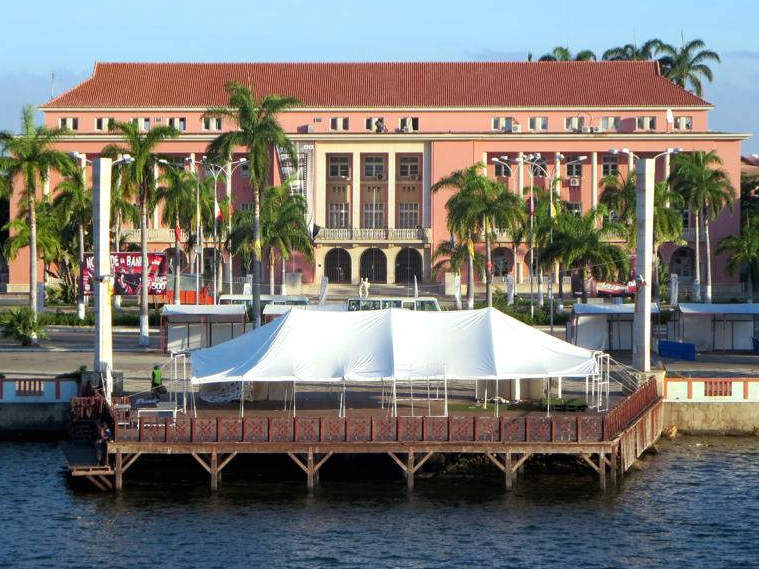
Lobito is one of those cities whose history is written in its geography. Born in the early 20th century in the shelter of the Restinga —a sand spit that nature drew across the Atlantic to enclose a perfect bay—, it quickly became the great port of Angola's central coast and the gateway to the sea for the legendary Benguela railway, which carried copper and manganese from the heart of Africa.
Today Lobito is a calm, bright city, with a different feel from bustling Luanda. Its soul is the Restinga, that strip of sand lined with fish restaurants, waterfront bars and gentle beaches where the people of Lobito spend their weekends. Across the water, the port and the railway station tell the industrial epic that gave the city life, which is being revived today by the Lobito Corridor, the great logistics project that once again links the Atlantic with the copper of Zambia and the Congo.
This guide covers Lobito with a practical eye: what to see on the Restinga and in the centre, how to make sense of the railway and the port, where to eat well by the sea and how to combine the city with neighbouring Benguela and its beaches. A relaxed destination of coastline, industrial history and Atlantic flavour, ideal for slowing down on your trip through Angola.
Lobito did not exist as a city until 1905, when the Portuguese chose its bay —sheltered by the Restinga, a natural sand spit— to build a deep-water port and the terminus of the Caminho de Ferro de Benguela, the railway that would link the Atlantic with the mines of the African interior. Within a few decades, that railway and port project turned a fishing spot into one of the most dynamic cities of colonial Angola. The civil war (1975-2002) hit the port and the railway hard; today both are being reborn with the modern Lobito Corridor. Its full story is told on our history page.
Read the full history ↓Benguela and Lobito, Angola's central coast: colonial cities with tree-lined streets and wide beaches, linked by the historic Benguela railway that crosses the country to the Congo.
Read the history of The central coast of Benguela →No exact prices: a scale from $ (budget) to $$$$$ (luxury), with 2-3 options per category.
Origins, formation and what the sources say.
Long before Lobito existed as a city, there was the bay. At this point on Angola's central coast, nature drew something exceptional: a narrow tongue of sand, the Restinga, which runs parallel to the shore and curves out over the sea until it encloses a wide lagoon of calm, deep water. The result is one of the best natural harbours on the whole west coast of Africa, sheltered from the Atlantic swell by that strip of sand, which the sea current itself laid down over thousands of years.
Bantu-speaking peoples had lived in the area for centuries, especially communities linked to the kingdom of Benguela and the Ovimbundu peoples of the interior. On the coast, small fishing villages made the most of the rich waters of the cold Benguela Current, one of the most productive on the planet. The Portuguese, present in neighbouring Benguela since 1617, knew Lobito Bay and its value, but for a long time they did not develop it: it was a natural anchorage rather than a built port.
All that would change at the start of the 20th century, when the geography of this sheltered bay met one of the great projects of the imperial age: running a railway from the Atlantic to the mineral wealth at the heart of Africa. Lobito, until then little more than a name on the coast, was about to become the gateway to the sea for an entire inland region of the continent.
Lobito's modern history begins with the Caminho de Ferro de Benguela (CFB). In the early 20th century, the British businessman Robert Williams, linked to the mining interests of the Belgian Congo and of Cecil Rhodes, came up with a railway that would join the copper belt of the African interior (the 'Copperbelt' of Katanga and present-day Zambia) to an Atlantic port, so the ore could be exported by the shortest route. Lobito Bay, with its deep-water natural harbour, was the ideal spot for the Atlantic terminus.
Work on the railway started from Lobito in 1903, and in 1905 the city was officially founded to serve as the port and head of the line. Building it was an engineering epic that took more than two decades: the line had to climb from sea level up to the Angolan plateau, tackling the escarpment on brutally steep gradients, and push on for more than 1,300 kilometres through forests, savannahs and mountains. In 1929 the rails reached the border with the Belgian Congo, completing the link with the rail network of central and southern Africa.
With the railway and the port, Lobito grew at full speed. Up went docks, workshops, warehouses, the station, hotels and whole neighbourhoods. The city became a cosmopolitan hub through which passed copper and manganese from the interior, goods from half the world and workers from many places. Together with Benguela, it formed the great urban and port centre of colonial Angola's central coast, with a prosperity you could read in its architecture and in the bustle of its harbour.
Angola's independence in 1975 came hand in hand with a long and devastating civil war between the MPLA, in power, and UNITA, each backed by different powers in the context of the Cold War. That conflict, which dragged on until 2002, hit Lobito's economic heart squarely: the Benguela Railway. The line, which crossed areas of heavy fighting in the interior, was sabotaged, mined and cut again and again, until it was practically unusable for decades.
Without the railway, Lobito lost its main role as the sea outlet for African copper. The port kept working on a smaller scale and the city held on, but the energy of earlier years faded. The war also brought displaced people, hardship and the decay of much of the infrastructure. During the hardest years of the conflict, the central coast lived with the tension of a country split in two, although Lobito and Benguela never stopped being the region's urban and fishing landmarks.
The end of the war in 2002 opened a period of reconstruction. With the oil boom of the 2000s, Angola invested in rebuilding roads, airports and, above all, the Benguela Railway, which was almost completely rebuilt with Chinese support and reopened along its main section around 2014-2015. Lobito was once again linked to the interior by rail, and its port was getting ready for a new chapter.
In recent years, Lobito has made international headlines again thanks to the so-called Lobito Corridor. It is an ambitious logistics project that combines the rebuilt railway, the deep-water port and new roads to move, once more by the shortest Atlantic route, the critical minerals of the interior: copper and cobalt from the Democratic Republic of the Congo and Zambia, essential to the global energy transition (batteries, cables, electric vehicles).
Backed by international investment and agreements (with European and American involvement, among others), the corridor aims to turn Lobito back into the great Atlantic gateway of central Africa, competing with the routes to the Indian Ocean. For the city, it means new investment, jobs, a modernised port and a geopolitical importance it had not had since the golden days of the colonial railway. There has even been talk of extending the line and of passenger trains that could revive tourism in the interior.
This revival rests on the same logic that gave birth to Lobito more than a century ago: a perfect bay, a unique natural harbour and the will to connect the Atlantic with Africa's mineral heartland. What changes are the players and the minerals in demand; the geography stays the same.
Beyond its role in logistics, Lobito today is a city to enjoy at an easy pace. The Restinga, the strip of sand that made the port possible, has become the city's great promenade, with its fish and seafood restaurants, its bars facing the bay and its beaches on both sides. At weekends, whole families from Lobito and Benguela come here to eat, swim and watch the sun set over the Atlantic.
The city keeps the mark of its industrial and colonial past in the railway station, in the buildings of the centre and the port, and in an atmosphere that is somewhat calmer and more orderly than hectic Luanda. The mild climate, tempered by the cold Benguela Current, makes it pleasant almost all year round, and its closeness to Benguela (just half an hour away, with its beaches and colonial charm) makes it a perfect base for exploring Angola's central coast.
In its short but intense history, Lobito sums up much of contemporary Angola: a place born of geography and the railway, battered by war and reborn through reconstruction, which today looks to the future as Africa's Atlantic gateway while its people keep enjoying fresh fish and the calm sea of the Restinga at sunset.