Affiliate link: we earn a commission.
📌District
Cahal Pech is a Maya archaeological site in the Cayo District, in western Belize, perched on a hill just outside the town of San Ignacio (and its neighbor Santa Elena), in the Belize River valley. Its name, in modern Yucatec Maya, is usually translated as 'place of ticks' ('cahal', place; 'pech', tick), a name given in the 20th century because of the presence of cattle in the area. It's one of the oldest settlements in the valley, with a very long occupation dating back to the Middle Preclassic.
📌Gateway town
The service town is San Ignacio, the great adventure hub of western Belize, a few minutes from the site (you can even walk uphill to it). San Ignacio concentrates hotels, hostels, restaurants, tour agencies, banks and transport, and is the base for exploring the whole Cayo District: Xunantunich, the ATM Cave, Caracol, Mountain Pine Ridge and the rivers. Cahal Pech is, in fact, one of the easiest ruins to visit from the town.
📌Best time to go
The dry season (from late November to mid-April) is the most comfortable for touring the site and climbing the hill without mud. The rainy season (June to November) brings more humid heat and afternoon downpours, though the jungle looks greener and the site is usually very quiet. It's best to go in the morning, with less heat and better light, or in the late afternoon; sunset from the hill is especially beautiful.
📌Suggested days
Cahal Pech can be toured in one to two hours, which makes it ideal for a short visit within a stay in San Ignacio. Because of its closeness to the town, it's perfect for a morning or an afternoon, as a complement to the great excursions of the Cayo District (Xunantunich, ATM, Caracol). Many travelers combine it with a stroll through San Ignacio or visit it at sunset for the views over the valley.
💱 BZD exchange rate
Loading rate…
Cahal Pech is the Maya ruin closest to San Ignacio: a compact, charming site perched atop a hill, a stone's throw from the bustling adventure town of western Belize. Its easy access —you can even reach it on foot from the center— makes it a perfect visit for those with little time or who want a first taste of the Maya world without long journeys. And yet it hides an enormous history: it's one of the oldest settlements in the Belize River valley.
What sets Cahal Pech apart isn't its size —it's modest compared to Caracol or Xunantunich— but its intimacy and its antiquity. The site is an acropolis of courtyards, plazas, temples and palaces crowded on the hill, explored amid the vegetation with a sense of discovery. Walking its narrow passages and climbing its structures, with the jungle around and the valley at your feet, has a special charm, far from the crowds.
This guide covers Cahal Pech with a practical, warm eye: how to get there from San Ignacio (on foot or by taxi), what to see in its acropolis and its museum, how much time to spend, when to go and why this small great site, one of the oldest in the region, deserves a place in any visit to the Cayo District. It's an accessible, calm plan packed with history.
📖 History of Cahal Pech
Cahal Pech is one of the oldest Maya sites in the Belize River valley and in the whole region: the archaeological evidence indicates it was occupied from the Middle Preclassic period, around 1200-1000 BC, which makes it one of the earliest settlements in the Maya lowlands. Strategically located on a hill overlooking the confluence of the Macal and Mopan rivers (which form the Belize River), Cahal Pech controlled a key point of the valley. Over more than two thousand years of continuous occupation it grew into a palace-acropolis of courtyards, plazas, temples, a ball court and elite residences, which functioned as the seat of a local ruling family during the Classic period. Like so many Maya cities, it was abandoned toward the end of the Classic (around the 9th-10th century AD). Its current name, 'place of ticks', is modern and was given in the 20th century because of the presence of cattle on the hill. The site was excavated from the mid-20th century and, intensively, in recent decades (with the project of Northern Arizona University and archaeologist Jaime Awe), which has allowed a better understanding of the origins of Maya civilization in the region. Today it's a protected site, with a museum and visitor center, managed by the Belize Institute of Archaeology. The full story is on our history page.
Read the full history ↓🏛️ Cahal Pech is in Cayo District
The great western district, between rainforest, rivers and the Maya Mountains: seat of the capital Belmopan, adventure base at San Ignacio and heart of Belizean archaeology with Caracol, Xunantunich and the mystical ATM cave.
Read the history of Cayo District →🗺️ What to see
Tours nearby, in San Ignacio
They depart from San Ignacio, 1 km away. Affiliate link: we earn a commission.
1
The acropolis: courtyards, plazas and palaces on the hill
The heart of the site, a compact cluster of courtyards, plazas and palatial structures crowded atop the hill.
Read more ↓
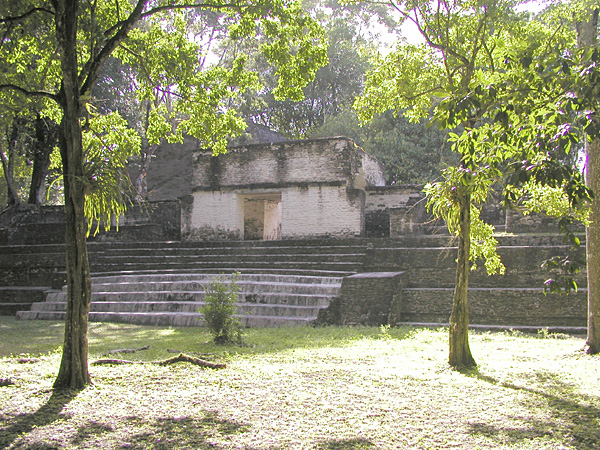
The heart of Cahal Pech is its acropolis: a compact, labyrinthine cluster of courtyards, plazas, temples and palaces built atop the hill, packed into a relatively small space. This dense, vertical layout is precisely what gives Cahal Pech its intimate character and its particular charm: unlike the great sites of open plazas, here you walk among structures, narrow passages and stairways, with a sense of exploration.
The site's core gathers about 34 structures organized around seven plazas and courtyards, in barely a couple of hectares: residences of the ruling elite, ceremonial and administrative spaces, pyramidal temples and even a temazcal (ritual steam bath). Going up and down among the structures lets you imagine the life of a local Maya court: the homes of the nobles, the meeting spaces and the temples where the rituals were performed. The vegetation surrounding the site reinforces the jungle and tranquil atmosphere.
From the top of the acropolis you get views of the valley and, on clear days, of the San Ignacio area. It's a good place to appreciate why the Maya chose this hill: it overlooks the confluence of the rivers and the surrounding valley, a strategic location.
Best time and hours: in the morning or at sunset, with good light and less heat. Tips: sturdy footwear for the stairways and slopes, water, repellent and sunscreen; take your time to explore the corners of the acropolis.
ℹ️ Distance: Site core, atop the hill · Best time: Morning or sunset (better light and less heat) · Admission: Included in the entry to the site (US$ 10 / BZ$ 20 foreigners; source: neverendingfootsteps.com and themayanruinswebsite.com, verified July 2026) · Duration: 1 to 1.5 hours
2
The Maya ball courts
The two courts of the ritual Mesoamerican ball game that the Cahal Pech complex preserves.
Read more ↓
Like many Maya centers, Cahal Pech has ball courts —archaeologists identified two in the complex— where the famous ritual Mesoamerican ball game was played, with its sloping lateral structures that delimited the playing space. The ball game was not just a sport, but an activity charged with religious and political meaning, associated with creation myths, the movement of the stars and, on occasion, rituals and sacrifices.
Seeing the court in the context of the acropolis helps understand the site's ceremonial dimension: Cahal Pech was not only a place of elite residence, but a center with its own ritual life, where ceremonies and events took place that reinforced the social order and the legitimacy of the local rulers.
It's an element that connects Cahal Pech with the great Mesoamerican tradition of the ball game, present from the Gulf of Mexico to Central America. Though modest, it completes the portrait of a functional Maya city, with its residential, ceremonial and sporting-ritual spaces.
Best time and hours: part of the general site tour, best in the morning or at sunset. Tips: a local guide can explain the rules and symbolism of the ball game, which greatly enriches the visit.
ℹ️ Distance: Within the site complex · Best time: Morning or sunset · Admission: Included in the entry to the site · Duration: Part of the general tour
3
The museum and visitor center
A small museum at the site entrance that contextualizes its very long history and displays archaeological finds.
Read more ↓
At the entrance to Cahal Pech there's a small museum and visitor center that helps contextualize the visit before climbing to the acropolis. It explains the enormous antiquity of the site —one of the earliest settlements in the Belize River valley, occupied from the Middle Preclassic— and displays pieces and archaeological finds that illustrate the life of its inhabitants over more than two thousand years.
The museum is especially valuable because Cahal Pech's importance is above all historical: its value lies not so much in monumentality as in what it reveals about the origins of Maya civilization in the region. The excavations of recent decades have provided a great deal of information on how the first communities formed and how they evolved toward more complex societies, and the visitor center gathers part of that knowledge.
Spending a few minutes there before touring the ruins lets you better appreciate what you're about to see and understand why this site, modest in size, is so relevant to archaeologists. It's a good educational complement to the visit.
Best time and hours: at the start of the visit, during the site's opening hours (8:00 to 17:00). Tips: start with the museum to get context; check the signs and, if you can, hire a guide.
ℹ️ Distance: At the site entrance · Best time: At the start of the visit · Admission: Included in the entry to the site (US$ 10 / BZ$ 20 foreigners; verified July 2026) · Duration: 20 to 30 minutes
4
The oldest temple and the Maya origins
The structures and courtyards that reveal Cahal Pech as one of the earliest Maya settlements in the lowlands.
Read more ↓
Cahal Pech's great scientific value lies beneath and within its structures: here some of the oldest evidence of Maya occupation in the lowlands has been found, tracing the first settlements to around 1200-1000 BC, in the Middle Preclassic. The excavations have revealed that the pyramids and palaces visible today were built over layers upon layers of much older constructions, in a process of superposition typical of Maya architecture, where each generation raised new structures on top of the previous ones.
The complex features several plazas (Plaza B is the largest) surrounded by pyramidal temples, and Structure A-1, the tallest temple at the site at about 25 meters, which offers a good perspective of the complex. Archaeologists have found here elite burials, offerings of jade and ceramics, and remains that document the transition from a small farming village to a political center with hereditary rulers.
For the visitor interested in history, this makes Cahal Pech a privileged window onto the very origins of Maya civilization, rather than its monumental heyday. How to see it: touring the plazas and climbing the main structures, with the context of the museum. Best time: morning or sunset. Tips: a guide helps you 'read' the construction layers and understand the antiquity of the site.
ℹ️ Distance: In the complex's main plazas and temples · Best time: Morning or sunset · Admission: Included in the entry to the site · Duration: Part of the tour (with the museum, more context)
5
For its hilltop location and closeness to town, Cahal Pech is a very pleasant place for the end of the day.
Read more ↓
One of Cahal Pech's advantages is its location: perched on a hill just outside San Ignacio, a few minutes from the center. This makes it a very pleasant place to visit in the late afternoon, when the warm light of sunset bathes the structures and the jungle, and the heat of the day eases.
From the hill and from the top of the acropolis you enjoy views of the Belize River valley and of the San Ignacio and Santa Elena area, a green, rolling landscape. It's a quiet, uncrowded spot, ideal for closing a day of exploration through the Cayo District with a short walk and a relaxed visit.
The closeness to town lets you combine Cahal Pech with a stroll through San Ignacio, a meal or a drink, since you can go and return on foot (uphill on the way there) or on a short taxi ride. It is, in many ways, the 'home' ruin for those staying in San Ignacio.
Best time and hours: the late afternoon, mindful of the site's closing time (17:00). Tips: confirm the closing time so you don't get stuck; bring repellent for sunset (more mosquitoes) and a flashlight in case it gets late on the way.
ℹ️ Distance: On the outskirts of San Ignacio (uphill on foot or by taxi) · Best time: Late afternoon (warm light and less heat) · Admission: Included in the entry to the site (closes at 17:00) · Duration: Part of the visit (views and sunset)
6
Cahal Pech fits perfectly into an itinerary with Xunantunich, the ATM Cave, Caracol and the town of San Ignacio.
Read more ↓
For its manageable size and its closeness to town, Cahal Pech is the ideal piece to start (or round off) an exploration of the Cayo District, the archaeological and adventure heart of Belize. Many travelers visit it on the first day, as an introduction to the Maya world, before tackling the great excursions: Xunantunich, with its imposing 'El Castillo' pyramid and the hand-cranked ferry crossing; the remote and spectacular Caracol, the largest Maya city in Belize, deep in the jungle; and the unforgettable ATM Cave, with its ritual remains and pots.
Moreover, Cahal Pech combines very well with the life of San Ignacio itself: the lively market (huge on Saturdays), the restaurants and bars of Burns Avenue, the walks along the Macal River and the agencies that organize tubing, canoeing and birdwatching. The town is a relaxed, friendly base, with a strong backpacker and adventure vibe.
This makes the area a multi-day destination, where Cahal Pech provides history and sunsets without long journeys. How to organize it: from San Ignacio, on foot or with local agencies. Best time: dry season. Tips: if you have a single day, combine Cahal Pech at sunset with a day at Xunantunich or ATM.
ℹ️ Distance: All the sites are in the Cayo District, near San Ignacio · Best time: Dry season · Admission: Cahal Pech US$ 10; Xunantunich US$ 10; ATM US$ 90–200 (ranges verified July 2026) · Duration: Cahal Pech 1-2 h; the rest, half day to full day
🛡️ Getting sick far from home shouldn't cost you thousands of USD
Abroad, getting sick is more than a bad day. In many destinations public healthcare depends on appointments, queues and availability, and private care is paid upfront. An emergency can cost thousands of USD, right when you are far from home and on a tight budget. That is why I recommend you never leave without travel assistance.
I recommend GO! Assistance because it covers what matters: medical care, emergencies, medication and hospitalization depending on the plan. It protects you 24 hours a day, anywhere in the world, with real-time solutions on the ground. GO! 365 ECO and GO! 365 give you USD 45,000 of global coverage: the first with a USD 100 deductible, the second with none.
If you quote from Argentina, in October GO! also offers 12 interest-free instalments on all its products.
An emergency abroad can cost thousands of dollars. Travel with assistance.
GO! Assistance has 50% off in October and, with our link, you get an extra 20%.
Pick origin, destination, dates and ages and see the price of your travel assistance in a minute.
📶 Internet from the moment you land
I have never been left without internet on a trip. I land and my phone connects to the strongest network in the country I am visiting: I can let people know I arrived, sort out transport, book tours and keep posting content at a super affordable price (really cheap!). I always use the Maya Mobile eSIM, check out its plans by clicking the banner. See Maya Mobile plans →
Affiliate link: we earn a commission.


💵 Prices
Tickets
| Type | Price |
|---|
| Entry to the Cahal Pech archaeological site (Belize Institute of Archaeology / NICH) | US$ 10 (BZ$ 20) foreigners; BZ$ 10 (US$ 5) residents; under 5 free (source: neverendingfootsteps.com and themayanruinswebsite.com, verified July 2026). Includes the museum |
| Local guide at the site (optional) | approx. US$ 25 (BZ$ 50) per small group (range according to traveler blogs, verified July 2026) |
| Taxi from San Ignacio (round trip) | approx. US$ 8–15 round trip with wait (range according to traveler forums, verified July 2026); on foot it's free (uphill) |
🔄 updated monthlyOfficial / reference values · double-check when buying
Activities and tours
Guided visit of the Cahal Pech acropolis and museum
PriceGuide at the site approx. US$ 25; tour with transport from San Ignacio approx. US$ 75 (range according to San Ignacio agencies, verified July 2026)
Self-guided visit (on foot from San Ignacio)
Visit combined with a San Ignacio city tour
PriceUS$ 40–75 per person depending on operator (range according to San Ignacio agencies, verified July 2026)
🔄 updated monthlyOfficial / reference values · double-check when buying
🚌 How to get there and distances
Getting around
NotesCahal Pech is on the outskirts of town; you can walk up on a short but steep route. Bring water and comfortable footwear
Priceapprox. US$ 5–8 each way; US$ 8–15 round trip with wait (range according to traveler forums, verified July 2026)
NotesConvenient, especially for the climb or if it's very hot; it's best to agree on the price and, if you want, the return
Tour or transfer with guide
NotesAn option for those who prefer to go with a guide and combine the visit with other points of San Ignacio
🔄 updated monthlyOfficial / reference values · double-check when buying
How to get there
| Route | Airlines / operators | Avg. price | Duration |
|---|
| San Ignacio → Cahal Pech (on foot or by taxi) | On foot or local taxis | On foot free; taxi US$ 5–8 each way (verified July 2026) | A few minutes (the site is on the outskirts of town) |
| Belize City / Belmopan → San Ignacio (departure base) | Western Highway buses, cars and taxis | Bus from Belize City approx. US$ 5–8 (verified July 2026) | Approx. 2 h from Belize City via the Western Highway |
| Guatemala border (Benque/Melchor) → San Ignacio | Taxis and local buses | Bus approx. US$ 1–2; taxi US$ 15–25 (range according to traveler forums, verified July 2026) | Short trip from the western border |
🔄 updated monthlyOfficial / reference values · double-check when buying
🏨 Where to stay
No exact prices: a scale from $ (budget) to $$$$$ (luxury), with 2-3 options per category.
Lodges and boutique hotels in San Ignacio and surroundings
Recommended optionsUS$ 110–250 per night. The San Ignacio area and the Cayo valley offer jungle lodges and charming boutique hotels, some near Cahal Pech itself (Cahal Pech Village Resort, from US$ 85 according to Kayak, Ka'ana), ideal for combining nature, ruins and comfort (range according to
Booking.com and Kayak, verified July 2026)
Mid-range hotels in San Ignacio
Recommended optionsUS$ 60–120 per night. San Ignacio has a good offering of mid-range hotels (San Ignacio Resort Hotel, Casa Blanca), well located relative to the center, the agencies and transport, perfect as a base for exploring western Belize (range according to
Booking.com, verified July 2026)
Hostels and budget in San Ignacio
Recommended optionsUS$ 15–55 per night. The town is very popular with backpackers and budget travelers, with hostels and budget hotels (Bella's Backpackers, Old House) and a lively adventure atmosphere (range according to Hostelworld and
Booking.com, verified July 2026)
🍴 Where to eat
Restaurants and market of San Ignacio
Options / signature dishDish US$ 8–18. San Ignacio offers Belizean cuisine, international food, vegetarian options and cafés (Burns Avenue area), plus the huge Saturday market where you can try cheap local food. The best area to eat around a visit to Cahal Pech (range according to Tripadvisor, verified July 2026)
Cheap local food and antojitos
Options / signature dishUS$ 2–8. Stalls and eateries of San Ignacio with home-style food and antojitos of Mestizo and Mexican influence (tacos, salbutes, garnaches, pupusas), ideal for a quick, cheap lunch (range according to traveler blogs, verified July 2026)
Cafés and healthy options
Options / signature dishUS$ 5–14. Specialty cafés, juices, bowls and vegetarian offerings that have flourished with tourism in San Ignacio, good for a breakfast or a snack before or after the ruin (range according to Tripadvisor, verified July 2026)
📖 History of Cahal Pech
Origins, formation and what the sources say.
The name 'Cahal Pech': 'place of ticks'
When Rome did not yet have its Republic and Alexander the Great's birth was still seven centuries away, on a hill in western Belize there already lived people who made ceramics, grew maize and buried their dead. That place, one of the oldest settlements in the entire Maya world, today bears a most prosaic name: 'place of ticks'. The name 'Cahal Pech' is modern and rather picturesque: it was coined in the 20th century, when the hill on which the site sits was used as pasture for cattle. In Yucatec Maya, 'cahal' means 'place' and 'pech' means 'tick', so the name is usually translated as 'place of ticks', referring to the parasites associated with the cattle that grazed there at the time.
As is the case with the vast majority of Belize's archaeological sites, this is not the name the city bore in Maya times, which has been lost. The original names of many Maya cities are known only when they appear recorded in their own hieroglyphic inscriptions; in the absence of that data, the sites receive modern names in Maya, Spanish or English, often descriptive of the place or of the circumstances of their rediscovery.
The case of Cahal Pech is a good example of how recent history —the cattle use of the hill— was inscribed, almost by chance, in the name of a millennia-old site. Despite the prosaic origin of the name, Cahal Pech is one of the most important places for understanding the beginnings of Maya civilization in the Belize River valley.
A modern name from the cattle on the hill
The sources agree that 'Cahal Pech' ('place of ticks') is a modern 20th-century name, linked to the presence of cattle on the hill. The original Maya name of the site is unknown.
Source: https://en.wikipedia.org/wiki/Cahal_Pech
One of the oldest settlements in the Belize River valley (Middle Preclassic)
Cahal Pech's great relevance lies in its antiquity. The excavations have revealed that the site was occupied from the Middle Preclassic period, around 1000-1200 BC, which makes it one of the earliest settlements in the Belize River valley and in the Maya lowlands in general. In other words, when Cahal Pech was already an established community, many centuries still remained before the heyday of the great cities of the Classic period.
That very long occupation sequence —more than two thousand years practically continuously— makes Cahal Pech a privileged site for studying the origins and evolution of Maya society. In its deepest layers appeared the ceramics of the so-called Cunil complex (around 1200-900 BC), defined precisely at Cahal Pech: the oldest ceramic technology documented in western Belize and one of the earliest in the Maya lowlands. In its archaeological layers you can follow the transition from an early farming village to an increasingly complex community, with social hierarchies, monumental architecture and ceremonial life.
The location helps explain this continuity: Cahal Pech rises on a hill overlooking the confluence of the Macal and Mopan rivers, which upon joining form the Belize River. That strategic position, over a waterway and with visual control of the valley, offered defensive, commercial and resource-access advantages that sustained the community for millennia.
Occupation from the Middle Preclassic
The sources place the start of Cahal Pech's occupation in the Middle Preclassic (approx. 1000-1200 BC), which makes it one of the oldest settlements in the Belize River valley. The datings come from excavations and should be taken as approximate ranges.
Source: https://en.wikipedia.org/wiki/Cahal_Pech
The Classic heyday: an elite palace-acropolis
Throughout its long history, Cahal Pech grew and transformed until it became, during the Classic period (roughly between AD 200 and 900), a palace-acropolis: a compact cluster of about 34 structures organized around seven plazas and courtyards, with pyramidal temples (the largest, Structure A-1, reaches about 25 meters), residences, two ball courts and even a temazcal or ritual steam bath, all packed atop the hill. This core functioned as the seat of a local ruling family and as the ceremonial and administrative center of the surrounding area.
Cahal Pech's dense, labyrinthine architecture —with its courtyards surrounded by buildings and its narrow passages— is typical of the palatial complexes of the Maya elite, designed both for the residence of the nobles and for the performance of ceremonies and the management of power. The ball courts complete the picture of a city with its own ritual life, tied to Maya myths and cosmology.
Although Cahal Pech never reached the scale of great capitals like Caracol, its regional importance was notable, and its long continuity sets it apart from many other sites. For archaeologists, studying how this settlement went from a Preclassic village to a Classic court offers an exceptional window onto the development of social and political complexity among the ancient Maya of the Belize River valley.
Seat of a local ruling elite
The sources describe the core of Cahal Pech as a palace-acropolis that during the Classic was the seat of a local ruling family, with courtyards, temples, elite residences and a ball game. Its scale is smaller than that of the great capitals, but its continuity makes it very relevant.
Source: https://en.wikipedia.org/wiki/Cahal_Pech
Abandonment, modern excavations and conservation
Like so many Maya cities of the lowlands, Cahal Pech was abandoned toward the end of the Classic period, around the 9th-10th centuries AD, in the context of the phenomenon known as the Maya 'collapse'. The causes of that process are debated —combinations of droughts, environmental pressures, conflicts and political crises are mentioned— but the result was that the site ceased to function as an inhabited center and lay covered by vegetation for centuries.
In modern times, the first to excavate the site was archaeologist Linton Satterthwaite, of the University of Pennsylvania museum, who in the 1950s documented stelae and worked on the ball court (though he published barely a couple of paragraphs about his findings). The great leap came in 1988, when the Belizean archaeologist Jaime Awe began the systematic research that the Belize Valley Archaeological Reconnaissance Project (BVAR) would continue for decades, focused especially on the earliest phases of the settlement. This research has been fundamental for understanding the origins of Maya civilization in the region —including the definition of the Cunil ceramic complex— and has allowed much of the structures visible today to be consolidated and restored. Since 2006 the site has also hosted field schools where archaeology students excavate each season.
At present, Cahal Pech is a protected archaeological site, with a museum and visitor center, managed by the Belize Institute of Archaeology. Its closeness to San Ignacio has made it one of the most accessible Maya sites in the country and a common visit for those touring the Cayo District. It represents well the way Belize integrates its rich Maya heritage into its cultural and tourist offerings, and offers the visitor an intimate window onto more than two millennia of history.
Abandonment in the Maya collapse and recent excavations
The sources place the abandonment of Cahal Pech in the Terminal Classic Maya collapse (9th-10th centuries), of debated causes, and highlight the modern excavations —intensive in recent decades— to understand its early phases. The specific details may vary by source.
Source: https://es.wikipedia.org/wiki/Cahal_Pech
❓ Frequently asked questions
How much does it cost to enter Cahal Pech?+
Admission for foreigners is US$ 10 (BZ$ 20) and includes the museum (verified July 2026); residents pay BZ$ 10 (US$ 5) and children under 5 enter free. You can pay in cash or card, in Belizean or US dollars. The site is open daily from 8:00 to 17:00. A guide at the entrance costs about US$ 25. Check prices when you visit.
Is it worth visiting Cahal Pech, being a small site?+
Yes. Cahal Pech is modest in size compared to Caracol or Xunantunich, but it has a special charm: it's an intimate, labyrinthine acropolis on a hill, very quiet, and it's one of the oldest Maya settlements in the valley, occupied from the Middle Preclassic (around 1200-1000 BC). Its closeness to San Ignacio makes it ideal for a short visit, especially if you're interested in the origins of Maya civilization.
How do I get there from San Ignacio?+
Cahal Pech is on the outskirts of town, so you can reach it on foot on a short but steep route (15-20 minutes uphill), or on a brief taxi ride (about US$ 5–8), more comfortable if it's hot. It's one of the easiest ruins to visit in all of Belize because of its proximity to the center.
What does the name 'Cahal Pech' mean?+
It's a modern name, given in the 20th century, which in Yucatec Maya is usually translated as 'place of ticks', because of the presence of cattle on the hill at that time. It isn't the name the site bore in antiquity, which is unknown, as happens with many archaeological sites in Belize.
How much time do I need?+
One to two hours are enough to tour the acropolis, the ball court, the plazas and the museum. Because of its size and closeness, it's perfect for a morning or an afternoon, and it combines very well with a stroll through San Ignacio or with the great excursions of the Cayo District (Xunantunich, ATM, Caracol).
Can you visit at sunset?+
Yes, and it's a very pleasant time for the warm light and the views over the Belize River valley, plus it's less hot. That said, the site closes at 17:00, so confirm the hours so you don't get stuck; bring repellent (at sunset there are more mosquitoes) and, if you go on foot, a flashlight in case it gets late on the way.
Sources consulted (12)
- Wikipedia (EN) — «Cahal Pech»: https://en.wikipedia.org/wiki/Cahal_Pech
- Wikipedia (ES) — «Cahal Pech»: https://es.wikipedia.org/wiki/Cahal_Pech
- Wikipedia (EN) — «Cahal Pech»: https://en.wikipedia.org/wiki/Cahal_Pech
- Travel Belize (official, Belize Tourism Board): https://www.travelbelize.org/
- Institute of Archaeology Belize (NICH): https://nichbelize.org
- Travel Belize (official, Belize Tourism Board): https://www.travelbelize.org/
- Lonely Planet — «Cayo District»: https://www.lonelyplanet.com/belize/cayo-district
- Never Ending Footsteps — «Cahal Pech» (fare US$10/BZ$20): https://www.neverendingfootsteps.com/cahal-pech/
- The Mayan Ruins Website — «Cahal Pech»: https://www.themayanruinswebsite.com/cahal-pech-1.html
- Kayak — Cahal Pech Village Resort (from US$85): https://www.kayak.com/San-Ignacio-Hotels-Cahal-Pech-Village-Resort.201887.ksp
- Travel Belize (official, Belize Tourism Board): https://www.travelbelize.org/
- Wikipedia (EN) — «Belizean cuisine»: https://en.wikipedia.org/wiki/Belizean_cuisine