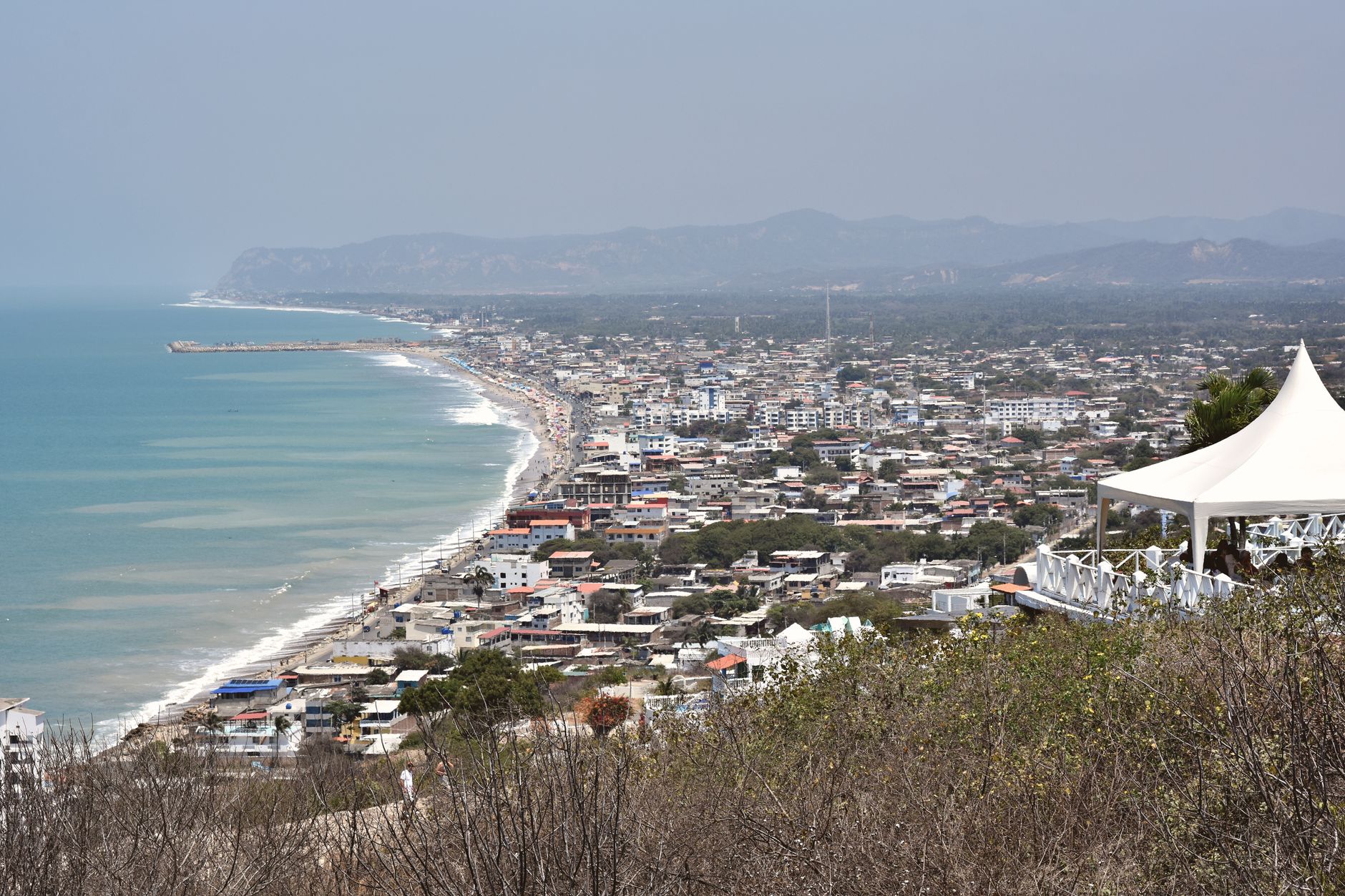
Olón is Montañita's quiet neighbor: they share almost everything —the same coastline, the same stretch of the Ruta del Spondylus, barely a hill between them— but their personalities are opposites. While Montañita means partying, surfing and nightlife, Olón offers a long golden-sand beach, a more relaxed and family-friendly feel, and the option of resting by day and, if you feel like it, having Montañita's party scene a few minutes away at night.
Its great pride is the beach: some 7 kilometers of golden sand —one of the longest on mainland Ecuador's coast—, perfect for long walks, for surfing without the crowds and for sunsets over the Pacific. And its most famous image is the Santuario Blanca Estrella de la Mar, a church shaped like a sailboat perched on the hill that separates Olón from Montañita, with a stunning view of the sea and the coast: a place of pilgrimage and a must-see.
This guide covers Olón with a practical eye: how to get there along the Ruta del Spondylus, what to do (beach, surfing, the sanctuary, sunsets), how to make the most of being close to Montañita and Ayampe, and how to use it as a quiet base for exploring the beaches and Parque Nacional Machalilla on the Ecuadorian coast.
Olón is a coastal commune in the province of Santa Elena, in an area inhabited since pre-Columbian times by the seafaring peoples of the Ecuadorian shoreline, tied to the spondylus trade that gives the coastal route its name. Like many villages on the peninsula, it was for a long time a quiet fishing town. Its tourist history is closely bound to that of its neighbor Montañita: when Montañita became, from the late 20th century, the great magnet for surfing and partying on the Ecuadorian coast, Olón began to receive the travelers looking for a quieter, more family-friendly alternative, keeping its long stretch of sand and its serene atmosphere. The Santuario Blanca Estrella de la Mar, inaugurated in 1984 on top of the hill that separates it from Montañita, established itself as a place of devotion and a symbol of the village. The full story is on our history page.
Read the full history ↓The southwestern peninsula, one of the country's youngest provinces (2007): cradle of the Las Vegas and Valdivia cultures —the origin of civilization in Ecuador—, land of Ancón oil and Salinas salt, of the «Lovers of Sumpa», La Chocolatera and the surfing mecca of Montañita on the Spondylus Route.
Read the history of Santa Elena →They depart from Montanita, 3 km away. If you book from this link we earn a commission and you pay no more.
No exact prices: a scale from $ (budget) to $$$$$ (luxury), with 2-3 options per category.
Origins, formation and what the sources say.
The coast where Olón stands today is part of the Santa Elena peninsula, one of the regions with the oldest human history in Ecuador. Thousands of years ago the Las Vegas culture, the country's oldest, lived in the surrounding area, famous for the 'Amantes de Sumpa', a pair of skeletons found in an embrace. Later, cultures such as the Valdivia and the Guangala flourished, and the whole coastal strip was the territory of seafaring and fishing peoples.
These peoples lived facing the sea and took part in the spondylus trade, the red shell considered sacred, which was exchanged all along the Pacific coast and inland into the Andes. That ancient trading circuit gives its name to today's 'Ruta del Spondylus', the axis that now runs along the shoreline and on which Olón sits, alongside Montañita, Ayampe and other beaches.
So, long before the surfers, the hotels and the sanctuary on the cliff, this coast was part of a world of fishermen and sea traders going back millennia. The historical depth of the Santa Elena peninsula —among the oldest on the continent— is the backdrop for a village that, like so many on this shoreline, was born out of the relationship between people and the ocean.
For most of its history, Olón was a quiet fishing commune on the Santa Elena peninsula. Like so many places along the Ecuadorian shoreline, its daily life revolved around the sea: small-scale fishing, the work of the boats, the relationship with a long golden-sand beach and an unhurried pace, typical of a small coastal village far from the big cities.
The figure of the commune, the traditional form of rural organization in the area, structured life in Olón and in many neighboring places for generations. The long beach, today its main tourist attraction, was then above all the working and living space of a fishing community that drew its livelihood from the sea.
That seafaring identity left marks that endure, such as the devotion to the Virgin as protector of fishermen that would culminate in the Santuario Blanca Estrella de la Mar. Being a quiet, small-scale village, which for a long time kept Olón on the margins of development, would later become one of the traits travelers learned to value, when tourism completely transformed its neighbor Montañita.
Olón's most recognizable symbol is its sanctuary on top of the hill: the Santuario Blanca Estrella de la Mar. It is a temple shaped like a boat or sailing ship, dedicated to the Virgin as 'Star of the Sea' (a Marian invocation traditionally associated with the protection of sailors and fishermen), built on the highest part of the hill that separates Olón from Montañita, in one of the most spectacular settings on the entire Ecuadorian coast. It was inaugurated on 8 September 1984.
Devotion to the Virgin of the Sea has a logical root in a fishing village, where entrusting yourself to a heavenly protector before heading out to the ocean was part of life. The sanctuary thus became a place of faith and pilgrimage, where locals and visitors come to pray, give thanks or ask for protection, in a tradition that joins spirituality with the trade of the sea.
At the same time, its privileged position on the hill turned it into a tourist magnet: from up there you can take in a stunning panoramic view of Olón's long beach and the Pacific. Over time, the access from Olón was closed by landslides and the way in moved to the Montañita side, from the Monumento al Surfista. That double condition —sacred place and exceptional viewpoint— is what makes the Santuario Blanca Estrella de la Mar the symbolic heart of the village and its most widely shared image.
Olón's tourist history cannot be separated from that of its neighbor Montañita. In the late 20th century, Montañita —a small coastal village separated from Olón by just a hill— became one of the great surf and party destinations in South America. Drawn first by its waves and then by its bohemian atmosphere and its intense nightlife, travelers, backpackers and surfers arrived from all over the world, and Montañita turned into a tourism phenomenon.
That boom had a direct effect on Olón. As Montañita grew and became noisier, more crowded and more party-focused, many travelers started looking nearby for a quieter alternative to stay and rest in, without giving up being close to the action. Olón, with its long beach and its serene atmosphere, was the natural option: close enough to enjoy Montañita, far enough to escape its intensity.
So Olón developed as a tourist destination largely as the quiet, family-friendly flip side of Montañita, offering beach, calm and the sanctuary while leaving the partying to its neighbor. That complementarity —two villages side by side with opposite personalities— defined Olón's tourist identity and remains, today, one of the keys to its appeal.
Today's Olón is an established beach town on the Ruta del Spondylus that has found its place within the tourist corridor of the Ecuadorian coast. Its long golden-sand beach, its relaxed and family-friendly atmosphere and the Santuario Blanca Estrella de la Mar position it as a destination that combines rest, nature and a touch of spirituality, clearly distinct from Montañita's party profile.
The village receives a varied mix of visitors: families looking for quiet, surfers who prefer waves without crowds, travelers using Olón as a serene base for exploring the area, and pilgrims who climb up to the sanctuary. Its position on the Ruta del Spondylus gives it easy access both to the scene to the south (Montañita) and to the natural wonders to the north (Ayampe, Puerto López, Parque Nacional Machalilla and whale watching).
Like any destination that grows, Olón faces the challenge of developing without losing the calm and the character that are its greatest attraction. For now, it remains the serene complement to its famous neighbor: a village of long golden beach, crowned by a sanctuary on the cliff, where the old seafaring identity of the Santa Elena peninsula carries on in a new life tied to sun, sea and rest tourism.