GO! Assistance has 50% off in October and, with our link, you get an extra 20%.
Pick origin, destination, dates and ages and see the price of your travel assistance in a minute.
Affiliate link: we earn a commission.
There are cities that become synonymous with an object, and in Paraguay that city is Itauguá: the birthplace of ñandutí. On Route PY02, half an hour from Asunción, this town of the central region is where the country's most famous lace is born, that very fine weaving that imitates a spider's web —hence its name, 'ñandutí', which in Guaraní means exactly that— and that has become one of the great symbols of Paraguayan identity.
Touring Itauguá is entering a world of color and patience. Along the roadside and in the city center follow the stalls and workshops where the weavers —heirs to a tradition passed from mothers to daughters— display tablecloths, table runners, blouses, fans and all kinds of pieces in which the ñandutí bursts into circles, suns and flowers of a thousand colors. Buying a ñandutí in Itauguá isn't just taking home a souvenir: it's taking home a piece of hand-woven culture.
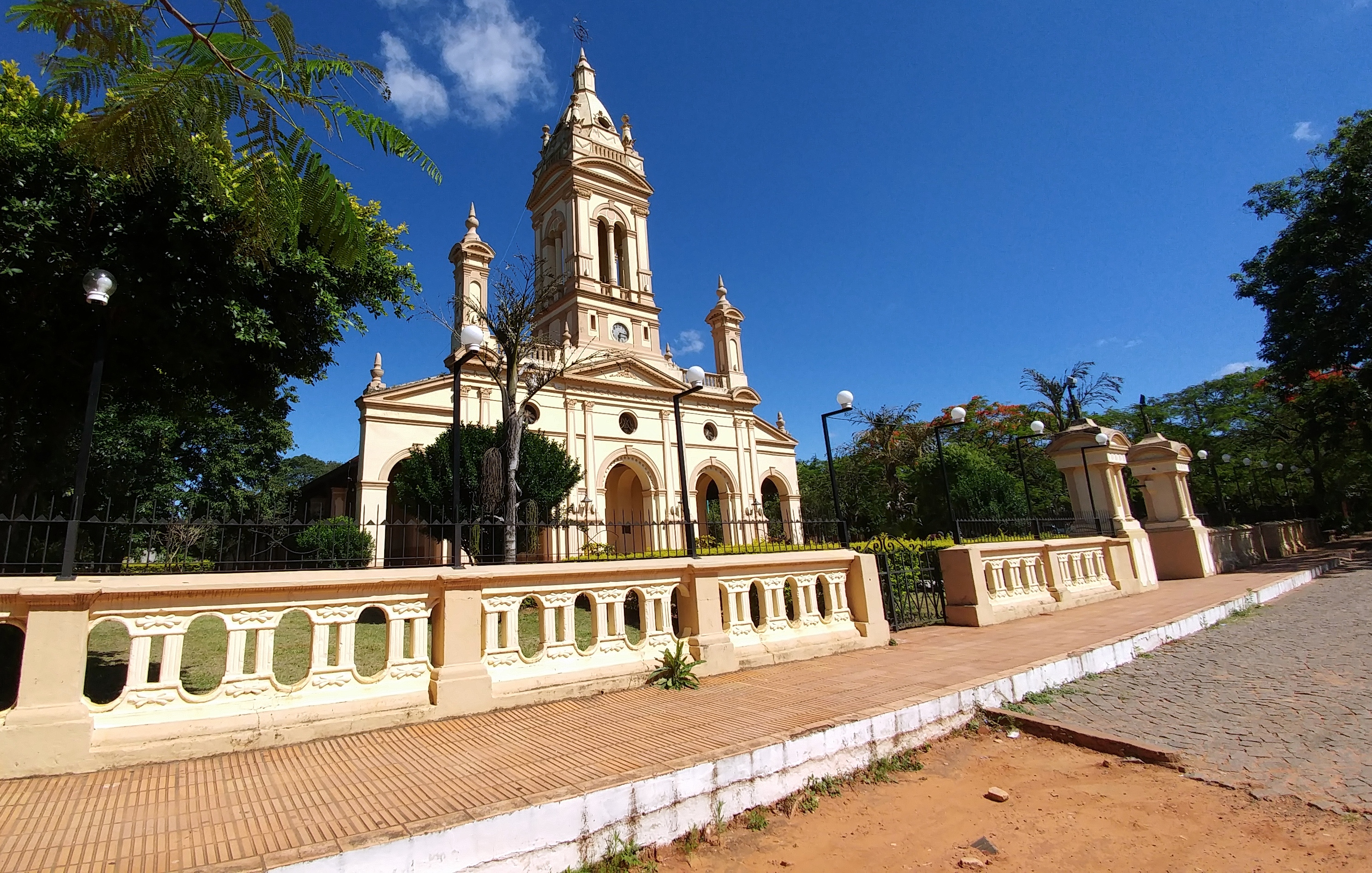
But Itauguá is more than its lace. It preserves a charming historic center, with veranda houses of red tiles, a traditional church and museums that tell the history of the city and its craft. This guide covers Itauguá with a practical, warm eye: what to see, how to buy ñandutí, when the festival that celebrates it falls and how to combine it with the other destinations of the country's central region, on one of the most authentic outings in Paraguay.
Itauguá was founded in 1728 by Governor Martín de Barúa, as one of the colonial towns established in the central region, near Asunción. Its name, of Guaraní origin, is associated with the idea of a place of stones or rocky ground ('itá' means stone). Like many towns in the area, it lived off agriculture, cattle raising and craft trades. Its hallmark —the ñandutí— has its roots in colonial times: this needle-lace technique is believed to have reached Paraguay through Spanish influence (linked to laces like those of Tenerife, in the Canary Islands) and was reinterpreted and perfected by the local weavers, who transformed it into an art of their own inspired by a spider's web. Over time, Itauguá consolidated itself as the undisputed center of this craft, passed down from generation to generation, especially among women. The city was declared City of Ñandutí and is home to the National Ñandutí Festival. It preserves a valuable colonial architectural heritage, with its veranda houses and its church, which attest to its age. The full history is on our history page.
Read the full history ↓Paraguay's smallest and most populated department, wrapped around Asunción: the heart of Greater Asunción, land of the ñandutí lace of Itauguá, the filigree and harps of Luque, the strawberries and ceramics of Areguá, on the shore of the legendary Ypacaraí lake.
Read the history of Central →A local guide tells you in half an hour what no sign at the site will ever explain. We look ours up on Civitatis: guided in Spanish and booked online with no fuss. They have 15 activities in Asuncion. And there are free tours here: you book without paying and tip the guide whatever you think at the end, so trying one costs you nothing. Three are below so you get the idea: tap any of them and they all open.
They depart from Asuncion, 26 km away. Affiliate link: we earn a commission.
Abroad, getting sick is more than a bad day. In many destinations public healthcare depends on appointments, queues and availability, and private care is paid upfront. An emergency can cost thousands of USD, right when you are far from home and on a tight budget. That is why I recommend you never leave without travel assistance.
I recommend GO! Assistance because it covers what matters: medical care, emergencies, medication and hospitalization depending on the plan. It protects you 24 hours a day, anywhere in the world, with real-time solutions on the ground. GO! 365 ECO and GO! 365 give you USD 45,000 of global coverage: the first with a USD 100 deductible, the second with none.
If you quote from Argentina, in October GO! also offers 12 interest-free instalments on all its products.
GO! Assistance has 50% off in October and, with our link, you get an extra 20%.
Pick origin, destination, dates and ages and see the price of your travel assistance in a minute.
I have never been left without internet on a trip. I land and my phone connects to the strongest network in the country I am visiting: I can let people know I arrived, sort out transport, book tours and keep posting content at a super affordable price (really cheap!). I always use the Maya Mobile eSIM, check out its plans by clicking the banner. See Maya Mobile plans →
Affiliate link: we earn a commission.
No exact prices: a scale from $ (budget) to $$$$$ (luxury), with 2-3 options per category.
Origins, formation and what the sources say.
Itauguá was founded in 1728 by the governor of Paraguay Martín de Barúa, as part of the organization of the colonial towns of the central region, near Asunción. The Paraguayan capital, founded in 1537, was the center from which the colonization of the territory radiated, and throughout the seventeenth and eighteenth centuries towns, parishes and reductions arose around it. Itauguá was born as one of those towns of the central zone, on lands of warm climate and fertile soil.
The name 'Itauguá' is of Guaraní origin, the indigenous language that in Paraguay not only survived colonization but remained an everyday language to this day. The most widespread interpretation associates it with the root 'itá', which means 'stone', referring to a place of stones or rocky ground. As with many Guaraní place names, there are nuances and variants in the translation and spelling (Itauguá, Itaugua), which are best taken as approximations.
From its origins, the life of Itauguá revolved around agriculture, cattle raising and the craft trades typical of the Paraguayan towns. Its location in the central region, on the road linking Asunción with the interior and the east of the country, gave it the role of a town of passage and exchange that, over time and with the construction of the modern road, would be reinforced. But what would end up giving it world fame was neither its trade nor its agriculture, but a hand-woven art: ñandutí.
Ñandutí is the soul of Itauguá and one of the great symbols of Paraguayan craft. Its name comes from Guaraní and means, literally, 'spider's web' (from 'ñandu', spider, and 'tí'), in clear allusion to its appearance: a very fine lace, of circular and radial motifs, that evokes the webs spiders weave. It's a needle lace made on a frame, first stretching radial threads that serve as a base and then embroidering over them the characteristic designs of suns, stars, flowers and geometric figures, in one or many colors.
The technique has roots in the Spanish tradition. The most accepted explanation is that ñandutí derives from needle laces brought to Paraguay during colonial times, in particular the so-called 'Tenerife' or 'sun' laces, originating in the Canary Islands, which are in turn linked to peninsular lace traditions and those of other places. That European technique was adopted and, above all, reinterpreted and enriched by the Paraguayan weavers, who gave it an identity of its own: the incorporation of bright colors, the motifs inspired by local nature and the Guaraní name finished turning it into something genuinely Paraguayan.
Itauguá consolidated itself as the undisputed center of this craft. The weaving of ñandutí is passed down from generation to generation, from mothers to daughters, forming part of the economy and identity of many families in the city. It's a work of great patience and skill, in which a single large piece can demand many hours or days of labor. For all this, Itauguá proudly holds the title of 'City of Ñandutí'.
Ñandutí is not just a technique, but a living tradition sustained for generations by the women of Itauguá. The craft is learned at home, from a young age, observing and helping mothers and grandmothers, and becomes part of family and community identity. For many families, moreover, the weaving and sale of ñandutí have historically represented a source of income, which ties the local economy to this craft.
Over time, the weavers expanded the ñandutí repertoire: from the traditional tablecloths and table runners they moved on to blouses, dresses, fans, parasols, pictures, accessories and all kinds of decorative and everyday pieces, which keep the art alive and adapt it to new tastes and markets. The creativity in the designs and the variety of colors are part of the appeal and value of each piece.
This heritage is celebrated and preserved in various ways. The city preserves a historic center with its traditional veranda houses —the gallery homes with wooden columns and tile roofs, typical of traditional Paraguay, where ñandutí is often woven— and has museum spaces, like the San Rafael Parish Museum, that safeguard the city's historical, religious and craft heritage. Ñandutí is, moreover, a source of national pride and part of the imaginary and cultural representation of Paraguay in the world.
The recognition of Itauguá as the capital of ñandutí found its greatest expression in the National Ñandutí Festival, the great annual event that celebrates this craft and Paraguayan culture. The festival turned the city into a reference point of the country's cultural calendar and into a showcase for the talent of its weavers.
During the festival —usually held around July, with dates that can vary—, Itauguá fills with ñandutí exhibitions and sales, contests that award the best weavers and the most outstanding works, and shows of Paraguayan folklore: music like the guarania and the polka, and traditional dances, among them the spectacular bottle dance, in which the dancers spin with bottles balanced on their heads. The election of a festival queen and the influx of visitors complete the festive atmosphere.
Beyond the festival, the projection of Itauguá and ñandutí transcends borders: the lace has become one of the most sought-after souvenirs and gifts by tourists, an emblem of national craft and a recognizable image of Paraguay abroad. The combination of its colonial heritage, its living craft tradition and its location right in the central tourist region —near Lake Ypacaraí and Caacupé— makes Itauguá a mandatory stop for anyone who wants to understand Paraguayan popular culture.
The history of Itauguá can't be understood without its geography. Located on the axis linking Asunción with the interior and the east of the country —today Route PY02—, the city was from its origins a point of passage and exchange in the central region, the most densely populated and worked area of Paraguay since colonial times. That condition as a town on the road favored the trade of its products, among them, naturally, ñandutí, which the weavers offered to travelers.
The modernization of the country and the construction of the paved road reinforced that role: Itauguá became integrated into a tourist and commercial corridor connecting the capital with destinations like Lake Ypacaraí, Areguá, San Bernardino and Caacupé. Today, that same road is the one that leads thousands of visitors to stop at its lace stalls, which keeps alive the bond between the road and the craft that made it famous.
Itauguá represents, on a small scale, many of the traits that define Paraguayan identity: the Guaraní language present in its name, the veranda houses of traditional Paraguay, the mix of indigenous and Hispanic roots in its culture, the religiosity of its church and its museums, and the pride in a popular art that became a national emblem. That's why getting to know Itauguá is a glimpse into the cultural heart of the country, beyond taking home a lace as a souvenir.