
What is it like to live in Fukuoka on the Working Holiday?
Fukuoka is the big city of Kyushu, in southern Japan: compact, with beach and mountains nearby, and the prefecture's minimum wage is ¥1,114 per hour. There is work in hospitality, hotels, tourism and shops, and with basic Japanese more customer-facing jobs open up. The Kuko subway line links the centre with the airport.
- What is the minimum wage in Fukuoka?
- ¥1,114 per hour.
- How hot is Fukuoka?
- Average high of 32.5 °C in August and 10.2 °C in January.
- Which is the rainiest month in Fukuoka?
- July, with 299.1 mm.
- When do you have to register your address in Fukuoka?
- Within 14 days of having somewhere to live.
🍜 What is it like to live in Fukuoka on the Working Holiday?
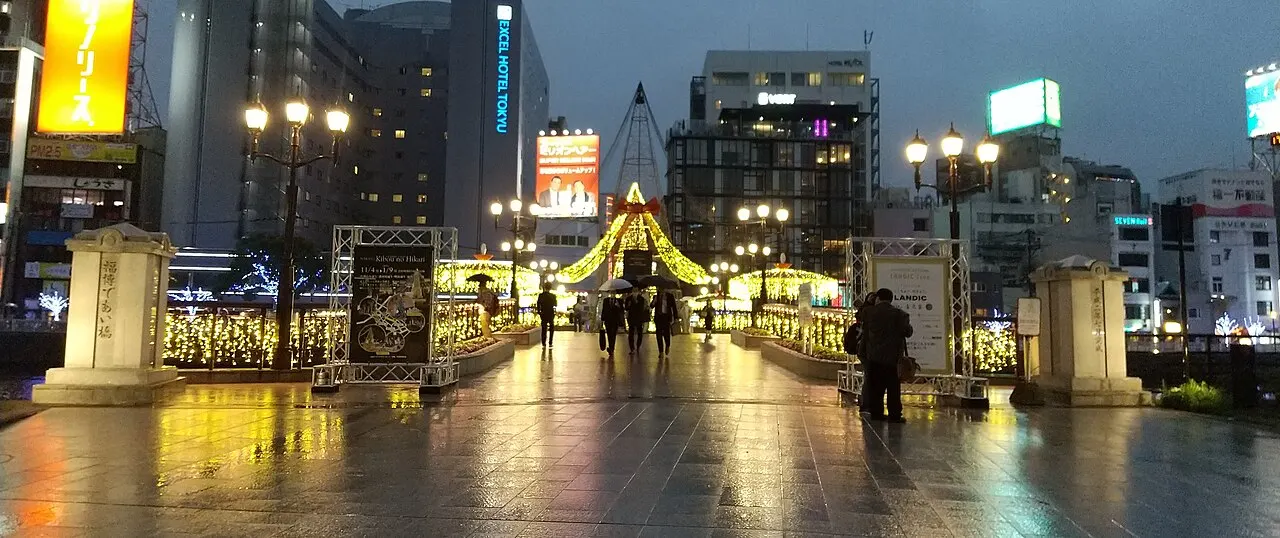
Fukuoka is the big city of Kyushu, in southern Japan: compact, with beach and mountains nearby. It is big enough to have everything and small enough to get around easily.
How is the city of Fukuoka organised? Fukuoka has two centres side by side: Hakata, with the bullet train station and the business district, and Tenjin, the commercial and nightlife heart, linked by a short subway stretch. Around them are quiet residential neighbourhoods, the river, the bay and the mountains.
What is surprising about living in Fukuoka? In Fukuoka, the yatai are a surprise: the street food stalls set up at night on the riverbank, and how easy life is.
🎯 Who is living in Fukuoka on the Working Holiday right for?
Fukuoka suits someone looking for a big but compact city, with beach and mountains nearby; it is not ideal for someone who wants to be close to Tokyo or Osaka.
| Fukuoka suits you if… | Fukuoka does not suit you if… |
|---|---|
| You want a big but compact city | You want a minimum wage like Tokyo's (¥1,280) |
| You want beach and mountains nearby | You do not cope well with humid heat: August reaches an average high of 32.5 °C |
| You prefer getting around by subway or bicycle | You want to be near Tokyo or Osaka |
🏆 What does Fukuoka have for living on the Working Holiday?
Fukuoka is well balanced: compact and with everything, beach and mountains nearby, the airport linked to the centre by the Kuko subway line and a mild winter, with an average high of 10.2 °C in January, according to JMA.
🌡️ What is Fukuoka's climate like, month by month?
Fukuoka has hot, humid summers, with an average high of 32.5 °C in August, and mild winters, with highs of 10.2 to 12.6 °C, and a lot of rain in June and July. For people coming from the southern hemisphere, the seasons are reversed.
| Month | Average high | Average low | Rain | Humidity |
|---|---|---|---|---|
| January | 10.2 °C | 3.9 °C | 74.4 mm | 63% |
| February | 11.6 °C | 4.4 °C | 69.8 mm | 62% |
| March | 15 °C | 7.2 °C | 103.7 mm | 63% |
| April | 19.9 °C | 11.5 °C | 118.2 mm | 64% |
| May | 24.4 °C | 16.1 °C | 133.7 mm | 67% |
| June | 27.2 °C | 20.3 °C | 249.6 mm | 75% |
| July | 31.2 °C | 24.6 °C | 299.1 mm | 75% |
| August | 32.5 °C | 25.4 °C | 210 mm | 72% |
| September | 28.6 °C | 21.6 °C | 175.1 mm | 73% |
| October | 23.7 °C | 16 °C | 94.5 mm | 68% |
| November | 18.2 °C | 10.6 °C | 91.4 mm | 66% |
| December | 12.6 °C | 5.8 °C | 67.5 mm | 63% |
🧭 What weather will you find in Fukuoka in the month you arrive?
Source: Japan Meteorological Agency climate normals for the Fukuoka station.
🗓️ What is the best month to arrive in Fukuoka on the Working Holiday?
The most comfortable months to arrive in Fukuoka are April, May, October and November, with highs of 18.2 to 24.4 °C, according to JMA; June and July are the rainiest, with 249.6 and 299.1 mm. December is the driest (67.5 mm).
- Spring (March to May): from 15 to 24.4 °C high.
- Summer (June to September): rain in June and July and 32.5 °C in August.
- Autumn (October and November): from 18.2 to 23.7 °C high, drier.
- Winter (December to February): mild, with lows of 3.9 to 5.8 °C.
💼 What work is there in Fukuoka on the Working Holiday?
In Fukuoka, on the Working Holiday, there is work in hospitality (yatai, ramen and izakayas), hotels, tourism, shops and language teaching. With some Japanese, more customer-facing jobs open up.
| Sector | Where | Japanese |
|---|---|---|
| Food service | Yatai, ramen shops and izakayas in Tenjin and Hakata | Basic for serving; none in the kitchen |
| Hotels | Hakata and Tenjin | Basic or English |
| Tourism | Hakata and Tenjin | Basic; languages add up |
| Shops | Tenjin | Basic conversation |
| Language teaching | English or Spanish | Basic or English |
Is Fukuoka a base for seasonal work in Kyushu? Yes: from Fukuoka you can get to seasonal work in the rest of Kyushu, in tourism and in the countryside.
🧭 What work can you do while living in Fukuoka?
Source: the Viaja con Gus guide to Fukuoka.
💴 What is the minimum wage in Fukuoka and how much is paid per hour?
The minimum wage in Fukuoka prefecture is ¥1,114 per hour since 4 October 2026, and no hourly job can pay less. It is lower than Tokyo's, ¥1,280, according to the same MHLW table.
| Work | Hourly pay |
|---|---|
| Fukuoka minimum wage | ¥1.114 |
| Shifts from 22:00 to 05:00 | At least 25% more |
🔎 Where to look for work in Fukuoka on the Working Holiday?
In Fukuoka, work is sought on Townwork, Baitoru and Indeed Japan, on GaijinPot and Jobs in Japan for English-language listings, and at Hello Work. You can also hand your CV in person to cafés, izakayas and hotels in Tenjin and Hakata.
- Townwork, Baitoru and Indeed Japan: the part-time job portals, in Japanese.
- GaijinPot and Jobs in Japan: English-language listings.
- Hello Work: the public employment agency, free of charge.
What do you need to get hired in Fukuoka? Ask your employer what they need to pay your salary; the requirements to open an account are at the Japan Post Bank guide and the My Number matter, at the Digital Agency.
🗣️ Which Japanese phrases help you look for work and a room in Fukuoka?
To look for work and a room in Fukuoka, five Japanese phrases are enough: saying you are looking for work, asking whether they are still hiring, saying you have brought your CV, asking whether you can see the room and how much the rent is.
| In English | In Japanese | How it sounds | Copy |
|---|---|---|---|
| I am looking for a part-time job | アルバイトを探しています | Arubaito o sagashite imasu | |
| Are they still hiring? | まだ募集していますか | Mada boshū shite imasu ka | |
| I brought my CV | 履歴書を持ってきました | Rirekisho o motte kimashita | |
| Can I see the room? | 部屋を見てもいいですか | Heya o mite mo ii desu ka | |
| How much is the rent per month? | 家賃は月いくらですか | Yachin wa tsuki ikura desu ka |
📍 Which Fukuoka neighbourhood is best to live in on the Working Holiday?
In Fukuoka, for the Working Holiday, Tenjin and Hakata are the central neighbourhoods; Ohori and Akasaka are green and quiet; Hakozaki is the residential and university area in the east; and Nishijin is near Momochi beach.
| Neighborhood | How it is | Who it suits |
|---|---|---|
| Tenjin (center) | The commercial and nightlife heart, with hospitality and shop jobs close by. Central. | For those working in hospitality or shops |
| Hakata | Around the bullet train station, a business and hotel area, very well connected to the airport by the Kuko line. | For those who need to get around a lot |
| Ohori / Akasaka | Next to Ohori park and the castle, elegant, green and quiet, with good cafés. | For those who prioritise a pretty, quiet neighbourhood |
| Hakozaki / Higashi-ku (east) | Residential and university area, well connected by subway and JR. | For those looking for a residential neighbourhood |
| Nishijin / Sawara-ku (west) | A quiet residential area near Momochi beach, with shopping streets. | For those who want to live near the sea |
🏠 How do you rent a room in Fukuoka on the Working Holiday?
In Fukuoka, the simplest option is a share house: a furnished room, with shared kitchen and bathroom and no guarantor. The price and contract vary by neighbourhood and operator: check them on each share house's page before booking. Living near the Kuko subway line connects you to the centre and the airport.
🚉 How do you get around Fukuoka on the Working Holiday?
Fukuoka is compact and the subway covers almost everything: the Kuko line links Tenjin, Hakata and the airport. The fare depends on the section. The city is flat and small, and a bicycle is useful for getting around. You do not need a car.
🪪 What paperwork do you need to do on arrival in Fukuoka on the Working Holiday?
On arrival in Fukuoka you need to register your address at your neighbourhood municipal office within 14 days of having somewhere to live, sign up for the national health insurance and open a bank account.
- 1Address registrationAt your neighborhood municipal office, with the residence card (or your passport, if at the entry you were told the card arrives later).
- 2National health insuranceDuring the same visit, at the municipal office.
- 3Bank accountJapan Post Bank is the easiest for someone who has just arrived.
- 4SIM card or mobile lineBanks and employers ask for it.
🛡️ What travel assistance (travel insurance) is best for living in Fukuoka on the Working Holiday?
For living in Fukuoka on the Working Holiday, travel assistance (travel insurance) is advisable from the day you leave your country: 50% OFF with GO! + an extra 20% OFF from Viaja con Gus.
🌎 Is there a Latin American community in Fukuoka?
To find Fukuoka's Latin American community, search for groups with the name of the city or of Kyushu and your nationality. Before paying for a room or accepting a job from there, check it in person.
🧭 Which cities near Fukuoka are worth looking at for work?
From Fukuoka, the nearest cities in this guide are in Chūgoku, with Hiroshima, and in Kansai, with Kobe, Osaka and Kyoto; Naha is to the south, in Okinawa.
📂 What should you have ready before travelling to Fukuoka on the Working Holiday?
Before travelling to Fukuoka on the Working Holiday you need six things: travel assistance (travel insurance), savings for the first month, a hostel for the first nights, share houses you have checked, a Japanese CV and a transport card.
✅ Checklist before travelling to Fukuoka on the Working Holiday
🪜 How do you settle in Fukuoka on the Working Holiday, step by step?
Settling in Fukuoka on the Working Holiday takes six steps: the hostel for the first nights, the share house, address registration, a bank account, the job portals and the CV handed out in Tenjin and Hakata.
- 1Book your first nights in a hostel in Hakata or TenjinWhile you look for a room and work.
- 2Look for a share house or guest houseNo guarantor or reikin, and furnished. Everything is within reach near the Kuko subway line.
- 3Register your address at your neighbourhood municipal officeWithin 14 days of having somewhere to live. That is also when you sign up for the national health insurance.
- 4Open a bank accountJapan Post Bank is the easiest bank for someone who has just arrived.
- 5Look for work on the job portalsTownwork, Baitoru and Indeed Japan; GaijinPot and Jobs in Japan for English-language listings.
- 6Hand out your CV in Tenjin and HakataIn cafés, izakayas and hotels.
⚠️ What mistakes should you avoid when settling in Fukuoka?
The two most common mistakes when settling in Fukuoka are living far from the subway and paying a deposit without seeing the room.
- Living far from the subway: the Kuko line connects everything.
- Paying a deposit without seeing the room: is never done.
📖 What do yatai, tonkotsu and rirekisho mean when living in Fukuoka?
To live in Fukuoka it helps to know fourteen Japanese terms: those for food and the city, for work and for renting.
- Street food stall (屋台)
- Yatai. Set up at night on the riverbank.
- Pork bone ramen (豚骨ラーメン)
- Tonkotsu rāmen. Pork-bone broth ramen.
- Fukuoka hotpot (もつ鍋)
- Motsunabe. Ordered to share.
- Hakata (博多)
- The area around the bullet train station, with business and hotels.
- Tenjin (天神)
- The shopping and nightlife centre.
- Kuko Line (空港線)
- Kūkō-sen. The subway line linking Tenjin, Hakata and the airport.
- Part-time work (アルバイト)
- Arubaito or baito. Hourly work paid by the hour.
- Japanese résumé (履歴書)
- Rirekisho. The one handed out in cafés, izakayas and hotels.
- Transport reimbursement (交通費)
- Kōtsūhi. What the employer pays for your trips to work.
- Share house (シェアハウス)
- Shea hausu. Furnished room with a shared kitchen and bathroom, no guarantor required.
- Traditional rental (賃貸)
- Chintai. The flat rented through a real estate agency.
- Deposit (敷金)
- Shikikin. The rental deposit, refunded when you leave.
- Gratitude money (礼金)
- Reikin. A payment to the landlord when you move in, which is not refunded.
- Guarantor (保証人)
- Hoshōnin. The person who answers for the rent; it can be replaced by a guarantee company.
➡️ What to do after choosing Fukuoka for the Working Holiday?
With Fukuoka chosen, the next steps are to book where to live, prepare the job search and draw up the budget.
🛂 What is the Japan Working Holiday like by citizenship?
The Working Holiday in Japan has a different quota, opening date and procedure depending on your citizenship: choose yours to see the requirements.
🧭 What guides are there for doing the Working Holiday in Japan?
The Viaja con Gus Working Holiday guides for Japan cover the full route: the form, first procedures, where to live, work, money and daily life.
📶 How to get internet, use a VPN and send money from Japan on the Working Holiday?
When you arrive you will need data to let people know you arrived, find accommodation and start looking for work. And when you work in another country, sooner or later you will want to send money home. This is what I use myself.
 Maya eSIMeSIM
You land and your phone already has data, without changing SIM or looking for wifi. With the code VIAJACONGUS you get a 10% discount.
See Maya Mobile plans → SurfsharkVPN
Connecting to hostel and airport wifi is not safe. With a VPN you protect your data, your passwords and your banking apps.
Learn about Surfshark → RemitlyTRANSFERS
Send money home in minutes and with low fees. With the code AMB6M8 you get USD 20 off your first transfer.
See discounts →Affiliate links: we earn a commission. Ad - paid Remitly Ambassador. The Remitly code applies to transfers from the countries where it operates: confirm in the app whether it applies in yours.
What is an eSIM and does it work for the Working Holiday in Japan? It is a virtual SIM that is installed from an app or a QR code, with no physical card. It gives you data as soon as you land, before you get a local number; afterwards many switch to a prepaid plan in the country to have their own number.
Is my phone compatible with eSIM for travel to Japan? Most iPhones from the XS onward and many recent Android phones are. Check it in your phone's settings before traveling and confirm that it is unlocked.
Do you need a local number on the Working Holiday in Japan? Yes, in the long run: the bank, employers and paperwork ask for it. The eSIM covers you for the first few days; after that get a SIM or a plan from the country.
What is a VPN for on the Working Holiday in Japan? To protect your data and your banking apps when you use wifi in hostels, airports or cafés, where anyone on the same network could see your traffic.
What is the cheapest way to send money home from Japan on the Working Holiday? A transfer service that shows the fee and the final amount before sending, generally cheaper than an international bank transfer.
❓ Frequently asked questions about living in Fukuoka on the Working Holiday
Where is there work in Fukuoka on the Working Holiday?
In Fukuoka, on the Working Holiday, there is work in hospitality (yatai, ramen and izakayas), hotels, tourism, shops and language teaching; with basic Japanese more customer-facing jobs open up.
What work there is →Do you need to speak Japanese to work in Fukuoka?
For customer-facing jobs, basic Japanese; without Japanese there is kitchen work, cleaning and English-language listings.
Which job suits you →What is the minimum wage in Fukuoka?
The minimum wage in Fukuoka is ¥1,114 per hour, the Fukuoka prefecture rate since 4 October 2026, according to the MHLW.
Minimum wage and pay →How much is paid per hour in an hourly job in Fukuoka?
An hourly job in Fukuoka cannot pay less than the prefecture minimum, ¥1,114 per hour; from 22:00 to 5:00 at least 25% more is paid.
Minimum wage and pay →Is Fukuoka's minimum wage lower than Tokyo's?
Yes: Fukuoka's minimum wage is ¥1,114 per hour and Tokyo's is ¥1,280, according to the MHLW table.
Minimum wage and pay →Where is work sought in Fukuoka?
In Fukuoka, work is sought on Townwork, Baitoru and Indeed Japan, on GaijinPot and Jobs in Japan, at Hello Work, and by handing out your CV in Tenjin and Hakata.
Where to look for work →What does Fukuoka have for living on the Working Holiday?
Fukuoka is the big city of Kyushu: compact, with beach and mountains nearby and a mild winter, with an average high of 10.2 °C in January, according to the Japan Meteorological Agency.
What Fukuoka has →Where is it best to live in Fukuoka on arrival?
On arrival in Fukuoka it is best to spend the first nights in a hostel in Hakata or Tenjin and then look for a share house in neighbourhoods such as Hakozaki, Nishijin or Ohori.
Neighborhoods →Which Fukuoka neighbourhood is near the beach?
In Fukuoka, Nishijin, in Sawara-ku, is near Momochi beach.
Neighborhoods →Do you need a car in Fukuoka?
No, you do not need a car in Fukuoka: the subway and a bicycle are enough to get around.
How to get around →How do you get from Fukuoka airport to the centre?
From Fukuoka airport to the centre you take the subway, on the Kuko line, which links the airport with Hakata and Tenjin.
How to get around →Can you ride a bike in Fukuoka?
Yes, you can ride a bike in Fukuoka: the city is flat and small.
How to get around →What are Fukuoka's yatai?
Fukuoka's yatai are the street food stalls that are set up at night on the riverbank.
What living in Fukuoka is like →How hot is Fukuoka in summer?
In Fukuoka, in summer, the average high in August is 32.5 °C, with 72% humidity, according to the Japan Meteorological Agency climate normals.
The climate, month by month →Is it cold in Fukuoka in winter?
Fukuoka's winter is not very cold: in January the average high is 10.2 °C and the average low 3.9 °C.
The climate, month by month →Which is Fukuoka's rainiest month?
Fukuoka's rainiest month is July, with 299.1 mm; June has 249.6 mm.
The climate, month by month →Is there a Latin American community in Fukuoka?
To find Fukuoka's Latin American community, search for groups with the name of the city or of Kyushu and your nationality, and check any room or job offer in person.
Latin community →What travel assistance (travel insurance) suits living in Fukuoka on the Working Holiday?
For living in Fukuoka on the Working Holiday, travel assistance (travel insurance) is advisable from the day you leave your country: 50% OFF with GO! + an extra 20% OFF from Viaja con Gus.
Traveler assistance (travel insurance) →What paperwork do you need to do on arrival in Fukuoka?
On arrival in Fukuoka you have to register your address at the city office within 14 days of having somewhere to live, enrol in the national health insurance and open a bank account.
Paperwork on arrival →Which cities are near Fukuoka?
From Fukuoka, the nearest cities in this guide are Hiroshima, in Chūgoku, and Kobe, Osaka and Kyoto, in Kansai; Naha is to the south, in Okinawa.
Nearby cities →
💬 Comments and questions: Living in Fukuoka on the Working Holiday
There are no comments yet. Be the first.
Do you have any doubts? Leave your question down here and I will answer you personally. And if you have already been through this, tell us how it went: your experience helps the next traveler.
🛠️ Working Holiday tools
📚 More Working Holiday guides
📑 Sources on living in Fukuoka on the Working Holiday
See sources ▾
- Japan Meteorological Agency (JMA): climate normals for Fukuoka
- Ministry of Health, Labour and Welfare (MHLW): minimum wage by prefecture
- e-Gov: Labor Standards Act, Article 37 (surcharge from 22:00 to 05:00)
- Immigration Services Agency (ISA): address registration within 14 days
- Viaja con Gus: guides to Japan's 14 cities
- Japan Post Bank: guide to opening an account (in English)
- Japan Digital Agency: My Number (in English)
Last verification: November 2026. Rules, quotas and amounts change often: always confirm with the official source before starting any procedure. How we verify →

I worked in tourism in Argentina, Brazil, Paraguay, Croatia and the United States. I verify every fact in this guide against the official source and update it when it changes.
