GO! Assistance has 50% off in October and, with our link, you get an extra 20%.
Pick origin, destination, dates and ages and see the price of your travel assistance in a minute.
Affiliate link: we earn a commission.
The Magnetic Pole is one of the most popular curiosities in the Dominican southwest: a stretch of mountain road in Barahona province, near the town of Polo, where vehicles seem to climb the slope on their own, without accelerating. If you put the car in neutral at the marked spot, it looks like it rolls uphill, as if drawn by some mysterious force.
For a long time the phenomenon was blamed on a supposed magnetic pull from the ground, hence the name. In reality, as with other 'magnetic hills' around the world, it's an optical illusion: the lay of the landscape and the lack of clear horizontal references trick the eye, and what looks like an uphill is really a slight downhill. The effect, though, is very convincing and great fun.
It's a brief but eye-catching stop, ideal to combine with a tour of Barahona's mountain country, known for its coffee, its green landscapes and its closeness to the coast and the southwestern parks. This guide gathers the practical side of visiting: how to get there, what to expect and what to pair it with.
The Magnetic Pole became famous as a roadside attraction thanks to the apparent phenomenon of cars that 'climb on their own'. Popularly attributed to magnetism, it's actually an optical illusion of the terrain, like other magnetic hills around the planet. It sits near the town of Polo, in the coffee-growing area of the Barahona range. The full story is on our history page.
Read the full history ↓The pearl of the deep south: a town founded by Toussaint Louverture in 1802, land of sugar, high-altitude coffee and larimar, the rare blue stone of the Caribbean, a step away from Bahía de las Águilas and the Sierra de Bahoruco.
Read the history of Barahona →They depart from Bahia De Las Aguilas, 34 km away. Affiliate link: we earn a commission.
Abroad, getting sick is more than a bad day. In many destinations public healthcare depends on appointments, queues and availability, and private care is paid upfront. An emergency can cost thousands of USD, right when you are far from home and on a tight budget. That is why I recommend you never leave without travel assistance.
I recommend GO! Assistance because it covers what matters: medical care, emergencies, medication and hospitalization depending on the plan. It protects you 24 hours a day, anywhere in the world, with real-time solutions on the ground. GO! 365 ECO and GO! 365 give you USD 45,000 of global coverage: the first with a USD 100 deductible, the second with none.
If you quote from Argentina, in October GO! also offers 12 interest-free instalments on all its products.
GO! Assistance has 50% off in October and, with our link, you get an extra 20%.
Pick origin, destination, dates and ages and see the price of your travel assistance in a minute.
I have never been left without internet on a trip. I land and my phone connects to the strongest network in the country I am visiting: I can let people know I arrived, sort out transport, book tours and keep posting content at a super affordable price (really cheap!). I always use the Maya Mobile eSIM, check out its plans by clicking the banner. See Maya Mobile plans →
Affiliate link: we earn a commission.
No exact prices: a scale from $ (budget) to $$$$$ (luxury), with 2-3 options per category.
Origins, formation and what the sources say.
Turn off the engine, put the car in neutral and release the brake. On any other slope in the world, the vehicle would roll backward. Here, on a lost stretch of the mountain road that climbs to the town of Polo, in Barahona province, exactly the opposite happens: the car begins to move slowly forward, uphill, as if an invisible hand were pulling it. The first time you see it, your skin prickles. The second time, you're already filming the video to show the whole world. Welcome to the Magnetic Pole, the most famous roadside curiosity in the Dominican southwest.
The effect has been tested over the years with all kinds of objects: cars, motorcycles, bicycles and even water bottles set on the ground that 'roll' uphill, against all logic. The surprise it sparks in those who experience it for the first time turned the place into a popular attraction, especially among Dominicans touring the southwest on a weekend. The name 'Magnetic Pole' arose precisely from the popular belief that some kind of magnetic force underground was responsible for the marvel, an explanation that has passed by word of mouth for decades.
Over time, the site became part of Barahona's tourist circuits, alongside the pebble beaches of the coast, the waterfalls and the coffee country of the range. Today it's an almost obligatory stop for anyone passing through the region, one of those roadside curiosities that generate photos, videos and the inevitable after-dinner argument about what's really going on. And the answer, as we'll see, is as fascinating as the legend, if not more so.
Despite its name, the Magnetic Pole has nothing to do with magnetism. The phenomenon belongs to a category well known around the world: the so-called 'magnetic hills', 'gravity hills' or 'gravity hills', of which there are examples in numerous countries. In every case, what looks like a physical mystery is actually an optical illusion.
The mechanism is this: in these places, the surroundings lack reliable horizontal references. The horizon is hidden or tilted, the trees grow crooked from the wind or the slope, and the general layout of the terrain fools the brain when it comes to judging what is flat, what goes up and what goes down. As a result, the eye perceives as 'uphill' what is really a slight 'downhill'. The car that seems to climb on its own is simply rolling downhill on a gentle slope that our perception reads in reverse.
Measurements with levels, surveying instruments or GPS carried out on various magnetic hills around the world have confirmed this explanation time and again. Knowing it doesn't take the fun out of the phenomenon: the effect remains convincing and entertaining, precisely because it lays bare the limits of our perception. In that sense, the Dominican Magnetic Pole is a small natural laboratory of the psychology of vision, disguised as a roadside mystery.
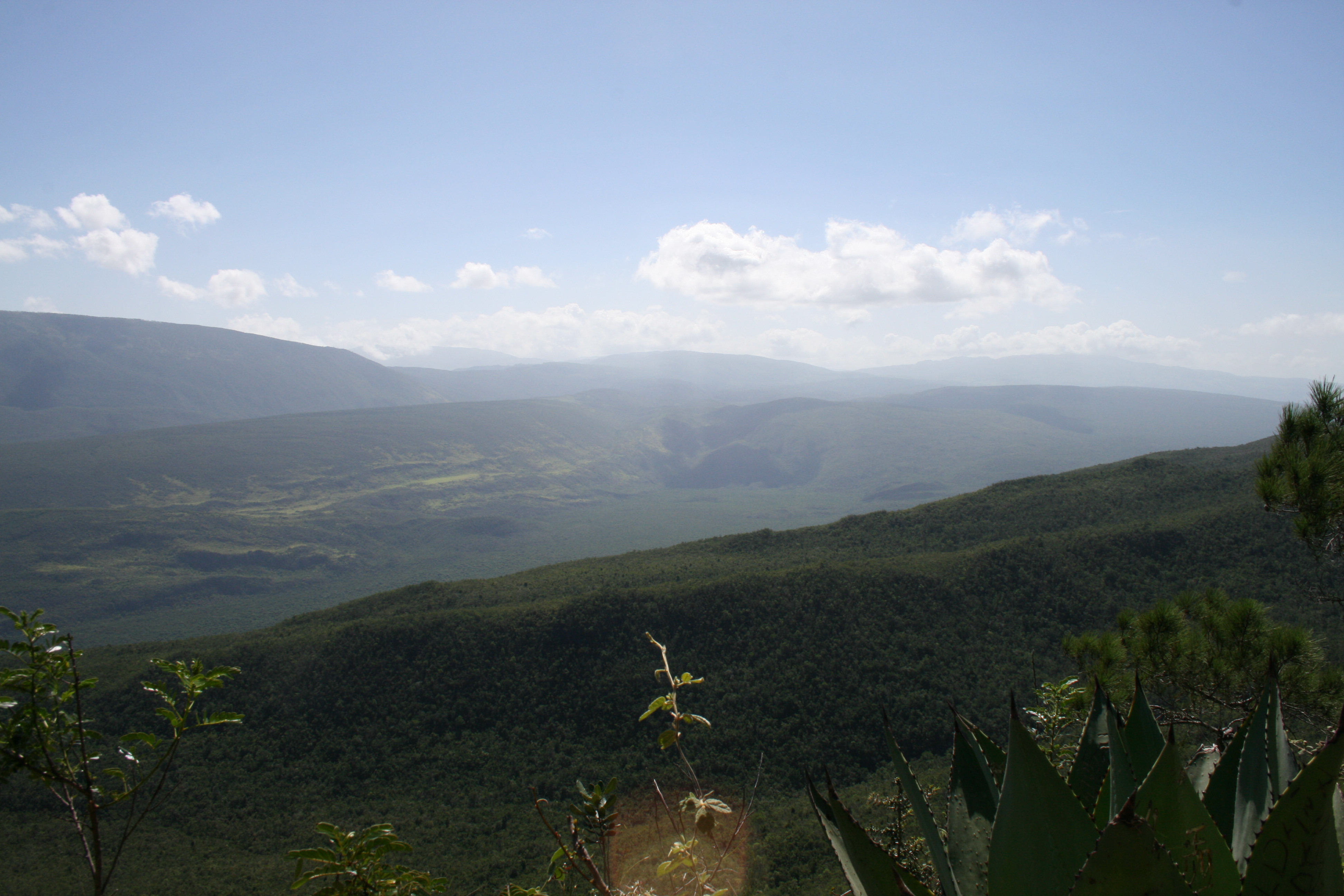
The Magnetic Pole can't be fully understood without its surroundings: the town of Polo and the mountains of the Barahona range, a region of cool climate, mist and lush vegetation that contrasts with the aridity of much of the Dominican southwest coastline. This altitude and this climate have made the area one of the country's traditional coffee-growing zones.
Polo is known for its coffee, largely organic, driven by local cooperatives that have worked to improve the quality and recognition of their product. Coffee became the economic and cultural hallmark of the area, to the point that the region holds an Organic Coffee Festival that gathers growers, visitors and the curious around this farming tradition.
And so what for many visitors begins as a stop to see 'the car that climbs on its own' often turns into the discovery of a green and cool corner of Barahona, with its coffee plantations, its overlooks and its mountain-town life. The Magnetic Pole is thus also a gateway to a lesser-known face of the southwest: that of the range, the coffee and the temperate climate, just a few kilometers from the hot Caribbean of the coast.
The Magnetic Pole can't be understood in isolation from the broader context of Barahona province and the Dominican southwest, a region that historically stayed on the margins of the country's great tourism development, concentrated in the white-sand beaches and big resorts of the east. The southwest, by contrast, offers a different profile: mountain landscapes, pebble beaches, saltwater lakes, semiprecious-stone mines and exceptional biodiversity, all with more modest tourist infrastructure and a much more gradual development.
In recent decades, as worldwide interest grew in nature tourism, adventure and authentic experiences away from the mass circuits, Barahona and its surroundings —including Polo's coffee country— began to attract a different kind of traveler: curious, interested in ecology, geography and local traditions, willing to travel mountain roads to reach places like Lake Enriquillo, the Larimar mines or, precisely, the Magnetic Pole.
This roadside curiosity thus became one more piece of a regional tourist circuit in the making, combining nature, geology, coffee culture and curious phenomena. Its free and accessible character —no entry fee or reservation required— turned it into an almost obligatory stop for those exploring the southwest, working as a kind of friendly and memorable gateway to a region that still preserves much of its genuine, uncrowded character.
The Dominican Magnetic Pole is no unique oddity: it belongs to a family of phenomena spread across the planet, known in English as 'gravity hills', 'magnetic hills' or 'mystery spots'. There are famous examples in India (Magnetic Hill, near Leh), in Scotland (the Electric Brae in Ayrshire), in the United States (Confusion Hill and Spook Hill), in South Korea, in Australia and on dozens of roads across Latin America. In all of them the story is the same: cars that climb on their own, water that flows 'uphill' and a local legend that speaks of magnetism, energies or inexplicable forces.
The charm of the Magnetic Pole is that anyone can debunk the mystery with their own hands, right there, without expensive instruments. The most classic trick is to pour water from a bottle and watch which way it really runs: it will always flow toward the true low point, which is usually the exact opposite of the one the eye marks as 'down'. Another test is to open the level or compass app on your phone, or check the altitude on Google Maps GPS before and after 'climbing': the number, invariably, drops. The landscape deceives; the numbers don't.
That doesn't take away one bit of its charm. On the contrary: understanding that the Magnetic Pole is actually a perfect demonstration of how the human brain interprets the world —and how easy it is to fool it when it lacks references— makes it even more interesting. It is, at heart, a little open-air science museum, free and open 24 hours, in the middle of the coffee country of Barahona. That's why it works so well as a stop: it entertains those who believe it and fascinates those who understand why it works.