GO! Assistance has 50% off in October and, with our link, you get an extra 20%.
Pick origin, destination, dates and ages and see the price of your travel assistance in a minute.
Affiliate link: we earn a commission.
The Reserva Natural Estero Padre Ramos is one of the best preserved mangroves on the whole Nicaraguan Pacific coast, a labyrinth of brackish-water channels, mangrove forests and islands stretching across the Padre Ramos peninsula, in the far northwest of the country, in the department of Chinandega. Protected since 1983, it covers dozens of square kilometres of estuary and is a crucial refuge for waterbirds, crabs, molluscs and, above all, for the sea turtles that come to nest on its beaches.
Unlike the mass destinations of the southern Pacific, Padre Ramos keeps a calm atmosphere of fishing villages and community tourism. The nearby beach of Jiquilillo (about 9 km away) and the community of Padre Ramos itself serve as a base for exploring the estuary by kayak or boat, gliding through mangrove tunnels where the only thing breaking the silence is birdsong. It is a destination for those looking for nature, calm and genuine contact with local communities.
This guide covers the essentials of the reserve with a practical eye: how to tour the estuary by kayak, where and when to see turtles nesting, what the mangrove ecosystem it protects is like, where to stay and eat in the area and how to get there from Chinandega. Padre Ramos is, above all, a conservation destination, where responsible tourism coexists with artisanal fishing and sea turtle protection projects.
The Padre Ramos estuary was declared a nature reserve in 1983, within Nicaragua's system of protected areas, to conserve one of the largest and best preserved mangroves of the Central American Pacific. Its name evokes a priest from local tradition. For decades the area lived from artisanal fishing and harvesting shellfish from the mangrove; since 2010, conservation and community tourism projects, together with the protection of the hawksbill turtle (with more than 25,000 hatchlings released by the local programmes), have shaped its direction. The full story is on our history page.
Read the full history ↓Nicaragua's hot west between volcanoes and mangroves: land of the Maribios range, of cotton and rum, with the country's highest volcano, the explosive Cosigüina, unspoilt beaches and the port of Corinto.
Read the history of Chinandega →They depart from Leon, 80 km away. Affiliate link: we earn a commission.
Abroad, getting sick is more than a bad day. In many destinations public healthcare depends on appointments, queues and availability, and private care is paid upfront. An emergency can cost thousands of USD, right when you are far from home and on a tight budget. That is why I recommend you never leave without travel assistance.
I recommend GO! Assistance because it covers what matters: medical care, emergencies, medication and hospitalization depending on the plan. It protects you 24 hours a day, anywhere in the world, with real-time solutions on the ground. GO! 365 ECO and GO! 365 give you USD 45,000 of global coverage: the first with a USD 100 deductible, the second with none.
If you quote from Argentina, in October GO! also offers 12 interest-free instalments on all its products.
GO! Assistance has 50% off in October and, with our link, you get an extra 20%.
Pick origin, destination, dates and ages and see the price of your travel assistance in a minute.
I have never been left without internet on a trip. I land and my phone connects to the strongest network in the country I am visiting: I can let people know I arrived, sort out transport, book tours and keep posting content at a super affordable price (really cheap!). I always use the Maya Mobile eSIM, check out its plans by clicking the banner. See Maya Mobile plans →
Affiliate link: we earn a commission.
No exact prices: a scale from $ (budget) to $$$$$ (luxury), with 2-3 options per category.
Origins, formation and what the sources say.
On a lost beach in northwestern Nicaragua a statistical miracle occurs each year: almost half of all the hawksbill turtles that nest in the eastern Pacific Ocean —from Mexico to Peru— choose to nest here, in the Padre Ramos estuary. That such a small, anonymous corner concentrates such a fraction of a critically endangered species says a lot about the hidden richness of this mangrove, and explains why egg gatherers who for generations lived from raiding the nests ended up becoming their guardians. But the history of Padre Ramos begins long before the turtles.
The estuary is part of a vast system of wetlands and mangroves that stretches along the northwest coast of Nicaragua, in the department of Chinandega, near the border with Honduras. These mangroves formed over millennia at the mouth of waterways descending from the Maribios volcanic range, where the fresh water mixes with the Pacific tide, creating a brackish environment of enormous biological richness. The result is one of the most extensive and best-preserved mangrove forests on the Pacific coast of all Central America.
Long before any legal protection status, the Indigenous and then peasant and fishing communities of the area lived from the estuary's resources: fish, shrimp, black cockles, oysters and crabs that the mangrove provides in abundance. Shellfish gathering and artisanal fishing shaped a riverside culture that still today defines the identity of the estuary's communities. The mangrove was not only a pantry, but also a natural barrier against storms and a nursery for countless marine species that sustain the fishing of the whole region.
The name Padre Ramos refers, according to local tradition, to a priest tied to the history of the area. Whatever its exact origin, the place name stuck to the estuary and the main community, giving its name today to the whole protected area. Understanding Padre Ramos requires first recognizing this long relationship between the people and the mangrove, prior to any tourism or conservation project.
The Estero Padre Ramos was declared a nature reserve in 1983, within the process of creating Nicaragua's National System of Protected Areas, which sought to put the country's most valuable ecosystems under legal protection. The declaration recognized the exceptional value of the mangrove as a critical habitat for resident and migratory birds, a nursery for marine species and, notably, a sea-turtle nesting site. The reserve spans the estuary itself, the Padre Ramos peninsula and the adjacent beaches.
The legal protection, however, did not immediately resolve the pressures on the ecosystem. The felling of mangrove for firewood and construction, the overexploitation of shellfish, the advance of the agricultural frontier and, especially, the poaching of turtle eggs, were persistent threats for decades. The management of the area was entrusted to the Ministry of the Environment and Natural Resources (MARENA), which with limited resources had to seek the collaboration of the communities and conservation organizations to make the protection effective.
Over time it was understood that the conservation of the estuary would only be viable if the local communities became allies and direct beneficiaries. So a participatory management model gained ground, in which the protection of the mangrove and the turtles was linked to the development of sustainable economic alternatives, like community tourism and ecotourism, instead of relying only on prohibition.
The discovery that the beaches of Padre Ramos held one of the largest concentrations of hawksbill turtle (Eretmochelys imbricata) nesting in the eastern Pacific transformed the reserve's destiny. The hawksbill is a species classified as critically endangered worldwide, historically hunted for its shell, from which the coveted tortoiseshell was obtained. Confirming that Padre Ramos was a key refuge for this species turned the estuary into a priority site for regional conservation.
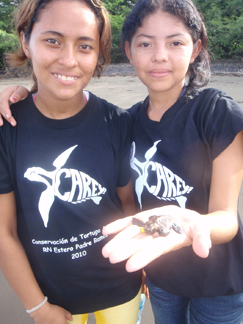
From the 2000s and 2010s, conservation organizations, in alliance with the local communities, promoted programs to protect the nests, monitor the beaches during the nesting season and reduce egg poaching, offering the former gatherers incentives to become guardians of the turtles. These projects managed to significantly increase the number of protected nests and hatchlings released to the sea, making Padre Ramos an emblematic case of community-based conservation.
In parallel, community tourism flourished in Jiquilillo and Padre Ramos: eco-lodges, kayak tours of the mangrove, birdwatching and volunteering activities around the turtles. This model seeks to have the visitor not only enjoy a pristine mangrove, but also contribute directly to its conservation and to the well-being of the families who live from the estuary. Today Padre Ramos represents, on the northwest coast of Nicaragua, an example of how nature, artisanal fishing and responsible tourism can coexist.
Beyond its scenic value, the Padre Ramos mangrove performs ecological functions that explain why it has been the object of so much scientific and conservationist interest. Mangrove forests act as natural nurseries for much of the marine species that sustain the fishing of the Nicaraguan Pacific: shrimp, fish and mollusks spend their first life stages protected among the stilt roots of the red mangrove, before migrating toward the open sea. Without that natural nursery, much of the region's coastal fishery would not be viable.
The estuary also functions as a natural sponge against extreme climate events: it absorbs the impact of surges and storms, retains sediments and protects the coastline from erosion. In a Central American region increasingly exposed to hurricanes and to the sea-level rise associated with climate change, this natural-barrier function has taken on growing importance in the environmental studies about Padre Ramos.
To this is added its value as a biodiversity refuge: dozens of species of resident and migratory birds —many of them coming from North America during the boreal winter— depend on the estuary as a feeding and resting site. This combination of ecosystem services (fishery nursery, coastal protection and bird refuge) is what sustains, to this day, the protected-area status of Padre Ramos within the Nicaraguan national system.
Today, Padre Ramos represents a balance still under construction between the traditional life of its fishing communities and the new opportunities that nature tourism offers. The families who for generations lived exclusively from artisanal fishing and shellfish gathering have increasingly incorporated activities tied to ecotourism: guiding kayak tours, lodging visitors in small community lodges, taking part in turtle monitoring or selling home cooking to the tourists who come to the area.
This process has not been free of challenges. The region's infrastructure remains limited, access along dirt roads can get tricky in the rainy season, and tensions persist between the need to generate immediate income —sometimes at the cost of unregulated extraction of mangrove resources— and the long-term conservation goals. However, the combination of international recognition (for example, through sea-turtle conservation programs with partners like Fauna & Flora International) and the growing interest of travelers in responsible tourism has helped consolidate more sustainable economic alternatives.
Today, Padre Ramos is among the least crowded nature destinations of the Nicaraguan Pacific, prized by those seeking a genuine experience of contact with the mangrove, the fishing communities and the wildlife, far from the busier tourist circuits of the country. Its history —from ancestral mangrove to protected reserve and, finally, to a model of community conservation— continues to be written with each nesting season and each visitor who paddles among its channels.