GO! Assistance has 50% off in October and, with our link, you get an extra 20%.
Pick origin, destination, dates and ages and see the price of your travel assistance in a minute.
Affiliate link: we earn a commission.
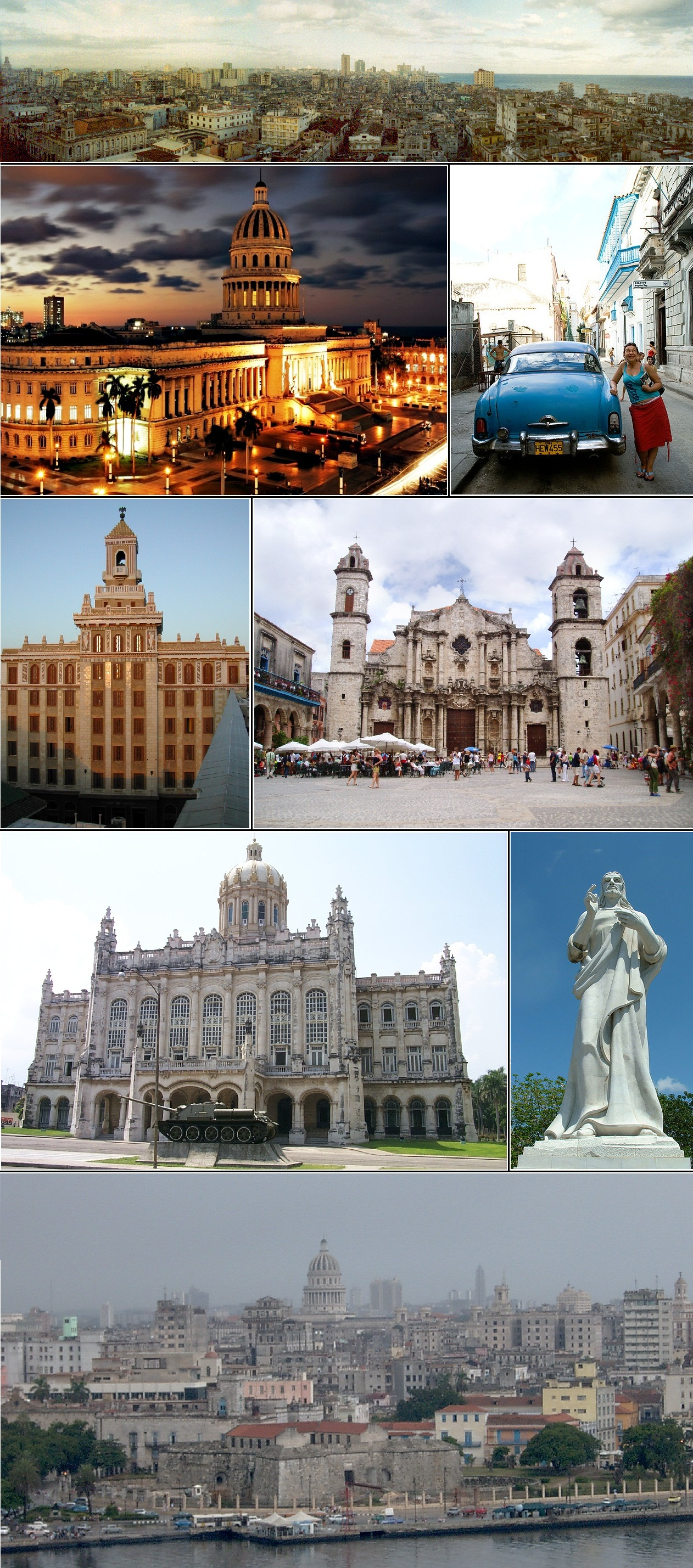
Havana is one of those cities that seem frozen in time and, at the same time, full of life. It's the capital of Cuba and its largest city, founded by the Spanish in the 16th century on the shore of a bay that made it the 'key to the Gulf': the port where the Spanish fleet gathered before crossing the Atlantic. Today you walk through Old Havana among colonial squares, faded palaces, 1950s American cars and music pouring out of every window. That mix of beautiful decay and contagious energy is what makes the city unique.
The historic center, declared a World Heritage Site by UNESCO in 1982, is organized around four great squares (Cathedral, Armas, San Francisco de Asís and Vieja) and a system of fortresses that guarded the entrance to the port. Beyond the old town, Havana stretches along the seafront Malecón, the Paseo del Prado, the monumental avenue of Vedado and the enormous Plaza de la Revolución. It's a city for walking a lot, sitting to watch and letting yourself be carried along.
An important note before you travel: in Cuba several forms of payment coexist and prices can vary enormously depending on the currency. The official currency is the Cuban peso (CUP), but many services for tourists are priced in dollars (USD) or euros, and there are MLC (freely convertible currency) stores. Cards issued by U.S. banks don't work because of the embargo, so it's best to arrive with cash. In this guide, all the prices we give are for reference and specify the currency; the real values may change and it's best to confirm them at the time.
The town of San Cristóbal de La Habana was founded in 1514 by Pánfilo de Narváez, under orders from Diego Velázquez, and after a couple of relocations settled definitively next to the bay around 1519. The name unites the patron saint, San Cristóbal, with 'Habana', linked to the Taíno cacique Habaguanex who dominated the area. Its port made it the gathering point of the fleet of the Indies and, for that very reason, a target of pirates and corsairs, which led to the building of a powerful system of fortresses. Capital of Cuba since 1607, it lived through the sugar wealth of the 19th century, the wars of independence and the whole turbulent 20th century. The full history, with its legends and versions, is on the history page.
Read the full history ↓Some places make no sense on your own; with someone explaining them, they change completely. We look ours up on Civitatis: guided in Spanish and booked online with no fuss. They have over 20 activities in La Habana. And there are free tours here: you book without paying and tip the guide whatever you think at the end, so trying one costs you nothing. Three are below so you get the idea: tap any of them and they all open.
Affiliate link: we earn a commission. Prices and availability come from Civitatis.
Abroad, getting sick is more than a bad day. In many destinations public healthcare depends on appointments, queues and availability, and private care is paid upfront. An emergency can cost thousands of USD, right when you are far from home and on a tight budget. That is why I recommend you never leave without travel assistance.
I recommend GO! Assistance because it covers what matters: medical care, emergencies, medication and hospitalization depending on the plan. It protects you 24 hours a day, anywhere in the world, with real-time solutions on the ground. GO! 365 ECO and GO! 365 give you USD 45,000 of global coverage: the first with a USD 100 deductible, the second with none.
If you quote from Argentina, in October GO! also offers 12 interest-free instalments on all its products.
GO! Assistance has 50% off in October and, with our link, you get an extra 20%.
Pick origin, destination, dates and ages and see the price of your travel assistance in a minute.
I have never been left without internet on a trip. I land and my phone connects to the strongest network in the country I am visiting: I can let people know I arrived, sort out transport, book tours and keep posting content at a super affordable price (really cheap!). I always use the Maya Mobile eSIM, check out its plans by clicking the banner. See Maya Mobile plans →
Affiliate link: we earn a commission.
No exact prices: a scale from $ (budget) to $$$$$ (luxury), with 2-3 options per category.
Origins, formation and what the sources say.
Havana was not born where we know it today. The town of San Cristóbal de La Habana was founded in 1514 by the conquistador Pánfilo de Narváez, under the orders of Diego Velázquez de Cuéllar, as part of the founding of the first seven Spanish towns in Cuba. But its first location was not next to the current bay, but on the south coast of the island, an unhealthy and impractical area, near the mouth of the river now associated with the Mayabeque region.
Due to the poor conditions of the first settlement (mosquitoes, lack of a good harbor), the town was relocated a couple of times. There was an intermediate site on the north coast, in the La Chorrera area, beside the Almendares river, until it finally moved to its definitive location on the shore of the magnificent bay of the north coast. Havanans take as the symbolic founding date of the city November 16, 1519, the day on which, according to tradition, the first Mass was celebrated beside a ceiba (a sacred tree for many cultures) at the point that today occupies the Plaza de Armas.
That origin was forever marked in El Templete, a small neoclassical monument raised in 1828 next to the Plaza de Armas, at the place where that first Mass and town council are said to have been held. A ceiba still grows there, replanted from time to time, that every November 16 gathers thousands of Havanans who walk around it three times making wishes. It's one of the city's most beloved traditions and connects the present with that founding act of five centuries ago.
The final choice of the site was no accident: that 'pocket' bay, with a narrow entrance and deep, sheltered waters, was one of the best natural harbors in the whole Caribbean. That geography, more than any administrative decision, would end up defining Havana's destiny as a great port of the Spanish empire.
The city's full name, San Cristóbal de La Habana, unites two worlds. 'San Cristóbal' (Saint Christopher) is the patron saint chosen by the Spanish to name the town (indeed, the image of San Cristóbal presides over the city's cathedral today). 'La Habana', on the other hand, comes from the indigenous world that the conquistadors found on their arrival, and several explanations coexist about its exact origin.
The most widespread version links the name to the Taíno cacique Habaguanex, who is said to have dominated the region where the town settled. 'Habana' would then be a form derived from the name of that indigenous lord or of his territory. Other interpretations relate the word to the Taíno language in a more geographic sense, associating it with ideas like 'place of waters' or 'savanna', because of the abundance of rivers, lagoons and the bay that characterized the area. As with so many American place names, the indigenous and the Spanish merged into a single name.
Whatever the precise etymology, what matters is what the name symbolizes: the encounter (and the clash) between Cuba's original Taíno culture and the arrival of the Spanish. The island's original peoples were decimated in the first decades of colonization, but they left their mark on the place names, on some words and on the Cuban imagination. The capital's name is, in itself, a small monument to that mixed origin.
What transformed a modest town into one of the most important cities of the Spanish empire was its port. Throughout the 16th century, the crown organized trade with the Americas through the fleet system: the ships laden with silver, gold and products of the New World did not cross the Atlantic on their own, but gathered in great escorted convoys to protect themselves from pirates. And the point where those convoys concentrated before setting out for the return to Spain was, precisely, Havana.
The reason was pure geography. The Havana bay offered a safe refuge, water, provisions and repairs, and it was located at the natural outlet of the Gulf of Mexico toward the Atlantic, taking advantage of the Gulf Stream that pushed the ships back to Europe. Here passed the Fleet of New Spain (from Veracruz) and the Galleons of Tierra Firme (from Panama and Cartagena), which gathered in the port and sailed together. Havana thus became the 'key to the Gulf' and the 'key to the New World', a role the crown officially recognized: toward the end of the 16th century it was granted the title of city and, in 1607, it became the capital of the island of Cuba, displacing Santiago.
That strategic role gave Havana an importance and a wealth that went far beyond its size. Shipyards, warehouses, shops and services grew around the traffic of the fleets. But the very wealth that passed through its port made it a coveted target: where there was silver, there were also corsairs and pirates willing to take it. Defending that port became a matter of state for the Spanish monarchy, and that necessity would, literally, shape the city.
Fame and wealth have their price. Being the port where the treasure of the Indies gathered, Havana was from very early on a target of attacks. One of the most famous occurred in 1555, when the French corsair Jacques de Sores seized and sacked the town, which was then practically defenseless, and burned much of it. Episodes like that left a clear lesson: without defenses, the most valuable port in the Caribbean was at the mercy of any enemy expedition.
The crown's response was to turn Havana into a fortified stronghold. The Castillo de la Real Fuerza was raised, one of the oldest stone fortresses in the Americas. And, above all, the two great fortresses that guard the bay entrance were built: the Castillo de los Tres Reyes del Morro (raised between the late 16th and early 17th centuries), perched on the rocks of the harbor mouth with its unmistakable lighthouse, and the Castillo de San Salvador de la Punta, across from it, on the other side of the entrance. Between the Morro and the Punta a thick chain was strung at night to close access to the bay. The firing of a cannon announced that closing: it's the origin of the tradition of the nine o'clock cannon shot, still reenacted today.
The blow that ended up defining the defenses came in 1762, when an enormous British expedition, with dozens of ships and thousands of soldiers, besieged and took Havana after several weeks of siege. The city remained in English hands for almost a year, until it was returned to Spain in 1763 in exchange for Florida, as part of the treaty that ended the Seven Years' War. That humiliation convinced the crown that the city had to be armored: between 1763 and 1774 the Fortress of San Carlos de la Cabaña was built, an immense defensive mass on the hill that dominates the bay, considered the largest Spanish military complex in all of the Americas. All that ensemble of walls and castles is, today, an essential part of Havana's heritage value.
The 19th century was the one of the great economic transformation of Cuba and its capital. After the independence of Haiti, which until then was the world's largest sugar producer, Cuba took that place and experienced a genuine sugar boom. The island filled with mills and cane plantations, and became one of the richest colonies on the planet. That wealth was based, in large part, on the labor of hundreds of thousands of enslaved people brought from Africa, whose culture would leave a deep and lasting mark on Cuban identity, still present in the music, the religion and daily life.
Havana was the great beneficiary and the showcase of that prosperity. Through its port left the sugar (and the tobacco and coffee) that enriched the creole oligarchy, and in came the goods and fashions of Europe. The city modernized and beautified itself: the old walls that encircled it were torn down, new promenades like the Prado were laid out, palaces, theaters and mansions were built, and in 1837 the first railway in all of Latin America was inaugurated, precisely to transport the sugar from the fields to the port. The Havana of the 19th century was an opulent, cosmopolitan city in full expansion beyond its colonial precinct.
That same prosperity, however, fed tensions. The wealth generated by slavery and colonial rule clashed with the ideas of freedom and independence that were sweeping across the Americas. The creole elite, increasingly powerful but without real political power against the metropolis, and the growing consciousness among the enslaved and free population of color, gradually created the breeding ground for the struggles that would mark the end of the century: the wars for Cuba's independence.
The road to Cuba's independence was long and costly. It began with the Ten Years' War (1868-1878), started by Carlos Manuel de Céspedes (the 'Father of the Homeland', whose statue presides over the Plaza de Armas today), and continued with the definitive war begun in 1895, inspired by the ideals of José Martí, the Cuban national hero, poet and politician who died that same year in combat. Cuba was fighting to free itself from Spanish rule, Spain's last great colonial bastion in the Americas along with Puerto Rico.
Havana was the scene of an episode that changed the course of history: in February 1898, the American battleship USS Maine exploded and sank in its bay, with the death of most of its crew. The cause was never entirely clear, but the event served as a trigger for the United States to enter the war against Spain. The Spanish defeat sealed the end of the empire: by the 1898 treaty, Spain gave up Cuba. After a few years of U.S. occupation and intervention, on May 20, 1902 the Republic of Cuba was proclaimed, with Havana as its capital, though under strong U.S. tutelage.
Havana's 20th century was intense and contradictory. The city grew, modernized and filled with cars, hotels, cabarets, art deco and, later, modernist buildings; it was a destination for international tourism, with its nightlife, its casinos and its fame as a capital of pleasure in the 1940s and 1950s. Beneath that glamorous façade coexisted inequality, corruption and dictatorships. Everything changed with the Cuban Revolution, which triumphed in January 1959 and completely transformed the life of the country and its capital. The events of the following decades (the nationalization, the U.S. embargo, the alliance with the Soviet Union, the missile crisis of 1962, the 'Special Period' of the 1990s after the Soviet collapse) left their mark on the look and economy of Havana, and explain much of the city that the traveler finds today.
By the mid-20th century, Havana's historic center was an architectural treasure, but also an ensemble increasingly deteriorated by the passage of time, the lack of maintenance and the growth of the city toward other neighborhoods. Its colonial squares, its palaces, its churches and its imposing system of fortifications held five centuries of history, from the early colonial period to the baroque and neoclassical, in a concentration hard to match in the Americas.
That exceptional value was recognized internationally: in 1982, UNESCO inscribed 'Old Havana and its Fortification System' on the World Heritage List. The distinction covers not only the historic center with its four great squares and its colonial layout, but also the fortresses that defended the port (the Morro, La Punta, the Real Fuerza, La Cabaña), understood as a unique ensemble that illustrates the strategic role of the city in the history of the Caribbean and of Atlantic trade. Cuba, which has several World Heritage sites, has in Old Havana one of its emblems.
That designation drove an ambitious restoration program led by the City Historian's Office, which for decades has been recovering buildings, squares and streets of the old town, returning their splendor and turning them into museums, hotels, restaurants and homes. The result is uneven: alongside the restored axes coexist areas still very deteriorated, and the balance between conservation, tourism and the daily life of Havanans remains a challenge. Even so, exploring Old Havana is one of the most impressive heritage experiences in the Americas: a living city where five centuries of history remain, literally, standing.